Table of Contents
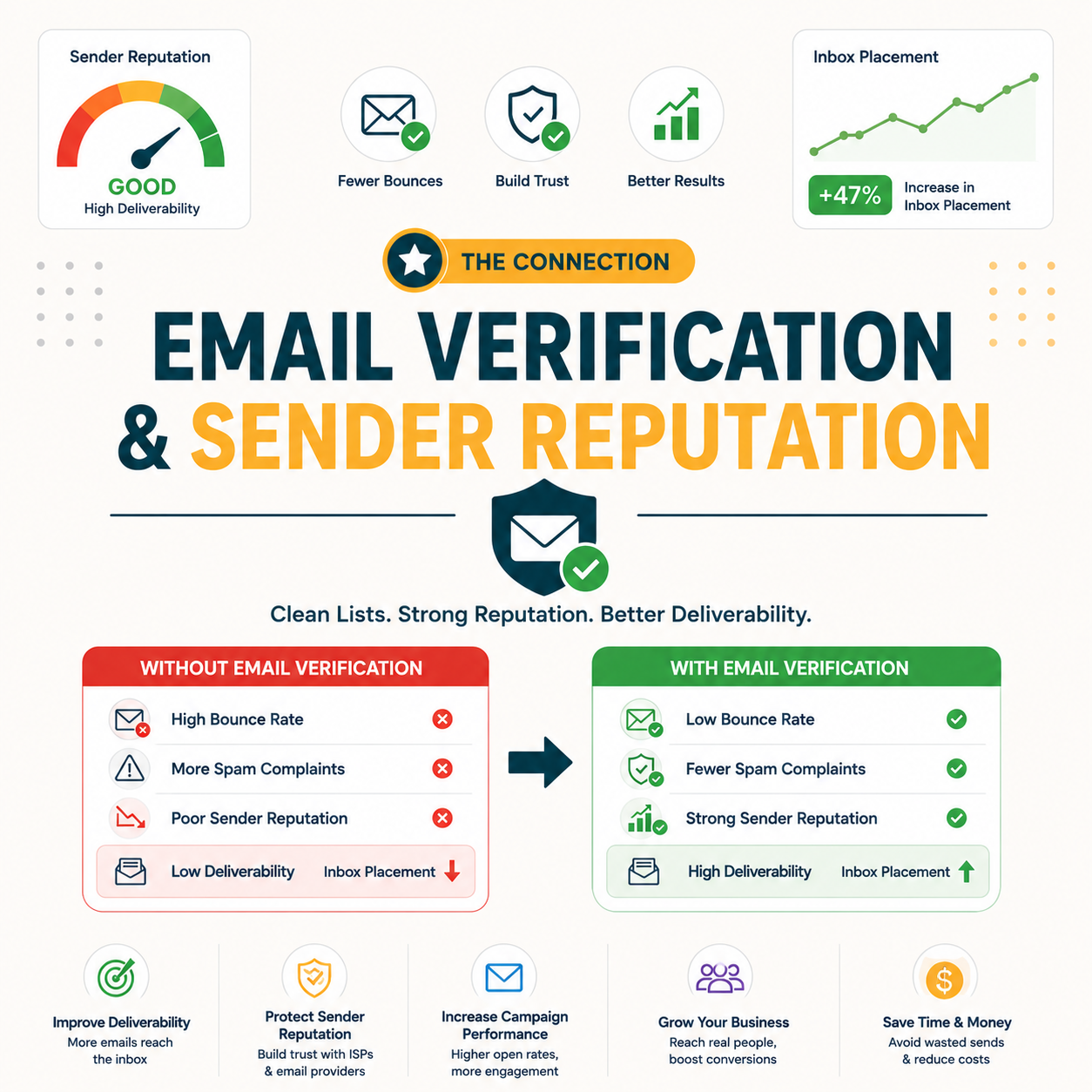
Email verification sender reputation are tightly linked: every bounce and spam-trap hit signals carelessness to mailbox providers and drags inbox placement down. Verifying a list before sending removes invalids and traps, keeping bounce rate under the safe threshold that protects domain reputation. This guide shows the mechanism, the before-and-after data, and the protection workflow that keeps a sending domain in the inbox.
Protect your domain — verify your list free before you send.
Protect Your Domain Free →Free plan included · No credit card · Full status and scoring
What Is Sender Reputation and Why Does It Matter?
Sender reputation is the trust score mailbox providers assign to a sending domain and IP, based on bounce rates, spam complaints and recipient engagement. A high reputation means mail reaches the inbox; a low one routes it to the spam folder or blocks it outright. It is the single biggest factor in deliverability, and it sits upstream of every campaign result a sender sees.
Sender reputation is the gatekeeper of the inbox — every deliverability outcome traces back to it.
How Does a Dirty List Damage Sender Reputation?
A dirty list full of invalids and traps generates bounces and complaints the moment it is sent. Mailbox providers read those signals as carelessness and lower the domain’s reputation, so future mail — even to valid, engaged subscribers — starts landing in spam. The damage is collective and lingering: one bad send taxes every send that follows from the same domain.
- Bounces from invalids: Invalid and dead addresses bounce on contact, and a spike in hard bounces tells mailbox providers the sender did not clean the list, triggering throttling and a measurable reputation drop within a single send.
- Complaints from bad targeting: Stale and mismatched addresses produce spam complaints from people who never expected the mail, and providers weight complaints heavily, treating even a small rate as proof the program lacks consent and hygiene.
- Spam-trap exposure: Purchased and aged lists hide recycled and pristine traps that look ordinary, and hitting one tells providers the sender harvested or neglected the data, often blocklisting the domain outright rather than merely lowering its score.
- Engagement erosion: Disposable and abandoned addresses never open or click, dragging down the engagement metrics providers fold into reputation, so even a list with few bounces can still signal a low-quality audience worth filtering out.
- Collective downgrade: Reputation attaches to the domain, not the individual message, so a downgrade from one dirty send suppresses inbox placement for every legitimate subscriber on the next campaign and beyond.
A dirty list punishes the whole program — bad addresses lower placement for every good one on the file.
What Is the Link Between Bounce Rate and Reputation?
Bounce rate is the clearest reputation signal a sender controls. Cross roughly two percent and most mailbox providers flag the sender as careless and begin throttling delivery; climb past five percent and blocklisting becomes a real risk. Verifying a list first keeps bounce rate well under that two-percent line, which is the most direct lever any sender has on reputation.
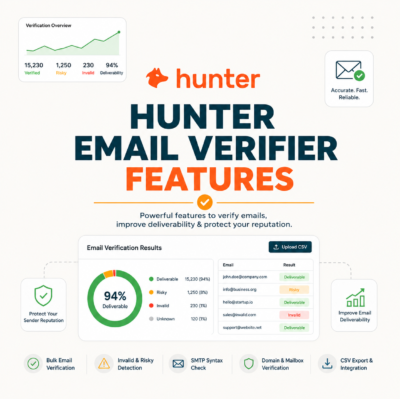
Hunter’s verifier checks each address against mailbox response so invalids are removed before they bounce.
— Hunter.io API documentation, paraphrased
Bounce rate is the lever a sender controls directly, and keeping it low is the most reliable way to protect reputation. The mechanics of cutting it appear in the guide to reducing email bounce rate with Hunter.
How Do Spam Complaints Hurt Reputation?
Spam complaints are weighted heavily by mailbox providers: even a small complaint rate signals unwanted mail and damages reputation fast. Verification cannot stop complaints that come from poor targeting or missing consent, but by removing invalids and traps it keeps the technical signals clean, so complaints are not compounded by a list that already looks careless on its face.
- Complaint weight: Mailbox providers treat each spam complaint as a strong negative vote, so a complaint rate far smaller than the bounce threshold can still pull reputation down and route future mail to the spam folder.
- Complaint threshold: Industry guidance places the danger zone near a 0.1 percent complaint rate, meaning one complaint per thousand sends starts to matter, which leaves almost no margin for sending to a list that was never cleaned or consented.
- What verification covers: List validation removes the invalids and traps that inflate the appearance of a bad program, leaving targeting and consent as the remaining levers that control the complaint rate itself.
Verification handles the technical signals while targeting and consent handle complaints — both are required to protect reputation in full.
How Does Email Verification Protect Your Domain?
Email verification protects a domain by removing the addresses that trigger negative signals: invalids that bounce, traps that blocklist, and disposables that lower engagement. With those gone before a send, bounce rate stays low and the domain keeps the trust that lands mail in inboxes. Verification is preventive reputation management rather than a cure applied after damage is done.
- Removes invalids: Verification checks syntax, domain records and mailbox response to flag addresses that cannot receive mail, cutting hard bounces at the source before they ever register as a reputation signal with a mailbox provider.
- Scrubs spam traps: Pattern checks and known-trap detection identify recycled and pristine traps hiding in old or purchased data, keeping them off the send list and preventing the sudden blocklisting a single trap hit can cause.
- Cuts disposables: Throwaway and temporary domains get flagged so they never reach a campaign, protecting engagement metrics that mailbox providers fold into the same reputation calculation as bounces and complaints.
- Flags risky roles: Role-based and accept-all addresses get marked with a confidence status so senders can segment or drop them, lowering the share of uncertain recipients that quietly raise bounce and complaint risk on a send.
- Holds the threshold: Removing the high-risk addresses keeps measured bounce rate beneath the roughly two-percent line mailbox providers watch, which is the concrete number that separates a trusted domain from a throttled one.
Verification is preventive reputation management — it removes the triggers before they fire rather than repairing damage afterward.
Before vs After: What Verification Does to Reputation Signals
Comparing a raw send to a verified one, the verified list shows a lower bounce rate, fewer complaints and stronger inbox placement. The table below contrasts the key reputation signals before and after verification, making the protective effect measurable rather than theoretical. The direction of every signal moves the same way once invalids and traps are removed first.
Source: Internal benchmark — directional comparison of raw vs verified B2B sends, 2026-06; bounce thresholds align with mailbox-provider guidance (Google Postmaster, ~2% reputation-risk line). Figures are illustrative ranges, not guaranteed outcomes.
The before-and-after gap quantifies protection — verification moves every reputation signal in the right direction at once.
How Do Spam Traps Trigger a Reputation Collapse?
A single spam-trap hit can collapse reputation overnight, blocklisting the domain and halting delivery to the inbox entirely. Traps hide in unverified, purchased and catch-all data where they look like ordinary addresses, so verifying before sending is the only reliable way to keep them off a list and avoid the sudden, severe reputation loss they cause.
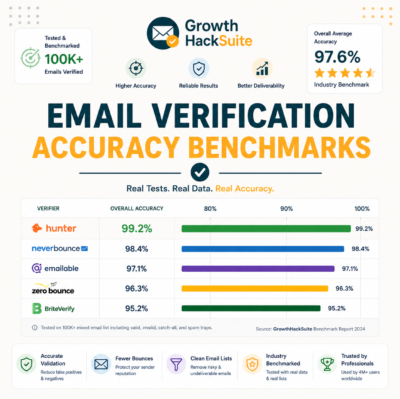
Hunter’s own verifier review found accuracy holds strong on standard domains, with valid-status addresses bouncing under 2% across a 2,000-email benchmark, the same threshold that separates safe sending from reputation risk.
— Growth Hack Suite, Hunter Email Verifier Review
Traps cause sudden collapse rather than slow decline, so verification is the guard that prevents an overnight blocklist event.
How Do You Protect Sender Reputation With Verification?
Protecting sender reputation means verifying before every send: bulk-clean the existing list, remove invalids, isolate catch-alls for separate handling, and verify new signups in real time at the point of capture. Combined with steady sending volume and good targeting, this keeps bounce and complaint signals in the safe zone continuously rather than only at the moment of a one-off cleanup.
- Verify before send: Bulk-validate the full list ahead of each campaign so invalids and traps are stripped before the message ever reaches a mailbox provider, holding bounce rate beneath the reputation-risk threshold every time.
- Isolate catch-alls: Accept-all domains that cannot be confirmed get segmented out of primary sends, since including them blind raises bounce risk and treating them cautiously protects the reputation of the main sending stream.
- Verify signups live: Real-time validation at the point of capture blocks fake and mistyped addresses before they enter the database, keeping the list clean at the source instead of relying on periodic batch cleanups alone.
- Re-verify aged segments: Addresses decay as people change jobs, so re-validating dormant or older segments before reactivating them prevents a once-clean list from quietly turning into a reputation liability over months of disuse.
- Monitor the signals: Tracking bounce rate, complaint rate and trap hits after each send confirms the hygiene is working and surfaces drift early, turning verification from a one-time chore into a continuous reputation safeguard.
Verify your list free and protect your domain before the next send.
Protect Your Domain Free →Free plan · No credit card · Status and confidence scoring
Verify before every send and at signup, because continuous hygiene keeps reputation in the safe zone rather than letting it drift back.
How Long Does Sender Reputation Take to Recover?
Recovery is slow: rebuilding a damaged reputation takes weeks of clean, consistent sending to engaged recipients before mailbox providers restore inbox placement. This asymmetry — fast to damage, slow to repair — is exactly why prevention through verification is far cheaper than recovery after the fact. One careless send can undo months of carefully built trust.
- Damage speed: Reputation can drop within a single dirty send, as bounce and trap signals register immediately and mailbox providers begin throttling almost at once rather than waiting for a pattern to build over time.
- Recovery time: Restoring trust typically takes several weeks of low-bounce, high-engagement sending, because providers rebuild confidence gradually and demand sustained proof that sending practices have genuinely improved.
- Why prevention wins: The cost gap between a few cents per verification and weeks of suppressed delivery makes list validation cheap insurance, since avoiding the damage entirely beats the slow, uncertain work of earning reputation back.
Reputation is fast to lose and slow to rebuild, which makes verification cheap insurance against an expensive recovery.
What Tools and Signals Measure Sender Reputation?
Sender reputation is measured by signals like bounce rate, complaint rate, spam-trap hits and engagement, tracked through tools such as Google Postmaster Tools and third-party reputation monitors. Verification influences the inputs to these signals; the monitoring tools report the result. The table maps each signal to what it shows and where a sender can watch it.
Source: Google Postmaster Tools and standard ESP reputation reporting, verified 2026-06-27. Available signals vary by mailbox provider and tool.
Verification shapes the inputs while monitoring tools show the output, so a sender uses both to manage reputation end to end.
Is Verification Enough, or Do You Need Authentication Too?
Verification protects reputation on the list side, but it is not the whole picture, and saying otherwise would be dishonest. Email authentication — SPF, DKIM and DMARC — proves the sender is legitimate, while steady volume and good targeting complete the set. Verification is necessary for strong reputation but not sufficient on its own; it works as one pillar among several.
- Verification covers: List hygiene controls bounce rate, trap exposure and disposable filtering, removing the data problems that damage reputation, but it does nothing to prove the sending domain is who it claims to be.
- Authentication covers: SPF, DKIM and DMARC let mailbox providers confirm a message genuinely comes from its claimed domain, blocking spoofing and giving the reputation system a trusted identity to attach scores to.
- Targeting covers: Consent, relevance and consistent volume keep complaint rates low and engagement high, addressing the human side of reputation that no amount of technical cleaning or authentication can fix on its own.
- Volume covers: Steady, predictable sending patterns reassure mailbox providers that a domain is an established sender, since sudden spikes from a cold domain read as suspicious regardless of how clean or authenticated the underlying list happens to be.
- Monitoring covers: Watching Postmaster signals and blocklist status closes the loop, catching a reputation dip early enough to correct it before delivery suffers, a role that neither verification nor authentication performs by design on its own.
Verification is one pillar of reputation, so pairing it with authentication and good targeting delivers the full protective effect.
Verdict: Email Verification Sender Reputation in One View
Email verification protects sender reputation by removing the addresses that trigger bounces, complaints and trap hits, keeping the signals mailbox providers watch inside the safe zone. It is the foundational, preventive step in deliverability — and paired with authentication and good targeting, it keeps a domain trusted and its mail in the inbox where it belongs.
Verdict: Verification holds bounce rate under the ~2% reputation-risk line, removes the traps that blocklist a domain, and shrinks the complaint signal to targeting alone. The before-and-after gap is real, but verification is necessary, not sufficient — pair it with SPF, DKIM and DMARC for full protection.
Email deliverability is the measure of how successfully messages reach recipients’ inboxes.
— Wikipedia, Email deliverability
Protect your sender reputation — verify your list free today.
Protect Your Domain Free →Free plan · No credit card · Prevention beats recovery
Related Tools in the Hunter Stack
Protecting reputation starts with verification and continues with list hygiene across the wider stack. The Hunter verifier review covers cleaning depth and accuracy, and the email finder review covers building the lists worth keeping clean, all on one connected credit pool.
- Hunter Email Verifier: The validation layer that does the reputation protection covered here, including accuracy and what it flags — see the Hunter Email Verifier accuracy benchmark and what the Hunter Email Verifier is.
- Hunter Email Finder: The list-building half of the bundle on the same credit pool — read the Hunter.io email finder review for sourcing costs and accuracy.
- Verifier comparisons: For how Hunter stacks against a pure-play verifier on price and reputation features, see the Hunter vs ZeroBounce comparison and a refresher on what email verification is.
Email Verification and Sender Reputation: Frequently Asked Questions
The 12 most-asked questions about email verification and sender reputation.
What is sender reputation?
Sender reputation is the trust score mailbox providers assign to a sending domain and IP, based on bounce rates, spam complaints, trap hits and engagement. A high score lands mail in the inbox; a low one routes it to spam. It is the single biggest factor deciding deliverability.
How does email verification protect sender reputation?
Email verification protects sender reputation by removing invalids that bounce, traps that blocklist and disposables that lower engagement before a send. With those gone, bounce rate stays under the safe threshold and the domain keeps the trust that lands mail in the inbox. It is preventive, not corrective.
How does a dirty list damage reputation?
A dirty list generates bounces and complaints the moment it sends, and mailbox providers read those signals as carelessness. They lower the domain’s reputation, so future mail to valid subscribers also lands in spam. The damage is collective: one bad send taxes every send that follows.
What is the link between bounce rate and reputation?
Bounce rate is the clearest reputation signal a sender controls. Crossing roughly two percent flags the sender as careless and triggers throttling; past five percent risks blocklisting. Verifying first keeps bounce rate well under that line, making it the most direct lever on reputation available.
How do spam complaints hurt reputation?
Spam complaints are weighted heavily, so even a small complaint rate signals unwanted mail and damages reputation fast. Verification cannot stop complaints from poor targeting, but by removing invalids and traps it keeps the technical signals clean so complaints are not compounded by an already careless-looking list.
Do spam traps damage sender reputation?
Yes, and severely. A single spam-trap hit can blocklist a domain overnight and halt inbox delivery entirely. Traps hide in unverified, purchased and catch-all data where they look ordinary, so verifying before sending is the only reliable way to keep them off a list and avoid sudden collapse.
How long does reputation take to recover?
Recovery is slow, typically several weeks of clean, consistent sending to engaged recipients before mailbox providers restore inbox placement. Reputation is fast to damage and slow to repair, which is exactly why prevention through verification costs far less than recovery after the fact.
What tools measure sender reputation?
Reputation is tracked through signals like bounce rate, complaint rate, spam-trap hits and engagement, measured in tools such as Google Postmaster Tools, ESP analytics and third-party reputation monitors. Verification shapes the inputs to these signals; the monitoring tools report the resulting score.
Is verification enough to protect reputation?
Not on its own. Verification protects the list side by controlling bounces and traps, but authentication proves sender legitimacy and targeting controls complaints. Verification is necessary for strong reputation but not sufficient; it works as one pillar alongside SPF, DKIM, DMARC and good sending practice.
Do I need SPF, DKIM and DMARC too?
Yes. SPF, DKIM and DMARC let mailbox providers confirm a message genuinely comes from its claimed domain, blocking spoofing and giving the reputation system a trusted identity. Verification cleans the list, but authentication proves the sender, and both are needed for strong, durable inbox placement.
Does verifying improve inbox placement?
Yes. By removing invalids and traps, verification lowers bounce rate and trap exposure, two signals that directly shape inbox placement. A cleaner list keeps reputation high, and high reputation is what routes mail to the inbox rather than the spam folder across major mailbox providers.
How do I protect my domain reputation?
Verify the list before every send, verify new signups in real time, keep bounce rate under the safe threshold, and isolate catch-alls. Add SPF, DKIM and DMARC authentication, send at steady volume, and target engaged recipients. Verification is the foundation; the rest builds durable domain reputation on top.