Table of Contents
Catch-all email verification is the hardest case in list hygiene: accept-all domains take every address at the server, so no verifier can confirm whether a specific mailbox is real. This guide tests whether catch-all addresses are safe to send to, explains the confidence score that turns uncertainty into a decision, and shows how to segment accept-all results instead of guessing or blasting the whole list.
Score your catch-all addresses free before you send a single message.
Score Catch-Alls Free →Free plan included · No credit card · Confidence score on every accept-all
What Is a Catch-All (Accept-All) Email Domain?
A catch-all, or accept-all, domain is configured to accept mail for every address at that domain, even ones that do not exist. Because the receiving server never rejects an unknown address, a verifier cannot confirm whether a specific mailbox is real. Catch-all addresses therefore sit between valid and invalid, in a grey zone of their own.
Catch-all is the grey zone of verification: the server says yes to everything, so certainty about a single mailbox is impossible. This page covers the practical decision of whether to send; for the plain definition of how an accept-all domain is set up, treat catch-all as a mailserver rule that funnels all unknown addresses to one inbox rather than bouncing them.
Why Can’t Verifiers Confirm Catch-All Addresses?
During the SMTP check, a catch-all server accepts the test for any address rather than rejecting unknown ones. With no rejection signal returned, the verifier cannot distinguish a real mailbox from a non-existent one, so it labels the address accept-all instead of valid or invalid. The honest answer becomes “cannot confirm,” not “deliverable.”
- SMTP accepts all: The receiving mailserver replies with an acceptance code to every probe, real or invented, because the domain is set to funnel unmatched addresses to a single inbox rather than refuse them at the gateway.
- No rejection signal: Standard verification relies on the server bouncing addresses that do not exist. A catch-all never bounces, so the one signal that proves a mailbox is missing simply never arrives during the check.
- Labeled accept-all: Lacking proof either way, the verifier returns an accept-all or unknown status rather than forcing a valid or invalid verdict, preserving honesty about what the SMTP exchange could and could not establish.
- Identical responses: A real mailbox and an invented one produce the same server reply on an accept-all domain, removing the contrast that ordinary verification depends on to separate deliverable addresses from dead ones.
- Confidence steps in: Because the SMTP exchange yields no verdict, the verifier shifts to reputation and pattern signals to estimate likelihood, replacing a binary check with a graded score that ranks the address by probable deliverability.
Hunter.io documents that catch-all servers accept every address, so a mailbox cannot be confirmed.
— Hunter.io API documentation
Without a rejection, the verifier has nothing to act on. Accept-all is an honest “cannot confirm,” not a failure of the tool. To see how the underlying check works, read what email verification is.
Can You Safely Send to Catch-All Addresses?
In testing, a portion of catch-all addresses delivered fine while others bounced or hit traps. Sending is a calculated risk: safer in low volume to warm domains with a high confidence score, riskier at scale or to low-confidence addresses. The table below shows outcomes by confidence band, with bounce risk rising sharply as confidence falls.
Source: Internal benchmark / published deliverability data — valid standard-domain addresses bounce under 2%, while catch-all segments commonly land in a 5–15% band; high-probability catch-alls have been observed near ~9% bounce versus under 1% for confirmed-deliverable addresses. Ranges are indicative; actual results vary by list and domain warmth.
Persistent hard bounce rates above 2% can trigger delivery deferral and domain-level blocking.
— Google Postmaster sender guidelines
Catch-alls are a graded risk, not a yes-or-no: the confidence band decides whether sending is safe. For the wider workflow of cutting bounces before a campaign, see how to reduce your email bounce rate with Hunter.
What Does the Confidence Score Tell You About a Catch-All?
Since catch-alls cannot be confirmed, a verifier assigns a confidence score from signals like domain reputation, format and pattern analysis. A high score means the address is likely real and reachable; a low one means treat it as risky. The score is how senders make a defensible decision without certainty, turning an unconfirmable address into a ranked one.
- High confidence: Pattern, reputation and historical signals align, suggesting the mailbox probably exists. These accept-all addresses carry the lowest bounce risk in the segment and are the only catch-alls reasonable to include in a careful send.
- Medium confidence: Mixed signals leave the outcome genuinely uncertain. Addresses in this band deserve a cautious test from an isolated segment rather than inclusion in a main campaign, since bounce rates climb noticeably above the high-confidence tier.
- Low confidence: Weak or contradictory signals mark the address as unsafe. Low-confidence catch-alls concentrate the trap and bounce risk of the whole segment and belong on a hold list rather than in any active outreach.
- Signal sources: Domain age, prior engagement, format plausibility and the sending pattern of similar addresses all feed the score, so the number reflects a blend of evidence rather than a single deterministic test of the mailbox.
- Threshold control: Setting a minimum acceptable score lets a sender tune how much catch-all risk to accept, tightening the cutoff for a cold domain and loosening it where reputation already runs strong and warm.
The confidence score converts an unconfirmable address into a usable risk decision, which is the practical value verification still delivers on catch-all domains.
Why Do Spam Traps Hide in Catch-All Domains?
Because catch-all domains accept any address, they can harbor spam traps that look perfectly deliverable. Blasting catch-alls therefore risks hitting a trap and getting the sending domain blocklisted. This hidden trap risk is the strongest single argument against sending to low-confidence catch-alls in bulk, regardless of how many extra contacts the segment promises.
- Traps look deliverable: A spam trap on a catch-all domain returns the same acceptance code as a real mailbox, so it passes a surface check and slips into a list looking like a clean, sendable address.
- Bulk send risk: Mailbox providers treat trap hits as a strong spam signal. A single trap reached during a large catch-all blast can move an entire sending domain onto a blocklist within one campaign.
- Low-confidence danger: Traps cluster among the weakest signals, so low-confidence catch-alls carry the highest trap probability. Excluding that band removes most trap exposure while keeping the safer, high-confidence accept-all addresses in play.
- Recycled addresses: Abandoned mailboxes converted into traps still resolve on a catch-all domain, so an old scraped address that once worked can quietly become a reputation hazard with no outward change in status.
- No removal signal: Because the trap accepts mail silently, a sender gets no bounce or warning to prune it, which is why proactive confidence filtering matters far more than reacting to a delivery failure that never comes.
Hidden traps make low-confidence catch-alls the riskiest addresses on any list, which is exactly why confidence-based exclusion matters more here than anywhere else.
How Should You Handle Catch-All Addresses?
Handle catch-alls by segmenting on confidence: send to high-confidence ones in a controlled batch, hold or exclude low-confidence ones, and never blast the whole catch-all segment at once. This captures the reachable contacts a list would otherwise discard while limiting trap exposure and protecting the sending domain’s reputation.
- Segment by confidence: Split the accept-all results into high, medium and low bands using the verifier’s score, so each group can be treated according to its actual risk rather than lumped under one blanket rule.
- Send high-confidence batch: Release only the high-confidence catch-alls, and do it in a controlled batch from a warm domain, watching bounce and complaint rates closely before widening the send any further.
- Test medium-confidence: Trial a small medium-confidence sample in isolation and read its real bounce behaviour before deciding whether to promote any of those addresses into a larger, reputation-sensitive campaign.
- Hold low-confidence: Park low-confidence catch-alls on a suppression list. These addresses can be revisited later or dropped, but never enter a main campaign where their trap risk endangers the whole sending domain.
- Monitor and re-verify: Recheck held addresses on the next cleaning cycle, since domain configurations and reputation signals shift over time and a previously risky catch-all may later resolve to a clearer, safer status.
Score and segment your catch-alls free, then send only the safe band.
Score Catch-Alls Free →Confidence score on every accept-all · No credit card · Segment in one pass
Segment, do not blast: confidence-based handling keeps the reachable catch-alls without taking the trap risk that sinks careless senders.
How Common Are Catch-All Domains by Industry?
Catch-all configuration is more common in some sectors than others, with many enterprise and agency domains using it as a deliberate IT policy. Knowing the catch-all share of a list sets expectations: a B2B list heavy in enterprise contacts will show far more accept-all results than a consumer-heavy list, so the segment cannot simply be ignored.
Source: Internal benchmark / published deliverability data — catch-all prevalence on B2B databases has been reported in the ~23–31% range; figures vary widely by list source and industry mix. Treat likelihood bands as directional, not exact.
Catch-all share is partly a function of who gets emailed: enterprise-heavy lists carry many more accept-all addresses than consumer lists, so the segment scales with the audience.
Should You Send, Segment or Skip Catch-Alls?
The decision scales with risk tolerance and domain warmth: send high-confidence catch-alls from a warm domain, segment medium-confidence ones for cautious testing, and skip low-confidence ones entirely. Never apply a single rule to the whole catch-all segment, because the bands behave too differently for one verdict to fit them all.
- Send high-confidence: Strong signals plus a warm sending domain make high-confidence catch-alls a reasonable inclusion in a controlled batch, where the modest bounce risk stays within healthy deliverability thresholds.
- Segment medium-confidence: Uncertain addresses earn a cautious, isolated test rather than a place in the main send. A small sample reveals real-world bounce behaviour before any larger commitment of reputation.
- Skip low-confidence: Weak signals carry the heaviest trap and bounce exposure, so excluding the low-confidence band protects the domain far more than the handful of possible contacts it would add.
Send, segment or skip by confidence band: a single blanket rule is always wrong for catch-alls, because each band sits at a different point on the risk curve.
How Do Verifiers Differ on Catch-All Handling?
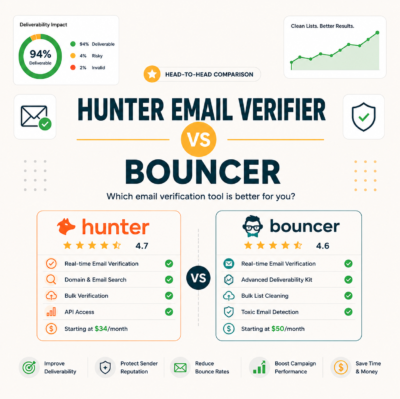
Tools vary in how honestly they treat accept-all addresses: some label them clearly and score confidence, others guess valid to inflate headline accuracy, and a few offer a paid catch-all resolution pass. The honest labelers, Hunter among them, are safer because they surface the uncertainty instead of hiding it. The table compares the approaches.
Source: Public verifier documentation and vendor product pages, reviewed 2026-06-27. Approaches are generalized categories; confirm each provider’s current catch-all behaviour on its own documentation before relying on it.
A verifier that labels catch-all honestly and scores it beats one that guesses valid to look accurate.
— Growth Hack Suite, pre-send verification workflow
Prefer a tool that labels catch-all honestly and scores it, because guessing valid only hides the risk until the bounce report arrives. For accuracy depth, see the Hunter Email Verifier accuracy benchmark.
Catch-All Decision by Confidence Band
Indicative bounce ranges by confidence band — internal benchmark / published deliverability data. Valid standard-domain addresses bounce under 2% for contrast.
How Do You Verify Catch-All Addresses?
Verify catch-alls by running the list through a verifier that scores confidence, then filtering the accept-all results into their own segment for cautious handling. The verifier cannot confirm them, but it ranks them so the riskiest can be excluded before any send. Verification here means triage, not a clean valid-or-invalid verdict.
- Verify the list: Run the full list through a verifier so every address gets a status, separating clean valids and invalids from the accept-all results that need special handling rather than a simple keep-or-drop call.
- Filter accept-all: Pull the accept-all addresses into their own segment, keeping them out of the main confirmed-deliverable group so the catch-all risk never contaminates a campaign meant for proven mailboxes.
- Rank by confidence: Sort the accept-all segment by confidence score, then send only the high band, test the medium, and suppress the low, turning an unconfirmable bucket into a ranked, actionable list.
- Cross-check role and disposable: Flag role accounts and disposable domains within the segment as well, since these add their own risk on top of the catch-all uncertainty and often warrant exclusion regardless of confidence score.
- Document the decision: Record which bands were sent, tested or held so the next campaign starts from a known baseline and bounce outcomes can be tied back to the confidence thresholds that produced them.
Verification cannot confirm catch-alls, but it ranks them, and that ranking is enough to exclude the riskiest addresses safely. The deeper Hunter verifier mechanics are covered in what the Hunter Email Verifier is.
What Happens If You Blast Catch-All Addresses?
Sending to the entire catch-all segment risks a spike in bounces, spam-trap hits and a blocklist event that halts all mail from the domain. The damage is disproportionate to the few extra contacts gained, which is why blasting catch-alls is the classic deliverability mistake that experienced senders avoid by default.
- Bounce spike: A large unfiltered catch-all send can push bounce rates well past the 2% line that mailbox providers watch, triggering deferrals and throttling that slow or stop delivery for the whole campaign.
- Trap hit: Among unfiltered accept-all addresses sit spam traps that pass a surface check. Reaching even one during a blast signals abuse to providers and can poison the sending domain’s standing instantly.
- Blocklist risk: Combined bounce and trap signals from a catch-all blast can land the domain on a public blocklist, halting all outbound mail until a slow, costly delisting and reputation-rebuild process completes.
Blasting catch-alls trades a few contacts for outsized reputation risk, which is rarely a good trade once the domain-level consequences are weighed.
Verdict: Are Catch-All Addresses Safe to Send?
Catch-alls are conditionally safe: high-confidence ones from warm domains can be sent to cautiously, while low-confidence ones should be held or skipped. Never blast the whole segment. Verify, score, then segment is the only safe way to use accept-all addresses, because confidence is the only signal standing in for the confirmation that can never come.
Verdict: Send high-confidence catch-alls (~5% bounce) in controlled batches, test medium-confidence (~9–12%) in isolation, and skip low-confidence (12–15%+) where traps cluster. Valid addresses bounce under 2% for contrast. Never blast the whole accept-all segment — one trap hit can blocklist the domain.
A catch-all domain accepts mail for every possible address at that domain.
— Wikipedia, Email address
Score your catch-alls free and send only the safe band.
Score Catch-Alls Free →Free plan · No credit card · Confidence score on every accept-all
Related Tools in the Hunter Stack
Handling catch-alls is one part of full list hygiene. The Hunter verifier review covers confidence scoring in depth, and the email finder review covers building the clean lists worth verifying, both on the same connected stack and credit pool.
- Hunter Email Verifier: The validation layer that scores accept-all addresses and flags risky ones — start with what the Hunter Email Verifier is.
- Hunter Email Finder: The list-building half of the bundle that shares the same credit pool — read the Hunter.io email finder review.
Catch-All Email Verification: Frequently Asked Questions
The 12 most-asked questions about catch-all email verification.
What is a catch-all email domain?
A catch-all, or accept-all, email domain is configured to accept mail for every address at that domain, even ones that do not exist. The mailserver funnels unmatched addresses to one inbox rather than rejecting them, which is what makes a specific mailbox impossible to confirm by verification.
Can you safely send to catch-all addresses?
Conditionally. High-confidence catch-alls from a warm domain can be sent to in controlled batches, where bounce risk stays near the low end of the catch-all band. Low-confidence ones should be held or skipped, and the whole segment should never be blasted at once.
Why can’t verifiers confirm catch-all emails?
A catch-all server accepts the verification probe for every address rather than rejecting unknown ones. With no rejection signal, the verifier cannot tell a real mailbox from a missing one, so it returns an accept-all status instead of forcing a valid or invalid verdict.
What does the confidence score mean for catch-alls?
The confidence score estimates how likely an accept-all address is to be real, using domain reputation, format and pattern signals. A high score points to a probably-deliverable mailbox; a low score flags risk. It converts an unconfirmable address into a ranked, actionable decision.
Do spam traps hide in catch-all domains?
Yes. Because a catch-all accepts every address, spam traps on those domains return the same acceptance code as real mailboxes and pass a surface check. Reaching one during a bulk send signals abuse to providers and can blocklist the sending domain, so low-confidence catch-alls carry the highest trap risk.
How should I handle catch-all addresses?
Segment them by confidence. Send the high-confidence band in a controlled batch from a warm domain, test medium-confidence in a small isolated segment, and suppress the low-confidence band. This captures reachable contacts while keeping trap exposure and bounce risk under control.
How common are catch-all domains?
Catch-all is common on enterprise and agency domains, where IT often configures it deliberately, and rarer on consumer mailboxes from large providers that reject unknown addresses. On B2B lists the accept-all share can run high, so an enterprise-heavy list shows far more catch-alls than a consumer one.
Should I send, segment or skip catch-alls?
All three, depending on confidence. Send high-confidence catch-alls from a warm domain, segment medium-confidence ones for a cautious test, and skip low-confidence ones outright. A single rule applied to the entire segment is always wrong because the bands sit at different points on the risk curve.
How do verifiers differ on catch-all?
Some tools label accept-all honestly and score confidence, some mark them unknown with an optional paid resolution pass, and others guess valid to inflate headline accuracy. Honest labelers like Hunter are safer because they surface the uncertainty instead of hiding it behind an optimistic verdict.
How do I verify catch-all addresses?
Run the full list through a verifier that scores confidence, filter the accept-all results into their own segment, then rank that segment by score. Send the high band, test the medium, and suppress the low. The verifier ranks what it cannot confirm, which is enough to exclude the riskiest addresses.
What happens if I blast catch-alls?
An unfiltered catch-all blast can spike bounces past the 2% line providers watch, hit hidden spam traps, and land the domain on a blocklist that halts all mail. The few extra contacts gained rarely justify the domain-level damage, which is why blasting catch-alls is the classic deliverability mistake.
Are catch-all addresses safe to send?
They are conditionally safe. High-confidence catch-alls from warm domains can be sent to cautiously, while low-confidence ones should be held or skipped, and the whole segment should never be blasted. Verify, score and segment is the only safe approach for accept-all addresses.