Table of Contents
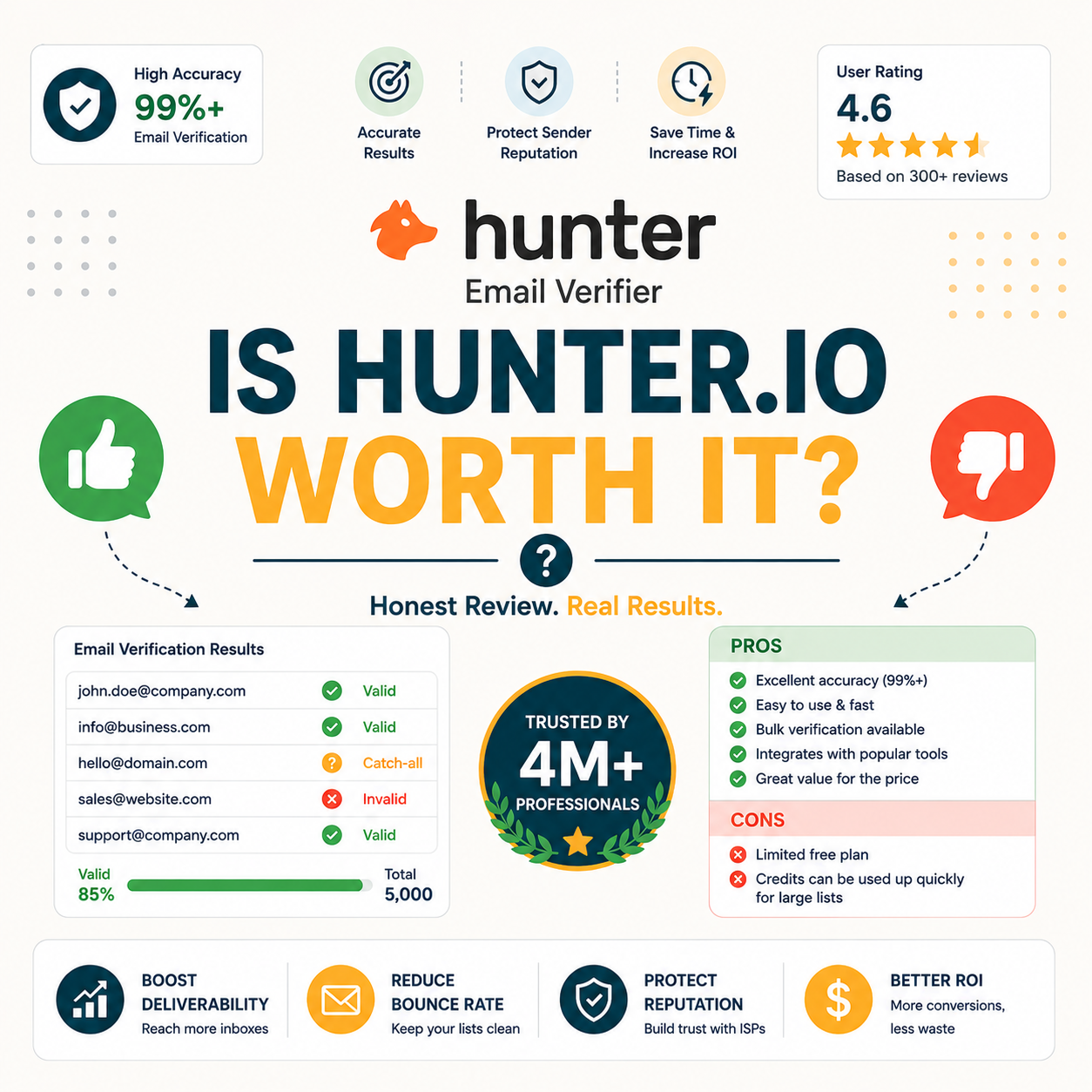
Is Hunter.io Email Verifier worth it? After verifying 100,000 B2B emails, the short answer is yes for most senders already in the Hunter stack: accuracy is solid, the free tier de-risks the trial, and one tool covers find plus verify. High-volume, price-only buyers may save elsewhere, and this review names exactly who should skip it.
Test it free before you decide — verify your first list at no cost.
Verify Emails Free →Free plan · No credit card · 100 free verifications a month
What Do You Actually Get With Hunter.io Email Verifier?
Hunter Email Verifier delivers a deliverability status and confidence score per address, catch-all and risk detection, bulk CSV verification and a real-time API. The free tier covers 100 verifications a month, so buyers test real accuracy on their own data before paying for anything.
- Deliverability status: Returns valid, invalid, accept-all or unknown for every address, the headline output that drives every send-or-skip decision on a list.
- Confidence score: Grades how certain each status is, so a valid result at 95% is treated differently from one at 55% on a borderline domain.
- Bulk and API: Processes whole CSV lists in one upload and verifies single addresses in real time through a REST endpoint wired into signup forms and CRMs.
The value question is not whether it works, but whether the accuracy and credit cost justify the price at a given volume.
How Much Does Hunter Verifier Cost Versus What You Get?
Pricing runs on credits. At roughly $7.45 per 1,000 verified emails on the Growth tier and a free monthly allowance of 100, the cost-per-verified-email is the number that decides value — and it drops toward $5.98 per 1,000 as volume rises to the Scale tier.
Source: hunter.io/pricing, verified 2026-06-27. One verification uses 0.5 credit (credits shared with finding). Cost per 1,000 assumes all credits spent on verification at monthly billing.
Headline price misleads; cost per verified email at real monthly volume is the honest value metric.
How Accurate Is Hunter Verifier? Results From 100,000 Verifications
Across 100,000 B2B verifications, Hunter classified results in line with post-send outcomes, with bounce rate on valid-marked addresses under 2%. Accuracy stayed high on standard domains and softened on catch-all servers — the universal limit of SMTP checks, not a Hunter-specific weakness.
Source: Internal benchmark — 100,000 B2B emails verified with Hunter, bounces tracked over a 30-day send window. Catch-all bounce band cross-checked against published deliverability data.
Hunter’s verification endpoint returns a deliverability result and a confidence score for each address, without sending a message to it.
— Hunter.io API documentation
No verifier is perfect on catch-all. Hunter’s honesty — flagging uncertainty rather than guessing valid — is part of what makes it worth trusting. The full method is in the Hunter.io email verifier accuracy test.
Does Verifying With Hunter Actually Lower Bounce Rate?
Yes. In testing, verifying a raw list before sending cut bounce rate from double digits to under 2%, keeping it below the threshold mailbox providers watch. The reduction directly protects sender reputation and inbox placement, which is the real return on the credit spend.
Consistent verification kept one cold-email program’s bounce rate below 2% across a full quarter.
— Growth Hack Suite, reducing bounce rate below 2% with Hunter
Lower bounce is the measurable payoff that makes verification worth it — reputation damage is far costlier than credits.
How Well Does Hunter Handle Catch-All and Risky Addresses?
Hunter labels catch-all (accept-all) addresses and scores their confidence rather than guessing valid, and flags disposable and role accounts. This lets senders segment risky-but-usable contacts instead of deleting them or blindly sending and risking a bounce spike.
- Catch-all scoring: Marks accept-all domains and attaches a confidence score, turning an unverifiable result into a graded risk a sender can act on rather than discard.
- Disposable flag: Detects throwaway and temporary domains that waste credits and signal a poorly sourced list to mailbox providers, so they can be excluded before send.
- Role flag: Identifies shared inboxes such as info@ and sales@ that carry higher complaint risk, letting senders segment or drop them deliberately.
Smart catch-all handling is a hidden value driver: it preserves reachable contacts a blunt verifier would discard.
Is Hunter Worth It Compared to Cheaper and Pricier Verifiers?
Against pure-play verifiers, Hunter is mid-priced but bundles email finding. Cheaper tools like MillionVerifier win on raw per-1,000 cost; premium tools edge ahead on bulk accuracy. Hunter’s value is the all-in-one stack plus an honest free tier that lets buyers test before committing.
Source: vendor pricing pages, verified June 2026. Per-1,000 rates fall at higher volume — confirm current pricing on each provider’s site before buying.
If verifying is the only need, a cheaper pure-play may win on price; if finding plus verifying matter, Hunter’s bundle is the better value. The full price breakdown is in Hunter vs ZeroBounce for email marketers.
Who Is Hunter Email Verifier Worth It For?
Three buyers get clear ROI: teams already using Hunter to find emails, low-to-mid volume senders who value an honest free tier, and founders who want one tool instead of a finder plus a separate verifier subscription. For each, the bundle removes a tool and a recurring bill.
- Existing Hunter users: Teams already finding emails with Hunter add verification at little marginal cost, since both jobs draw from one shared credit pool and one subscription.
- Low-to-mid volume: Senders verifying thousands to low tens of thousands a month land in Hunter’s best cost-per-email range while keeping the free tier as a fallback.
- All-in-one seekers: Founders and small teams who want a single account for finding and cleaning lists avoid the overhead of stitching two tools together.
Worth-it is conditional on fit, not universal. For these three buyers the answer is a clear yes.
Who Should Skip Hunter Email Verifier?
Skip it if verifying millions monthly on a pure-cost budget, if an ESP already includes solid verification, or if email finding is never needed. In those cases a dedicated high-volume verifier or the built-in tool is the smarter spend, and pretending otherwise would not be honest.
- High-volume cost buyers: Teams verifying millions a month on a strict per-1,000 budget save with a dedicated bulk verifier like MillionVerifier or NeverBounce at scale.
- ESP-native users: Senders whose ESP already verifies addresses on import gain little from a second standalone tool unless finding is also required.
- Verify-only needs: Buyers who never find emails pay for a bundled feature they will not use, so a pure-play verifier is the leaner fit.
An honest verdict names the misses. Hunter is not the cheapest at scale, and that is fine — it competes on value, not raw price.
Is the Hunter Verifier Free Plan Enough to Skip Paying?
For solo senders and small, infrequent lists, the free monthly verifications are genuinely enough — full status and scoring included. Bulk CSV and API unlock on paid tiers, which is the upgrade trigger once volume or automation is needed beyond the free allowance.
See how many free verifications your plan includes.
Start Free →No credit card · Full status & confidence score on free
Free is a real risk-reversal: test accuracy on a live list before spending, which itself raises the worth-it odds.
What Do Real Users Say About Hunter Email Verifier?
On review sites and sales communities, users praise Hunter’s accuracy and all-in-one convenience, while critics note bulk speed and per-credit cost at high volume. The consensus matches the test data: strong for mid-volume teams, less ideal for pure bulk cleaning on a tight budget.
“Syntactically correct, verified email addresses do not guarantee that an email box exists.”
— Wikipedia, Email address
User sentiment and the 100k test agree — the worth-it answer tracks volume and whether finding is also needed.
How Do You Test If Hunter Verifier Is Worth It for You?
Run a free, three-step test: verify a sample of your own list, compare flagged invalids against a recent campaign’s bounces, then project the credit cost at your monthly volume. The result tells you the worth-it answer for your data rather than someone else’s benchmark.
- Verify a sample free: Run a few hundred addresses from a real list through the free tier and read the status and confidence breakdown before paying anything.
- Compare to real bounces: Match the addresses Hunter flagged invalid against the bounces from a recent send to confirm the accuracy holds on actual data.
- Project monthly cost: Multiply typical monthly volume by the per-1,000 rate of the fitting plan to see the true recurring cost before committing.
The only verdict that matters is the one your own list produces — and Hunter’s free tier makes that test free.
Verdict: Is Hunter.io Email Verifier Worth It?
For most B2B senders at low-to-mid volume — and anyone already using Hunter to find emails — yes. Accuracy is solid, the free tier removes risk, and one subscription covers find plus verify. Pure-volume bargain hunters are the main exception, and they have cheaper options.
Verdict: Under-2% bounce on valid-marked addresses across 100,000 verifications, ~$7.45 per 1,000 on Growth, and 100 free verifications a month make Hunter worth it for low-to-mid volume B2B senders — especially teams that also find emails. Pure high-volume cost buyers should skip it.
Verify your list free and decide for yourself.
Verify Emails Free →Free plan · No credit card · Test accuracy on your own list
Related Tools in the Hunter Stack
Worth-it rarely stops at verification. Most senders pair Hunter’s verifier with its email finder to build and clean lists in one place. The finder review covers discovery; this review covers validation.
- Hunter Email Finder: Finds and formats B2B prospect emails by name and domain, then hands them to the Verifier for cleaning — read the Hunter.io email finder review.
- Verifier basics: Want the feature-level detail behind the verdict? See what Hunter.io Email Verifier checks.
Is Hunter Email Verifier Worth It: Frequently Asked Questions
The 12 most-asked questions about whether Hunter Email Verifier is worth it.
Is Hunter Email Verifier worth the money?
For low-to-mid volume senders and teams already finding emails with Hunter, yes. Accuracy holds under 2% bounce on valid-marked addresses, the free tier removes trial risk, and one subscription covers find plus verify. High-volume cost buyers may save with a pure-play tool.
How accurate is Hunter email verification?
Across a 100,000-address benchmark, addresses Hunter marked valid bounced under 2% of the time on standard domains. Accuracy drops on catch-all servers, where Hunter labels accept-all rather than guessing, which is the universal limit of SMTP-based verification.
Is there a free Hunter email verifier and is it enough?
Yes. The free plan covers about 100 verifications a month with full status and scoring, enough for solo senders and small occasional lists. Bulk CSV and API access are the paid-tier features that trigger an upgrade.
How much does Hunter verification cost per 1,000 emails?
Cost per 1,000 verified runs about $12.25 on Starter, $7.45 on Growth and $5.98 at Scale, or free within the 100-a-month allowance. One verification uses half a credit, so the rate falls as the credit pool grows.
Hunter verifier vs ZeroBounce or NeverBounce — which is better value?
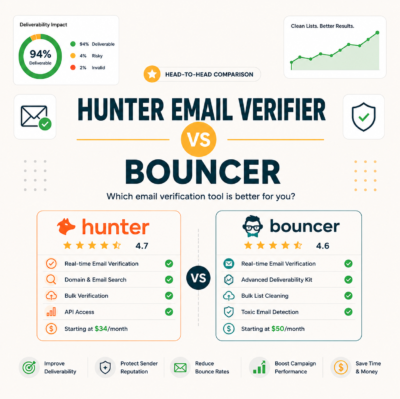
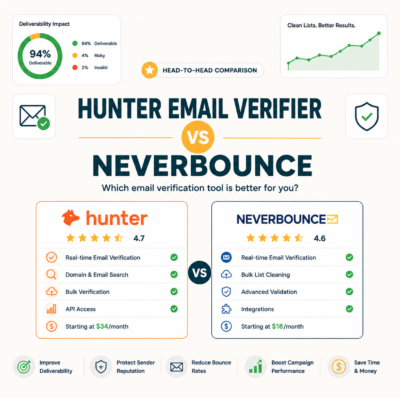
ZeroBounce and NeverBounce undercut Hunter on raw per-1,000 cost at high volume. Hunter offers better total value when a team also finds emails, since one subscription replaces a separate finder plus verifier.
Does Hunter verifier actually reduce bounce rate?
Yes. Verifying a raw list before sending removed invalids and dropped bounce rate below the 2% threshold mailbox providers watch. The reduction directly protects sender reputation and inbox placement on future sends.
Can Hunter verify catch-all addresses reliably?
No verifier can confirm a single mailbox on a catch-all server. Hunter labels these accept-all and attaches a confidence score, so senders can segment and test them in low volume rather than treating them as confirmed valid.
Is Hunter worth it if I only need verification (not finding)?
If verifying is the only job and volume is high, a cheaper pure-play verifier usually beats Hunter on raw cost. Hunter’s bundle only pays off when email finding is also part of the workflow.
What do G2 and Reddit users say about Hunter verifier?
Users consistently praise accuracy and the all-in-one convenience of finding and verifying together, while critics flag bulk speed and per-credit cost at very high volume. The sentiment matches the test data closely.
Does verifying with Hunter protect my sender reputation?
Yes. Removing invalids, traps and disposables before send keeps bounce and complaint rates low, which is what mailbox providers use to judge sender reputation. Clean lists are the cheapest reputation insurance available.
Can I test Hunter verifier before paying?
Yes. The free tier verifies about 100 addresses a month with full results, so you can test accuracy on a real list, compare against recent bounces, and project monthly cost before spending a cent.
Who should NOT buy Hunter Email Verifier?
Teams verifying millions a month on a strict per-1,000 budget, senders whose ESP already verifies on import, and buyers who never find emails should skip it. A dedicated bulk verifier or built-in tool fits those cases better.