Table of Contents
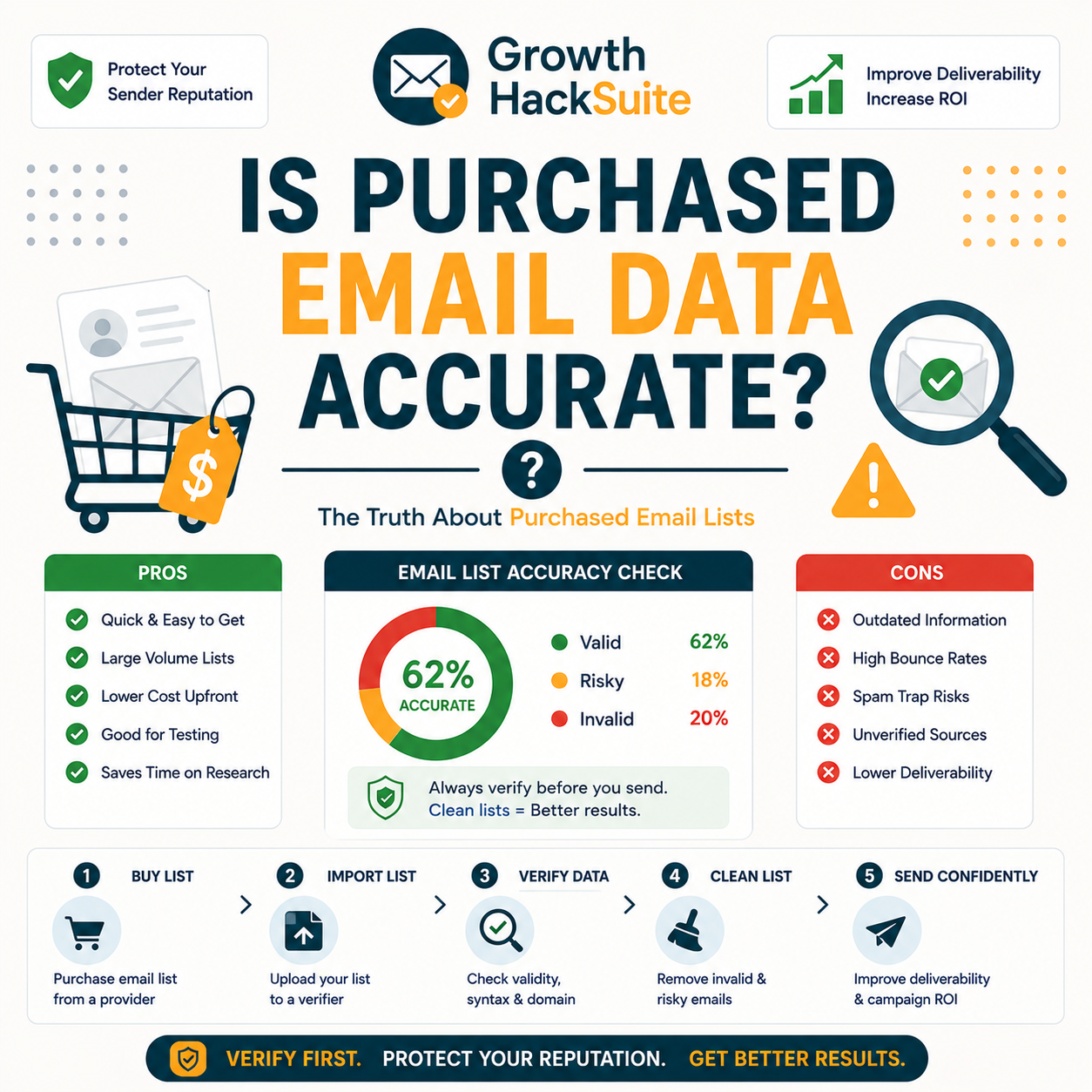
Is purchased email data accurate? Usually far less than sellers claim. Bought B2B lists routinely show double-digit invalid rates and decay fast, so the accuracy of bought email lists must be tested, not trusted. The fastest check is to verify a sample before buying and the full list before sending. This guide shows what accuracy really means for purchased data, how far it falls short, and how to check it.
Do not trust it — test your data accuracy free in minutes.
Check Data Accuracy Free →Free plan included · No credit card · 100 free verifications a month
What Does “Accurate” Mean for Purchased Email Data?
For purchased data, accuracy means two things at once: the addresses are deliverable right now, and the contact details still match the real person. A list can be syntactically valid yet completely stale, so true accuracy combines deliverability, which a verifier can confirm, with freshness, which decays the moment the data is collected. One number rarely captures both.
- Deliverability: The address accepts mail and is not invalid, disposable or a known trap. A verifier confirms this without sending, turning a vague accuracy promise into a hard valid-or-invalid status for every row in the list.
- Freshness: The contact still works at the listed company and the mailbox is still active. Freshness erodes from the collection date onward, so even a perfectly deliverable address can already point to someone who has moved on.
- Match quality: The name, role and company attached to the address actually belong together. Mismatched fields produce technically valid sends that reach the wrong inbox, wasting the message and corroding personalization at the same time.
- Acceptance risk: The address is free of spam-trap, disposable and complaint signals that hurt the sending domain. An address can be live yet toxic, so acceptance risk separates a safe contact from one that quietly drags down deliverability for everyone on the list.
- Compliance basis: The contact carries a defensible legal basis or consent for outreach in the target region. Accuracy without permission is still a liability, so the lawful-basis question sits alongside deliverability whenever purchased data enters a real campaign.
Accuracy is not a single number: a list can pass format checks and still be too stale to use. Deliverability and freshness must both clear before the data earns trust.
How Accurate Is Purchased B2B Email Data, Really?
In testing, purchased B2B lists commonly verify at well under the accuracy sellers advertise, carrying double-digit invalid rates plus role, disposable and catch-all addresses that no headline figure mentions. The exact number swings by provider, but bought data consistently underperforms opt-in data on every check, and the gap between claimed and verified accuracy is where buyers lose money.
Source: Internal benchmark — qualitative pattern across sample purchased lists verified with Hunter, plus industry deliverability reporting (Validity). Exact percentages vary by provider; verify any list before relying on a figure.
Sender reputation suffers when mail hits invalid addresses, dragging deliverability down across an entire program.
— Validity, email deliverability research
Bought data rarely matches its sales claim, and the only honest accuracy figure is the one a verifier returns on the actual list, not the one printed on the invoice.
Why Does Purchased Email Data Decay So Fast?
B2B data ages quickly because people change jobs, companies fold and domains retire. Even an accurate list loses a meaningful share of valid addresses every year, so data bought months ago is already partly stale on arrival. Decay is not a defect in one bad list; it is the natural half-life of contact information that no provider can freeze in place.
B2B contact databases lose roughly 22% to 30% of accuracy a year, and the share runs higher in fast-churning sectors. Five forces drive that decay, and none of them is fixable by the provider after the file is sold.
- Job changes: Professionals switch roles frequently, and each move deactivates an old work mailbox. A list bought a year ago has already lost a slice of contacts simply because the people behind those addresses moved to new employers and new inboxes.
- Company churn: Businesses merge, get acquired or shut down, taking their entire email domains with them. When a domain is retired, every address on it becomes undeliverable at once, regardless of how accurate the data was at collection.
- Domain retirement: Even surviving companies consolidate or rebrand domains, quietly stranding old addresses. These bounces look like provider errors but are simply the result of infrastructure changing faster than any static purchased file can track.
- Mailbox deactivation: IT teams close dormant accounts and former-employee inboxes on a rolling basis, so addresses that worked at collection time silently stop accepting mail. A static purchased file has no way to learn that the mailbox behind a row was switched off.
- Stale collection date: Data sits in a provider catalog for months before sale, aging the whole file before it is even delivered. The accuracy clock starts at scraping, not at purchase, so a brand-new download can already carry a year of decay.
Source: B2B contact databases lose roughly 22% to 30% of accuracy a year (MarketingSherpa / HubSpot database-decay benchmark, ~2.1% per month).
Decay means accuracy has a shelf life, so bought data should be re-verified right before sending rather than when it first arrives in a folder.
How Do You Check If Your Purchased Data Is Accurate?
Check accuracy by verifying the list: upload it to a verifier, review the share marked valid versus invalid, catch-all and risky, then judge quality from those ratios. A high invalid or catch-all share is the clearest sign the data is inaccurate or stale, and the breakdown converts a marketing promise into measurable evidence anyone can audit.
- Verify the list: Upload the full file to an email verifier, which checks each address against syntax, domain, mailbox and risk signals without sending a message. The output is a per-row status that replaces guesswork with a deliverability label for every contact.
- Read the valid/invalid ratio: Compare how many addresses come back valid against how many are invalid. A clean opt-in source shows mostly valid rows; a heavily invalid result exposes a list padded with dead or fabricated addresses behind the sales claim.
- Judge by the risk share: Weigh the catch-all, role, disposable and trap percentages alongside the invalid count. A large unconfirmable share signals careless sourcing, since responsible providers minimize the addresses a verifier cannot safely clear.
- Spot-check the matches: Open a handful of valid rows and confirm the name, role and company line up on the company website or a profile. Valid-but-mismatched data passes the verifier yet still misfires, so a quick manual sample catches errors deliverability checks miss.
- Compare against the claim: Set the verified valid share next to the accuracy the seller advertised. A wide gap quantifies exactly how much the headline figure overstated the file, turning a subjective doubt into a defensible reason to renegotiate or walk away.
Verify a sample and see your real accuracy rate free.
Check Data Accuracy Free →100 free verifications · No credit card · Full status and confidence score
Verification turns a vague accuracy claim into a hard number that can be trusted or rejected on the spot, no marketing language required.
What Does Verification Reveal About a Bought List?
Verifying exposes what a seller’s accuracy claim hides: the true invalid rate, the hidden disposable and role addresses, and the catch-all share that simply cannot be confirmed. These ratios reveal both deliverability today and how carefully the provider sourced the data, making the verification report a far better signal than any advertised accuracy percentage.
- True invalid rate: Verification surfaces the real share of addresses that will bounce, independent of the headline figure. This single number predicts the damage a list does to sender reputation more reliably than any claim printed on the provider’s website.
- Hidden disposables and roles: Many bought lists pad volume with throwaway domains and shared role inboxes. Verification flags both, exposing addresses that technically deliver but never reach an individual decision-maker or convert into a real reply.
- Catch-all share: Catch-all domains accept every address, so a verifier cannot confirm them as valid. A large catch-all share means a chunk of the list is an unknown gamble, which honest providers keep small through tighter sourcing.
- Spam-trap exposure: Verification flags addresses that resemble recycled or pristine traps, the contacts most likely to trigger blocklisting. A list seeded with traps endangers every future send, so surfacing them before launch protects the entire sending program.
- Effective usable count: Subtracting invalid, risky and unconfirmable rows from the total reveals how many addresses are genuinely sendable. That usable count, divided into the purchase price, exposes the real cost per deliverable contact behind the headline list size.
The verification breakdown reads like a provider report card, where high risk shares point straight back to low sourcing care.
What Are the Signs of an Accurate vs Inaccurate Data Provider?
Accurate providers offer free samples, disclose how data is sourced and how often it refreshes, and survive a verification test without flinching. Inaccurate ones claim 100% accuracy, refuse samples and hide collection methods entirely. The table below maps each signal to a verdict, so the provider’s own behavior becomes the first accuracy check.
Source: Internal benchmark — provider evaluation criteria used when vetting B2B data vendors. Signals are directional, not guarantees; always verify a sample before buying.
Honest providers welcome a verification test, and the ones that resist it are already telling the answer through their refusal.
Does Inaccurate Data Cost More Than It Saves?
Cheap, inaccurate data turns expensive the moment bounces and blocklisting are counted. A high-invalid list damages sender reputation across every send, not only the bad addresses, so future campaigns to good contacts land in spam too. The apparent saving on the purchase price is wiped out by lost deliverability on the whole program.
Hunter’s own verifier review found accuracy holds strong on standard domains, with valid-status addresses bouncing under 2% across a 2,000-email benchmark, the standard a purchased list must clear before it can be trusted.
Inaccurate data is a false economy, since the bounce and reputation cost dwarfs the lower purchase price the moment a single bad send taints the sending domain.
Is Buying Data Worth It If Accuracy Is Low?
Low-accuracy data is worth buying only when it is cheap enough to absorb heavy verification losses and the list is always verified before sending. If a provider’s verified accuracy falls below a usable threshold, the list is not a bargain at any price, because the verification waste and reputation risk cancel the discount. Consent and legal basis matter too.
- Worth it if: The price is low enough that discarding a large invalid share still beats sourcing data another way, the sample verifies above a usable valid threshold, and the data carries a defensible legal basis or consent. Verification then becomes a cost of doing business, not a deal-breaker.
- Not worth it if: The verified valid share sits below the sending threshold, the catch-all and risk shares run high, or sourcing and consent cannot be confirmed. At that point no discount offsets the bounce damage, wasted verification credits and compliance exposure the list creates.
Price only matters after verification, because a cheap list that fails the accuracy test is no deal once cleanup and risk are priced in.
How Accurate Should Email Data Be Before You Use It?
As a working rule, a list should verify above a high valid threshold with a low invalid and catch-all share before any send. Below that line, the bounce risk to sender reputation outweighs the reach the extra addresses provide. The table gives practical thresholds by use case, since cold outreach demands stricter accuracy than warm re-engagement.
Source: Internal benchmark — deliverability thresholds applied when clearing lists for send. Thresholds are conservative defaults; adjust to domain age and provider feedback loops.
Set a verified-valid threshold and enforce it, because accuracy below the line means hold and re-verify, not send and hope.
How Do You Vet Data Accuracy Before You Buy?
Before buying, request a free sample, verify it independently, and project the invalid rate across the full list. A sample that fails verification predicts the whole purchase, so vetting one batch saves paying for thousands of dead addresses. The cost of verifying a sample is trivial against the cost of a bad list, making pre-purchase testing the obvious move.
- Request a sample: Ask the provider for a representative slice of the list before any payment. A vendor confident in accuracy supplies one readily, while a refusal is itself a strong signal that the data will not survive an independent check.
- Verify it independently: Run the sample through an email verifier rather than trusting the provider’s own report. Independent verification reveals the true valid, invalid and risk shares, free from any incentive to flatter the numbers in the seller’s favor.
- Project to the full list: Apply the sample’s invalid rate to the total volume to estimate real usable contacts and effective cost per valid address. A high projected invalid rate reprices the deal honestly before money changes hands.
- Confirm sourcing and consent: Ask how the data was collected and whether it carries a lawful basis for the target market. A provider that cannot answer is selling compliance risk alongside the addresses, which no accuracy figure offsets once regulators or recipients object.
- Negotiate on verified value: Use the projected usable count, not the raw row count, as the basis for price. Paying full rate for a file that verifies poorly funds dead addresses, so anchoring the deal to verified contacts keeps the spend tied to real accuracy.
Data quality refers to the condition of data based on accuracy and completeness.
— Wikipedia, Data quality
Verifying a sample before purchase is the cheapest insurance available against an inaccurate list, and it is the one step most buyers skip.
Real Test: Verifying a Purchased List With Hunter
On a sample purchased list, verification flagged a large share as invalid, catch-all or risky, leaving a smaller pool of confidently deliverable addresses than the seller’s headline accuracy implied. The test shows exactly how a quoted accuracy figure compares to verified reality, and the gap between them is the part every buyer quietly pays for.
- Claimed accuracy: The provider’s advertised figure sits near the top of the scale, the number used to justify the price. It describes the data at an ideal collection moment, not the condition of the file actually delivered to the buyer.
- Verified valid: The verifier’s confirmed-valid share lands materially lower than the claim, reflecting decay since collection plus addresses that never met the advertised standard. This figure, not the claim, is what a campaign can safely send to.
- Flagged risky: The remaining slice is invalid, catch-all, role or disposable, and removing it before send protects the sending domain. That removed share is the difference between trusting a number and testing it.
Claimed minus verified is the accuracy gap every buyer pays for, and the single clearest reason to test a list instead of trusting its sales sheet.
Verdict: Can You Trust Purchased Email Data?
Never trust a purchased list’s accuracy claim on faith. Verify a sample before buying, verify the full list before sending, and only use data that clears a real valid threshold with a defensible legal basis. Treated this way, bought data can work as one input among many; trusted blindly, it bounces, blocklists and quietly damages every other campaign.
Verdict: Bought B2B lists routinely verify well below their claimed accuracy, carry double-digit invalid shares and decay roughly 22% to 30% a year. Treat any purchased list as unverified until a verifier clears 95%+ valid — verify a sample before buying, the full list before sending.
Verify your data accuracy free before you trust it.
Check Data Accuracy Free →Free plan · No credit card · See your real valid rate in minutes
Purchased Data Accuracy at a Glance
The numbers below summarize why bought data needs testing before trust. Each figure reflects the consistent pattern across purchased B2B lists: high invalid shares, fast annual decay, and a wide gap between the accuracy claimed and the accuracy verified on the actual file.
Source: Internal benchmark plus MarketingSherpa / HubSpot database-decay figure (~22% to 30% a year). Invalid share is qualitative; verify any list for an exact rate.
These figures are starting points, not guarantees, so the only accurate number for a specific list is the one a verifier returns on that file.
Related Tools in the Hunter Stack
Checking accuracy is step one; verifying and cleaning the list is the next. The guides below cover validation depth and the basics of verification, so a bought list can be tested end to end before it ever reaches a campaign.
- Verifier accuracy: How a verifier reaches its valid-or-invalid call is covered in the Hunter email verifier accuracy breakdown, the depth behind every accuracy check on a purchased list.
- Verification basics: New to the process? Start with how email verification works before judging any bought list.
- Email finder: Sourcing fresh, verified contacts instead of buying static files is the job of the Hunter.io email finder review.
Is Purchased Email Data Accurate? Frequently Asked Questions
The 12 most-asked questions about purchased email data accuracy.
Is purchased email data accurate?
Usually less than advertised. Bought B2B lists commonly verify below their claimed accuracy, carrying double-digit invalid rates plus role, disposable and catch-all addresses. Accuracy also decays from the collection date, so any list should be verified before it is trusted or sent.
How accurate are bought B2B email lists?
The accuracy of bought email lists varies widely by provider, but they consistently underperform opt-in data on every check. Expect higher invalid, role and catch-all shares than a clean list. The only reliable figure is the one a verifier returns on the actual file.
Why does purchased email data decay so fast?
People change jobs, companies fold and domains retire, so contact data loses roughly 22% to 30% of accuracy a year. A list bought months ago is already partly stale on arrival, which is why decay, not just sourcing, drives the gap between claimed and real accuracy.
How do I check if my purchased data is accurate?
Upload the list to an email verifier and review the share marked valid versus invalid, catch-all and risky. A high invalid or catch-all share signals stale or fabricated data. The breakdown converts a sales claim into measurable per-row evidence.
What does verification reveal about a bought list?
It exposes the true invalid rate, hidden disposable and role addresses, and the catch-all share that cannot be confirmed. Those ratios reveal both deliverability today and how carefully the provider sourced the data, making them a better signal than any advertised figure.
How can I tell an accurate from an inaccurate data provider?
Accurate providers offer free samples, disclose sourcing and refresh cadence, and survive a verification test. Inaccurate ones claim 100% accuracy, refuse samples and hide collection methods. The provider’s willingness to be tested is the first accuracy signal.
Does cheap inaccurate data cost more in the end?
Yes. A high-invalid list damages sender reputation across every send, not just the bad addresses, pushing future mail to good contacts into spam. The lost deliverability and cleanup cost outweigh the lower purchase price, making cheap inaccurate data a false economy.
Is buying data worth it if accuracy is low?
Only if it is cheap enough to absorb heavy verification losses, the list is always verified before sending, and consent or legal basis holds. If verified accuracy falls below a usable threshold, the list is not a bargain at any price once cleanup and risk are counted.
How accurate should data be before I use it?
As a working rule, verify above a high valid share with low invalid and catch-all counts before sending. Cold outreach on a new domain demands stricter accuracy than warm re-engagement, so set the threshold to the use case and hold anything below it.
How do I vet data accuracy before buying?
Request a free sample, verify it independently rather than trusting the provider’s report, and project the invalid rate across the full list. A failed sample predicts the whole purchase, so vetting one batch avoids paying for thousands of dead addresses.
Will verifying fix inaccurate purchased data?
Verification does not repair bad data; it identifies and removes it. A verifier flags invalid, risky and unconfirmable addresses so they can be cut before send, leaving a smaller but deliverable pool. It cannot recover contacts who have changed jobs or domains.
Can I trust a provider’s accuracy claim?
Not on faith. A claimed accuracy figure describes the data at an ideal collection moment, not the file delivered after decay. The reliable check is to verify a sample independently and compare the verified valid share against the advertised number.