Table of Contents
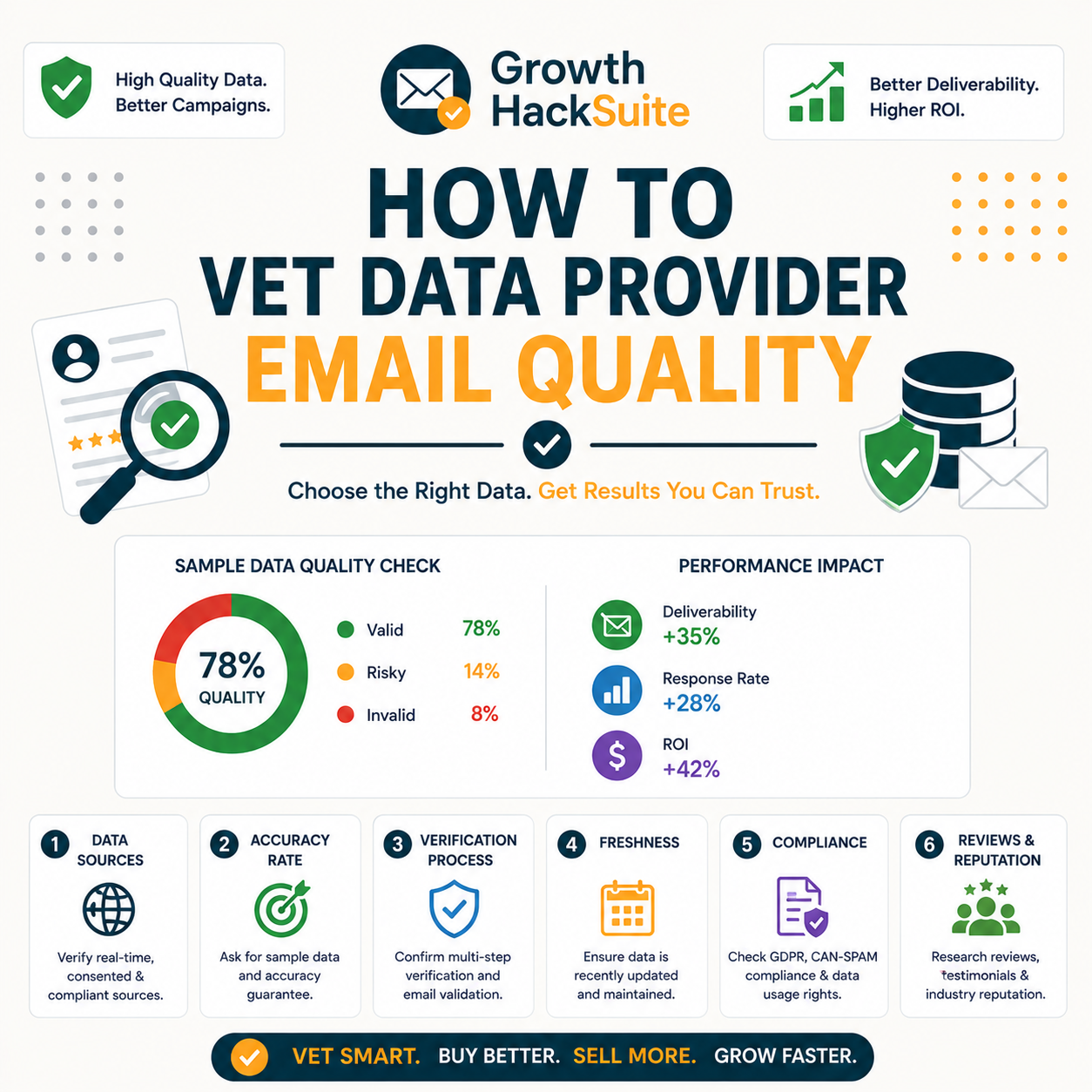
To vet data provider email quality before you buy, never trust the accuracy claim on the sales page: request a free sample, verify it independently, and read the invalid and catch-all rates the test exposes. A provider that refuses a sample or claims 100% accuracy is the clearest warning sign. This guide covers the positive signals, the red flags, and the one test that reveals what the data is worth.
Test any provider’s sample free before you pay a cent.
Test a Sample Free →Free plan included · No credit card · Full status and scoring
What Should You Vet in a Data Provider’s Email Quality?
Vet four things: deliverability, which is verifiable right now; freshness, meaning how recently the data was sourced; sourcing transparency; and refund or replacement terms. Accuracy claims mean nothing without a verifiable sample, so the vetting centers on testing real data rather than reading marketing pages. Each dimension is checkable before any money changes hands.
- Deliverability: Confirms whether each sampled address can actually receive mail today, measured by running the sample through a verifier. This is the only quality dimension that can be tested objectively before purchase rather than taken on faith.
- Freshness: Reflects how recently the provider sourced or refreshed the records, because contacts decay continuously as people change jobs. A list accurate at sourcing can already be partly stale by the delivery date.
- Sourcing transparency: Reveals where the data came from and how it was collected, separating compliant first-party sourcing from scraped or recycled lists. Providers confident in their methods disclose them plainly without hedging or vague claims.
- Refund terms: Define what happens when a portion of the list bounces, since even good data carries some invalid share. A replacement or credit guarantee shifts decay risk back onto the provider where it belongs.
- Compliance basis: Establishes the legal ground the records were collected under, separating opt-in or legitimate-interest sourcing from grey-market scraping. Compliant sourcing protects the buyer from regulatory exposure that no accuracy figure can offset.
Vetting is testing, not reading. A verifiable sample tells more about real quality than any accuracy claim printed on a pricing page ever can.
What Are the Signs of a High-Quality Data Provider?
Quality providers offer a free sample, disclose how data is sourced and refreshed, guarantee an accuracy threshold with replacement, and survive an independent verification test. Transparency and a willingness to be tested are the strongest positive signals. The table below contrasts how a quality provider and a weak one behave across the same four checks.
Source: Internal benchmark — criteria drawn from B2B data-buying evaluations and vendor sample-test practice, compiled 2026-06. Signals are qualitative checks, not a vendor ranking.
A provider that welcomes a verification test is signalling confidence in its own data. The rest is marketing, and marketing is not a quality signal.
How Do You Test a Provider’s Sample Before Buying?
Request a representative sample, run it through a verifier, and read the valid, invalid and catch-all ratios it returns. A low invalid rate on the sample predicts the full purchase well; a high one is a clear reason to walk away before spending. The sample is a free preview of the data the money actually buys.
- Request a representative sample: Ask for a few hundred records drawn from the same segment, industry and geography as the intended purchase, not a hand-picked best-of set. A representative slice prevents a provider from cherry-picking its cleanest addresses to pass the test.
- Verify it independently: Run the sample through a trusted verifier that returns a deliverability status for each address. Independent verification removes the provider’s own scoring from the equation and produces numbers neither side can dispute after the fact.
- Read the ratios: Compare the valid, invalid, catch-all and risky shares against a fixed threshold set in advance. A high invalid or catch-all share signals careless sourcing, so the ratios decide the purchase rather than the headline accuracy figure.
- Check the risky buckets: Inspect the disposable, role-based and unknown counts the verifier breaks out separately. A list padded with role addresses or disposable domains inflates the headcount while lowering the share that actually drives replies.
- Compare to the full quote: Project the sample’s pass rate onto the full purchase price to find the real cost per usable address. A cheap list with a poor sample often costs more per deliverable contact than a pricier, cleaner one.
For the deeper logic behind judging bought data, the question of whether purchased data is accurate at all is worth reading alongside this test.
Verify a provider sample free and read the real numbers.
Test a Sample Free →Free plan · No credit card · Full valid, invalid and catch-all breakdown
The sample’s invalid rate is the single most honest quality signal a buyer can get. Test it before paying, because the number cannot be argued with afterward.
What Red Flags Signal a Low-Quality Data Provider?
Walk away if a provider refuses a sample, claims 100% accuracy, hides how data is sourced, or offers no refund on bounces. Each red flag signals data that will not survive an independent verification test. The table below maps every red flag to the risk it actually represents for the buyer.
Source: Internal benchmark — red-flag criteria from B2B data-vendor evaluation practice, compiled 2026-06. Disclosed in the interest of honest buyer guidance.
Any single red flag is enough reason to pass. Quality providers have nothing to hide from a sample test, so hiding from one says everything.
Why Do Provider Accuracy Claims Mislead?
Headline accuracy claims often exclude catch-all and unknown addresses or rest on an outdated audit. Measured on a real verified sample, true quality is usually lower than the figure advertised. Treat any claim as a hypothesis to test, never as a fact to trust, because the methodology behind the number is rarely shown.
Email verification confirms an address exists and can receive mail before sending.
— Hunter API documentation, Email Verifier
A claim is a hypothesis; a verified sample is the evidence. Never confuse the two, because only one of them can be checked before money is spent.
How Does Data Decay Affect Provider Quality?
Even a quality provider sells data that decays: people change jobs and domains retire continuously. Ask how recently and how often the data is refreshed, because a list accurate at sourcing can be partly stale by the time it is delivered. Freshness, not just accuracy, determines how much of the purchase still works.
How B2B Data Decays Over Time
Source: Cleanlist B2B data-decay statistics (~2.1%/month, ~22.5%/year) and U.S. job-tenure data, verified 2026-06-28: cleanlist.ai/blog/2026-01-22-b2b-data-decay-statistics.
- Sourcing date: Marks when the records were originally collected, which sets the clock on decay. Data sourced many months before delivery has already lost a measurable share of valid addresses before it ever reaches the buyer’s inbox.
- Refresh cadence: Describes how often the provider re-verifies and updates the database. A short cadence keeps decay in check, while an unknown or yearly cadence means a large slice of contacts may already be stale.
- Decay since delivery: Accounts for the addresses that go invalid between purchase and first use. Even a fresh list keeps decaying, so re-verifying right before sending recovers the deliverability lost during the gap.
- Segment volatility: Reflects that some industries churn faster than others, with tech and SaaS roles turning over well above the average. A list heavy in volatile segments decays quicker than a blended database of the same age.
- Replacement coverage: Confirms whether the provider replaces records that bounce within a stated window. Coverage that spans normal decay turns freshness risk into a vendor obligation rather than a buyer loss after delivery.
Freshness matters as much as accuracy. Ask for the sourcing date, not just the accuracy figure, because a stale list fails regardless of how clean it once was. See what email data decay is for the full mechanism.
What Does a Verification Test Reveal About a Provider?
Verifying a sample exposes the true invalid rate, the catch-all share, and any disposable or role addresses padding the count. These ratios reveal both deliverability and how carefully the provider sourced the data, a report card no sales page ever provides. The test turns a vague accuracy claim into specific, comparable numbers.
Hunter’s own verifier review found accuracy holds strong on standard domains, with valid-status addresses bouncing under 2% across a 2,000-email benchmark, the same standard a provider sample must clear before the full list is worth buying.
The verification breakdown is the provider’s real report card. Sourcing care shows directly in the invalid, catch-all and risky shares the test returns.
Is the Provider’s Data Worth Buying After Vetting?
Buy only if the verified sample clears a high valid threshold with low invalid and catch-all shares, sourcing is transparent, and a replacement guarantee covers decay. Below that bar, the data is not a bargain at any price. Vetting decides the purchase, not the sticker price on the plan.
- Buy when: The verified sample clears the valid-rate threshold with a low invalid share, sourcing is disclosed and recent, and the provider backs the list with a replacement or refund on bounces. These conditions together mean the data is likely to perform as priced rather than collapse on first contact with a sending domain.
- Walk away when: The sample fails the threshold, the catch-all share is large, sourcing stays vague, or no refund covers decay. A cheap list that fails vetting costs more in damaged deliverability than it saves, so a low sticker price never offsets a poor sample result here.
Price matters only after the sample clears the bar. A cheap list that fails vetting is no deal, because the bounces it causes outlast the money it saves.
What Quality Threshold Should a Provider Meet?
Set a clear bar before testing: a high verified-valid share, a low invalid rate, a manageable catch-all share, and transparent sourcing. Holding every provider to the same threshold makes vetting objective rather than swayed by a sales pitch. The table below gives a practical pass bar and the reason behind each line.
Source: Internal benchmark — threshold values reflect common deliverability targets; a bounce rate under 2% is the widely cited safe ceiling. Compiled 2026-06; tune to the sending program before buying.
A fixed threshold turns vetting from gut feel into a repeatable, objective decision. The same bar applied to every provider makes the comparisons fair and the result defensible.
How Do You Vet a Data Provider Step by Step?
Vet in four steps: request a representative sample, verify it against a fixed threshold, check sourcing and refund terms, then buy only if all three clear. Documenting the sample results lets the buyer hold the full delivery to the same standard. The process is short, repeatable, and built around one test.
- Request a sample: Ask for a representative slice from the same segment as the intended buy. A genuine sample, not a curated best-of, is the foundation every later step depends on for an honest result.
- Verify against the threshold: Run the sample through an independent verifier and compare the valid, invalid and catch-all shares to the pass bar set in advance. The numbers, not the pitch, drive the decision here.
- Check the terms: Confirm sourcing transparency, refresh cadence, and a refund or replacement guarantee on bounces. Strong data with weak terms still leaves the buyer carrying the decay risk alone.
- Re-verify before sending: Run the delivered list through the verifier again right before the first send, because decay continues after purchase. A pre-send re-check recovers deliverability lost in transit and protects the sending domain from avoidable bounces.
- Buy if all clear: Purchase only when the sample passes, sourcing is disclosed, and the guarantee holds. Any failed step is a stop, since one weak link undermines the whole purchase regardless of price.
Four steps make vetting repeatable, and the sample test is the gate everything else hinges on. Skip it and the other steps lose their meaning.
Verdict: How to Vet Data Provider Email Quality
Vet by testing, not trusting: request a sample, verify it against a fixed threshold, demand sourcing transparency and a replacement guarantee, and walk away at the first red flag. A provider confident in its data will pass the test; the rest reveal themselves the moment a sample is requested. The test, not the claim, decides.
Verdict: Sample-test first — require ~90%+ verified-valid, under ~3% invalid, and a low catch-all share before buying. Demand transparent sourcing and a bounce replacement guarantee. Treat a no-sample, a 100% accuracy claim, or hidden sourcing as an automatic walk-away. Never trust the claim; trust the test.
Verify any provider sample free before you commit.
Test a Sample Free →Free plan · No credit card · The sample test decides
What Data Quality Basics Sit Behind Vetting?
Vetting rests on data quality fundamentals: accuracy, completeness and timeliness. For email specifically, the testable dimension is deliverability, which is why a verification test is the practical core of vetting any provider. The abstract quality concepts all reduce to one checkable question about whether an address still receives mail.
Data quality refers to the condition of data based on accuracy and completeness.
— Wikipedia, Data quality
Deliverability is the testable face of data quality, which makes verification the heart of vetting. For the underlying basics, see what email verification is and how email validation works.
Related Tools in the Hunter Stack
Vetting a provider is step one; verifying the purchase and re-verifying it over time follow. The Hunter verifier review covers validation depth, and the finder covers building lists worth verifying, both on one connected credit pool.
- Hunter Email Verifier: The validation layer that turns a provider sample into hard deliverability numbers — start with what the Hunter Email Verifier is.
- Hunter Email Finder: The sourcing half of the bundle for building first-party lists — read the Hunter.io email finder review for an alternative to buying data.
Vetting a Data Provider: Frequently Asked Questions
The 12 most-asked questions about vetting a data provider’s email quality.
How do I vet a data provider’s email quality?
Request a representative sample, verify it independently against a fixed threshold, and read the valid, invalid and catch-all ratios. Confirm sourcing transparency and a refund guarantee, then buy only if every check clears. The sample test, not the accuracy claim, is what reveals real quality.
Should I trust a provider’s accuracy claim?
No. Treat any accuracy claim as a hypothesis to test, never a fact to trust. Headline figures often exclude catch-all addresses or rest on an old audit, so true quality measured on a fresh verified sample is usually lower than advertised.
How do I test a data sample before buying?
Ask for a representative sample from the same segment as the intended purchase, run it through an independent verifier, and compare the valid, invalid and catch-all shares against a pass threshold. A low invalid rate on the sample predicts the full list; a high one is a reason to walk.
What are the red flags of a bad data provider?
The main red flags are refusing a sample, claiming 100% accuracy, hiding how data is sourced, and offering no refund on bounces. Each signals data that will not survive verification. Any single one is enough reason to pass, because quality providers have nothing to hide from a test.
Why do accuracy claims mislead?
Accuracy claims mislead because they often exclude catch-all and unknown addresses, rest on outdated audits, or hide their methodology. Measured on a real verified sample, true quality is usually lower. The number proves nothing until it is reproduced on a fresh slice of the actual data.
How does data decay affect provider quality?
B2B data decays at roughly 2% a month as people change jobs and domains retire, so a list accurate at sourcing can be partly stale by delivery. Ask for the sourcing date and refresh cadence, and re-verify right before sending to recover deliverability lost since the data was collected.
What does verifying a sample reveal?
Verifying a sample exposes the true invalid rate, the catch-all share, and any disposable or role addresses padding the count. Those ratios reveal both deliverability and how carefully the provider sourced the data, a report card no sales page provides and no claim can substitute for.
Is the data worth buying after vetting?
Buy only if the verified sample clears a high valid threshold with low invalid and catch-all shares, sourcing is transparent, and a replacement guarantee covers decay. Below that bar the data is not a bargain at any price, because the bounces it causes cost more than it saves.
What quality threshold should a provider meet?
Set a clear bar before testing: roughly 90% or higher verified-valid, an invalid rate under about 3%, a low and segmented catch-all share, and fully disclosed sourcing. Holding every provider to the same threshold makes vetting objective rather than swayed by a sales pitch.
How do I vet a provider step by step?
Four steps: request a representative sample, verify it against a fixed threshold, check sourcing and refund terms, then buy only if all three clear. Documenting the sample results lets the full delivery be held to the same standard. Any failed step is a stop, not a negotiation.
Can I verify a provider sample for free?
Yes. A verifier with a free tier lets a sample be checked at no cost before any data is bought. Hunter’s free plan includes about 100 verifications a month with full status and scoring, enough to test a representative provider sample and read its real invalid and catch-all shares.
What’s the best way to vet data quality?
The best way is an independent verification test on a representative sample, judged against a fixed threshold set in advance. Combine it with sourcing transparency and a refund guarantee. Reading marketing pages or trusting an accuracy claim is the least reliable approach a buyer can take.