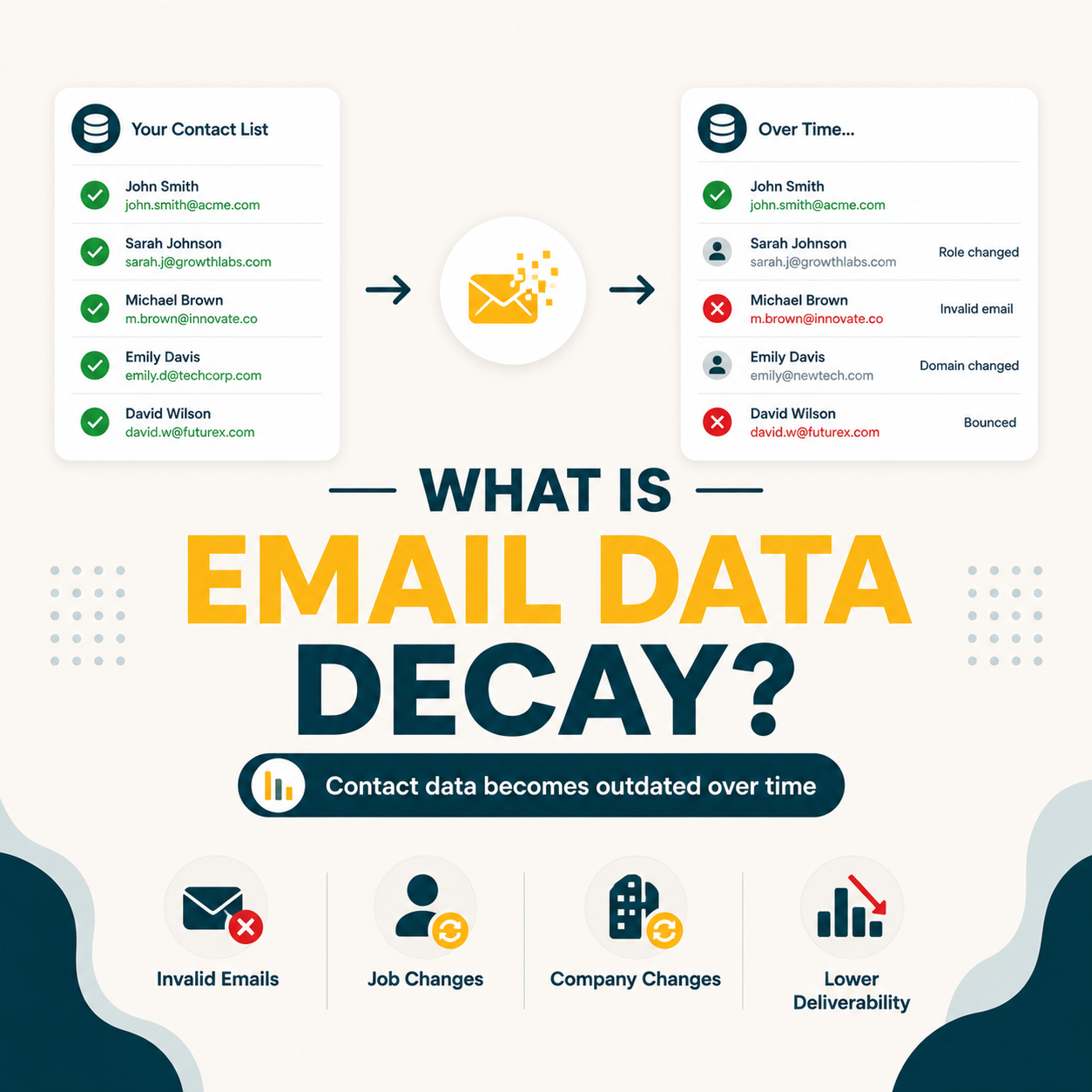
Email dta decay is the natural degradation of B2B contact databases as employees change jobs, companies shut down, and email addresses get deactivated. Industry research shows B2B contact lists decay 25 to 30 percent per year on average. Apollo refreshes its database quarterly. Hunter relies on real-time SMTP verification per query. The choice between them depends on whether you trust periodic batch refresh (Apollo) or live verification at point of use (Hunter).
Table of Contents
What Is Email Data Decay and Why Does It Cost B2B Teams 30 Percent Per Year?
Email data decay is the natural degradation of B2B contact databases as employees change jobs, companies shut down, and email addresses get deactivated. Industry research shows B2B contact lists decay 25 to 30 percent per year on average. A 10000 contact list goes from 10000 valid emails today to 7000 valid emails 12 months later without active refresh. The cost compounds because stale lists damage sender reputation and pollute marketing analytics simultaneously.
“Database normalization is the process of organizing a relational database to reduce data redundancy and improve data integrity.”
: Wikipedia: Database normalization
Data decay is the silent budget killer in B2B Sales Ops. The 30 percent annual rate means every year you must re-verify your entire contact list or watch deliverability drop and analytics accuracy crater.
How Do You Calculate Email Data Decay Rate for Your B2B Contact List?
Four metrics drive decay rate calculation. Job change frequency in your ICP industry, B2B SaaS employees change companies every 2.5 to 3 years on average. Company shutdown rate, 10 to 15 percent of SMB companies dissolve annually. Email deactivation rate after employee departure, typically 30 to 60 days post-termination. Domain change frequency from acquisitions and rebrands, 5 to 8 percent of B2B domains change per year. Combined decay rate equals roughly 30 percent annual for typical B2B SaaS targeting.
- Job change frequency: B2B SaaS employees change jobs every 2.5 to 3 years on average, equals 33 to 40 percent of contacts changing employers annually, the largest single driver of email data decay.
- Company shutdown rate: 10 to 15 percent of SMB companies dissolve annually based on Bureau of Labor Statistics data, removing entire batches of contacts at affected domains in one event.
- Email deactivation post-departure: when an employee leaves, email gets deactivated within 30 to 60 days typically, sometimes forwarded to manager, sometimes hard bounced, creating verification ambiguity.
- Domain changes from M&A and rebrands: 5 to 8 percent of B2B company domains change per year through acquisition rebrand or strategic renaming, breaking all email addresses at the old domain simultaneously.
Decay is not random, it follows predictable patterns. Job changes drive 60 percent of decay, company changes 25 percent, technical (domain, deactivation) 15 percent. Measure your specific decay rate to size verification budget accurately.
What Are the 5 Drivers of B2B Email Data Decay Sales Ops Should Track?
Five drivers shape decay rate per industry. Job mobility rate in your ICP industry sets baseline (tech 33 percent annual, finance 20 percent). Company growth stage affects decay differently, Series A startups churn faster, enterprises more stable. Geographic region influences via cultural job-change norms. Role seniority matters, IC roles change faster than VP+. Tech stack volatility correlates with employee mobility in adjacent companies. Measure your specific blend to size annual verification budget against expected decay percentage.
Five decay drivers below help Sales Ops teams measure their specific decay rate and budget verification cycles accordingly.
- Job mobility rate per ICP industry: tech and SaaS employees change jobs every 2.5 years (33 to 40 percent annual decay), finance and healthcare stay 4 to 5 years (20 to 25 percent decay), measure your industry baseline.
- Company growth stage volatility: Series A to B startups churn 50 percent of staff in 2 years, Series C+ stabilize to industry baseline, public enterprises show lowest decay at 15 to 20 percent annual.
- Geographic region cultural norms: US tech hubs show 30 to 40 percent annual mobility, European markets 20 to 30 percent, Asia-Pacific varies widely by country with Singapore high (30 percent), Japan lower (15 percent).
- Role seniority and tenure patterns: IC and manager roles change faster (40 percent annual), Director-VP level 25 to 30 percent, C-suite 15 to 20 percent, weight ICP refresh frequency by typical seniority targeted.
- Tech stack volatility in target accounts: companies undergoing platform migrations or M&A see 50 to 70 percent annual decay due to mass restructuring, target accounts in active transition need real-time verification.
“According to HubSpot research, B2B marketing databases naturally degrade at a rate of about 22.5 percent every year.”
: HubSpot: Database Decay Guide
Decay drivers are predictable per ICP segment. Measure your specific blend to budget verification cycles accurately. Trying to handle decay with one annual cleaning batch underbudgets refresh needs for high-mobility ICPs.
What Are the 5 Gaps in How Apollo and Other Tools Handle Data Decay?
Five gaps cap how database tools handle decay. Quarterly refresh cycle (Apollo, Cognism) leaves 7 to 8 percent decay between refreshes. Real-time verification (Hunter) catches decay but cannot fix the underlying database. Annual refresh (some legacy vendors) leaves 30 percent decay annually before refresh. Self-reported data sources (ZoomInfo opt-in panels) have inherent freshness bias. Crowdsourced corrections (Clearbit-style) lag actual decay events by 60 to 90 days. No single mechanism solves decay alone.
For tools that fill these specific gaps, see our review of tool alternatives for decay-resistant data workflows.
Five gaps below shape why no single tool fully solves data decay: mature stacks combine multiple approaches.
- Quarterly refresh interim decay gap: Apollo and Cognism refresh quarterly meaning 7 to 8 percent decay accumulates between refresh events, contacts queried mid-cycle have stale data.
- Real-time verification database staleness: Hunter verifies live at query time but cannot fix the underlying contact database, returns valid status on a current employee who left but whose mailbox still accepts mail.
- Annual refresh extreme staleness: some legacy vendors refresh annually leaving 30 percent decay accumulated before refresh, unusable for B2B SaaS at any meaningful scale, avoid these vendors.
- Self-reported data freshness bias: ZoomInfo opt-in panels and similar sources have inherent bias toward active users updating profiles, ghost profiles of departed employees linger longer than reality.
- Crowdsourced correction lag: Clearbit-style crowdsourced data corrections lag actual decay events by 60 to 90 days because corrections accumulate from user reports rather than systematic refresh.
“As detailed in our Hunter.io Email Finder review, real-time SMTP verification catches decay at point of query, complementing database refresh tools like Apollo by adding a freshness check independent of vendor refresh cycle timing.”
: Growth Hack Suite: Hunter.io Email Finder review
Every tool has decay gaps. Quarterly refresh misses interim decay. Real-time verification misses underlying database staleness. Combine real-time verification (Hunter) with periodic database refresh (Apollo, ZoomInfo) for best coverage. For how reliable that real-time check is, see our Hunter email verifier accuracy results.
Top 5 B2B Data Tools Compared by Refresh Cadence and Decay Handling
Five tools handle data decay differently. Hunter verifies real-time per query, catching decay at point of use. Apollo refreshes database quarterly with mass batch updates. ZoomInfo refreshes daily on enterprise tier for premium accuracy. Clearbit (now HubSpot) refreshes via crowdsourced corrections plus periodic batch. Cognism refreshes quarterly with EU compliance focus. Combining real-time verification (Hunter) with periodic database refresh (Apollo or ZoomInfo) covers both decay timing and underlying database freshness.
See the full Apollo vs Hunter comparison for a deeper breakdown of how each platform handles data freshness at different subscription tiers.
Five tools below compared by refresh cadence and decay handling approach, tested with 5000-contact freshness verification batches in early 2026.
Real-time verification (Hunter) catches decay at query. Periodic refresh (Apollo, ZoomInfo) keeps database fresh between queries. Combine both for full decay coverage. Choose primary based on whether you need fresh queries or a fresh database.
How Do You Mitigate Email Data Decay? 5-Step Workflow with Hunter and Apollo
Five steps build a decay-resistant data workflow. Step 1: measure your specific decay rate on a 1000-contact sample from CRM segments. Step 2: choose primary refresh approach, Apollo for database refresh or Hunter for query-time verification. Step 3: set verification cadence by ICP mobility, quarterly for stable ICPs, monthly for high-mobility. Step 4: integrate verification into pre-send workflow on Hunter free 50 credits per month. Step 5: monitor bounce rate trend monthly as decay signal indicator.
Five mitigation steps below build a decay-resistant data workflow, measurable on your specific CRM in under 30 days.
- Step 1, measure baseline decay rate: sample 1000 contacts from oldest CRM segment, verify with Hunter free tier (50/month, spread across 20 days), measure percentage flagged invalid or risky, calculate your annual decay rate.
- Step 2, choose primary refresh approach: high-volume CRM enrichment workflows favor Apollo quarterly database refresh, accuracy-critical pre-send workflows favor Hunter real-time verification per query.
- Step 3, set verification cadence by ICP mobility: stable enterprise ICP needs quarterly refresh, mid-market SaaS targeting needs monthly cycles, startup-focused ICP needs every-send verification to catch fast-moving job changes.
- Step 4, integrate verification into pre-send workflow: Hunter free tier of 50 credits monthly handles small-team workflow, Hunter Starter at 49 dollars per month (34 dollars billed annually) flat unlocks 2,000 credits for mid-volume teams.
- Step 5, monitor bounce rate trend monthly: sudden bounce rate jumps from 1 to 3 percent signal accumulated decay since last refresh, trigger re-verification cycle when bounce trend crosses your threshold consistently.
Measure your true data decay free with Hunter.
Test your oldest CRM segment on Hunter free tier of 50 credits per month to measure exact decay percentage on your specific contact list. Foundational data for budgeting verification cycles annually.
Measure data decay free with Hunter →50 credits per month free · Real-time SMTP verification · Catches decay Apollo refresh misses
Five steps, measurable decay reduction. Hunter free tier covers initial decay measurement on 50 contacts. Apollo Professional adds quarterly database refresh. Combine both for a mature decay-resistant workflow.
Email Data Decay: Frequently Asked Questions
Twelve questions below cover what Sales Ops and Marketers search when planning decay mitigation: how fast B2B data decays, Apollo vs Hunter refresh handling, optimal verification cadence, free verification options, and impact on deliverability.
How fast does B2B email data decay per year?
B2B contact lists decay 25 to 30 percent per year on average. Tech and SaaS industries hit 33 to 40 percent due to higher job mobility (2.5 year average tenure). Finance and healthcare run lower at 20 to 25 percent (4 to 5 year tenure). Without active refresh, a 10000 contact list goes from 10000 valid emails today to 7000 valid in 12 months, costing both deliverability and analytics accuracy.
How does Apollo handle data decay compared to Hunter?
Apollo refreshes its 275M+ contact database quarterly, meaning 7 to 8 percent decay accumulates between refresh events. Hunter takes a different approach with real-time SMTP verification at each query, catching decay at point of use regardless of vendor refresh cycle. Apollo wins on systematic database-level freshness. Hunter wins on query-time freshness for verification-critical workflows. Combining both covers full decay scope.
What is the optimal data verification cadence for B2B teams?
Depends on ICP mobility. Stable enterprise ICP needs quarterly refresh to match natural decay pace. Mid-market SaaS targeting needs monthly verification cycles. Startup-focused ICP needs every-send verification to catch fast-moving job changes. High-mobility tech industry SDR teams should verify before every campaign send, not just on periodic batch refresh schedules.
Can data decay be eliminated entirely with the right tools?
No, but it can be reduced to under 2 percent at any given moment with proper workflow. Combination of Apollo quarterly database refresh plus Hunter real-time verification before send catches decay at both levels. Self-reported updates from contacts (via newsletters with unsubscribe plus update profile links) add user-driven correction layer. No single tool fully eliminates decay, but a layered approach minimizes impact to acceptable thresholds.
How much does data decay cost B2B teams annually?
Direct cost equals 25 to 30 percent of contact acquisition spend lost yearly. For a team spending 60k annually on contact data (Apollo Professional plus verification plus enrichment), 30 percent decay means 18k worth of data degrades unused without active refresh. Indirect costs include damaged sender reputation, lower email deliverability, polluted CRM analytics, all compounding over 12 to 24 month cycles.
Will reducing data decay improve cold email reply rate?
Yes by 15 to 30 percent typically. Lower decay means higher verified email rate, which translates to higher inbox placement, which translates to higher open rate, which feeds into higher reply rate. The compound effect of clean data through the funnel often delivers 2x to 3x reply rate compared to running uncleaned dirty lists, before any copy or targeting improvements.
Can the data decay rate be measured for free?
Yes with Hunter free tier. Sample 50 contacts from your oldest CRM segment (12+ months old), verify with Hunter free tier of 50 credits per month, measure percentage flagged invalid or risky. The result gives actual decay rate for your specific ICP. Spread the 50 credits across 20 days to get a representative sample of decay patterns across multiple time windows.
Does verifying contacts before send actually reduce data decay impact?
Yes by catching decay at query time independent of database freshness. Even if Apollo or ZoomInfo database has stale data, real-time Hunter verification at point of use catches the actual current mailbox state. The verification step adds 5 to 10 minutes per 1000 contacts but prevents 6 to 10 percent bounce rate that would otherwise damage sender reputation and inbox placement long-term.
What is email data decay?
Email data decay is the natural degradation of B2B contact databases as employees change jobs, companies shut down, and email addresses get deactivated. Industry research shows B2B contact lists decay 25 to 30 percent per year on average, with tech and SaaS industries reaching 33 to 40 percent due to higher job mobility patterns.
How fast does B2B email data decay annually?
25 to 30 percent average decay per year across B2B industries. Tech and SaaS at 33 to 40 percent due to 2.5 year average tenure. Finance and healthcare at 20 to 25 percent due to 4 to 5 year tenure. Geographic and seniority variations apply. The largest single driver is job change frequency contributing 60 percent of total decay, followed by company shutdowns at 25 percent.
Does Apollo or Hunter handle data decay better?
Different approaches. Apollo refreshes its database quarterly with mass batch updates, fixing database-level decay at the cost of 7 to 8 percent interim staleness between refreshes. Hunter verifies real-time per query, catching decay at point of use regardless of database freshness. Apollo wins on systematic database refresh, Hunter wins on query-time freshness. Many mature stacks combine both for full coverage.
Can data decay be measured for a specific contact list?
Yes through sampling. Take a random 50 to 100 contact sample from your oldest CRM segment (12+ months old), verify with Hunter or ZeroBounce free tier, measure percentage flagged invalid or risky. The result equals your actual decay rate. Repeat the measurement quarterly to track decay trend over time. Most B2B teams discover their actual decay rate exceeds industry averages by 5 to 10 percent.
Email data decay costs B2B teams 25 to 30 percent of contact list quality annually if not actively managed. Combine periodic database refresh (Apollo, ZoomInfo) with real-time verification (Hunter) for full decay coverage at both query time and database level.
Try Hunter.io free: see Hunter live verification vs Apollo quarterly refresh
B2B data decays 30 percent yearly. Apollo refreshes quarterly meaning 7 to 8 percent decay between refreshes. Hunter verifies live at each query, catching decay in real time. Test Hunter free on 50 contacts from your oldest CRM segment to measure your true decay exposure.
Measure your data decay free with Hunter →7M+ professionals use Hunter. No card. Cancel anytime.