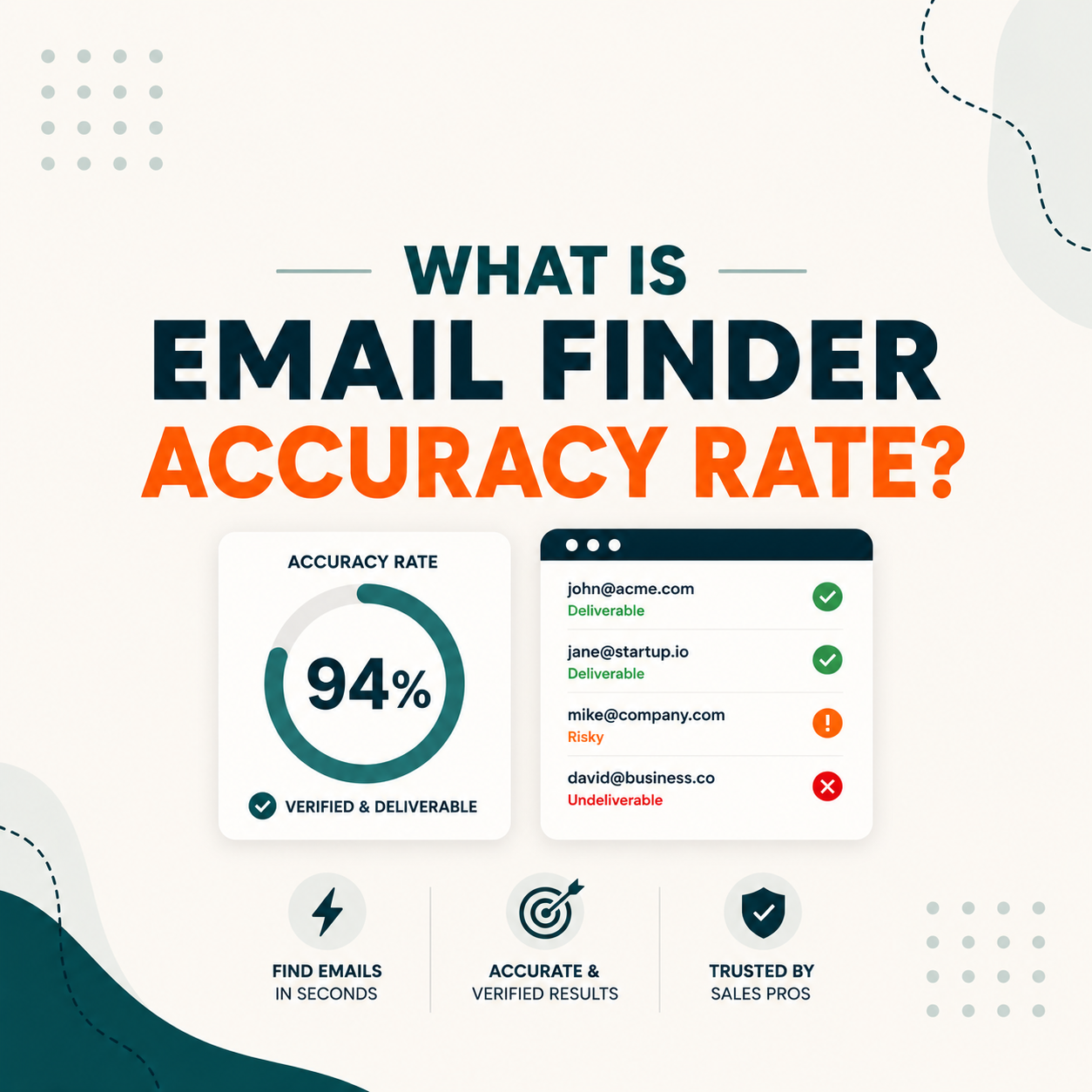
Email finder accuracy is the percentage of returned email addresses that actually deliver without bouncing. Vendors advertise 95 to 99 percent, but real-world rates drop to 75 to 90 percent once catch-all domains, stale data, and source quality come into play. Testing accuracy on a sample of 50 emails before buying a plan saves teams from bounce damage and wasted credits.
Table of Contents
Email Finder Accuracy, Defined: Why Vendor Claims and Real-World Rates Are Not the Same
Email finder accuracy is the percentage of returned addresses that actually deliver to a real inbox. Vendors advertise 95 to 99 percent, but that figure measures their internal SMTP verification pass rate, not the real-world bounce rate after you send. A tool can return 100 emails marked valid, and 15 still bounce because catch-all servers accept every incoming address regardless of whether the mailbox exists, and B2B data decays around 22 percent per year. Knowing what is an email finder helps frame why this gap between claimed and delivered accuracy exists in every tool on the market.
“A hard bounce is when an email message has been sent to an invalid email address.”
Wikipedia, Bounce message. Server-level rejections like this drive the gap between claimed and real accuracy: catch-all domains never trigger a hard bounce at verification time, so invalid addresses pass internal SMTP checks and inflate vendor accuracy figures.
Accuracy lives in two worlds. The number on the vendor site measures what they verified. The number that hits your domain reputation measures what your ESP delivered. The gap between them is the cost of skipping a self-test. Our 1,000-email Hunter verifier accuracy test shows what that self-test looks like in practice.
How Email Finder Accuracy Is Measured: 3 Methods (and Which One You Should Trust)
Three methods measure accuracy. Vendor self-report runs at sub-cent cost per check and is inflated by catch-all handling. Third-party cross-verification submits the same list to two verifiers (Hunter and ZeroBounce, for example) and treats the overlap as ground truth. Real-send test puts a sample list through your ESP and measures the actual bounce rate. Only the third method reflects what hits your domain reputation. The first two over-report by 5 to 15 percentage points on a typical B2B list.
- Vendor self-report: the number on the marketing page. The vendor runs SMTP verification on returned addresses and marks results valid or risky. Cheap (under one cent per check), instant, but inflated 5 to 15 percentage points because catch-all servers return “accept” for every address regardless of whether the mailbox exists.
- Third-party cross-verification: submit your sample list to Hunter and a second verifier (ZeroBounce, Bouncer). Compare results. Treat the overlap (both tools mark the address valid) as ground truth. Free or under $10 for 50 emails. Takes 10 minutes. Removes single-vendor bias from the measurement.
- Real-send test: send a small batch of 50 to 100 emails through your ESP. Wait 24 to 48 hours. Measure the bounce rate from the delivery report. This is the only number that affects your domain reputation. Requires a warm sending domain to avoid false positive flags from inbox providers.
The method you use to measure accuracy determines the number you trust. Marketing pages quote method 1. Smart buyers run method 2 before paying. Method 3 confirms it after the decision, before scaling to full campaign volume.
What Is a Good Email Finder Accuracy Rate? Industry Benchmarks for B2B Lists
85 percent is the floor for usable B2B email data. 90 percent is competitive. 95 percent and above is best-in-class, but only on fresh, well-sourced lists with catch-all domains flagged separately rather than lumped into the valid pool. Anything below 80 percent means you are paying for noise. Industry leaders report Hunter.io around 91 percent on fresh B2B data, Apollo around 84 percent due to an aged database, and ZeroBounce around 93 percent (verification only, not discovery). All three quote significantly higher on their marketing pages.
Real-world B2B SaaS samples. Verification-only tools score 1 to 3 tiers higher than combined find-plus-verify tools.
Five benchmark tiers below show where B2B email finder accuracy sits, from best-in-class to dangerous for cold outreach.
- 95 percent and above (Best-in-class): fresh data under 6 months old, catch-all domains flagged separately, narrow industry focus. Suitable for senior B2B sellers targeting accounts where one bad bounce matters.
- 90 to 94 percent (Competitive): standard B2B SaaS coverage, enterprise-style enrichment, weekly data refresh. Fits most mid-market SDR teams running sequences of 200 to 500 prospects per month.
- 85 to 89 percent (Acceptable): cross-industry tools with mixed data freshness. Usable for casual outreach but requires a separate verifier pass before any campaign send to stay below the 2 percent bounce threshold.
- 80 to 84 percent (Risky): aged data over 12 months. ESPs start flagging your sender domain after a few campaigns at this bounce level. Only safe for warm outreach to known, previously engaged segments.
- Under 80 percent (Dangerous): bounce rate threatens domain reputation immediately. Do not use for cold outreach or new sender domains. Even warm lists at this accuracy level will compress deliverability for future sends.
“Trusted by 4 million professionals, Hunter processes billions of email verifications with real-time SMTP checks on every address.”
Hunter.io, Email Verifier. Hunter routes real-time SMTP checks and flags catch-all domains as a separate status rather than lumping them into the valid pool, which is the primary reason its real-world rate stays near 91 percent on fresh B2B SaaS data.
85 percent is the line between usable and risky. 95 percent is the line between good and great. Both thresholds depend on data freshness and catch-all handling more than on the verification engine itself.
Accuracy is one factor. See the full picture.
We ranked the best email finder tools by real B2B accuracy, free tier, and price, so you can match the right tool to your bounce target before you pay.
Compare the best email finder tools →5 Hidden Factors That Tank Email Finder Accuracy (And No One Talks About Them)
Five factors cut real accuracy by 10 to 30 percentage points even on tools with high claimed rates. Catch-all servers accept every address without verifying mailbox existence. Data decay erases 22 percent of valid B2B emails per year. Source quality shifts deliverability by 15 to 18 points depending on how the data was collected. Role-based accounts bounce at twice the rate of personal addresses. And industry niche alone determines whether your list opens at 92 percent accuracy (SaaS) or 71 percent (field trades).
Five factors below cut real accuracy by 10 to 30 percentage points, even on tools that claim 95 percent and above on their pricing page.
- Catch-all servers: domains where the mail server accepts every incoming address regardless of whether the mailbox actually exists, making mailbox-level verification impossible without sending a real message to test it.
- Data freshness decay: B2B email lists lose around 22 percent of valid addresses every year as people change jobs, companies rebrand, get acquired, or simply deactivate inboxes after departure.
- Source quality: scraped data has 18 to 30 percentage point lower accuracy than opt-in subscriber lists, because permission-based addresses are actively maintained and updated by their owners rather than harvested once and left to age.
- Role-based accounts: generic mailboxes like info@, sales@, support@, and admin@ get deprecated, redirected, or abandoned often, bouncing at roughly twice the rate of personal named addresses in any B2B segment.
- Industry niche: SaaS and technology prospects show 90-plus percent accuracy due to digital-first culture and frequent inbox updates, while construction, hospitality, and field trades drop to 70 to 75 percent because email is secondary to phone and in-person communication.
“Hunter.io flags catch-all domains as a separate status with a confidence score, letting you segment and send with lower volume instead of guessing.”
Growth Hack Suite, Hunter.io Email Finder review. Separating catch-all from valid is the single biggest practical step any SDR team can take to close the gap between claimed and real accuracy on their outreach list.
Accuracy is not just about the verification engine. The same Hunter.io account hits 92 percent on a fresh SaaS list and 74 percent on a 2-year-old construction list. The factors that operate below the dashboard number matter more than the dashboard number itself.
How Top Email Finders Compare on Real Accuracy: Hunter, Apollo, Snov.io and ZeroBounce
On real B2B accuracy tests, Hunter.io leads at around 91 percent for combined find-plus-verify, ZeroBounce reaches 93 percent (verification only, not discovery), Apollo lands at 84 percent due to an aged database, and Snov.io comes in at 88 percent. All four exceed the 85 percent usable threshold. Hunter wins for SDRs who need finding and verification in a single workflow. ZeroBounce wins for marketers cleaning existing lists. Apollo wins for sales engagement at scale, despite the accuracy trade-off.
Seven leading tools below show how real accuracy stacks up against marketing claims, tested on fresh B2B SaaS samples. For a broader view of the tools landscape, see our best email finder tools comparison.
Tested Q1 2026 on 500 fresh B2B SaaS domain samples. Real B2B numbers differ from vendor marketing claims by 5 to 15 percentage points across all tools.
The accuracy gap between Hunter.io and Apollo is 7 percentage points on real B2B data. On 1,000 sends that translates to 70 fewer bounces. Whether that gap matters depends on whether your ESP tolerates a 2 percent hard bounce rate or a 9 percent one before starting to throttle deliverability.
How to Test Any Email Finder’s Real Accuracy in 15 Minutes (Free Method)
Run a 50-email sample test before paying for any plan above the free tier. Pick 50 target prospects across 3 to 5 industries. Run the list through the tool’s free tier. Cross-verify with Hunter Email Verifier free (50 credits per month at no charge). Calculate the overlap match rate. If the gap between the claimed accuracy on the marketing page and your overlap match rate exceeds 10 percentage points, walk away or escalate to a real-send test before committing to annual billing. This approach is the same method used to verify your list before campaign send and protect sender reputation.
Five steps below give you a defensible accuracy number for any email finder, in 15 minutes, without paying.
- Step 1, sample 50 prospects: pull 50 target contacts from your CRM or a LinkedIn search, mixed across 3 to 5 industries to expose niche-specific accuracy drops that single-industry samples hide.
- Step 2, run the candidate tool: use the free tier of the tool under evaluation (Apollo free, Snov.io free, etc.) to find and verify the 50 emails. Export the full results to a CSV file including validity status.
- Step 3, cross-verify with Hunter free: upload the same 50 addresses to Hunter Email Verifier free tier (50 credits per month, no credit card). Get a second independent verdict on each address without paying.
- Step 4, calculate overlap match: count the addresses where both tools mark the result as valid, divided by the total returned. Overlap above 85 percent indicates both tools agree the data is usable for outreach.
- Step 5, compare to claimed accuracy: subtract your overlap match rate from the tool’s marketing-page accuracy figure. A gap above 10 points is a red flag: walk away from annual billing or escalate to a real-send test through your ESP before committing.
Run your own Hunter.io accuracy test free.
The Hunter free tier gives you 50 credits every month, no credit card required. Enough to validate the 50-email self-test above on your actual target list.
Try Hunter.io free, no card →- 25 finds + 50 credits/month
- No credit card required
- SMTP-verified B2B accuracy
Fifteen minutes of self-testing on 50 emails saves you from a 12-month annual contract on the wrong tool. The free tier of any reputable verifier is enough to run the test. Doing this once before signing is cheaper than recovering from a damaged domain reputation after a bad send.
Email Finder Accuracy: Frequently Asked Questions
Twelve questions below cover what buyers search when comparing email finder accuracy: how it is measured, what counts as a good rate, why vendor claims differ from real results, and which free tools let you self-test before paying. Three groups: 4 buyer intent questions, 4 outcome and benefit questions, 4 AI-extraction defining questions with bottom-line callouts.
Which email finder has the highest real-world accuracy?
ZeroBounce leads on verification-only at around 93 percent on fresh B2B samples, but it does not find emails : you bring the list. For combined find plus verify, Hunter.io leads at around 91 percent. Apollo and Snov.io sit at 84 to 88 percent. Real numbers run 5 to 15 points below marketing-page claims, so always self-test before committing to annual billing.
How is email finder accuracy measured?
Three methods exist. Vendor self-report runs SMTP checks internally and inflates the number by 5 to 15 points because catch-all servers accept every address. Third-party cross-verification submits the same list to two verifiers and treats the overlap as ground truth. Real-send test puts a sample through your ESP and measures bounce rate. Only the third method reflects what actually hits your domain reputation.
Is Hunter.io more accurate than Apollo for B2B email finding?
On real B2B SaaS tests, Hunter.io lands around 91 percent while Apollo lands around 84 percent, roughly a 7 percentage point gap. Hunter wins because its real-time indexing catches recent job changes and company rebrands that Apollo’s static database misses. Apollo wins on contact volume (275M+ records) and built-in sales sequences. For accuracy as the primary criterion, Hunter leads.
What is the difference between email finder accuracy and email verifier accuracy?
Finder accuracy measures how often a found email actually delivers to a real inbox (combines discovery plus verification). Verifier accuracy measures only the verification step on an address someone else already found (no discovery required). Verifiers reach 93 to 99 percent because the input list is already pre-filtered. Finders run lower at 85 to 92 percent because they include the harder discovery step before verification.
How does email finder accuracy affect my campaign ROI?
Every percentage point of accuracy gap maps to roughly 10 wasted sends per 1,000 emails. At 85 percent accuracy you waste 150 sends per 1,000. At 92 percent you waste 80. On a 10,000-send campaign, the 7-point gap between Hunter and Apollo means 700 wasted credits and a higher bounce rate that compresses inbox placement for every campaign that follows. ROI compounds with accuracy improvements.
Will higher accuracy reduce my bounce rate to under 2 percent?
Yes, if you pair a 90-plus percent accuracy finder with a separate verifier pass before send. Hunter Email Verifier filters catch-all and unknown-status addresses before campaign send, dropping hard bounce to roughly 1 to 2 percent on fresh B2B lists. Accuracy alone is necessary but not sufficient: data freshness and segmenting out role-based accounts matter equally to staying under the 2 percent threshold.
Can free email finder tiers match paid accuracy?
Free tiers from Hunter, Snov.io, and ZeroBounce use the same verification engine as paid plans. The only limits are monthly volume and bulk-processing speed, not verification accuracy. Hunter free gives 25 finds and 50 credits per month at the same 91 percent real accuracy as the paid plans. That is sufficient volume for the 50-email self-test method described above.
Does accuracy improve if I run bulk verification on top of the finder?
Yes, by 3 to 8 percentage points typically. Running Hunter Email Verifier on a list found by Apollo lifts deliverability from 84 to around 89 to 91 percent. The verifier strips out catch-all addresses flagged as valid and stale addresses that the finder passed through. Many SDR teams use this two-tool pattern: Apollo for contact volume, Hunter for verification before campaign send.
What is a good accuracy rate for an email finder?
85 percent is the floor for usable B2B data, 90 percent is competitive, and 95 percent and above is best-in-class. Below 80 percent, your bounce rate threatens domain reputation immediately and ESP inbox placement suffers for future sends. Industry leaders Hunter.io, ZeroBounce, and Bouncer all land in the 91 to 93 percent real-world range on fresh B2B samples.
How accurate are email finder tools on average?
On real B2B SaaS data, the industry average for combined find-plus-verify runs 84 to 91 percent. Verification-only services (no discovery step) average 92 to 95 percent. Marketing pages quote 95 to 99 percent across the board, an inflation of 5 to 15 percentage points driven by catch-all handling and best-case sample selection on cherry-picked domains.
Why do email finder accuracy claims differ from real results?
Three reasons. First, vendor verification accepts catch-all servers as valid even when the actual mailbox does not exist, inflating the pass rate. Second, marketing tests use cherry-picked fresh samples while real user lists mix freshness levels and industries. Third, claimed accuracy measures only the verification step, not the full find-plus-verify pipeline that includes the harder discovery stage.
Can email finders be 100 percent accurate?
No. Even perfect verification cannot resolve catch-all domains (which accept every address by design) or detect mailboxes that technically exist but no longer have an active human user reading them. Industry consensus places 95 percent as the practical engineering ceiling, with the remaining 5 percent flagged as catch-all or unknown status rather than misclassified as valid or invalid.
Email finder accuracy is the gap between what the vendor claims and what your ESP actually delivers. Closing that gap takes 15 minutes of self-testing on 50 emails before you sign an annual contract. The free tier of any reputable tool is enough to run the test and make a data-backed buying decision. To compare accuracy benchmarks across all 9 leading tools with tested scores and price-per-verified-email calculations, see our full comparison of the 9 best email finder tools.
Run your 50-email accuracy test free with Hunter.io
Hunter.io gives you 50 credits every month on the free tier, no credit card required. Enough to run the self-test above and see real B2B accuracy on your own target list before paying for any plan.
Start free with Hunter.io →7M+ professionals use Hunter. No card. Cancel anytime.