Table of Contents
What causes email bounces comes down to two groups: address problems like invalid or non-existent mailboxes, and server problems like full inboxes or temporary outages. Address problems trigger permanent hard bounces, while server problems trigger temporary soft bounces. Most hard bounces are preventable with list verification before a send. This guide explains every common cause and which ones cleaning actually fixes.
Prevent bounces at the source — verify your list free before the next send.
Verify Your List Free →Free plan included · No credit card · Removes invalid addresses
What Causes Email Bounces?
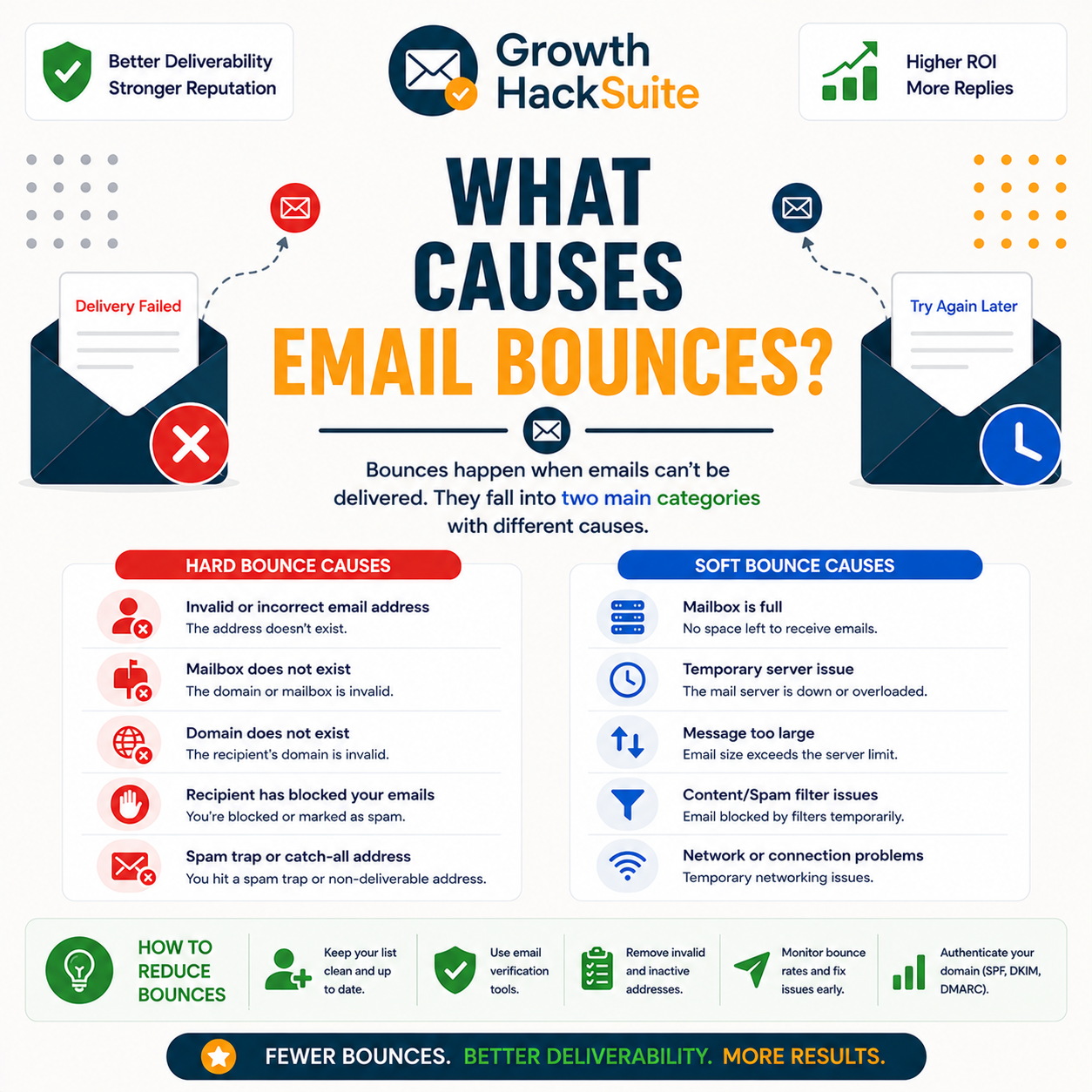
Email bounces are caused by two broad groups. Address problems occur when the mailbox is invalid or does not exist, and server problems occur when a valid mailbox is temporarily unreachable. Address problems cause permanent hard bounces; server problems cause temporary soft bounces. A smaller third group covers sender-side rejections from authentication or content. Most hard bounces are preventable.
- Address problems: Invalid, misspelled or non-existent mailboxes and dead domains cause permanent hard bounces. The receiving server confirms the address cannot accept mail, so it rejects the message outright and the address should be removed from the list.
- Server problems: A full mailbox, an oversized message, a server outage or greylisting causes temporary soft bounces. The address is often valid, so providers retry delivery over hours or days before treating the failure as permanent.
- Content and policy problems: Failed SPF, DKIM or DMARC checks, spam-like content or poor sender reputation cause block-style rejections. These come from the sending side rather than the address, and authentication or reputation work resolves them rather than list cleaning.
- Permanent versus temporary: The permanence of a cause decides the action. Permanent address faults demand removal from the list, while temporary server faults resolve on retry, so classifying each bounce correctly prevents deleting addresses that are still valid.
- Preventable versus inherent: Address-based bounces are preventable through pre-send verification, whereas a share of soft bounces from outages or full inboxes is inherent to email and cannot be removed entirely no matter how clean the list is.
Bounces come from address problems (permanent) or server problems (temporary), with a smaller sender-side group. That split sets the cause and the right fix.
What Causes Hard Bounces?
Hard bounces come from invalid or non-existent addresses, dead or misspelled domains, deleted mailboxes, and recipients who blocked the sender. Each is a permanent condition tied to the address itself, which is exactly what verification detects and removes before a send. Hard bounces are the dangerous category that damages sender reputation fastest.
- Non-existent address: The local part before the @ does not exist on the receiving server, often from a typo, a guessed address or an outdated record. The server returns a permanent rejection, and the address should be deleted from the list.
- Dead domain: The domain after the @ no longer resolves or has no mail server, because the company folded, rebranded or let the registration lapse. No mailbox can receive mail there, so every address on that domain hard bounces.
- Deleted mailbox: A once-valid address whose owner left the company or closed the account now rejects mail permanently. List decay makes this common, since roughly a fifth of B2B addresses go stale each year as people change jobs.
- Misspelled address: A typo in the local part or domain, such as a missing letter or a wrong extension, points the message at a mailbox that does not exist. The receiving server returns a permanent failure, so the corrected or removed entry resolves it.
- Blocked sender: A recipient or their administrator has explicitly blocked the sending address or domain, so the server refuses delivery permanently. Repeated attempts will keep failing until the block is lifted, marking the address effectively undeliverable for that sender.
Hunter documentation distinguishes deliverable, risky and undeliverable results so senders can drop the undeliverable ones before mailing.
— Hunter.io API documentation
Hard bounces are address conditions — invalid, dead-domain or deleted mailboxes that verification can remove before they ever reach a send.
What Causes Soft Bounces?
Soft bounces come from temporary conditions: a full mailbox, an oversized message, a server that is down, or greylisting that delays first-time senders. The address is often valid, so receiving providers retry delivery automatically. Persistent soft bounces across many sends eventually signal a dead address that should be treated as a hard bounce.
- Full mailbox: The recipient mailbox has hit its storage quota and cannot accept new mail until space frees up. The address stays valid, so the provider retries later, and the message often lands once the inbox clears.
- Server down: The receiving mail server is temporarily offline for maintenance or an outage, so it cannot process incoming messages. Delivery is queued and retried over hours, and the bounce resolves itself once the server returns online.
- Greylisting: A receiving server deliberately defers a first delivery attempt from an unknown sender to deter spam, then accepts the retry. Legitimate senders pass automatically on the second try, so greylisting rarely causes a permanent failure.
- Oversized message: An email exceeding the recipient server’s size limit, often from heavy attachments or embedded images, is refused temporarily. Trimming the message or hosting large files externally lets a resend pass, since the address itself stays valid throughout.
- Rate limiting: A receiving server throttling a sender that mails too fast defers messages to protect its infrastructure. The deferral is temporary and clears once the pace drops, so the bounce reflects sending speed rather than any fault with the address.
Soft bounces are temporary conditions, not address faults — usually valid mailboxes the receiving server retries until delivery succeeds.
What Content and Authentication Issues Cause Bounces?
Some bounces stem from the sender side rather than the address. Failing SPF, DKIM or DMARC checks, spam-like content, or poor sending reputation can cause a receiving server to reject mail. These are block-style rejections, fixed by proper authentication and reputation management, not by list verification, which only addresses the mailbox itself.
- Failed authentication: Missing or misconfigured SPF, DKIM and DMARC records make a receiving server doubt the sender is genuine, so it blocks or quarantines the message. Correcting DNS authentication records resolves these rejections across the whole sending domain.
- Spam-like content: Messages with trigger phrases, heavy links, poor text-to-image ratios or a damaged reputation get filtered or rejected by spam defences. Cleaning the content, warming the domain and maintaining engagement reduce these block-style bounces over time.
Some rejections are sender-side — failed authentication or bad content, fixed by correct setup and reputation work rather than by verification.
Which Bounce Causes Does Verification Fix?
Verification fixes the address-based causes behind hard bounces, removing invalid, non-existent and dead-domain addresses before sending. It cannot fix server-side soft causes or sender-side authentication issues. So it targets the largest and most damaging category of bounces, which is why pre-send cleaning has the biggest single impact on bounce rate.
Verifying a list before the first send is the cheapest way to remove the address-based bounces that hurt deliverability most.
— Growth Hack Suite, reduce email bounce rate
Verification fixes the address causes of hard bounces — the largest, most damaging category — while server and content causes need other fixes.
How Common Is Each Bounce Cause?
On unverified lists, invalid addresses dominate the bounce causes and drive the dangerous high rates above the safe threshold. Soft and sender-side causes are smaller shares. After verification, address-based bounces nearly vanish, leaving mostly transient soft ones. Keeping bounce rate under roughly 2% is the widely cited healthy benchmark.
- Unverified, address-heavy: Stale or guessed lists bounce mostly because addresses are invalid or domains are dead, pushing rates well past the safe 2% line and risking deliverability throttling from mailbox providers on the next campaign.
- Verified, mostly soft: After cleaning, the remaining bounces are largely transient soft ones from full mailboxes or brief outages. Rates fall under the 2% benchmark, and the few failures resolve on retry rather than signalling list rot.
Invalid addresses dominate bounces on unverified lists; verification leaves mostly harmless soft ones and pulls the rate back under the safe 2% mark.
Address Causes vs Server Causes: How Do They Differ?
Address causes are permanent and fixable by removing the address; server causes are temporary and resolve on their own or on retry. The distinction decides the action: delete address-based bounces, retry server-based ones. The table below contrasts the two groups so the right response is clear at a glance.
Source: Bounce classification per RFC 5321 SMTP reply codes and mailbox-provider postmaster guidance; permanent (5xx) versus transient (4xx) failure definitions, verified 2026-06-27.
Address causes mean remove, server causes mean retry, and sender-side blocks mean fix setup — the group decides the response.
Can You Prevent All Email Bounces?
No. Verification prevents the address-based hard bounces, which are the majority and the dangerous kind, but soft bounces from full mailboxes or outages will always occur occasionally. The honest goal is to eliminate preventable bounces and keep the rate under roughly 2%, not to chase an impossible zero across every send.
- Preventable, address-based: Invalid, dead-domain and deleted-mailbox bounces are fully avoidable by verifying before sending and removing flagged addresses. Eliminating this group is what brings a list back under the safe bounce-rate benchmark and protects sender reputation.
- Unavoidable, transient: Soft bounces from full inboxes, brief outages or greylisting cannot be predicted or eliminated, since they depend on the recipient server at send time. They stay rare and resolve on retry, so they do not threaten deliverability.
You can prevent address-based bounces, not transient ones — the realistic goal is zero preventable bounces, not zero total.
How Do You Prevent Email Bounces?
Prevent the bulk of bounces by verifying addresses before sending, removing hard bounces promptly, verifying at signup, authenticating with SPF, DKIM and DMARC, and re-verifying aging lists. Verification addresses the largest cause; authentication handles the sender-side ones. Together they remove nearly every controllable bounce a campaign can face.
- Verify before sending: Run the full list through a verifier so invalid, dead-domain and risky addresses are flagged and removed prior to any campaign. This single step eliminates the address-based hard bounces that cause the most deliverability damage.
- Authenticate the domain: Configure SPF, DKIM and DMARC records correctly so receiving servers trust the sender. Proper authentication removes the block-style rejections that no amount of list cleaning can fix on its own.
- Re-verify aging lists: Re-clean lists every few months because addresses decay as people change jobs and companies fold. Periodic re-verification keeps the bounce rate under the safe benchmark between major sends rather than letting rot accumulate.
- Verify at signup: Validate addresses at the point of entry on forms and sign-ups so invalid or mistyped ones never enter the list. Catching bad addresses at the source prevents the slow build-up of hard bounces over the life of a list.
- Monitor and prune bounces: Track bounce reports after every send and remove confirmed hard bounces promptly. Keeping the list current stops repeat sends to dead addresses, which protects sender reputation and holds the rate under the safe benchmark.
Verify your list free to prevent the address bounces that hurt deliverability most.
Verify Your List Free →Free plan · No credit card · Status and confidence scoring
Verification handles the biggest cause and authentication the sender-side ones — together they cut nearly every bounce within a sender’s control.
What Tools Prevent Email Bounces?
A verifier prevents address-based bounces; authentication setup and ESP tools handle the rest. Hunter covers the verification side with a recurring free tier and bundled email finding. The table below compares verifier options for cutting the main bounce cause before a campaign ever sends.
Source: hunter.io/pricing, verified 2026-06-27 for the recurring free verification allowance; other rows reflect general verifier and ESP category behaviour, not a single vendor.
A verifier removes the address causes, authentication setup handles sender-side blocks, and ESP hygiene catches the rest — all three together keep bounces low.
Verdict: What Causes Bounces and How to Stop Them
Email bounces come from address problems that cause permanent hard bounces and server problems that cause temporary soft bounces, plus sender-side authentication and content issues. Verification removes the address causes, the majority and most damaging kind, before a send. Pair it with authentication to prevent nearly all controllable bounces and stay under the safe rate.
Verdict: Address problems cause permanent hard bounces, server problems cause temporary soft bounces, and sender-side issues cause block rejections. Verification removes the address causes — the largest group — before a send; authentication fixes the sender-side ones. Aim for under 2% bounce rate; transient soft bounces are unavoidable.
A bounce message is an automated reply reporting a message failed to deliver.
— Wikipedia, Bounce message
Verify your list free and stop preventable bounces before they happen.
Verify Your List Free →Free plan · No credit card · Cut the biggest bounce cause
Why Does Verification Matter for Bounce Causes?
Verification matters because the address-based causes it removes are both the most common reason emails bounce and the most damaging to sender reputation. Confirming an address exists before sending eliminates the hard bounces that mailbox providers penalize. Understanding that link explains why pre-send cleaning is the single highest-impact bounce defence.
For the underlying concept, see what email verification is, or read the dedicated Hunter Email Verifier overview and the Hunter verifier accuracy benchmark for how reliably it catches invalid addresses.
Verification removes the most common and most damaging bounce cause — invalid addresses — which is why it sits at the centre of any bounce-prevention plan.
Related Tools in the Hunter Stack
Bounce causes tie directly to verification and list quality. The Hunter verifier review covers how prevention works in practice, and the email finder covers building the lists worth keeping clean on the same connected stack.
- Hunter bounce reduction: The practical pre-send workflow that removes address-based bounces — see how to reduce your email bounce rate with Hunter step by step.
- Hunter Email Finder: The other half of the bundle that shares one credit pool with verification — read the Hunter.io email finder review for sourcing clean addresses.
What Causes Email Bounces: Frequently Asked Questions
The 12 most-asked questions about what causes email bounces.
What causes email bounces?
Email bounces are caused by two main groups: address problems, where a mailbox is invalid, misspelled or no longer exists, and server problems, where a valid mailbox is temporarily unreachable. A smaller third group covers sender-side rejections from failed authentication or spam-like content. Address problems are permanent; server problems are temporary.
What causes hard bounces?
Hard bounces come from permanent address conditions: an invalid or non-existent mailbox, a dead or misspelled domain, a deleted account, or a sender the recipient has blocked. Each tells the receiving server the address cannot accept mail, so the message is rejected outright and the address should be removed from the list.
What causes soft bounces?
Soft bounces come from temporary conditions such as a full mailbox, an oversized message, a server outage, or greylisting that defers a first-time sender. The address is usually valid, so the receiving provider retries delivery over hours or days. Repeated soft bounces across many sends eventually indicate a dead address.
What content or authentication issues cause bounces?
Sender-side bounces come from failed SPF, DKIM or DMARC authentication, spam-like content, or poor sending reputation. A receiving server treats these as untrustworthy and blocks or quarantines the message. These rejections are fixed by correcting DNS records, improving content and warming the domain, not by cleaning the recipient list.
Which bounce causes does verification fix?
Verification fixes the address-based causes behind hard bounces. It detects and removes invalid, non-existent and dead-domain addresses before a send, eliminating the largest and most damaging bounce category. It cannot fix server-side soft bounces or sender-side authentication issues, which need retries and DNS configuration respectively.
How common is each bounce cause?
On unverified lists, invalid addresses dominate the bounce causes and push rates well past the safe benchmark of roughly 2%. Soft and sender-side causes are smaller shares. After verification, address-based bounces nearly vanish, leaving mostly transient soft ones and a rate comfortably under the 2% line.
Address causes vs server causes — what’s the difference?
Address causes are permanent and tied to the mailbox, so the fix is to remove the address. Server causes are temporary and tied to the receiving system, so the fix is to let it retry. The distinction decides the action: delete address-based bounces, but never purge an address for a one-off soft bounce.
Can I prevent all email bounces?
No. Verification prevents the address-based hard bounces that make up the majority and the dangerous kind, but soft bounces from full inboxes or brief outages will always happen occasionally. The realistic goal is to eliminate preventable bounces and keep the rate under about 2%, not to reach an impossible zero.
How do I prevent email bounces?
Verify addresses before sending, remove hard bounces promptly, verify new sign-ups at entry, authenticate the domain with SPF, DKIM and DMARC, and re-verify aging lists every few months. Verification handles the largest cause and authentication the sender-side ones, so the two together cut nearly every controllable bounce.
What tools prevent email bounces?
A verifier prevents address-based bounces, DNS and authentication setup prevents sender-side block rejections, and ESP list hygiene catches repeat soft and stale failures. Hunter covers the verification side with a recurring free tier and bundled email finding, so list building and cleaning share one account and credit pool.
Do invalid addresses cause bounces?
Yes. Invalid addresses are the single most common cause of hard bounces. When a mailbox does not exist, has a typo, or sits on a dead domain, the receiving server rejects the message permanently. Invalid addresses dominate bounce rates on unverified lists, which is exactly why pre-send verification has the biggest impact.
Can verification stop hard bounces?
Verification stops the large majority of hard bounces by flagging invalid, non-existent and dead-domain addresses before a send so they can be removed. It cannot stop sender-side block rejections or temporary soft bounces, but since address faults drive most hard bounces, verification is the most effective single defence against them.