Table of Contents
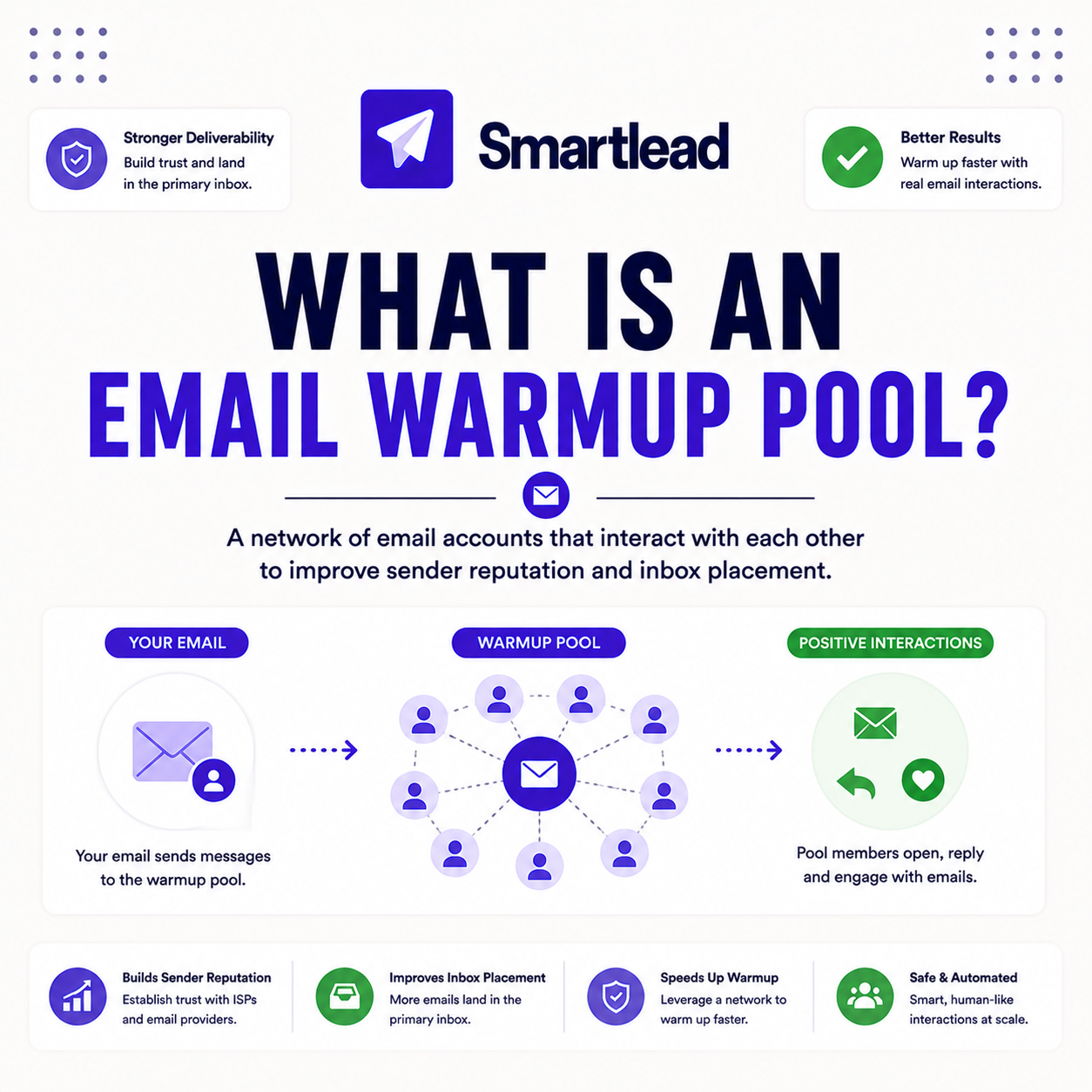
An email warmup pool is a private network of mailboxes that exchange and positively interact with each other’s emails to build sender reputation before real cold email campaigns begin. This guide explains what a warmup pool is, how it works, why it builds reputation, what makes a good one, how it differs from manual warmup, and how to use it safely.
An email warmup pool is a private network of mailboxes that interact to build reputation before real sends.
Best for: any new mailbox or domain before its first campaign.
Caveat: a low-quality pool can associate a mailbox with bad senders.
Bottom line: pool quality decides whether warmup helps or hurts.
Put this into practice. Try Smartlead free for 14 days.
Start Smartlead Free Trial →Unlimited mailboxes · no credit card · 14-day trial
What Is an Email Warmup Pool?
An email warmup pool is a private, reward-based network of mailboxes that send and positively interact with each other’s messages, so each account builds a track record of good engagement. The interactions simulate the behavior of real, trusted correspondence. The deciding factor is that the pool creates positive signals a new mailbox has no other way to earn. The list below covers the core idea.
- Private network: a set of participating mailboxes that exchange warmup messages with each other.
- Positive signals: pool emails are opened, replied to and rescued from spam to build reputation.
- Automated exchange: the platform sends and receives warmup mail without manual effort.
- Reputation building: the track record of engagement is what earns inbox trust over time.
- Pre-campaign only: the pool runs before and alongside real sends, not as the campaign itself.
“A warmup pool earns the engagement history a new mailbox needs before it can reach the inbox.”
— Growth Hack Suite
How Does a Warmup Pool Work?
In it, a mailbox sends warmup messages to other pool accounts and receives theirs, with each side opening, replying and marking messages as important. Volume ramps gradually so the pattern looks organic. The deciding factor is that the pool automates the exchange of positive signals at scale. The list below covers the mechanism.
- Send and receive: the mailbox exchanges warmup messages with other accounts in the pool.
- Positive actions: pool accounts open, reply to and mark the mail as important automatically.
- Spam rescue: warmup mail landing in spam is moved back, which trains the filter over time.
- Gradual ramp: volume rises slowly so the sending pattern looks natural, not sudden.
- Runs automatically: the platform handles the whole exchange without manual sending.
“Engagement signals like opens and replies are what build a sender’s inbox reputation over time.”
— HubSpot, on sender reputation
Why Does a Warmup Pool Build Reputation?
It builds reputation because providers weigh engagement: emails that get opened, answered and kept out of spam signal a trustworthy sender. The pool manufactures that engagement history safely. The deciding factor is that reputation is earned through positive interactions, which the pool supplies. The list below covers why it works.
- Providers weigh engagement: opens, replies and non-spam placement all signal a good sender.
- History from nothing: a new mailbox has no track record, and the pool creates one safely.
- Consistent positive pattern: steady good interactions teach filters to trust the mailbox.
- Spam recovery counts: moving mail out of spam is a strong trust signal to providers.
- Foundation for sending: the reputation built is what lets real campaigns reach the inbox.
What Makes a Good Warmup Pool?
A good one uses real, reputable accounts, varied interaction patterns and gradual ramping, rather than a mass of spammy accounts firing identical messages. Quality is what separates a pool that helps from one that hurts. The deciding factor is the reputation of the accounts in the pool. The table below compares the markers of pool quality.
Source: warmup pool quality markers from standard cold email practice, mid-2026. Directional, not a measured benchmark.
How Is a Warmup Pool Different From Manual Warmup?
It automates what manual warmup does by hand: sending small volumes, getting replies and building a positive history, but across a whole network at scale. Manual warmup is slow and hard to sustain. The deciding factor is that the pool delivers consistent, scalable engagement no manual effort can match. The honest read is that automated pool warmup is why warming many mailboxes is even practical.
The practical point is that a pool runs continuously across every mailbox, while manual warmup rarely lasts long enough or scales far enough to matter.
Does Smartlead Use a Warmup Pool?
Yes, Smartlead runs its warmup through a private pool, included free on the higher Unlimited tiers and available as a paid add-on on the lower Base and Pro plans. Whether it costs extra depends on the plan, so confirm the current terms on the pricing page. The deciding factor is that pool warmup on unlimited mailboxes is a major saving on the tiers that include it. The table below positions it against a typical rival.
Source: Smartlead warmup positioning, mid-2026. Plan inclusion and pricing change; verify current terms on smartlead.ai.
Can a Warmup Pool Hurt You?
A low-quality pool of spammy accounts can associate a mailbox with bad senders, so pool quality matters as much as using one at all. The wrong pool teaches filters the wrong lesson. The deciding factor is the reputation of the accounts a mailbox is grouped with. The honest read is that a reputable pool helps, while a cheap or spammy one can quietly damage deliverability.
The practical guidance is to use a warmup pool from a reputable platform, since the quality of the network is what determines whether it builds or breaks reputation.
Want a reputable warmup pool? Test Smartlead free for 14 days.
Start Smartlead Free Trial →No credit card · unlimited mailboxes
How Do You Use a Warmup Pool Effectively?
Use it by enabling warmup on every new mailbox, letting the pool run one to two weeks before real sends, and keeping it active alongside campaigns. Consistency is what makes the pool pay off. The ordered steps below make pool warmup effective.
- Enable on new mailboxes: turn warmup on for each mailbox the moment it connects.
- Run one to two weeks: let the pool build reputation before any real campaign sends.
- Keep it active: leave warmup running alongside campaigns to maintain reputation.
- Ramp real volume slowly: increase campaign sends gradually rather than all at once.
- Watch the signals: monitor warmup interaction rates and pause if they weaken.
Who Gets the Most Value From a Warmup Pool?
Agencies and scale senders get the most value, since it compounds across many mailboxes and clients. A solo sender still needs it for any new mailbox, but the payoff grows with the number of accounts to warm. The deciding factor is how many mailboxes rely on the pool. The honest read is that the more mailboxes a sender runs, the more automated pool warmup pays back.
The practical point is that the pool is essential at any size, but the operational saving from automated warmup is largest for agencies and high-volume teams.
How Do You Get Started Today?
Start on the 14-day free trial, connect a mailbox, enable warmup and let the pool run while you verify a small list. Beginning warmup on day one means the mailbox is closer to ready by the trial’s end. The trial needs no card, so the only cost is the warmup time. By the end of the window, the mailbox is ready for a careful first send.
How Long Should You Run a Warmup Pool?
Run a warmup pool for one to two weeks on a new mailbox before real sends, and keep it active afterward to sustain reputation. The initial window builds the base; the ongoing run maintains it. The deciding factor is that reputation needs maintenance, not just a one-time build. The honest read is that turning the pool off after launch slowly erodes the gains it created.
The practical guidance is to leave the pool running permanently, so every mailbox keeps a steady base of positive interactions while it sends campaigns.
Is a Warmup Pool Safe to Use?
A reputable warmup pool is safe and is standard practice for cold email, since it simulates the normal engagement a healthy mailbox earns. The risk comes only from low-quality pools of spammy accounts. The deciding factor is the quality of the pool, not the concept of warming itself. The honest read is that pool warmup from a trusted platform is both safe and expected in modern cold email.
“Email deliverability is the ability to deliver emails to subscribers’ inboxes.”
— Wikipedia, Email deliverability
Email Warmup Pool: The Final Verdict
The final verdict is that an email warmup pool is the engine that builds sender reputation before real cold email: a private network of mailboxes exchanging positive signals so a new account earns inbox trust. Pool quality is everything, so use a reputable one, run it one to two weeks before sending, and keep it active. Done right, it is the foundation every campaign stands on.
Growth Hack Suite Editorial — Outbound Tools Team
This guide explains email warmup pools based on standard cold email deliverability practice plus hands-on testing of Smartlead’s warmup. Warmup timing varies by provider, and plan inclusion changes; warmup is included on the higher Unlimited tiers and is an add-on on lower plans. Verify current terms on smartlead.ai. We review outbound tools for B2B senders.
Last updated: June 2026. Confirm current warmup behavior and plan inclusion on smartlead.ai.
Affiliate disclosure: this page contains affiliate links. If you start a plan through them, Growth Hack Suite may earn a commission at no extra cost to you. It does not change our guidance.
Build reputation with a warmup pool. Start Smartlead free for 14 days.
Start Smartlead Free Trial →Unlimited mailboxes · no credit card · cancel anytime
Related Tools in the Outbound Stack
Two other tools in the Growth Hack Suite stack pair with a warmup pool before sending.
- Hunter Email Verifier: verifying lists protects the reputation the pool builds from bounce damage — see verifier accuracy.
- GMass: the Gmail-native option for a sender warming a single Gmail mailbox — read the GMass review.
- Gmail tools comparison: the Gmail-scoped breakdown for senders weighing platform versus extension — compare the Gmail tools.
Email Warmup Pool FAQ
The 12 most-asked questions about email warmup pools.
What is an email warmup pool?
An email warmup pool is a private, reward-based network of mailboxes that send and positively interact with each other’s messages to build sender reputation before real cold email campaigns begin.
How does an email warmup pool work?
Your mailbox sends warmup messages to other pool accounts and receives theirs, with each side opening, replying and rescuing mail from spam. Volume ramps gradually so the pattern looks organic.
Why does a warmup pool build reputation?
Providers weigh engagement, so emails that get opened, answered and kept out of spam signal a trustworthy sender. The pool manufactures that positive engagement history safely for a new mailbox.
What makes a good warmup pool?
Real, reputable accounts, varied interaction patterns and gradual ramping, rather than a mass of spammy accounts firing identical messages. The reputation of the pool accounts is what matters most.
How is a warmup pool different from manual warmup?
It automates what manual warmup does by hand: sending small volumes, getting replies and building history, but across a whole network at scale. Manual warmup is slow and hard to sustain.
Does Smartlead use a warmup pool?
Yes, Smartlead runs its warmup through a private pool, included on the higher Unlimited tiers and available as a paid add-on on lower plans. Confirm the current plan terms on smartlead.ai.
Can a warmup pool hurt my deliverability?
A low-quality pool of spammy accounts can associate your mailbox with bad senders, so pool quality matters. A reputable pool helps, while a cheap or spammy one can quietly damage deliverability.
How long should I run a warmup pool?
Run it one to two weeks on a new mailbox before real sends, and keep it active afterward to sustain reputation. The initial window builds the base and the ongoing run maintains it.
Is a warmup pool safe to use?
A reputable warmup pool is safe and is standard practice for cold email, since it simulates the normal engagement a healthy mailbox earns. The risk comes only from low-quality, spammy pools.
Does a warmup pool guarantee inbox placement?
No, it builds reputation, but you still need authentication, a verified list and sensible volume. It is necessary for placement but not sufficient on its own; the other steps still matter.
How many emails does a warmup pool send?
A warmup pool ramps volume gradually, starting low and increasing daily warmup sends over time. The gradual ramp is what keeps the sending pattern looking natural to providers.
Is the warmup pool free in Smartlead?
The warmup pool is included free on the higher Unlimited tiers and is a paid add-on on the lower Base and Pro plans, so it depends on the plan. Confirm the current terms on smartlead.ai.