
Table of Contents
Email warmup time is one to two weeks for most mailboxes, longer for stricter providers or fresh domains, because sender reputation is built through steady positive engagement over time. This guide explains the typical timeline, why it takes that long, what changes it, how to tell a mailbox is ready, and how to plan around the warmup window.
Warm up an email account for one to two weeks before real sends, longer for fresh domains or strict providers.
Best for: planning a launch date around the warmup window.
Caveat: a brand-new domain needs closer to two weeks or more.
Bottom line: reputation is built over time and cannot be safely rushed.
Put this into practice. Try Smartlead free for 14 days.
Start Smartlead Free Trial →Unlimited mailboxes · no credit card · 14-day trial
How Long Should You Warm Up an Email Account?
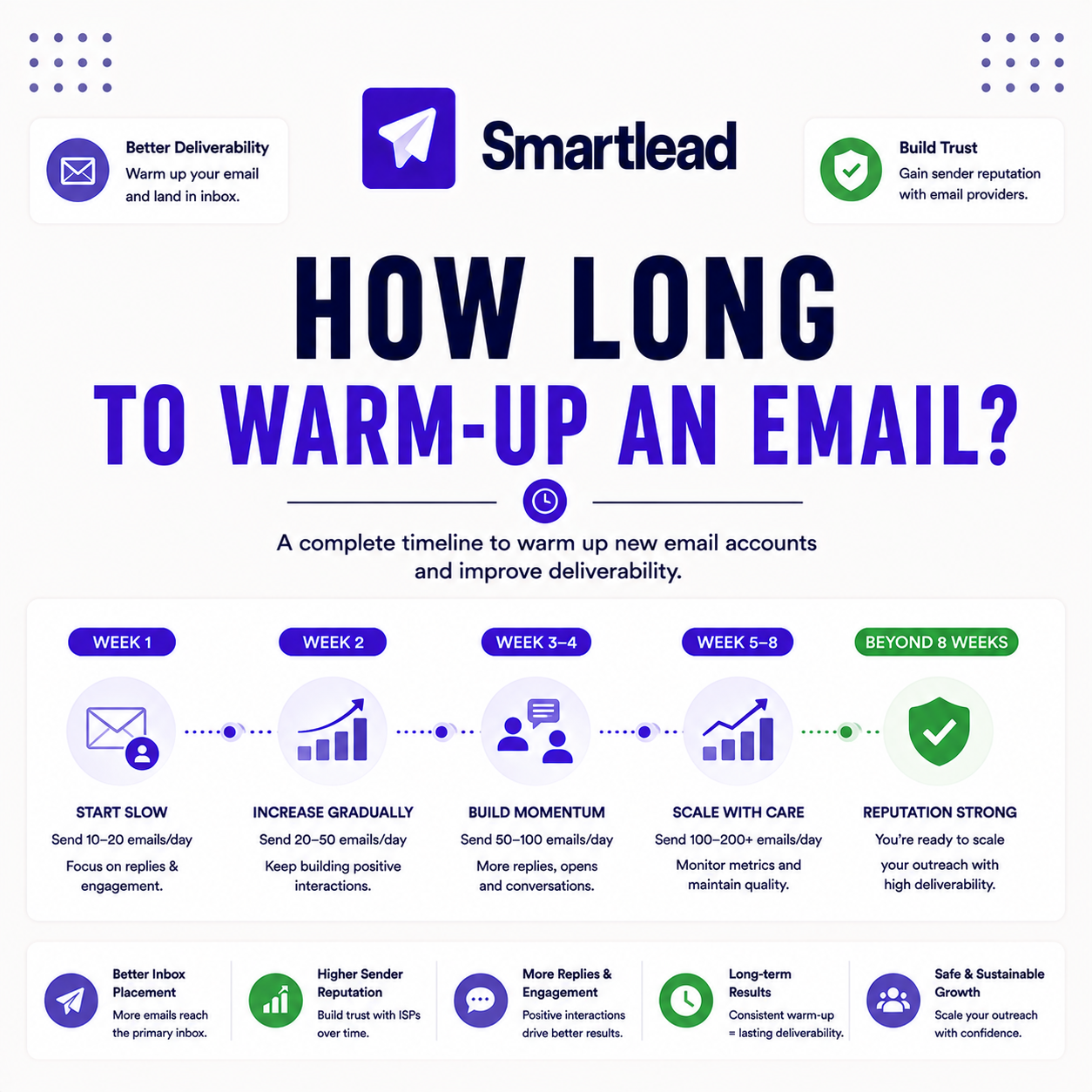
Answering how long to warm up email account: at least one to two weeks before sending real cold email, with fresh domains and strict providers needing the longer end or more. The window gives providers time to build trust. The deciding factor is that reputation forms gradually, not overnight. The list below sets the timeline.
- Typical window: one to two weeks covers most established sending domains and mailboxes.
- Fresh domain: a brand-new domain needs closer to two weeks or more before real sends.
- Strict providers: mailboxes at strict corporate filters warm more slowly and need extra time.
- Higher volume goals: planning for high daily sends calls for a longer, more careful ramp.
- Signals over calendar: readiness comes from stable engagement, not a fixed number of days alone.
“Give warmup one to two weeks, because reputation earned slowly is what actually reaches the inbox.”
— Growth Hack Suite, on warmup timing
Why Does Warmup Take That Long?
Warmup duration runs one to two weeks because providers build trust over repeated positive interactions, not instantly. A mailbox needs a consistent history of good engagement before filters treat it as safe. The deciding factor is that trust accrues gradually with each day of positive signals. The list below covers why the window exists.
- Trust accrues slowly: providers weigh a pattern of behavior, not a single day of activity.
- Consistent history: filters want steady positive engagement before trusting a mailbox.
- Gradual volume: warmup ramps sends slowly so the pattern never looks like a sudden blast.
- No instant reputation: there is no way to buy or shortcut a trusted sending history.
- Window protects launch: the full window is what keeps the first real campaign out of spam.
“Providers build trust in a new sender gradually, so warmup cannot be safely rushed.”
— HubSpot, on sender warmup
What Changes the Warmup Timeline?
For how long does email warmup take, the timeline lengthens for brand-new domains, strict providers like some corporate filters, and higher target volumes, while an established domain with history warms faster. Each factor shifts the window up or down. The deciding factor is the mailbox’s starting reputation and the volume it must reach. The table below maps the factors to their effect.
Source: warmup timeline factors from standard cold email practice, mid-2026. Directional, actual timing varies by mailbox and provider.
How Do You Know a Mailbox Is Ready?
On the email warmup timeline, a mailbox is ready when warmup has run one to two weeks with strong, stable engagement and few messages landing in spam. Readiness is about the signals, not just the calendar. The deciding factor is a consistent, healthy warmup trend over several days. The list below covers the readiness markers.
- Stable engagement: warmup opens and replies hold steady or improve over the window.
- Low spam rate: warmup mail mostly lands in the inbox rather than the spam folder.
- Held for days: the healthy trend persists for several days, not just one good day.
- Full window done: at least one to two weeks of warmup have actually elapsed.
- Weak signals mean wait: unstable or poor signals mean the mailbox needs more time.
Can You Warm Up Faster?
You cannot safely shortcut warmup, since rushing it triggers spam filters on a new account. Some signals improve within days, but the full window is what protects the first real campaign. The deciding factor is that trust cannot be forced faster than providers grant it. The honest read is that any “instant warmup” claim is a shortcut that risks the mailbox.
Source: warmup automation positioning, mid-2026. Verify current features and plan inclusion on smartlead.ai.
Planning a launch? Test Smartlead free for 14 days.
Start Smartlead Free Trial →No credit card · unlimited mailboxes
Should You Keep Warming After You Start Sending?
Yes, once you warm up email before sending, keep warmup running alongside campaigns, especially on newer domains, so real sending does not erode the reputation warmup built. Ongoing warmup maintains the base. The deciding factor is that reputation needs upkeep, not a one-time build. The honest read is that turning warmup off right after launch slowly undoes the gains.
The practical guidance is to leave a baseline of warmup running permanently, so every mailbox keeps a steady stream of positive interactions while it sends.
Does Domain Age Affect Warmup Time?
Yes, an older domain with sending history warms faster than a brand-new one, which has zero reputation to build on. Age gives a head start, but it is not a substitute for warmup. The deciding factor is the domain’s existing sending reputation. The honest read is that even an aged domain still needs warmup, just often a shorter window.
The practical point is to allow the longer window for any brand-new domain and a shorter one for an established domain, but never to skip warmup entirely.
How Do You Plan Around the Warmup Window?
Plan by setting up mailboxes one to two weeks before you need to send, so warmup finishes by the launch date rather than delaying it. Building the window into the schedule is what avoids a rushed, risky start. The ordered steps below make planning around warmup simple.
- Set up mailboxes early: connect and authenticate one to two weeks before the target launch.
- Warm one to two weeks: run warmup for the full window before any real send.
- Verify the list meanwhile: clean the target list during the warmup window to save time.
- Confirm readiness: check the warmup signals are strong and stable before launching.
- Launch small: start with a limited batch, then ramp volume gradually after launch.
Who Gets the Most Value From Warming Properly?
Agencies and scale senders get the most value, since warming properly compounds across many mailboxes and clients. A solo sender still needs the window for any new mailbox, but the payoff grows with the number of accounts. The deciding factor is how many mailboxes must be warmed. The honest read is that the more mailboxes a sender runs, the more disciplined warmup timing pays back.
The practical point is that the same one-to-two-week window applies at any size, but automating it across many mailboxes matters most for agencies.
How Do You Get Started Today?
Start on the 14-day free trial, connect a mailbox, enable warmup and let it run while you verify a small list. Beginning on day one means the trial itself covers most of the warmup window. The trial needs no card, so the only cost is the warmup time. By the end of the trial, the mailbox is close to ready for a careful first send.
Is One Week of Warmup Enough?
One week is the minimum for some established setups, but one to two weeks is safer, especially for new domains or strict providers. A single week rarely builds enough trust for a fresh mailbox. The deciding factor is the mailbox’s starting reputation. The honest read is that when in doubt, the extra week of warmup is cheap insurance against landing in spam.
The practical guidance is to treat one week as a floor for established domains and two weeks as the target for anything new or sending at higher volume.
How Long to Warm Up a Brand-New Domain?
Allow two weeks or more for a brand-new domain, since it starts with zero reputation and needs the longer window to build trust. Rushing a fresh domain is the fastest route to spam. The deciding factor is that a new domain has no history to lean on. The honest read is that the extra patience on a new domain protects every campaign that follows.
“Email deliverability is the ability to deliver emails to subscribers’ inboxes.”
— Wikipedia, Email deliverability
How Long to Warm Up an Email: The Final Verdict
The final verdict is that how long to warm up an email comes down to one to two weeks for most mailboxes, and two weeks or more for a brand-new domain or a strict provider. Readiness is proven by stable engagement, not a fixed date, and warmup should keep running after launch. Build the window into the plan, and the first campaign lands where it should.
Growth Hack Suite Editorial — Outbound Tools Team
This guide explains warmup timing based on standard cold email deliverability practice plus hands-on testing of Smartlead’s warmup. Warmup timing is directional and varies by provider and domain age; verify current features on smartlead.ai. We review outbound tools for B2B senders.
Last updated: June 2026. Confirm current warmup behavior on smartlead.ai.
Affiliate disclosure: this page contains affiliate links. If you start a plan through them, Growth Hack Suite may earn a commission at no extra cost to you. It does not change our guidance.
Warm up right, launch on time. Start Smartlead free for 14 days.
Start Smartlead Free Trial →Unlimited mailboxes · no credit card · cancel anytime
Related Tools in the Outbound Stack
Two other tools in the Growth Hack Suite stack pair with warmup before sending.
- Hunter Email Verifier: verifying lists protects the reputation warmup builds from bounce damage — see verifier accuracy.
- GMass: the Gmail-native option for a sender warming a single Gmail mailbox — read the GMass review.
- Gmail tools comparison: the Gmail-scoped breakdown for senders weighing platform versus extension — compare the Gmail tools.
Email Warmup Time FAQ
The 12 most-asked questions about how long to warm up an email.
How long should I warm up an email account?
One to two weeks before sending real cold email, with fresh domains and strict providers needing the longer end or more. Readiness comes from stable engagement, not just a fixed number of days.
Why does email warmup take so long?
Providers build trust over repeated positive interactions, not instantly. A mailbox needs a consistent history of good engagement before filters treat it as safe, and that history accrues gradually.
Can I warm up an email faster?
Not safely, since rushing triggers spam filters on a new account. Some signals improve within days, but the full one-to-two-week window is what protects the first real campaign.
How do I know a mailbox is ready to send?
When warmup has run one to two weeks with strong, stable engagement and few messages landing in spam. Readiness is about the signals holding steady for several days, not just the calendar.
What changes the warmup timeline?
Brand-new domains, strict providers and higher target volumes all lengthen it. An established domain with existing sending history warms faster than a fresh one with no reputation.
Should I keep warming after I start sending?
Yes, keep warmup running alongside campaigns, especially on newer domains, so real sending does not erode the reputation warmup built. A baseline of warmup maintains the mailbox’s standing.
Does domain age affect warmup time?
Yes, an older domain with sending history warms faster than a brand-new one with zero reputation. Age gives a head start, but even an aged domain still needs a warmup window before real sends.
How do I plan around the warmup window?
Set up mailboxes one to two weeks before you need to send, so warmup finishes by the launch date rather than delaying it. Verify the target list during the window to save time.
Is one week of warmup enough?
One week is the minimum for some established setups, but one to two weeks is safer, especially for new domains or strict providers. When in doubt, the extra week is cheap insurance against spam.
How much can I send right after warmup?
Start with small volumes and ramp gradually across warmed mailboxes. Jumping straight to high volume right after warmup can undo the reputation the window just built.
Does warmup ever end?
Active warmup can taper once a mailbox is established, but keeping a baseline running protects reputation as real sending continues. Many senders leave a low level of warmup on permanently.
How long to warm up a brand-new domain?
Allow two weeks or more for a brand-new domain, since it starts with zero reputation and needs the longer window to build trust. Rushing a fresh domain is the fastest route to spam.