Table of Contents
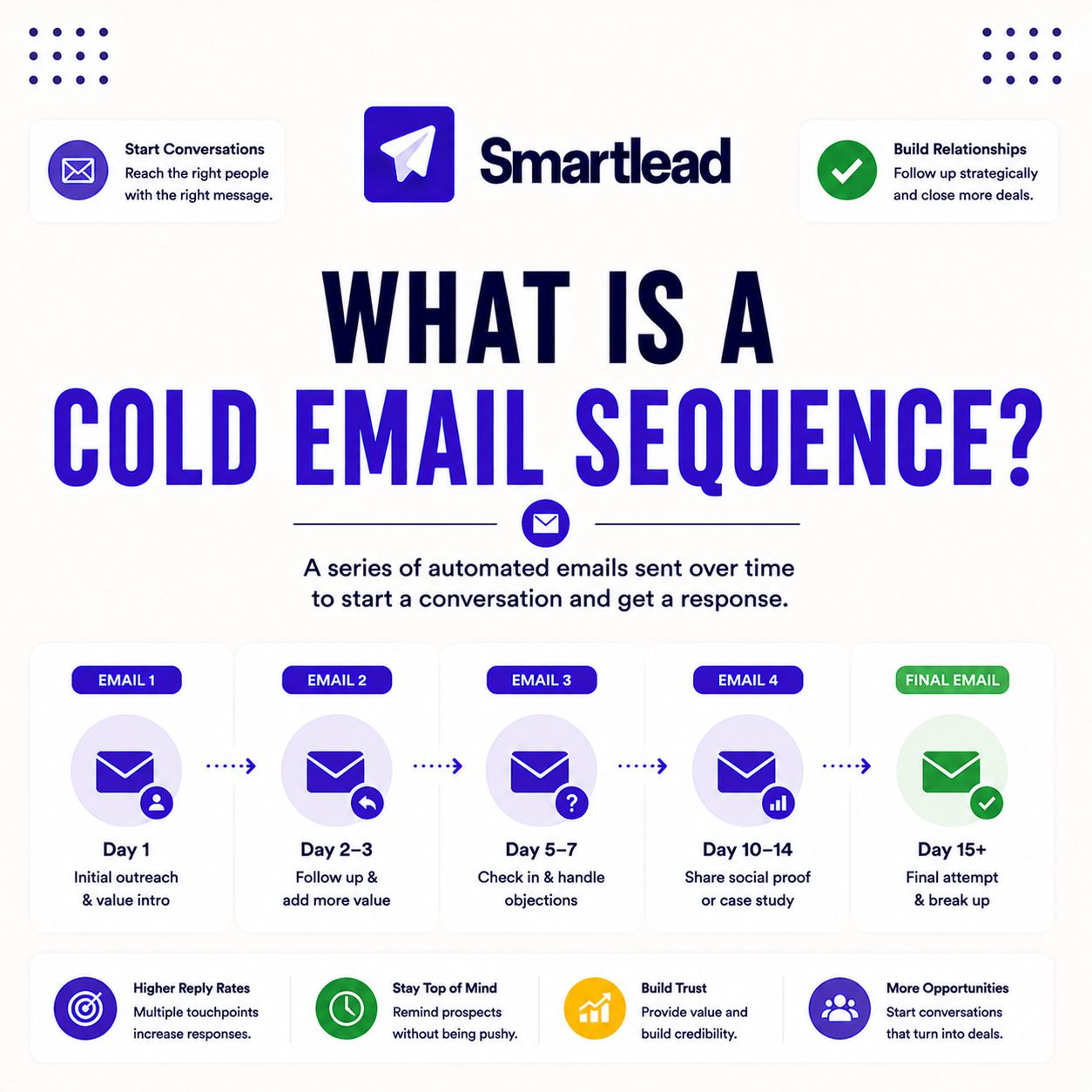
A cold email sequence is a series of automated emails sent to a prospect over time, a first message plus timed follow-ups, that pauses when the prospect replies. This guide explains what a cold email sequence is, how it works, why most replies come from the follow-ups, how many steps to use, how to write one, and how it differs from a cadence.
A cold email sequence is a first email plus timed follow-ups that pauses on reply. Most replies come from the follow-ups.
Best for: agencies and scale senders running persistent outreach.
Caveat: low-volume single senders see a smaller benefit.
Bottom line: the sequence, not the first email, drives replies.
Put this into practice. Try Smartlead free for 14 days.
Start Smartlead Free Trial →Unlimited mailboxes · no credit card · 14-day trial
What Is a Cold Email Sequence?
A cold email sequence is a series of automated emails, a first message and several timed follow-ups, sent to a prospect until they reply or the sequence ends. It automates persistent outreach, which is what turns a single send into a campaign that earns replies. The deciding factor is that the follow-ups, not the opener, do most of the work. The list below covers the parts.
- First email: the opener that introduces the offer and asks for a reply.
- Timed follow-ups: scheduled touches that nudge non-responders over days.
- Auto-pause: the sequence stops the moment a prospect replies.
- Varied angles: each step offers a fresh reason rather than repeating.
- One thread: the steps read as a consistent conversation to the prospect.
“A sequence keeps working after the first send, and the follow-ups are where most replies come from.”
— Growth Hack Suite, on cold email tools
How Does a Cold Email Sequence Work?
A sequence sends each step on a schedule, pausing the moment a prospect replies so they are not over-emailed. The sender sets the steps and timing, and the platform delivers each follow-up automatically, keeping outreach consistent without manual chasing. The deciding factor is that automation makes persistence reliable. The list below covers the flow.
- Setup: a mailbox is connected and authenticated before any sending begins.
- Warmup: the mailbox builds reputation gradually before the first campaign.
- Verify: the list is cleaned to protect placement and cut bounces.
- Schedule: each step goes out on its set delay from the previous one.
- Pause on reply: a response stops the remaining steps automatically.
“The fortune is in the follow-up, where most conversions in outreach actually happen.”
— HubSpot, on follow-up
Why Do Most Replies Come From Follow-Ups?
Most replies come from follow-ups because the first email is often missed or deprioritized, while a polite second or third touch catches the prospect at a better time. Reply rate typically rises across the first few follow-ups before tapering. The deciding factor is timing, not persistence for its own sake. The list below covers why.
- Missed opener: the first email is easy to overlook in a busy inbox.
- Better timing: a later touch may land when the prospect has a moment.
- Rising then tapering: replies climb over early follow-ups, then level off.
- Signal of intent: a considered follow-up shows the outreach is deliberate.
- Pairs with basics: follow-ups work best alongside warmup and verification.
How Many Steps Should a Sequence Have?
A typical sequence has three to five steps, enough to lift replies without becoming spammy. Beyond that, returns drop and annoyance rises, so a short, well-spaced sequence usually outperforms a long, aggressive one. The deciding factor is diminishing returns after a handful of touches. The list below covers the shape.
- Three to five steps: the sweet spot that lifts replies without fatigue.
- Spaced timing: steps sit two to four business days apart, not back to back.
- Varied angle: each touch brings a new reason rather than a repeat.
- Diminishing returns: extra steps past five add annoyance more than replies.
- Clean exit: a final step closes the loop politely if no reply comes.
How Should You Space the Steps?
Space steps two to four business days apart, persistent without being annoying. Too close looks aggressive and risks complaints, while too far apart loses momentum, so a steady cadence over a short window works best. The deciding factor is a rhythm that stays present without crowding. The table below positions the feature against a typical rival.
Source: vendor sites plus internal review, mid-2026. Verify current features on smartlead.ai.
How Do You Write a Good Sequence?
Write a short opener with a clear ask, then follow-ups that add value or a new angle rather than repeating the first email. Each step should stand alone, since a prospect may only read one. The ordered steps below make a strong sequence repeatable.
- Clear opener: a short first email states the offer and one specific ask.
- Value-add follow-ups: each later step brings proof, a case or a new angle.
- Vary the angle: no step simply repeats the opener in different words.
- One CTA throughout: the same clear call to action runs across all steps.
- Stand-alone steps: each email makes sense even if the others went unread.
Ready to build a sequence? Test Smartlead free for 14 days.
Start Smartlead Free Trial →No credit card · unlimited mailboxes
What Is the Difference Between a Sequence and a Cadence?
A sequence usually means a series of emails, while a cadence often spans channels, email, calls and social. A cadence is the broader multichannel plan, and an email sequence is the email portion of it. The deciding factor is scope: one channel versus several. The table below draws the distinction.
Source: standard outreach terminology, mid-2026. Directional, not a measured benchmark.
Does Smartlead Automate Cold Email Sequences?
Yes, Smartlead automates sequences with timed follow-ups, conditional branching and auto-pause on reply. This is core to its value, since automated follow-ups are where most cold email replies come from. The deciding factor is that the platform runs the persistence a sender would otherwise do by hand. The honest read is that sequence automation is the reason to use a dedicated tool at all.
The practical point is that timed, auto-paused follow-ups let a sender stay persistent across many prospects without manual chasing. Verify current features on smartlead.ai.
Who Gets the Most Value From a Cold Email Sequence?
Agencies and scale senders get the most value, since sequences compound across many mailboxes and clients. Low-volume single-account senders see a smaller benefit, so weigh it against actual sending volume before deciding. The deciding factor is how much outreach relies on persistent, repeatable follow-up. The honest read is that the more prospects a sender works, the more a sequence pays back.
The practical point is that even a solo sender benefits from automated follow-ups, while agencies gain most across their client and mailbox volume.
How Do You Get Started Today?
Start on the 14-day free trial, connect a mailbox, warm it, verify a small list and run a test sequence. Confirming results on your own domains before committing is the lowest-risk way to begin. The trial needs no card, so the only cost is setup time. By launch, timed follow-ups run automatically and pause on reply.
Does a Sequence Stop When Someone Replies?
Yes, a well-built sequence auto-pauses the moment a prospect replies, so they get no further follow-ups. This keeps the conversation natural and prevents the over-sending that damages reply rates. The deciding factor is that a reply should always end the automation for that prospect. The honest read is that auto-pause is what separates a sequence from a blast.
The practical point is that reply detection stops the remaining steps automatically, so a prospect who answers never gets a redundant chase.
Can You Personalize Each Step of a Sequence?
Yes, sequences support personalization fields and spintax so each step feels tailored rather than mass-sent. Personalized, varied follow-ups lift replies while keeping the sending pattern natural for deliverability. The deciding factor is that tailoring makes persistence feel like a conversation, not a blast. The honest read is that personalization is what keeps a multi-step sequence from reading as spam.
“Email marketing is sending a commercial message to a group using email.”
— Wikipedia, Email marketing
Cold Email Sequence: The Final Verdict
The final verdict is that a cold email sequence, a first email plus timed follow-ups that pauses on reply, is what turns outreach into pipeline. Most replies come from the follow-ups, so the sequence, not the opener, does the work. Keep it to three to five well-spaced steps with varied angles and one clear call to action, and let automation handle the persistence.
Growth Hack Suite Editorial — Outbound Tools Team
This guide explains cold email sequences based on standard outreach practice plus hands-on testing of Smartlead. Behavior varies; verify current features on smartlead.ai. We review outbound tools for B2B senders.
Last updated: June 2026. Confirm current sequence features on smartlead.ai.
Affiliate disclosure: this page contains affiliate links. If you start a plan through them, Growth Hack Suite may earn a commission at no extra cost to you. It does not change our guidance.
Build a sequence that earns replies. Start Smartlead free for 14 days.
Start Smartlead Free Trial →Unlimited mailboxes · no credit card · cancel anytime
Related Tools in the Outbound Stack
Two other tools in the Growth Hack Suite stack pair with a cold email sequence.
- Hunter Email Verifier: verifying the list before a sequence protects deliverability and cuts bounces — see verifier accuracy.
- GMass: the Gmail-native option for a sender running sequences from Gmail — read the GMass review.
- Gmail tools comparison: the Gmail-scoped breakdown for senders weighing platform versus extension — compare the Gmail tools.
Cold Email Sequence FAQ
The 12 most-asked questions about cold email sequences.
What is a cold email sequence?
A cold email sequence is a series of automated emails, a first message and several timed follow-ups, sent until a prospect replies or the sequence ends. It automates persistent outreach, turning a single send into a campaign that earns replies.
How does a cold email sequence work?
It sends each step on a schedule, pausing the moment a prospect replies. The sender sets the steps and timing, and the platform delivers each follow-up automatically, keeping outreach consistent without manual chasing.
Why do most replies come from follow-ups?
The first email is often missed or deprioritized, while a polite second or third touch catches the prospect at a better time. Reply rate typically rises across the first few follow-ups before tapering.
How many steps should a cold email sequence have?
Three to five, enough to lift replies without becoming spammy. Beyond that, returns drop and annoyance rises, so a short, well-spaced sequence usually outperforms a long, aggressive one.
How should I space the steps in a sequence?
Two to four business days apart, persistent without being annoying. Too close looks aggressive and risks complaints, while too far apart loses momentum, so a steady cadence over a short window works best.
How do I write a good cold email sequence?
Write a short opener with a clear ask, then follow-ups that add value or a new angle rather than repeating it. Each step should stand alone, with one clear call to action running through all of them.
What is the difference between a sequence and a cadence?
A sequence usually means a series of emails, while a cadence often spans channels, email, calls and social. A cadence is the broader multichannel plan, and an email sequence is the email portion.
Does Smartlead automate cold email sequences?
Yes, Smartlead automates sequences with timed follow-ups, conditional branching and auto-pause on reply. This is core to its value, since automated follow-ups are where most cold email replies come from.
Does a sequence stop when someone replies?
Yes, a well-built sequence auto-pauses the moment a prospect replies, so they do not get further follow-ups. This keeps the conversation natural and prevents the over-sending that damages reply rates.
Can I personalize each step of a sequence?
Yes, sequences support personalization fields and spintax so each step feels tailored. Personalized, varied follow-ups lift replies while keeping the sending pattern natural for deliverability.
How long should a cold email sequence run?
Usually one to three weeks across three to five steps. Long enough to catch prospects at different moments, short enough to avoid fatigue, with auto-pause ending it early when someone replies.
What makes a follow-up effective?
A new angle or value, not a repeat of the first email, plus a clear and easy call to action. Effective follow-ups respect the prospect’s time while giving a fresh reason to reply.