Table of Contents
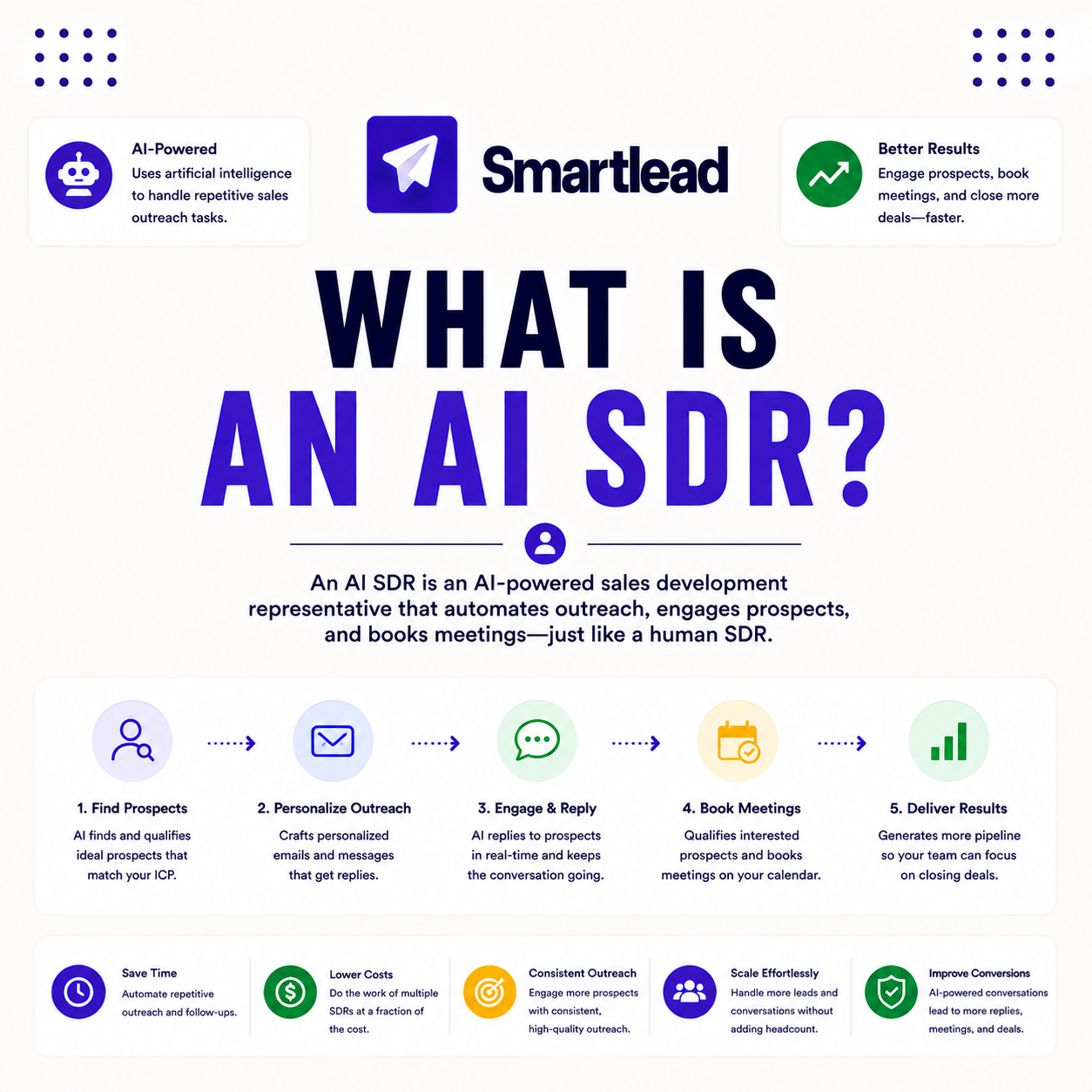
An AI SDR is software that automates the repetitive work of a sales development representative, researching leads, drafting outreach, sending sequences and classifying replies, while a human keeps offer and strategy. This guide explains what it is, how it works, whether it can replace a human, its economics, where a person is still needed, and how to deploy one.
This kind of software automates lead
Best for: teams scaling output without adding headcount.
Caveat: a human is still needed for offer, positioning and judgment.
Bottom line: AI handles volume, a person handles strategy.
Put this into practice. Try Smartlead free for 14 days.
Start Smartlead Free Trial →Unlimited mailboxes · no credit card · 14-day trial
What Is an AI SDR?
An AI SDR is software that automates the repetitive work of a sales development representative: researching leads, drafting outreach, sending sequences and classifying replies. It handles volume so a human can focus on strategy. The deciding factor is that the AI takes the repetitive tasks, not the judgment. The list below covers what it does.
- Researches leads: the AI enriches and qualifies prospects automatically.
- Drafts outreach: it generates personalized copy for each prospect.
- Runs sequences: it sends timed follow-ups without manual chasing.
- Triages replies: it tags responses so hot leads surface first.
- Frees the human: a person is left to handle offer and judgment.
“AI handles the volume of outbound, but a person still owns the offer and the judgment.”
— Growth Hack Suite, on cold email tools
How Does an AI SDR Work?
It works by chaining AI steps: pulling lead data, generating tailored emails, running sequences, and tagging replies so hot leads surface. A human reviews output and handles strategy. The deciding factor is that the AI runs an end-to-end pipeline under human oversight. The list below covers the flow.
- Pull lead data: the AI gathers and enriches prospect information.
- Generate emails: it drafts tailored copy for each contact.
- Run sequences: timed follow-ups go out and pause on reply.
- Tag replies: responses are classified so hot leads rise to the top.
- Human oversight: a person reviews output and owns strategy.
“AI augments sales teams best when it handles volume and leaves judgment to people.”
— HubSpot, on AI in sales
Can an AI SDR Replace a Human SDR?
Not fully. It handles top-of-funnel volume well but still needs a human for offer, positioning, strategy and nuanced replies. It reduces workload rather than eliminating the role. The deciding factor is that AI is strong on volume and weak on judgment. The table below shows the split.
Source: standard view of AI-in-outbound roles, mid-2026. Directional, not a measured benchmark.
What Are the Economics of an AI SDR?
The economics shift because one operator with this kind of tool can do work that once needed several reps, lowering cost per booked meeting. The saving comes from automating repetitive tasks, not from replacing judgment. The deciding factor is that productivity per operator rises. The table below frames the qualitative trade-off.
Source: directional economics of AI-assisted outbound, mid-2026. Qualitative only — not a measured cost figure.
Where Does an AI SDR Still Need a Human?
It needs a human for offer and positioning, ambiguous or high-stakes replies, and targeting strategy. AI is strong on volume and weak on judgment, so a person stays in the loop. The deciding factor is that decisions requiring context belong to a human. The list below covers where.
- Offer and positioning: the value proposition is human-led.
- Ambiguous replies: nuanced or high-stakes responses need review.
- Targeting strategy: deciding who to reach stays with a person.
- Brand judgment: tone and edge cases require human sign-off.
- Escalations: anything sensitive routes to a human quickly.
How Do You Deploy an AI SDR?
Deploy it by starting on lower-risk tasks like research and reply triage, reviewing output, then expanding to drafting as trust builds. Beginning with volume tasks lets quality be measured before wider rollout. The ordered steps below make deployment repeatable.
- Start with research and triage: begin on lower-risk, high-volume tasks.
- Review output: check quality before trusting the AI with more.
- Expand to drafting: let the AI draft copy once trust is established.
- Keep a human in the loop: a person reviews offer, tone and edge cases.
- Measure and scale: track quality, then widen the AI’s remit.
Want AI agents for outbound? Test Smartlead free for 14 days.
Start Smartlead Free Trial →No credit card · unlimited mailboxes
Is an AI SDR the Same as Marketing Automation?
No, marketing automation runs scheduled or triggered flows to opted-in audiences, while this kind of tool generates and adapts outbound to cold prospects. It reasons and drafts, rather than firing fixed sequences. The deciding factor is generative outbound versus rule-based flows. The table below draws the distinction.
Source: standard outbound terminology, mid-2026. Directional, not a measured benchmark.
Does Smartlead Have an AI SDR?
Yes, Smartlead’s SmartAgents act as AI SDRs, researching leads, drafting copy and classifying replies inside the platform. They reduce SDR workload while a human keeps offer and strategy. The deciding factor is that the AI runs inside the sending platform, not as a separate tool. The honest read is that it assists the team rather than replacing the human owner.
The practical point is to let SmartAgents handle research and triage while a person owns positioning. Verify current features on smartlead.ai.
Who Gets the Most Value From an AI SDR?
Agencies and scale senders get the most value, since an AI SDR compounds across many mailboxes and clients. Teams wanting deep human judgment on every touch gain less. The deciding factor is how much of the work is repetitive volume versus nuanced conversation. The honest read is that the more repetitive top-of-funnel work there is, the more an AI SDR pays back.
The practical point is that a high-volume outbound team gains most, while a low-volume, high-touch team should keep more work human.
How Do You Get Started Today?
Start on the 14-day free trial, connect a mailbox, warm it, verify a small list and let the AI handle research and triage first. Confirming quality on your own campaigns before committing is the lowest-risk way to begin. The trial needs no card, so the only cost is setup time. By launch, the AI runs volume tasks while a person owns strategy.
Is an AI SDR Worth It?
For teams wanting to scale output without adding headcount, it is worth it, since it multiplies one operator’s productivity. For teams needing deep human judgment on every touch, it assists rather than replaces. The deciding factor is whether the bottleneck is volume or judgment. The honest read is that an AI SDR pays off when repetitive volume is the constraint, not human insight.
The practical point is to adopt one when top-of-funnel volume is the limit, and keep more work human when nuance is the constraint.
Will AI SDRs Take SDR Jobs?
This kind of automation shifts human SDRs toward strategy, offer and high-value conversations. Rather than eliminating the role, they tend to raise its ceiling. The deciding factor is that judgment work grows in value as volume work is automated. The honest read is that the role shifts toward higher-skill work rather than disappearing.
“Artificial intelligence is intelligence demonstrated by machines, as opposed to natural intelligence.”
— Wikipedia, Artificial intelligence
AI SDR: The Final Verdict
The final verdict is that this kind of software automates the repetitive parts of sales development, research, drafting, sending and reply triage, so one operator does the work of several. It does not replace a human, who still owns offer, positioning and judgment. Deploy it on volume tasks first, keep a person in the loop, and it multiplies output where repetitive work is the constraint.
Growth Hack Suite Editorial — Outbound Tools Team
This guide explains the concept based on standard outbound practice plus hands-on testing of Smartlead. Behavior varies; verify current features on smartlead.ai. We review outbound tools for B2B senders.
Last updated: June 2026. Economics are directional, not measured figures.
Affiliate disclosure: this page contains affiliate links. If you start a plan through them, Growth Hack Suite may earn a commission at no extra cost to you. It does not change our guidance.
Put AI agents to work on outbound. Start Smartlead free for 14 days.
Start Smartlead Free Trial →Unlimited mailboxes · no credit card · cancel anytime
Related Tools in the Outbound Stack
Two other tools in the Growth Hack Suite stack pair with this kind of setup.
- Hunter Email Verifier: verifying AI-sourced lists protects the deliverability outbound depends on — see verifier accuracy.
- GMass: the Gmail-native option for a solo sender running lighter outreach — read the GMass review.
- Gmail tools comparison: the Gmail-scoped breakdown for senders weighing platform versus extension — compare the Gmail tools.
AI SDR FAQ
The 12 most-asked questions about this topic.
What is an AI SDR?
An AI SDR is software that automates the repetitive work of a sales development representative: researching leads, drafting outreach, sending sequences and classifying replies. It handles volume so a human can focus on strategy.
How does an AI SDR work?
It chains AI steps: pulling lead data, generating tailored emails, running sequences, and tagging replies so hot leads surface. A human reviews output and handles strategy, so the AI runs the pipeline under oversight.
Can an AI SDR replace a human SDR?
Not fully. It handles top-of-funnel volume well but still needs a human for offer, positioning, strategy and nuanced replies. It reduces workload rather than eliminating the role.
What are the economics of an AI SDR?
One operator with this kind of tool can do work that once needed several reps, lowering cost per booked meeting. The saving comes from automating repetitive tasks, not from replacing judgment.
Where does an AI SDR still need a human?
For offer and positioning, ambiguous or high-stakes replies, and targeting strategy. AI is strong on volume and weak on judgment, so the human stays in the loop.
How do I deploy an AI SDR?
Start it on lower-risk tasks like research and reply triage, review output, then expand to drafting as trust builds. Beginning with volume tasks lets quality be measured before wider rollout.
Is an AI SDR the same as marketing automation?
No, marketing automation runs scheduled flows to opted-in audiences, while an AI SDR generates and adapts outbound to cold prospects. The AI SDR reasons and drafts rather than firing fixed sequences.
Does Smartlead have an AI SDR?
Yes, Smartlead’s SmartAgents act as AI SDRs, researching leads, drafting copy and classifying replies inside the platform. They reduce SDR workload while a human keeps offer and strategy.
Is an AI SDR worth it?
For teams wanting to scale output without adding headcount, yes, since it multiplies one operator’s productivity. For teams needing deep human judgment on every touch, it assists rather than replaces.
Do AI SDRs write good cold emails?
They write competent first drafts a human can refine, speeding up campaign creation. The drafts handle structure and personalization, but a human sharpens the offer and tone before sending.
Will AI SDRs take SDR jobs?
They automate repetitive parts of the role, shifting human SDRs toward strategy, offer and high-value conversations. Rather than eliminating the role, they tend to raise its ceiling.
Do AI SDRs need coding to set up?
No, modern AI SDRs like SmartAgents are designed to run without code, configured inside the platform. Technical teams can extend them via API, but no-code setup makes them accessible to most users.