Table of Contents
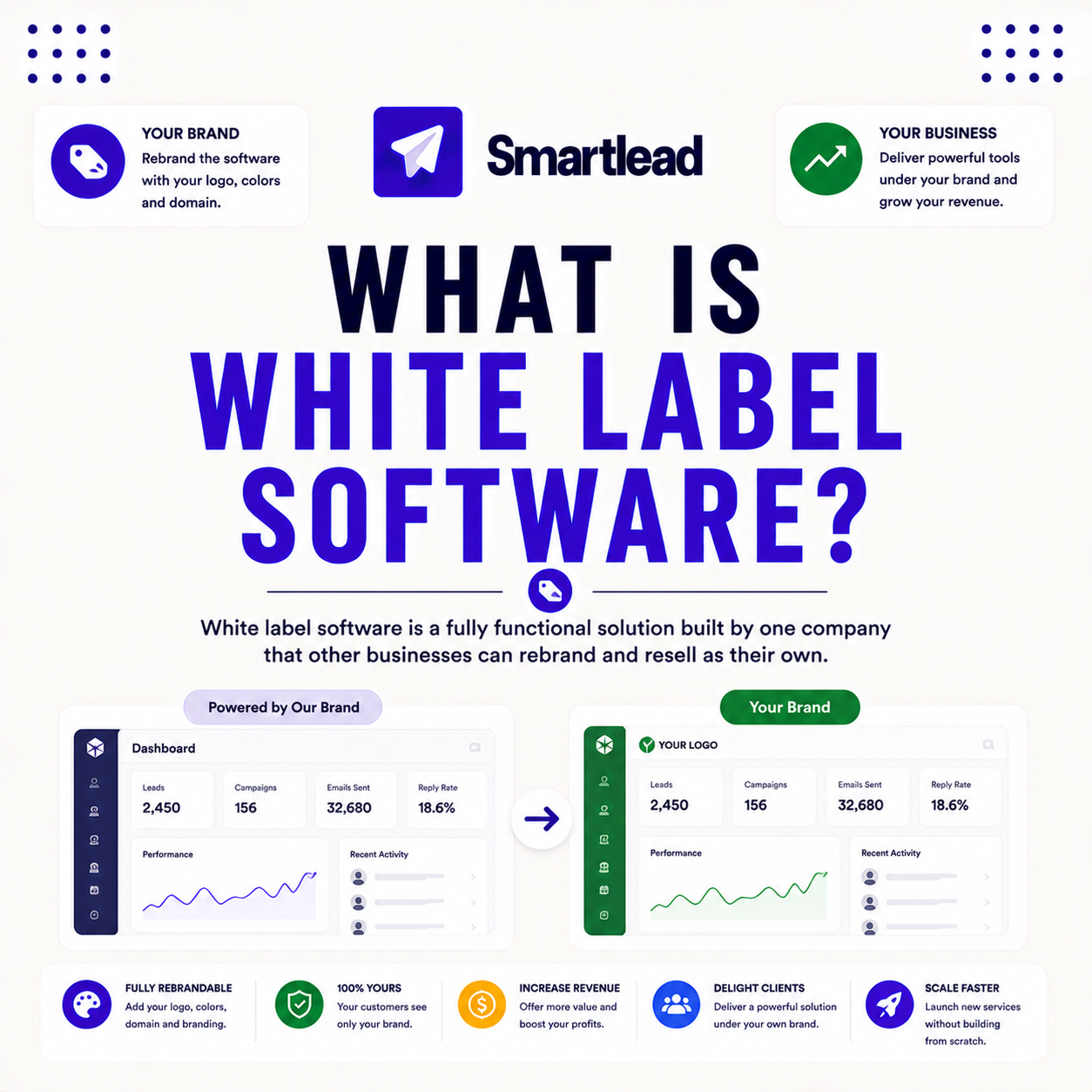
White-label software is a product one company builds and another rebrands as its own, so an agency can offer a tool under its own name, logo and domain without building it. This guide explains what white-label software is, how it works, why agencies use it, how it raises perceived value, how it differs from reselling, and who benefits most.
White-label software is a product one company builds and another rebrands as its own to sell under its brand.
Best for: agencies serving several clients under one brand.
Caveat: a single-client seller gains little from rebranding.
Bottom line: it raises perceived value, pricing and retention.
Put this into practice. Try Smartlead free for 14 days.
Start Smartlead Free Trial →Unlimited mailboxes · no credit card · 14-day trial
What Is White-Label Software?
White-label software is a product developed by one company and rebranded by another to sell as its own. An agency can put its name, logo and domain on the tool. The deciding factor is that the end client sees the agency’s brand, not the vendor’s. The list below covers the parts.
- Built by one, branded by another: the vendor makes it, the agency rebrands it.
- Agency brand: the tool carries the agency’s name, logo and domain.
- Client-facing portal: clients log into a branded interface.
- Vendor stays hidden: the software runs in the background invisibly.
- No build required: the agency offers the capability without engineering.
“White-label lets an agency sell a capability as its own without ever building the software behind it.”
— Growth Hack Suite, on cold email tools
How Does White-Label Software Work?
It works by the vendor providing branding controls, so the agency configures its identity and a client-facing portal. Clients then log into a branded interface while the vendor runs the software. The deciding factor is that branding sits on top of the vendor’s platform. The list below covers the flow.
- Vendor gives controls: branding settings let the agency add its identity.
- Agency configures brand: name, logo and domain are applied.
- Client portal is set up: a branded login is created for clients.
- Clients log in branded: the interface shows only the agency’s brand.
- Vendor runs it silently: the software operates behind the scenes.
“A branded, unified service reads as more professional and proprietary than reselling a tool.”
— HubSpot, on agency services
Why Do Agencies Use White-Label Software?
Agencies use white-label software to offer capabilities without building them, present a unified brand, and capture margin between vendor cost and client price. It productizes a service under one identity. The deciding factor is that it adds a capability and margin without engineering. The list below covers why.
- Offer without building: the capability ships without any development.
- Unified brand: every tool carries the agency’s identity.
- Capture margin: the gap between vendor cost and client price is profit.
- Best for agencies: the value grows with the number of clients served.
- Caveat: a single-client seller sees little benefit from rebranding.
How Does White-Label Raise Perceived Value?
White-label raises perceived value because a branded, integrated service looks more professional and proprietary than reselling. Clients associate the results with the agency, not a third-party vendor. The deciding factor is that ownership of the brand raises what clients will pay. The list below covers how.
- Looks proprietary: the service reads as the agency’s own, not resold.
- Higher pricing: a branded service commands more than a resold tool.
- Stronger retention: clients stay with a brand they associate with results.
- Unified experience: one brand across tools feels more cohesive.
- Ownership of results: outcomes are credited to the agency.
What Is the Difference Between White-Label and Reselling?
Reselling sells the vendor’s branded product as-is, while white-label rebrands it as the reseller’s own. White-label removes the vendor’s brand entirely; reselling keeps it. The deciding factor is whose brand the client sees. The table below draws the distinction.
Source: standard reselling versus white-label distinctions, mid-2026. Directional, not a measured benchmark.
How Do You Use White-Label Software?
Use it by configuring the brand and domain, setting up a client portal, then delivering the service under the agency’s identity. Getting the branding right before onboarding keeps the client experience seamless. The ordered steps below make it repeatable.
- Configure brand and domain: apply the agency name, logo and domain.
- Set up the portal: create the branded client-facing login.
- Onboard clients: bring clients into the branded interface.
- Deliver the service: run campaigns under the agency’s identity.
- Price for value: set client pricing above the vendor cost for margin.
Running a cold email agency? Test Smartlead free for 14 days.
Start Smartlead Free Trial →No credit card · unlimited mailboxes
Who Benefits From White-Label Software?
Agencies, consultants and service providers benefit most, especially those serving several clients who want a branded, productized offering. A single-client operator gains little. The deciding factor is how many clients see the brand. The table below positions the feature against a typical rival.
Source: vendor sites plus internal review, mid-2026. Verify current features on smartlead.ai.
Does Smartlead Offer White-Label Software?
Yes, Smartlead offers white-label so agencies can deliver cold email under their own brand with a client portal. This makes it a fit for agencies productizing outreach. The deciding factor is that branding and sending live in one platform. The honest read is that white-label features often sit on higher tiers, offset by the higher pricing an agency can charge clients.
The practical point is to brand the platform and portal, then deliver client campaigns under the agency name. Verify current features and plan tiers on smartlead.ai.
Who Gets the Most Value From White-Label Software?
Agencies serving several clients get the most value, since white-label raises perceived value, pricing and retention across the client base. A single-client operator gains little. The deciding factor is how many clients experience the brand. The honest read is that the more clients an agency serves, the more white-label pays back.
The practical point is that a multi-client agency gains most, while a solo operator with one client can send unbranded.
How Do You Get Started Today?
Start on the 14-day free trial, connect a mailbox, warm it, verify a small list and see how the branding and portal setup works. Testing the white-label flow on your own agency brand before committing is the lowest-risk way to begin. The trial needs no card, so the only cost is setup time. By launch, clients see the agency’s brand, not the vendor’s.
Can Clients Tell Software Is White-Labeled?
Done well, clients see only the agency’s brand, not the vendor’s. The vendor runs the software in the background, so a properly configured portal reads as the agency’s own product. The deciding factor is how completely the branding is applied. The honest read is that white-label is only seamless when the domain, logo and portal are all configured, leaving no vendor traces.
The practical point is to configure every branding surface, domain, logo and portal, so no vendor branding leaks through to clients.
Is White-Label the Same as SaaS Reselling?
They overlap but differ: SaaS reselling can keep the vendor’s brand, while white-label removes it entirely. White-label is the fuller form of rebranding, presenting the product as the agency’s own. The deciding factor is whether the vendor’s brand survives. The honest read is that all white-label is reselling, but not all reselling is white-label.
“A white-label product is made by one company and rebranded by another to sell.”
— Wikipedia, White-label product
White-Label Software: The Final Verdict
The final verdict is that white-label software is a product one company builds and another rebrands as its own, letting agencies offer a capability under their brand without building it. It raises perceived value, pricing and retention, and pays off most for agencies serving several clients. Configure every branding surface fully, price above vendor cost, and deliver the service as the agency’s own.
Growth Hack Suite Editorial — Outbound Tools Team
This guide explains white-label software based on standard agency practice plus hands-on testing of Smartlead. Behavior and plan tiers vary; verify current features on smartlead.ai. We review outbound tools for B2B senders.
Last updated: June 2026. White-label availability varies by plan tier.
Affiliate disclosure: this page contains affiliate links. If you start a plan through them, Growth Hack Suite may earn a commission at no extra cost to you. It does not change our guidance.
Deliver outreach under your own brand. Start Smartlead free for 14 days.
Start Smartlead Free Trial →Unlimited mailboxes · no credit card · cancel anytime
Related Tools in the Outbound Stack
Two other tools in the Growth Hack Suite stack pair with white-label software.
- Hunter Email Verifier: verifying client lists keeps agency campaigns deliverable — see verifier accuracy.
- GMass: the Gmail-native option for a solo operator running one client — read the GMass review.
- Gmail tools comparison: the Gmail-scoped breakdown for senders weighing platform versus extension — compare the Gmail tools.
White-Label Software FAQ
The 12 most-asked questions about white-label software.
What is white-label software?
White-label software is a product developed by one company and rebranded by another to sell as its own. An agency can put its name, logo and domain on the tool.
How does white-label software work?
The vendor provides branding controls, so the agency configures its identity and a client-facing portal. Clients log into a branded interface while the vendor runs the software behind the scenes.
Why do agencies use white-label software?
To offer capabilities without building them, present a unified brand, and capture margin between vendor cost and client price. It productizes a service under one identity.
How does white-label raise perceived value?
A branded, integrated service looks more professional and proprietary than reselling. Clients associate the results with the agency, not a third-party vendor, which supports higher pricing.
What is the difference between white-label and reselling?
Reselling sells the vendor’s branded product as-is, while white-label rebrands it as the reseller’s own. White-label removes the vendor’s brand entirely; reselling keeps it.
How do I use white-label software?
Configure your brand and domain, set up a client portal, then deliver the service under your identity. Doing this before onboarding keeps the client experience seamless.
Who benefits from white-label software?
Agencies, consultants and service providers, especially those serving several clients who want a branded, productized offering. A single-client operator gains little from rebranding.
Does Smartlead offer white-label software?
Yes, Smartlead offers white-label so agencies deliver cold email under their own brand with a client portal. This makes it a fit for agencies productizing outreach, with features often on higher tiers.
Is white-label software more expensive?
White-label features often align with higher plan tiers, but the cost is offset by higher client pricing and retention. For agencies serving several clients, the margin usually outweighs the tier.
Can clients tell software is white-labeled?
Done well, clients see only the agency’s brand, not the vendor’s. The vendor runs the software in the background, so a properly configured portal reads as the agency’s own product.
Is white-label the same as SaaS reselling?
They overlap but differ: SaaS reselling can keep the vendor’s brand, while white-label removes it entirely. White-label is the fuller form of rebranding, presenting the product as the agency’s own.
Is white-label software worth it for agencies?
For agencies serving several clients, yes, since it raises perceived value, pricing and retention. For a single-client operator, unbranded sending is usually enough.