

Table of Contents
Cache hit ratio is the percentage of requests served from cache rather than your origin server. A high ratio means most content is delivered quickly from cache, reducing origin load and speeding up your site, while a low ratio signals that caching is underused or misconfigured. Monitoring and improving it directly benefits performance, so this guide explains how it works and how to raise it.
Last updated: August 2026. Written by the Growth Hack Suite editorial team, with details cross-checked against provider documentation. This page carries affiliate links to Kinsta.
What Is a Cache Hit Ratio?
A cache hit ratio is the percentage of requests that are served from cache rather than fetched from your origin server. It measures how effectively your caching is working, with a higher ratio meaning more content is delivered quickly from cache and less reaches the origin.
“A cache hit occurs when the requested data can be found in a cache.”
— Wikipedia, Cache (computing)
The ratio simply counts how often those hits happen versus total requests, turning caching effectiveness into a single percentage.
How Is Cache Hit Ratio Calculated?
Cache hit ratio is calculated by dividing the number of cache hits by the total number of requests. If 90 of 100 requests are served from cache, the ratio is 90 percent, expressing how much traffic avoids the origin, so the formula is simply hits divided by total.
The formula is straightforward: it is the share of requests answered from cache, which is why a higher percentage is better.
What Is a Cache Hit vs a Cache Miss?
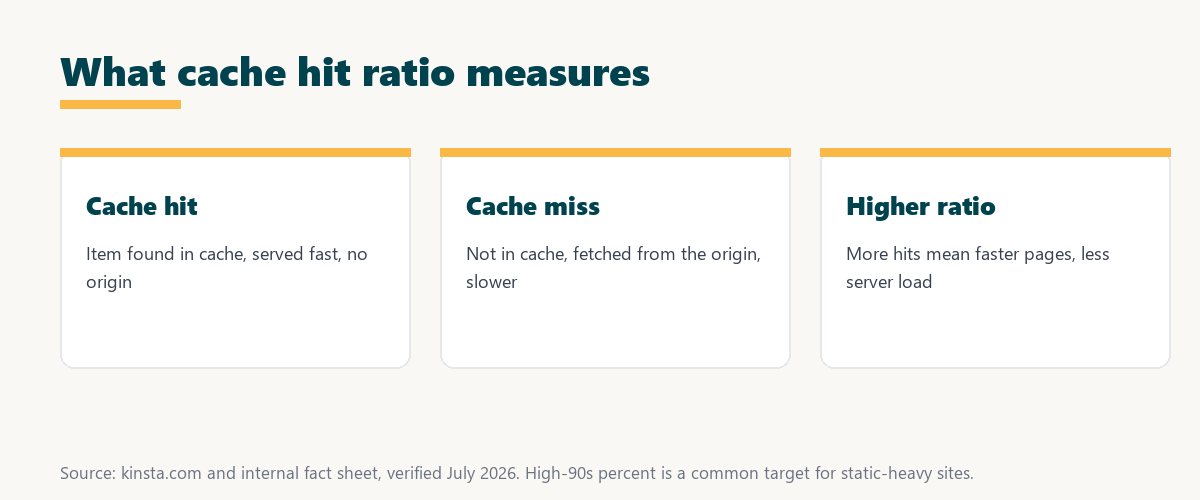
A cache hit is when a requested item is found in the cache and served from it, while a cache miss is when it is not, forcing a fetch from the origin. Hits are fast and misses are slower and add origin load, so the balance between them is what the ratio captures.
Source: provider documentation, verified August 2026. More hits and fewer misses raise the ratio.
Comparing speed, origin impact and cause shows hits are fast and skip the origin, while misses are slower and add load, which is exactly why a higher ratio helps.
See how Kinsta maximizes cache hits
Try Kinsta →Automatic caching and a CDN, with a 30-day money-back guarantee.
What Is a Good Cache Hit Ratio?
A good cache hit ratio is generally high, often in the high 90s percent for static-heavy sites, since the more requests served from cache, the faster the site and the lower the origin load. The ideal depends on how much of your content is cacheable, so treat it as a rule of thumb rather than a fixed target.
The honest point is that a very dynamic site will naturally have a lower ratio, so “good” is relative to how much content can be cached.
Why Cache Misses Happen
Cache misses happen when content is not cached, has expired, is set not to cache, or is requested for the first time. Understanding these causes helps you configure caching to reduce unnecessary misses, so a miss is not always a problem, but avoidable misses lower your ratio.
The practical takeaway is that some misses are unavoidable, but many come from short cache lifetimes or content needlessly excluded from cache.
Why the Hit Ratio Matters for Speed
The hit ratio matters because each hit is served quickly without origin work. A high ratio means faster responses and less server load, while a low ratio means more requests hit the origin, slowing the site and consuming resources, so the ratio is a direct signal of caching health.
“The first five seconds of page-load time have the highest impact on conversion rates.”
— HubSpot, page load time and conversion rates
Because a high hit ratio makes most responses near-instant, it protects those early seconds for the majority of visitors served from cache.
How to Improve Your Cache Hit Ratio
You improve your cache hit ratio by caching more content, setting appropriate cache lifetimes, avoiding unnecessary cache-busting and using edge caching. More requests are then answered from cache rather than falling through to the origin, so the ratio rises as caching covers more of your traffic.
The practical point is that most gains come from caching more and expiring less aggressively, both of which keep content in cache longer.
How to Monitor Your Hit Ratio
You monitor your hit ratio through your CDN or hosting analytics, which report hits versus misses. Tracking it over time shows whether caching is effective and reveals content that should be cached but is not, so monitoring turns the ratio into an actionable signal.
Source: provider documentation, verified August 2026. These steps raise the share served from cache.
Listing caching more content, sensible lifetimes and edge caching shows the practical levers for a higher ratio. Because a host is a long-term commitment, it is worth reading our note on SaaS vendor lock-in before choosing.
How Kinsta Helps Maximize Cache Hits
Kinsta helps maximize cache hits with automatic server-level and edge caching plus a CDN, so most requests are served from cache near visitors. Its analytics let you see cache performance for your site, so a high ratio comes from the platform rather than manual tuning on your part.
Serve most requests from cache automatically
Start With Kinsta →Free migration and a 30-day money-back guarantee.
Getting More Requests Served From Cache
You get more requests served from cache by using layered caching that covers pages and assets and by setting sensible cache rules. A managed host that handles this automatically keeps your ratio high, so most traffic is answered from cache without you configuring the layers yourself.
“A tool is only worth its premium when the hours or revenue it protects exceed the invoice.”
— Growth Hack Suite, on tool ROI
Applied to caching, a host that keeps the hit ratio high earns its cost when the speed and reduced origin load it delivers exceed the plan price.
The Hit Ratio and Origin Load
The ratio directly affects origin load, because every cache hit is a request your server does not process. A high ratio protects your origin during traffic spikes, while a low ratio leaves it exposed to unnecessary work, so the ratio is also a measure of how well your server is shielded.
The practical benefit is resilience: the higher the ratio, the more of a traffic surge the cache absorbs before your origin feels it.
Keeping Your Hit Ratio High
You keep your hit ratio high by caching the right content, setting sensible lifetimes, using edge caching and monitoring the ratio over time. A managed host that layers caching and reports performance makes this ongoing, so the ratio stays high as your traffic and content change.
The honest summary is that a high cache hit ratio is the outcome of good caching plus monitoring, both of which a managed platform keeps up for you.
Try Kinsta risk-free for a high cache hit ratio
Try Kinsta Risk-Free →Layered caching and free migration, with a 30-day money-back guarantee.
Cache Hit Ratio: Frequently Asked Questions
The 12 most-asked questions about cache hit ratio.
What is a cache hit ratio in simple terms?
A cache hit ratio is the percentage of requests served from cache rather than your origin server, so a higher ratio means more content is delivered quickly from cache.
How is cache hit ratio calculated?
Cache hit ratio is calculated by dividing cache hits by total requests, so if 90 of 100 requests are served from cache, the ratio is 90 percent.
What is a cache hit versus a cache miss?
A cache hit is when a requested item is found in cache and served from it, while a cache miss forces a fetch from the origin, so hits are fast and misses are slower.
What is a good cache hit ratio?
A good cache hit ratio is generally high, often in the high 90s percent for static-heavy sites, since more requests served from cache mean faster pages and lower origin load.
Why do cache misses happen?
Cache misses happen when content is not cached, has expired, is set not to cache, or is requested for the first time, so caching configuration affects how often they occur.
Why does cache hit ratio matter?
Cache hit ratio matters because each hit is served quickly without origin work, so a high ratio means faster responses and less server load than a low ratio.
How do I improve my cache hit ratio?
You improve it by caching more content, setting appropriate cache lifetimes, avoiding unnecessary cache-busting, and using edge caching, so more requests are answered from cache.
How do I check my cache hit ratio?
You check cache hit ratio through your CDN or hosting analytics, which report hits versus misses, so you can track effectiveness and find content that should be cached.
Does cache hit ratio affect server load?
Yes, cache hit ratio directly affects origin load, because every cache hit is a request your server does not process, so a high ratio protects the origin during spikes.
Can a cache hit ratio be too high?
A very high ratio is generally good, but if it comes from caching content that should be dynamic, it can serve stale data, so the goal is caching the right content effectively.
Does a CDN improve cache hit ratio?
Yes, a CDN improves cache hit ratio by caching assets and pages at edge locations, so more requests are served from the edge rather than falling through to your origin.
How does Kinsta help with cache hits?
Kinsta maximizes cache hits with automatic server-level and edge caching plus a CDN, so most requests are served from cache near visitors, with analytics to view cache performance.
About this guide
Written by the Growth Hack Suite editorial team, drawing on hands-on experience running WordPress sites. Details were cross-checked against provider documentation. This page carries affiliate links to Kinsta, so the position is stated plainly: cache hit ratio is the share of requests served from cache, a high ratio speeds the site and protects the origin, and the right target depends on how cacheable your content is. Kinsta maximizes cache hits with automatic server-level and edge caching plus a CDN, with analytics to track performance.