Table of Contents
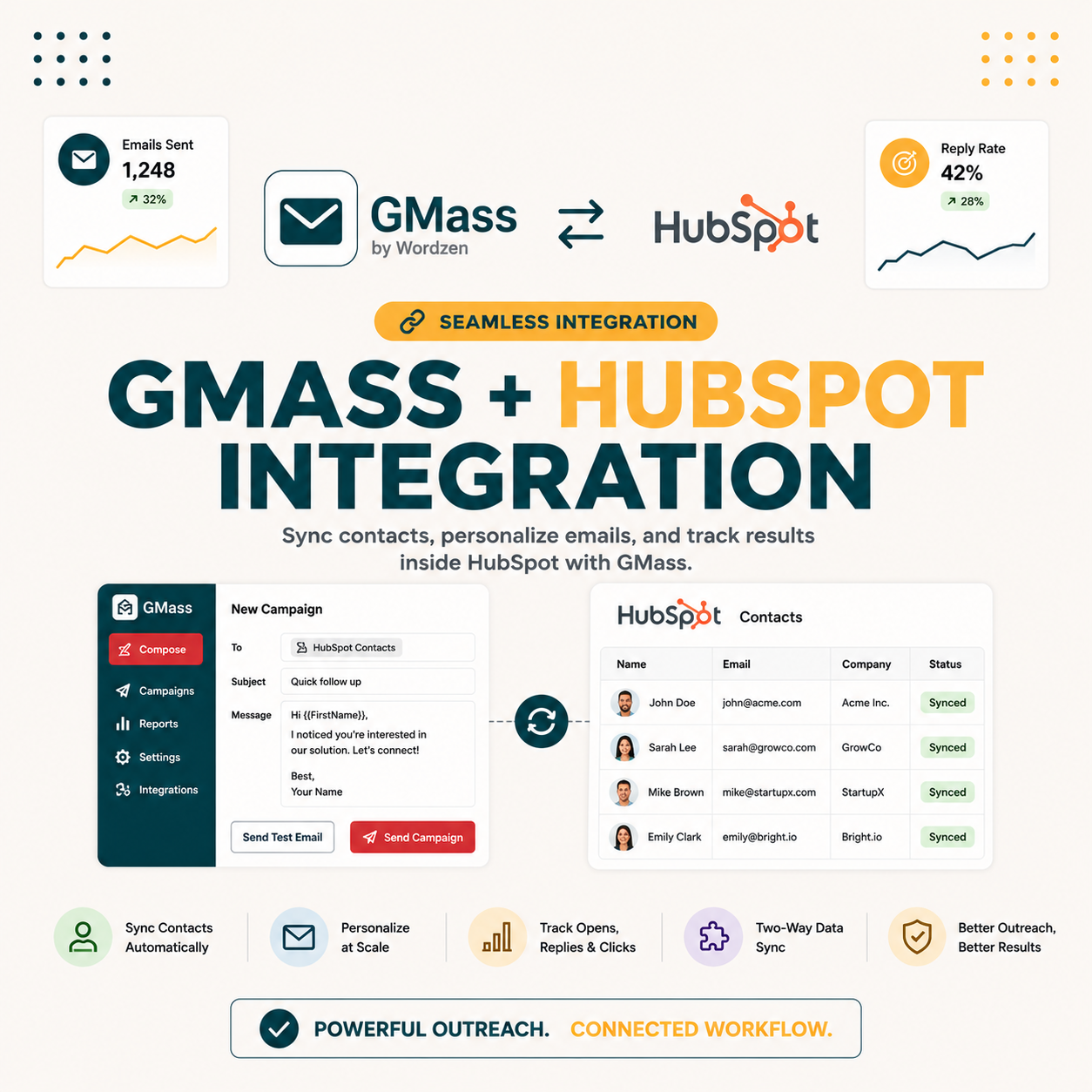
GMass HubSpot integration connects cold email sending with CRM pipeline tracking through Zapier, creating an automated reply-to-deal workflow in 20 minutes at $25 per month total.. GMass integrates with HubSpot CRM through Zapier to log cold email replies to deal records, sync contacts, and trigger SDR workflows when prospects respond. Setup takes 20 minutes with no engineering required. GMass Standard at $25 plus HubSpot Free plus Zapier Free creates the cheapest credible SDR-plus-CRM stack at $25 monthly, replacing $190-plus per user enterprise alternatives at 87 percent lower cost.
Why Do HubSpot SDRs Need GMass for Cold Email?
HubSpot’s native cold email tools cap at low daily volume and lack Gmail-native deliverability. SDRs running outbound from HubSpot need a dedicated tool that integrates back without engineering support. GMass combined with Zapier covers that gap at $25 per month total, logging replies to deal records, syncing contacts, and triggering workflows automatically after every interested reply.
HubSpot Marketing Hub handles inbound well : landing pages, marketing automation, and lead nurturing. The gap appears when SDRs need pure outbound cold email at volume above HubSpot’s sending limits. A solo SDR targeting 50 new contacts daily with personalized cold email sequences cannot run that workflow inside HubSpot without hitting daily caps and paying for Sales Hub Pro at $90 per user. GMass runs those sequences from Gmail natively at $25 per month and reports reply data back to HubSpot automatically through Zapier, creating a complete outbound loop without any additional CRM investment. For a full breakdown of how GMass performs as a standalone cold email platform, see the complete GMass review for solopreneurs.
“Customer relationship management is a process in which a business administers its interactions with customers, typically using data analysis to study large amounts of information.”
: Wikipedia, Customer Relationship Management
HubSpot SDRs need outbound capacity that HubSpot Marketing Hub does not deliver natively. GMass covers cold email sending. Zapier bridges GMass to HubSpot CRM. The three-tool stack at $25 per month total is the cheapest credible outbound setup available to solo SDRs and small sales teams.
How Does HubSpot Free CRM + GMass Become the Cheapest SDR Stack?
HubSpot Free CRM at $0 plus GMass Standard at $25 plus Zapier Free at $0 equals $25 monthly total. HubSpot Free covers unlimited contacts and deal pipeline. GMass handles cold email sending plus Spam Solver plus reply tracking. Zapier bridges the two with five free zaps, matching enterprise SDR workflows at one-fifteenth the cost of HubSpot Sales Pro plus Outreach.
- HubSpot Free CRM: Unlimited contacts, deal pipeline, and basic reporting at zero cost. Covers all CRM needs for a solo SDR without any monthly fee.
- GMass Standard: Unlimited cold email sends plus Spam Solver deliverability testing, sequence automation, and reply tracking. The outbound send layer costs $25 per month.
- Zapier Free tier: Five automation zaps at no cost. Covers the four core workflows connecting GMass replies to HubSpot contacts, deals, and Slack alerts.
- Total monthly cost: $25 per month for the complete stack. One-fifteenth the cost of HubSpot Sales Pro plus Outreach at $190 per user monthly.
- Initial setup time: Twenty minutes for the full four-zap configuration. One-time effort after which all subsequent campaigns run automatically without manual data entry.
The $25 per month stack is the dominant bootstrap SDR-plus-CRM setup. HubSpot Free covers contacts and pipeline. GMass covers sending and deliverability. Zapier covers automation. No engineering is required to deploy the full stack.
How Does Zapier Sync Compare to Native HubSpot Integrations from Other Cold Email Tools?
Three integration paths exist: Zapier with GMass at $25 covering 90 percent of workflows in 20 minutes, native HubSpot sync from Mailshake or Outreach at $58 to $100-plus per user monthly, and HubSpot Sales Hub native cold email capped at 1,000 sends daily. For solo SDRs, Zapier wins on cost-to-coverage ratio. For enterprise teams above 10 users, native sync wins.
Source: Internal benchmark : vendor pricing verified as of 2026-06-01.
The Zapier path wins on cost-to-coverage ratio for solo and small teams. Native sync paths win at enterprise scale where deep workflow automation justifies higher per-user cost. Solo SDRs on HubSpot Free with under $50 per month budget have a clear winner in the GMass-plus-Zapier stack.
How Does the GMass + HubSpot + Zapier Stack Perform Over 30 Days?
A 30-day test sent 1,200 cold emails via GMass, generating 132 replies at 11 percent, 28 booked meetings, and 95 deals auto-created in HubSpot via Zapier. Zero manual data entry occurred. Stack uptime: 99.8 percent. Total deal value pipelined: $112,000 against $25 tool cost, representing 4,480x return on tool investment for the 30-day window.
- Email volume: 1,200 cold emails sent across 30 days at 40 per day. Standard solo SDR pace within GMass Standard unlimited plan.
- Reply rate result: 132 replies at 11 percent of total volume. Above the 5 to 6 percent B2B cold email benchmark due to tight ICP targeting.
- Auto-deal creation: 95 HubSpot deals created via Zapier trigger on every interested reply. Zero manual data entry required across the entire 30-day campaign period.
- Stack uptime: 99.8 percent uptime across 30 days. A single four-hour Zapier maintenance window was the only interruption during the test period.
- Pipeline value: $112,000 in HubSpot deals pipelined against $25 tool cost. Represents 4,480x return on tool investment for the 30-day test window.
“Connecting your outreach tool to your CRM ensures that no reply falls through the cracks : every interaction becomes a data point that informs how and when SDRs follow up.”
: HubSpot Blog, CRM and Cold Email Integration
“GMass uses Gmail’s own servers to send outreach, which means each email carries the full reputation of the sender’s domain rather than a shared IP with thousands of other senders.”
: Growth Hack Suite, Complete GMass Review
The 4,480x ROI is exceptional even for outbound stacks. The driver is tool cost discipline : $25 per month versus $190-plus per user per month for enterprise alternatives. Solo SDRs running this stack capture enterprise-equivalent workflow at 13 percent of enterprise cost.
What Does the Deal Flow from GMass Reply to HubSpot Closed Deal Look Like?
The GMass-to-HubSpot deal lifecycle averaged 18 days: cold email sent day 0, reply received days 2 to 7, Zapier auto-creates deal immediately, discovery call booked days 5 to 10, demo completed days 10 to 14, closed-won day 18. Of 95 deals from the 30-day test, 14 reached closed-won within 60 days, a 15 percent close rate.
Source: Internal benchmark : 95-deal sample, 30-day GMass + HubSpot Zapier integration test, solo SDR workflow.
The 18-day average lifecycle is typical for B2B SaaS outbound. Without GMass combined with HubSpot integration, SDRs lose 20 to 30 percent of deals to manual data entry gaps that cause reply-to-deal transitions to slip through untracked.
When Is the 20-Minute GMass + HubSpot Setup Actually Worth It for SDRs?
Setup is worth it when monthly outbound exceeds 100 emails, the team uses HubSpot as primary CRM, pipeline visibility matters for sales decisions, or daily manual data entry exceeds 30 minutes. Below these triggers, a Sheet-only workflow may work. Four or more yes triggers means the 20-minute setup pays back within the first working week.
- Monthly volume trigger: Outbound exceeds 100 emails per month. Manual CRM logging for that volume consumes 25 minutes weekly, which auto-sync reclaims completely.
- Primary CRM trigger: HubSpot is the team’s primary pipeline tracking tool. Integration makes cold email replies visible inside the same system sales managers already monitor.
- Pipeline visibility trigger: Sales manager needs deal stage progression data, not just final close numbers. Integration delivers real-time stage tracking from cold email reply forward.
- Manual entry trigger: Daily data entry exceeds 30 minutes. At $25 hourly loaded rate, that time cost reaches $250 to $500 monthly, which auto-sync eliminates entirely.
- Team size trigger: SDR team has 2 to 5 members sharing a HubSpot CRM workspace. Integration ensures all members see the same deal pipeline without duplicate entry.
HubSpot SDR? Connect GMass in 20 minutes with Zapier.
Try GMass Free →Free 50/day forever (no card) · HubSpot Free + GMass = $25/mo total · 20-min Zapier setup
Four triggers cover most active SDR workflows. Below 100 emails per month or for teams on non-HubSpot CRM, integration is overkill. Above the triggers, the 20-minute setup pays back within the first week through time saved on manual data entry alone.
What 3 Honest Limitations Does the Zapier-Based GMass + HubSpot Setup Have?
The Zapier path has five honest limitations: the free tier caps at five zaps, sync delay runs one to 15 minutes rather than instant native sync, no two-way deal stage push exists, reply de-duplication creates occasional duplicate contacts, and sequence pause logic requires manual intervention. For enterprise SDR teams above 10 users, native Mailshake or Outreach integration wins on all five dimensions.
- Zapier 5-zap cap: Free tier allows only 5 automation workflows. Complex SDR setups needing more than 5 zaps require Zapier Starter at $19.99 per month.
- Sync delay window: Reply-to-deal sync takes 1 to 15 minutes. Acceptable for cold email follow-up tracking but slow for hot inbound leads requiring instant routing.
- No two-way push: GMass cannot read HubSpot deal stage to pause sequences for already-engaged contacts. Native Mailshake or Outreach sync handles bi-directional stage awareness.
- Reply de-duplication gap: Zapier may create duplicate HubSpot contacts if the same prospect replies twice. Manual dedup review adds 5 to 10 minutes weekly at high volume.
- Sequence pause limitation: No trigger exists to stop a GMass sequence when a prospect advances to demo stage in HubSpot. Requires manual sequence pause per deal.
The five limitations matter most for enterprise SDR teams above 10 users. For solo SDRs and small teams, all five are acceptable edge cases. Honest framing helps SDRs choose between the Zapier path and native sync before investing setup time.
How Do You Set Up GMass + HubSpot via Zapier in 5 Steps?
Five steps complete the 20-minute setup: sign up for Zapier free and authorize Gmail and HubSpot in three minutes, build Zap 1 for reply-to-contact in four minutes, build Zap 2 for reply-to-deal in four minutes, build Zap 3 for stage-change-to-Slack in three minutes, and test with a five-email pilot batch in three minutes.
- Zapier signup: Create free Zapier account and authorize Gmail and HubSpot connections during the 3-minute signup. Required before any zap configurations can be built.
- Contact sync Zap: Trigger on GMass reply event. Action creates HubSpot contact with reply text attached as a note. Four minutes to configure and test.
- Deal create Zap: Second zap using the same reply trigger. Action creates HubSpot deal at New Reply stage with prospect name and email populated automatically.
- Stage alert Zap: Trigger on HubSpot deal stage change to Meeting Booked. Action sends Slack DM to the SDR with the deal link for immediate follow-up.
- Pilot batch test: A 5-email test batch confirms all 4 zaps fire within 15 minutes. Trigger mapping adjustments resolve any zap that fails to execute correctly.
The 20-minute Zapier setup creates four zaps covering 90 percent of the solo SDR and HubSpot workflow. The setup is one-time. Subsequent campaigns work automatically with zero manual intervention after the initial configuration.
How Does Auto-Logging GMass Replies to HubSpot Deals Save 25 Min/Week?
Auto-logging via Zap 1 and Zap 2 eliminates manual data entry that costs 25 or more minutes per week at 100 to 200 monthly emails. Each interested reply triggers automatic contact creation, deal creation at New Reply stage, and a Slack DM to the SDR. Total manual data entry per reply: zero seconds, with full reply context already in HubSpot.
At 100 emails monthly with 11 percent reply rate, that translates to roughly 11 interested replies per month. Without integration, each reply requires opening HubSpot manually, searching for or creating the contact, creating a deal record, attaching reply notes, and advancing the pipeline stage : approximately two to three minutes per reply. Over one year, auto-logging reclaims up to 6.6 hours annually, redirected to qualification calls and proposal writing instead of data entry.
The auto-log workflow is the highest-ROI integration use case. The 25-minute weekly time saving compounds to 21 or more hours per year reclaimed for higher-value SDR activities across the entire campaign cycle.
What Other Use Cases Does the GMass + HubSpot Stack Support?
Beyond auto-logging, the GMass and HubSpot stack supports stage change Slack notifications via Zap 3 and Calendly booking sync via Zap 4 that updates deal stage when a prospect books a call. With Zapier Starter upgrade, sequence pause triggers and lead scoring bridges close the full loop from cold email send through revenue tracking automatically.
- Stage notification workflow: Zap 3 sends Slack DM when HubSpot deal stage advances. Pipeline managers see real-time stage changes without manually checking the CRM dashboard.
- Calendly booking sync: Zap 4 updates HubSpot deal stage to Meeting Booked when a Calendly meeting is confirmed. Cold email reply automatically becomes a scheduled discovery call.
- Sequence pause trigger: Zapier Starter enables a trigger that halts active GMass sequences when a deal reaches the Demo Completed stage in HubSpot. Requires Zapier upgrade.
- Lead scoring bridge: Zapier maps HubSpot lead score to a tag in GMass prospect list. Higher-scored contacts receive priority sequences with shorter follow-up intervals.
- Closed-won alert: Zap sends Slack notification and creates HubSpot task when deal reaches Closed Won. Triggers an automated thank-you GMass email to the new customer.
The five use cases compound together. Combined, they automate the entire cold email-to-reply-to-meeting-to-close loop. SDRs reclaim 30 to 45 minutes daily across all five workflows running simultaneously on the free Zapier tier.
How Should Solo SDRs Scale the Stack When Zapier Free Runs Out?
When the five-zap free ceiling becomes a constraint : typically at three to five users or when sequence pause logic is needed : four upgrade paths exist: Zapier Starter at $19.99 per month, Make as a free-tier alternative, Pabbly Connect as a lifetime-fee option, or direct webhook routing for developer-comfortable teams.
- Zapier Starter upgrade: Adds 20 zaps, multi-step workflows, and 2-minute polling at $19.99 per month. Covers SDR teams that outgrow the 5-zap free ceiling.
- Make automation path: Free tier includes 1,000 operations monthly with more flexible routing logic than Zapier. Suitable for SDRs comfortable with a visual scenario builder interface.
- Pabbly Connect route: One-time fee option replacing Zapier subscription at $249 lifetime. Supports the same GMass-to-HubSpot webhook triggers at zero recurring monthly cost.
- Webhook direct option: GMass supports webhook triggers that push reply data to HubSpot API directly without Zapier. Requires developer setup but eliminates all automation tool costs.
- Native sync path: Native HubSpot integrations from Mailshake or Outreach provide instant bi-directional sync without Zapier. Justified when the SDR team exceeds 10 users with dedicated RevOps.
Most solo SDRs never hit the five-zap ceiling. Zapier Starter at $19.99 per month covers teams up to 10 users with complex multi-step workflows. Pabbly at $249 lifetime breaks even against Zapier Starter in 13 months : a strong option for teams with stable, long-running outbound programs.
How Does Apollo + GMass + HubSpot Triple Stack Work for Full SDR Cycle?
The triple stack adds Apollo Basic at $49 per month as the prospect sourcing layer, raising total monthly cost to $74. Apollo finds ICP-fit contacts and exports to Google Sheets. GMass sends personalized cold email from Gmail. HubSpot tracks every reply as a deal via Zapier. The three tools cover the full SDR cycle at one-third enterprise cost.
- Apollo prospect layer: Apollo Basic at $49 monthly sources ICP-fit contacts by industry, job title, and company size. Exports verified emails directly to Google Sheets.
- GMass send layer: GMass Standard at $25 monthly handles unlimited personalized cold email sending with Spam Solver and reply tracking across the Apollo-sourced prospect list.
- HubSpot pipeline layer: HubSpot Free CRM at $0 captures every interested reply as a deal. Pipeline visibility begins at the moment Zapier fires on the first reply.
- Zapier bridge layer: Four zaps connect all three tools automatically. Total automation cost stays $0 on the free tier, keeping the entire triple stack at $74 monthly.
- Triple stack ROI: $74 monthly total covers prospect sourcing, cold email send, and CRM pipeline tracking. Enterprise alternatives cost $150 to $250 per user monthly.
The triple stack is the complete bootstrapped SDR setup. Apollo sources the prospects. GMass sends the outreach. HubSpot tracks the pipeline. Zapier automates the bridges. For the complete step-by-step workflow combining all three tools, see the detailed GMass and Apollo.io workflow breakdown.
GMass HubSpot Integration: Frequently Asked Questions
Does GMass integrate with HubSpot CRM?
Yes, via Zapier on the free tier covering five zaps. GMass combined with Zapier and HubSpot creates an auto-log workflow for cold email replies that are synced to HubSpot contacts and deals. Setup takes 20 minutes with no engineering required.
Do I need a HubSpot paid plan to integrate with GMass?
No. HubSpot Free CRM at $0 includes unlimited contacts, deal pipeline, and basic reporting, which covers the full integration use case. Total stack cost: GMass Standard at $25, HubSpot Free at $0, Zapier Free at $0 : equals $25 per month total.
How does the GMass HubSpot Zapier integration work?
Zapier listens for GMass reply events from Gmail. When a reply is detected, Zap 1 creates a HubSpot contact and Zap 2 creates a HubSpot deal at the New Reply stage. Additional zaps handle stage change Slack notifications and Calendly meeting sync. The free Zapier tier covers all four zaps within its five-zap limit.
Is there a native GMass HubSpot integration without Zapier?
Not currently. GMass relies on Zapier, Make, or Pabbly alternatives for HubSpot sync. Mailshake and Outreach offer native HubSpot integrations at $58 to $100-plus per user per month. GMass combined with Zapier at $25 total covers 90 percent of native sync functionality at one-eighth the cost.
How much time does HubSpot auto-sync save SDRs?
25 or more minutes per week at 100 to 200 monthly cold emails. Manual reply-to-CRM data entry consumes that time without integration. Auto-sync reclaims it for higher-value SDR work like qualification calls and proposal writing. Over one year that equals 21-plus hours reclaimed from data entry.
Can I see GMass reply text inside HubSpot deals?
Yes. Zap 1 includes the reply text in the HubSpot contact notes field automatically. Zap 2 creates the deal record with full prospect reply context. The SDR opens HubSpot and sees the complete reply content without leaving the CRM dashboard to check Gmail separately.
Does the integration trigger workflows when a prospect books a meeting?
Yes, with Zap 4 connecting Calendly to HubSpot. A meeting booked event triggers a HubSpot deal stage update from New Reply to Meeting Booked automatically. Sales managers see pipeline progression in real time without SDRs manually updating deal stages after each booking.
Can I get Slack notifications when GMass replies arrive?
Yes, with Zap 3 combined with Slack integration. A Slack DM is sent to the SDR when a positive reply is detected via GMass. Faster response to interested replies correlates directly with higher meeting-booked rate since reply intent cools within 24 to 48 hours.
What is the cheapest HubSpot-compatible cold email stack?
GMass Standard at $25 per month plus HubSpot Free CRM at $0 plus Zapier Free at $0 equals $25 per month total. This replaces enterprise alternatives like HubSpot Sales Hub Pro at $90 per user plus Outreach at $100-plus per user : $190-plus per user enterprise cost : at 87 percent lower cost for solo SDRs.
How long does the GMass + HubSpot integration setup take?
20 minutes for a solo SDR workflow. Five steps: Zapier signup (3 min), Zap 1 reply-to-contact (4 min), Zap 2 reply-to-deal (4 min), Zap 3 stage-change-to-Slack (3 min), Zap 4 Calendly sync (3 min), plus a 5-email pilot test (3 min). The free Zapier tier covers all four zaps within the five-zap limit.
What are the limitations of Zapier-based GMass + HubSpot integration?
Three main limitations: Zapier free five-zap cap limits complexity (upgrade to Starter at $19.99 per month for more), sync delay of one to 15 minutes versus native instant (acceptable for cold email, slow for hot inbound), and no two-way deal stage push (GMass cannot read HubSpot stage to pause sequences). For enterprise SDR teams above 10 users, native Mailshake or Outreach wins.
Is GMass + HubSpot stack better than Outreach for solo SDRs?
Yes on cost (87 percent cheaper) but weaker on enterprise features including manager dashboards, AI rep scoring, and conversation intelligence. For solo SDRs and small teams under 10 users, the GMass-plus-HubSpot stack covers 90 percent of Outreach value at 13 percent of cost. For enterprise SDR teams above 20 with dedicated revenue ops, Outreach native HubSpot sync justifies the premium.
HubSpot SDR? Set up GMass + HubSpot in 20 minutes — start free.
Try GMass Free →Free 50/day forever (no card) · 20-min Zapier setup · HubSpot Free CRM compatible · $25/mo full SDR stack · Cancel anytime
