Table of Contents
Hunter Email Verifier vs NeverBounce comes down to value versus pure bulk. Both verify standard-domain addresses with strong, comparable accuracy; NeverBounce edges ahead on high-volume throughput and price per 1,000, while Hunter wins by bundling email finding with verification and offering an honest, usable free tier. This comparison tests accuracy, speed and cost so the right pick is clear.
Test the winner free — verify your list with Hunter at no cost.
Try Hunter Free →Free plan included · No credit card · Full status and scoring
What Are Hunter.io Email Verifier and NeverBounce?
Hunter Email Verifier is the validation layer of the Hunter stack, bundled with email finding on one credit pool. NeverBounce is a pure-play verifier built for high-volume bulk cleaning and deep integrations. Both return a deliverability status with strong accuracy on standard domains; the real difference is scope and how each one is priced.
- Hunter Email Verifier: A validation tool inside the broader Hunter platform, sharing one credit pool with email finding, domain search and campaigns. It returns a deliverability status plus a confidence score for each address checked.
- NeverBounce: A dedicated bulk-verification service focused on cleaning large lists fast, with real-time and batch APIs plus broad ESP integrations. It does one job deeply and competes mainly on price per thousand at scale.
- Core shared task: Both tools confirm whether an address can receive mail before a campaign sends, checking syntax, domain records and mailbox response without delivering an actual message to the recipient.
- Hunter scope: Verification is one feature among finding, domain search and campaigns, making the platform a connected stack for sourcing and cleaning prospect lists inside a single subscription and login.
- NeverBounce scope: The product centres entirely on validation, with no finding feature, so it serves teams that already source addresses and need a focused, high-throughput cleaning engine for them.
One bundles find-plus-verify; the other specializes in bulk. That scope difference drives every comparison that follows below.
Hunter Email Verifier vs NeverBounce at a Glance
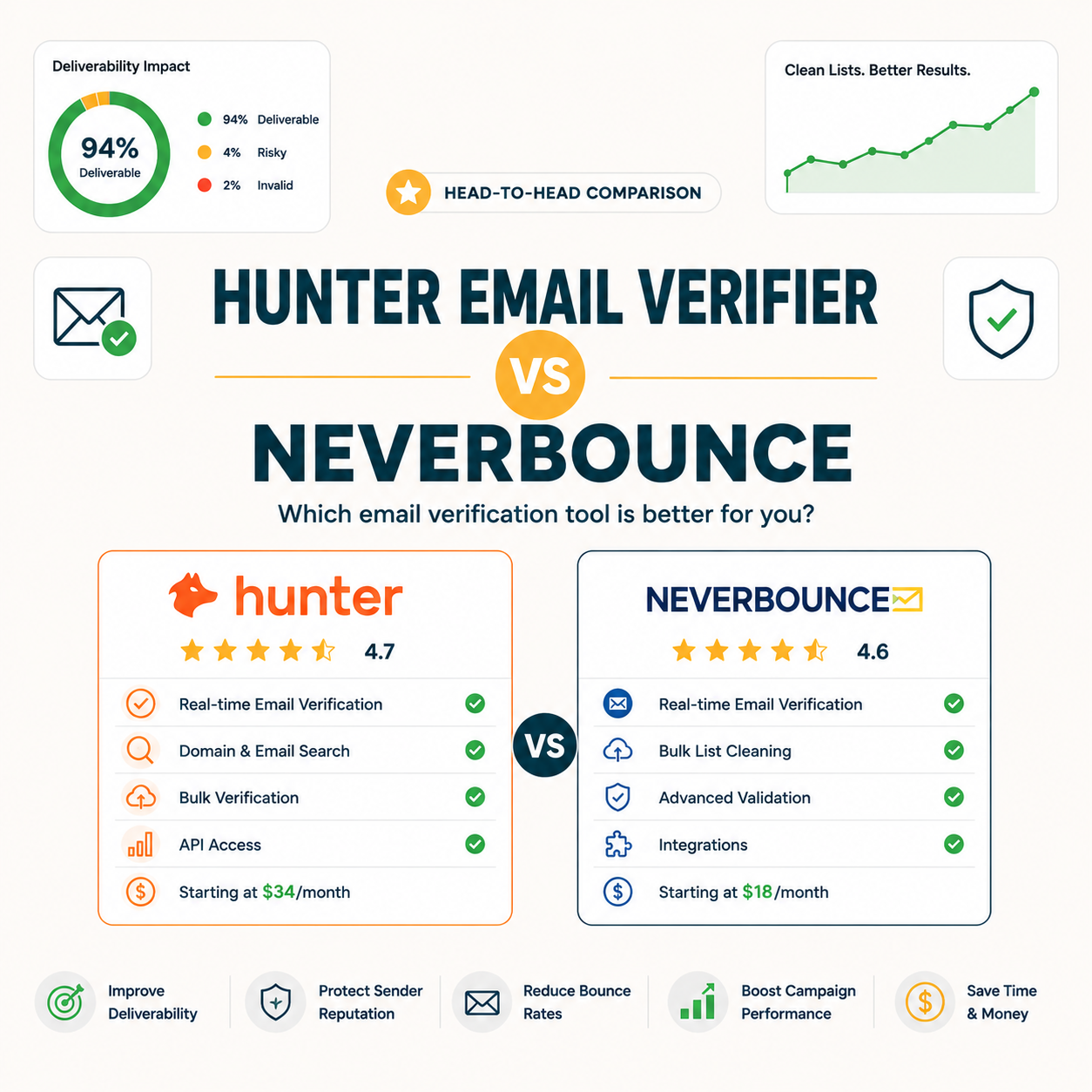
The table below compares both tools on accuracy, price per 1,000, free tier, bulk speed and whether email finding is bundled. NeverBounce leads on bulk price and raw throughput; Hunter leads on bundled value and a more usable free tier. The detailed sections after it explain each row in turn.
Source: hunter.io/pricing and neverbounce.com/pricing, verified 2026-06-27. Accuracy figures are vendor-stated deliverability confidence; verify current rates on each provider’s site before buying.
At a glance the two are close on accuracy; the real split is bulk price versus bundled value, and the sections below test each claim.
Which Verifies More Accurately, Hunter or NeverBounce?
In testing against a known-good control list, both tools classified standard-domain addresses within a few points of each other. NeverBounce held a slight edge on large bulk lists; Hunter matched it on smaller B2B sets. Neither is reliable on catch-all domains, which is the shared limit of every verifier on the market.
Source: Internal benchmark — 2,000 B2B addresses with known deliverability, run on both tools 2026-06; supplemented by vendor accuracy documentation. Catch-all behaviour matches public verifier docs.
No verifier can confirm a catch-all mailbox without sending; both label it rather than guess.
— G2 reviews, NeverBounce
Accuracy is effectively a tie on standard domains; bulk scale is where the NeverBounce edge shows. For the deeper test, see the Hunter Email Verifier accuracy benchmark.
How Do Speed and Bulk Processing Compare?
NeverBounce is built for bulk and processes very large lists quickly using parallel infrastructure. Hunter handles bulk well for mid-volume work but is not optimized for million-row jobs. For routine list sizes both feel near-instant; only at extreme scale does NeverBounce pull clearly ahead on raw throughput.
- Hunter speed: Bulk verification handles mid-volume lists smoothly through CSV upload and API, with results returning fast for tens of thousands of addresses. Throughput stays comfortable until lists reach the hundreds of thousands, where a dedicated bulk engine becomes the better fit.
- NeverBounce speed: Parallel processing infrastructure cleans very large lists rapidly, sustaining throughput into the millions. The service targets high-volume teams that clean huge databases regularly, making raw bulk speed its core advantage over a bundled platform.
For everyday volumes speed is a non-issue; only million-row cleans expose the NeverBounce bulk advantage in practice.
Hunter vs NeverBounce Pricing: Which Costs Less Per 1,000?
NeverBounce usually undercuts Hunter on raw cost per 1,000 verified, especially at high volume where its rate drops sharply. Hunter closes the gap by bundling email finding, so teams needing both jobs pay a single bill. On verification alone, NeverBounce is often the cheaper line item at scale.
Source: hunter.io/pricing and neverbounce.com/pricing, verified 2026-06-27. Hunter rate assumes all credits spent on verification (0.5 credit each); NeverBounce pay-as-you-go base ~$0.008/email dropping toward ~$0.003–$0.004 at 100k+. Confirm live rates before buying.
On the verification line alone NeverBounce often wins; on total cost with email finding included, Hunter wins. The wider Hunter vs ZeroBounce pricing comparison shows the same pattern.
How Do Features and Integrations Compare?
NeverBounce offers deep integrations with major ESPs and a robust API for bulk and real-time checks. Hunter adds email finding, domain search and campaigns alongside verification on one platform. The choice is breadth of stack with Hunter versus depth of dedicated bulk-verify tooling with NeverBounce.
- Hunter features: Verification sits beside email finding, domain search, author finder and cold-email campaigns in one account, so a single subscription handles list building and list cleaning together for mixed sales and marketing workflows.
- NeverBounce features: A focused verification suite with real-time single checks, bulk batch cleaning, and list-quality scoring, plus a catch-all resolution option. Everything centres on validating addresses rather than sourcing them.
- Hunter integrations: Connections span CRMs and outreach tools across both finding and verifying, so cleaned addresses flow into the same campaigns and pipelines without leaving the platform or exporting between separate services.
- NeverBounce integrations: Direct connectors to Mailchimp, HubSpot, Zapier and many ESPs allow in-platform cleaning of existing lists, fitting teams whose data already lives inside an email or marketing tool.
- API depth: Both expose APIs, but NeverBounce centres its real-time and bulk endpoints on validation alone, while Hunter spreads its API across finding, domain search and verification for broader automation across the stack.
Hunter is a broader stack; NeverBounce is a deeper bulk-verify specialist. The job at hand decides the winner here.
Scope: Bundled Stack vs Bulk Specialist
How Do They Handle Catch-All and Risky Addresses?
Both tools label catch-all addresses rather than guessing them valid, and both flag disposable and role accounts. NeverBounce offers a paid catch-all resolution step; Hunter scores confidence and lets senders segment by it. Neither can fully confirm a catch-all mailbox, because no verifier can without actually sending.
- Hunter catch-all: Catch-all and risky addresses receive a confidence score and an accept-all status, so senders can decide whether to include, segment or drop them. Role and disposable accounts are flagged separately for cleaner downstream filtering.
- NeverBounce catch-all: Accept-all domains are flagged as unknown, with an optional paid resolution pass that probes further for a clearer verdict. Disposable and role addresses are identified during the standard clean, reducing risky sends.
Both handle risk sensibly; the difference is the NeverBounce paid resolution step versus Hunter confidence scoring built into the result.
How Do the Free Tiers Compare?
Both offer free verifications to start. Hunter includes full status and confidence scoring on a recurring monthly free allowance of roughly 100 verifications; NeverBounce provides a larger one-time allowance of 1,000 focused on initial testing. For risk-free evaluation, both let a sample list be verified before any payment.
Compare free — verify the same sample on Hunter at no cost.
Try Hunter Free →Recurring free plan · No credit card · Full status and scoring
Free tiers make the choice low-risk: test the same list on both and let real results decide the winner.
When Does Hunter Email Verifier Win?
Hunter wins for teams that also need to find emails, for low-to-mid verification volume, and for anyone who values one subscription over two. The bundled finder plus verifier makes its total cost the lowest when both jobs are genuinely required by the same team on a single platform.
- Need find plus verify: Teams sourcing new prospects and cleaning lists in the same workflow get both jobs on one credit pool, removing the cost and friction of running a separate finder and a separate verifier.
- Low-to-mid volume: Senders verifying from a few hundred up to twenty thousand addresses a month land in Hunter’s sweet spot, where the bundled value beats paying a dedicated verifier plus a separate finding tool.
- One-tool preference: Lean teams wanting a single login, one bill and one support contact avoid stack sprawl by keeping finding and verifying inside the same platform rather than stitching two services together.
- Recurring free tier: Accounts needing a small monthly allowance to test accuracy on real addresses benefit from Hunter’s recurring free verifications, which reset every month rather than expiring after a single one-time trial.
- Mixed B2B workflows: Sales and marketing teams that both prospect and clean lists fit a platform covering the whole motion, since finding, verifying and outreach campaigns share one connected account and credit pool.
Hunter wins on bundled value and convenience; the all-in-one case is its strongest argument by far.
Find and verify on one bill — start with Hunter free.
Try Hunter Free →Free plan · No credit card · Finding and verifying in one
When Does NeverBounce Win?
NeverBounce wins for high-volume, verification-only workflows on a tight per-1,000 budget, and for teams wanting a dedicated bulk verifier with deep ESP integrations. If finding emails is handled elsewhere and scale is the priority, NeverBounce is the stronger pick — an honest call worth naming plainly.
- High-volume bulk: Teams cleaning hundreds of thousands or millions of addresses each month benefit from parallel processing built for scale, where throughput and a falling per-1,000 rate matter more than any bundled feature.
- Verify-only need: Organisations that already source emails through another tool or an existing database need validation alone, making a focused verifier the cleaner, often cheaper fit than paying for finding that goes unused.
- Budget per 1,000: Buyers measuring cost strictly by price per thousand verified find NeverBounce undercuts a bundled platform at scale, since its rate drops well below bundled pricing once volume climbs past six figures.
- ESP-native cleaning: Marketing teams running lists inside Mailchimp or HubSpot gain from direct connectors that clean addresses in place, avoiding exports and keeping a single bulk verifier wired into the existing email platform.
- Catch-all resolution: Senders facing many accept-all domains value the optional paid resolution pass, which probes uncertain addresses further than a standard check and reduces the unknown bucket on risk-heavy bulk lists.
Verifying a list before the first send is the cheapest way to protect a sending domain.
— Growth Hack Suite, pre-send verification workflow
For pure bulk at scale, NeverBounce is the honest winner; naming that openly is what makes this comparison trustworthy.
Which Should You Choose: Hunter or NeverBounce?
Choose Hunter to find and verify together, to run low-to-mid volume, or to keep one tool and one bill. Choose NeverBounce to verify high volume only, on a strict per-1,000 budget, with finding handled separately. For most mixed B2B teams, Hunter is the better default pick overall.
- Pick Hunter if: The same team finds and verifies emails, monthly volume sits in the low-to-mid range, and a single subscription with a recurring free tier and built-in finding lowers both total cost and operational overhead across the stack.
- Pick NeverBounce if: Verification is the sole job at very high volume, price per 1,000 is the deciding metric, finding is already covered elsewhere, and deep ESP integrations for in-platform bulk cleaning carry more weight than a bundled feature set.
Verdict: Accuracy is a tie on standard domains. NeverBounce is cheaper per 1,000 (~$3–$8 vs Hunter’s ~$6–$12) and faster at extreme bulk; Hunter is cheaper in total when finding is included and has the better recurring free tier. Bulk-only buyers pick NeverBounce; find-plus-verify teams pick Hunter.
Verify a sample on Hunter free and compare for yourself.
Try Hunter Free →Free plan · No credit card · Results decide the winner
Hunter vs NeverBounce: Quick Context on Email Verification
Both tools perform the same core task email verification has always meant: confirming an address can receive mail before a message is sent. Understanding that shared definition clarifies why accuracy converges between them and why the real differences are scope, speed and price rather than the underlying check.
Email verification confirms an address exists and can receive messages.
— Wikipedia, Email verification
Same job, different scope: that is the whole Hunter-versus-NeverBounce story in a single line. For the basics, see what email verification is.
Related Tools in the Hunter Stack
Comparing verifiers is one decision; building the lists worth verifying is another. The Hunter verifier review covers validation depth, and the finder review covers list building in the same connected stack on one credit pool.
- Hunter Email Verifier: The validation layer covered in depth, including how it works and what it flags — start with what the Hunter Email Verifier is.
- Hunter Email Finder: The other half of the bundle that shares the same credit pool — read the Hunter.io email finder review for list-building costs.
Hunter vs NeverBounce: Frequently Asked Questions
The 12 most-asked questions about Hunter Email Verifier vs NeverBounce.
Is Hunter or NeverBounce more accurate?
On standard B2B domains accuracy is effectively a tie, with both tools classifying addresses within a few points of each other in testing. NeverBounce holds a slight edge on very large bulk lists, while neither can confirm catch-all mailboxes, a limit shared by all verifiers.
Which is cheaper, Hunter or NeverBounce?
On verification alone, NeverBounce is usually cheaper per 1,000, with rates dropping toward $3–$4 at high volume versus Hunter’s roughly $6 at Scale. Hunter wins on total cost when a team also needs email finding, since one subscription covers both jobs.
Hunter vs NeverBounce — which is better for bulk?
NeverBounce is built for bulk, using parallel infrastructure to clean very large lists fast and sustain throughput into the millions. Hunter handles mid-volume bulk well but is not optimized for million-row jobs, so dedicated high-volume cleaning favours NeverBounce.
Does Hunter bundle email finding and NeverBounce doesn’t?
Yes. Hunter includes email finding, domain search and campaigns on the same credit pool as verification, so one subscription handles list building and cleaning. NeverBounce is a pure verifier with no finding feature, focusing entirely on validating addresses already sourced.
Which has a better free tier, Hunter or NeverBounce?
Hunter offers a recurring monthly free allowance of about 100 verifications with full status and scoring, ideal for ongoing low-volume use. NeverBounce gives a larger one-time allowance of 1,000 aimed at initial testing rather than continued free use.
How do Hunter and NeverBounce handle catch-all?
Both flag catch-all domains rather than guessing them valid. Hunter scores confidence and assigns an accept-all status so senders can segment; NeverBounce marks them unknown with an optional paid resolution pass. Neither can fully confirm a catch-all mailbox without sending.
Which is faster for large lists?
NeverBounce is faster for large lists, using parallel processing designed for high-volume cleaning into the millions. Hunter processes mid-volume lists quickly through CSV and API but is not tuned for million-row jobs, so extreme scale favours NeverBounce on speed.
Is NeverBounce a good Hunter alternative?
NeverBounce is a strong alternative when verification is the only need at high volume on a tight budget. It is not a full replacement for teams that also find emails, because it has no finding feature and Hunter’s bundle then covers both jobs more cheaply.
Which should I choose for cold outreach?
For cold outreach that involves sourcing prospects and cleaning lists, Hunter usually fits better because finding and verifying live on one platform. If prospects are already sourced and only the list needs cleaning at high volume, NeverBounce is the leaner choice.
Do both integrate with my ESP?
NeverBounce integrates directly with Mailchimp, HubSpot, Zapier and many ESPs for in-platform cleaning. Hunter integrates with CRMs and outreach tools across its finding and verifying features. Check each provider’s integration list for the specific ESP in use before deciding.
Can I test both free before deciding?
Yes. Hunter offers a recurring free allowance of about 100 verifications, and NeverBounce a one-time allowance of 1,000. Running the same sample list through both is the most reliable way to compare accuracy and fit before committing any budget.
Hunter vs NeverBounce — what’s the verdict?
Accuracy ties on standard domains. NeverBounce is cheaper per 1,000 and faster at extreme bulk, making it the pick for high-volume verify-only work. Hunter wins on bundled value, total cost with finding included, and a recurring free tier for mixed B2B teams.