Table of Contents
Dedicated hosting means renting an entire physical server exclusively for your website or application, with all its resources reserved for you. It delivers maximum performance and control at a premium price, suiting very high-traffic or resource-intensive sites, though managed cloud hosting now offers similar power without the cost and administration of a full server. This guide explains how it works and who needs it.
Last updated: August 2026. Written by the Growth Hack Suite editorial team, with details cross-checked against provider documentation. This page carries affiliate links to Kinsta.
What Is Dedicated Hosting?
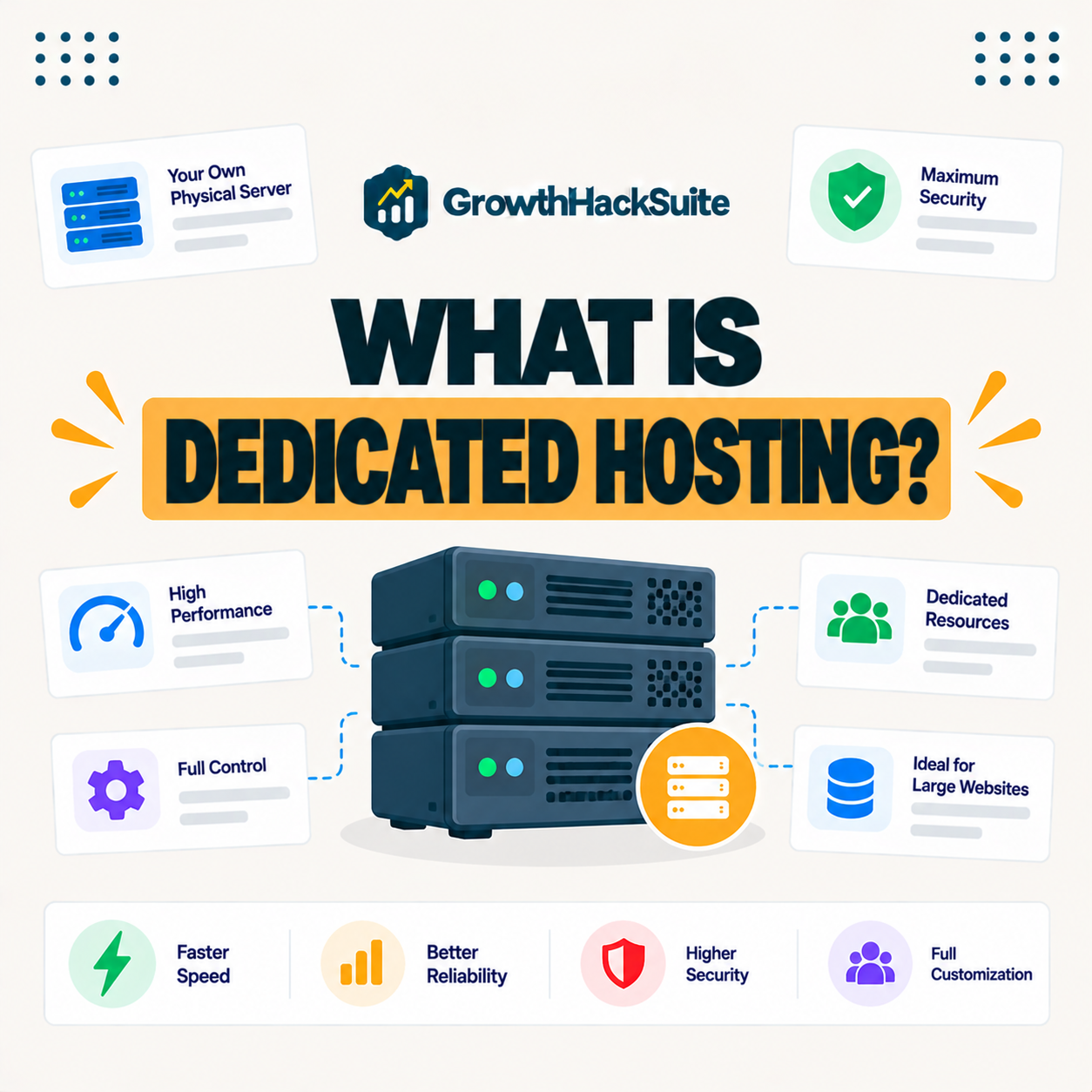
Dedicated hosting means renting an entire physical server exclusively for your website or application, so all of the machine’s CPU, memory and storage are reserved for you. It delivers maximum performance, control and isolation at a premium price, with no other sites sharing the hardware.
“A dedicated hosting service leases an entire server not shared with anyone else.”
— Wikipedia, Dedicated hosting service
Because the whole machine is yours, it offers the most raw power and control of any single-server option, which is also why it carries the highest price.
How Does Dedicated Hosting Work?
Dedicated hosting works by assigning one physical server to a single customer, who can configure the operating system, software and security to their needs. The provider supplies the hardware and network, while the customer or a managed service runs everything above that layer.
Verdict: Dedicated hosting reserves a whole physical server for one customer, giving maximum performance, control and isolation, at the highest price and with the most administration. It fits very high-traffic, resource-heavy or compliance-bound sites. The honest reality is that managed cloud hosting now delivers dedicated-level isolation and power for most demanding WordPress sites, without renting or running a physical machine, so a full physical server is needed less often than it once was.
In short, it is the maximum-power, maximum-responsibility option, and managed cloud has closed much of the gap for typical WordPress workloads.
What Are the Benefits of Renting a Whole Server?
The benefits of renting a whole server include full server resources with no neighbors, maximum performance for demanding workloads, deep configuration control and strong isolation. Together these make it suitable for very high-traffic or resource-intensive sites and applications that push a server hard.
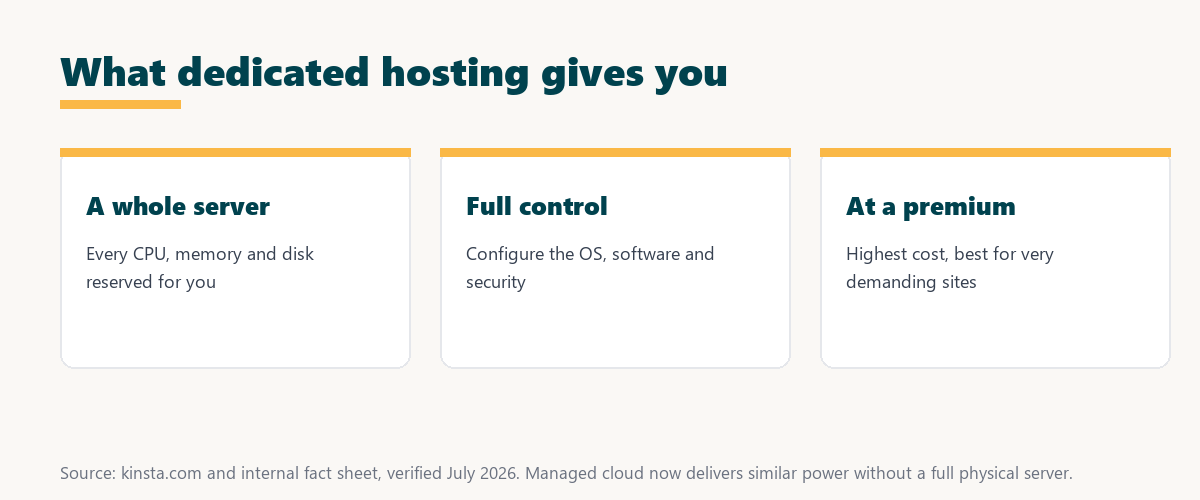
- Full server resources: All CPU, memory and storage are reserved, so no neighbour can consume them.
- Maximum performance: The whole machine serves one site, ideal for demanding, resource-heavy workloads.
- Deep control: Root access allows custom operating system, software and security configuration.
- Strong isolation: Exclusive hardware removes the shared-server risks that affect cheaper hosting.
- Compliance fit: Full control can help meet strict compliance or custom infrastructure requirements.
The honest takeaway is that these benefits are real but only matter when a site’s demands genuinely exceed what shared, VPS or managed cloud hosting can provide.
Dedicated Hosting vs VPS Hosting
Dedicated hosting gives you a whole physical machine, while VPS hosting gives you an isolated slice of one. Dedicated offers more resources and control at a higher cost, whereas a VPS suits sites needing isolation without a full server, so the choice is scale and budget.
Source: provider documentation, verified August 2026. Dedicated maximizes power; cloud maximizes flexibility.
Comparing resources, control, scalability, cost and management across dedicated, VPS and cloud hosting shows dedicated as the maximum-power, least-flexible option at the top of the price range.
See dedicated-level performance without the hardware
Try Kinsta →Isolated Google Cloud resources, with a 30-day money-back guarantee.
Dedicated vs Cloud Hosting
Dedicated hosting ties your site to one physical machine, while cloud hosting spreads it across a resilient network. Cloud scales and tolerates hardware failure more flexibly,though a single-tenant machine offers fixed, exclusive performance that some specialized workloads still prefer.
The honest point is that dedicated gives predictable, exclusive hardware, while cloud gives elasticity and redundancy, so the better fit depends on whether control or flexibility matters more.
Downsides of Renting a Whole Server
The downsides of renting a whole server include high cost, the need for technical management on unmanaged plans, less flexible scaling than the cloud, and hardware being a single point of failure. It therefore fits only when its power is genuinely required rather than as a default.
- High cost: Renting a whole server makes this among the most expensive options available.
- Management burden: An unmanaged machine requires skilled administration to run and secure.
- Limited scaling: Capacity is bounded by one machine, unlike the on-demand scaling of the cloud.
- Single point of failure: One physical server means hardware failure can take the site offline.
- Slower provisioning: Setting up or upgrading physical hardware takes longer than spinning up cloud resources.
“The first five seconds of page-load time have the highest impact on conversion rates.”
— HubSpot, page load time and conversion rates
Because performance protects those early seconds, the point of exclusive hardware is speed under heavy load, which managed cloud can now often match without the drawbacks.
Who Actually Needs Dedicated Hosting?
Businesses with very high traffic, resource-intensive applications, strict compliance needs or custom infrastructure requirements need dedicated hosting. That said, many sites that once required it now run well on managed cloud hosting instead, so the true need is narrower than it used to be.
The honest point is that exclusive hardware is a specialist tool, so most sites, even large ones, are better served by managed cloud unless a specific requirement demands exclusive hardware.
How to Decide Between Dedicated and Managed Cloud
Decide between dedicated and managed cloud hosting by weighing whether you need exclusive physical hardware and deep control, or whether managed cloud can deliver the performance and isolation you require without the cost and administration of a full server. For most sites, managed cloud wins.
Source: provider documentation, verified August 2026. Weigh the power against the cost and management.
Listing the performance and control benefits against the cost, management and scaling drawbacks shows a whole server is worth it only when its exclusive power is truly needed. Owners weighing platform commitment can also read our note on SaaS vendor lock-in.
How Kinsta Delivers Dedicated-Level Performance
Kinsta delivers dedicated-level performance through isolated Google Cloud containers with reserved resources, enterprise tiers and a scalable network. Demanding sites therefore get the isolation and power of dedicated hosting without managing physical hardware, so the benefit comes without the administration.
Get enterprise performance handled on Kinsta
Start With Kinsta →Free migration and a 30-day money-back guarantee.
Managed vs Unmanaged Dedicated Plans
Managed dedicated hosting has the provider handle server administration, security and monitoring, while unmanaged dedicated leaves that to you. Managed suits businesses wanting exclusive hardware without an in-house team, and unmanaged suits technical operations that want full control of the machine.
“A tool is only worth its premium when the hours or revenue it protects exceed the invoice.”
— Growth Hack Suite, on tool ROI
Applied here, a dedicated server or a managed alternative earns its premium only when the performance and control it provides protect more than its higher cost.
Is Dedicated Hosting More Secure?
Dedicated hosting can be very secure through isolation and full control, but security still depends on proper configuration, patching and monitoring, whether you or a managed service handles it. Exclusive hardware helps, yet a poorly maintained dedicated server is not safer than a well-managed platform.
The honest qualifier is that isolation is an advantage, but security comes from ongoing maintenance, which is why a managed platform can be as secure as an unmanaged dedicated server.
Choosing the Right High-Performance Hosting
You choose the right high-performance hosting by matching your traffic, control and compliance needs to the option. For most demanding WordPress sites, managed cloud hosting like Kinsta’s now provides the performance once reserved for dedicated servers, without the hardware to run.
The honest summary is that dedicated hosting remains the answer for specific heavy or compliance-bound needs, while managed cloud is the better default for high-performance WordPress.
Try enterprise-grade managed hosting risk-free
Try Kinsta Risk-Free →Isolated resources and free migration, with a 30-day money-back guarantee.
Frequently Asked Questions Before You Rent a Server
The 12 most-asked questions about dedicated hosting.
What is dedicated hosting in simple terms?
Dedicated hosting means renting an entire physical server just for your site, so all its resources are reserved for you, delivering maximum performance and control at a premium price.
How is dedicated hosting different from VPS?
Dedicated hosting gives you a whole physical machine, while VPS hosting gives you an isolated slice of one, so dedicated offers more resources and control at a higher cost.
What are the benefits of dedicated hosting?
Dedicated hosting benefits include full server resources with no neighbors, maximum performance, deep configuration control and strong isolation, suiting very high-traffic or resource-intensive sites.
What are the downsides of dedicated hosting?
Downsides include high cost, the need for technical management on unmanaged plans, less flexible scaling than the cloud, and the server being a single point of failure.
Who needs dedicated hosting?
Businesses with very high traffic, resource-heavy applications, strict compliance needs, or custom infrastructure benefit from dedicated hosting, though many now run well on managed cloud instead.
Is dedicated hosting better than cloud hosting?
Neither is simply better; dedicated ties you to one powerful machine, while cloud spreads your site across a resilient network that scales and tolerates failure more flexibly.
Is dedicated hosting expensive?
Yes, dedicated hosting is among the more expensive options because you rent an entire server, so it makes sense only when a site genuinely needs that exclusive power.
Do I need technical skills for dedicated hosting?
Unmanaged dedicated hosting requires strong technical skills to configure and secure the server, while managed dedicated plans have the provider handle that work for you.
Can managed cloud replace dedicated hosting?
For many sites, yes, managed cloud hosting now delivers the isolation and performance once reserved for dedicated servers, without the cost and administration of a full physical machine.
Is dedicated hosting more secure?
Dedicated hosting can be very secure through isolation and full control, but security still depends on proper configuration, patching and monitoring, whether you or a managed service handles it.
Does dedicated hosting scale easily?
Dedicated hosting scales less easily than the cloud, because you are limited to one machine’s capacity, whereas cloud hosting can draw more resources from a network on demand.
How does Kinsta compare to dedicated hosting?
Kinsta delivers dedicated-level performance through isolated Google Cloud containers with reserved resources and enterprise tiers, giving demanding sites that power without managing physical hardware.
About this guide
Written by the Growth Hack Suite editorial team, drawing on hands-on experience with high-performance hosting. Details were cross-checked against provider documentation. This page carries affiliate links to Kinsta, so the position is stated plainly: dedicated hosting reserves a whole physical server for one customer at the highest price and with the most administration, and it fits very demanding or compliance-bound sites. For most high-performance WordPress sites, managed cloud hosting like Kinsta’s delivers dedicated-level isolation and power without a physical server to run.