Table of Contents
Expandi vs Captain Data compares a managed LinkedIn outreach tool with a B2B data API. Expandi costs $99 per LinkedIn account per month and handles sending, warm-up, and a dedicated IP for each profile. Captain Data sells usage-based credits for people and company data through a REST API and sends no messages, so the two solve different problems.
Last checked: October 2026. Expandi figures come from expandi.io pricing, FAQ, Terms, and help center; Captain Data figures come from captaindata.com and its pricing configurator, read on October 2, 2026, where prices are shown in euros.
Need LinkedIn outreach that runs without writing code? Test Expandi on one account for seven days.
Start Your 7-Day Expandi Trial →Seven-day trial on the first subscription · dedicated country-based IP for each account · cancel anytime
Expandi vs Captain Data: Which One Does an Agency Need?
Expandi vs Captain Data is a choice between sending LinkedIn outreach and sourcing B2B data. Expandi fits agencies that run client campaigns and want safety managed for them, while Captain Data fits teams with developers who build their own data pipeline through an API and handle outreach in another tool.
Captain Data used to be discussed as a no-code automation tool for sales teams. The current site positions it very differently. Its hero line reads “AI Data for AI Products. Reliable B2B data for product builders, GTM platforms, and AI agents,” and its pricing page describes endpoints and credits rather than campaigns or sequences.
For an agency, that shift turns a head-to-head into a question of fit. Expandi is software an operator logs into and runs. Captain Data is a data source that a developer calls from code. Very few agencies need to pick one instead of the other, but many need to know which job each one actually does.
Agencies selling conversations need Expandi, agencies building data products need Captain Data, and agencies doing both may run them as separate layers of one stack.
What Is the Difference Between a Managed Tool and a Data Pipeline?
A managed tool is software where the vendor operates the infrastructure, limits, and safety settings on the user’s behalf. A data pipeline is a chain of API calls and storage that the buyer designs and maintains. Expandi is the first kind of product, and Captain Data supplies data for the second kind.
Five traits show where responsibility sits in each model:
- Vendor-run infrastructure: Expandi operates cloud sending and assigns each LinkedIn account a dedicated country-based IP without any server or proxy setup by the agency.
- Preset safety limits: Expandi ships an automatic warm-up and limit ranges with every connected profile, so operators adjust defaults rather than designing pacing rules.
- API endpoints: Captain Data returns people and company records as JSON through a REST API that software calls directly, with no campaign interface on top.
- Credit metering: each Captain Data endpoint consumes a different number of credits depending on the data returned, so usage drives the monthly cost.
- Buyer-owned logic: a pipeline built on a data API needs the buyer to write the processing, storage, and error handling that turns records into a usable list.
Wikipedia’s definition of the building block behind Captain Data is short:
“a connection between computers or between computer programs”
Wikipedia, API
Managed tools hide the plumbing and limit the options, while data pipelines expose the plumbing and leave every decision to the buyer, which is the real trade-off in this comparison.
What Does Expandi Manage for the User?
Expandi is a cloud-based LinkedIn automation platform that manages sending, pacing, and account protection for each connected profile. The platform assigns a dedicated IP, runs an automatic warm-up from five actions a day, and applies limit ranges, so agencies configure campaigns rather than the infrastructure underneath them.
- Dedicated country-based IP: every account receives its own data-center IP in the country selected when the LinkedIn profile is first connected to the platform.
- Profile auto warm-up: the gradual option starts at 5 actions per day and adds 3 every two days until it reaches a ceiling of 21 daily actions.
- Smart limit ranges: the pricing page lists smart algorithms for limit ranges, which vary daily activity instead of repeating an identical count every day.
- Campaign prioritization and recovery: operators decide which campaign uses the daily allowance first, and interrupted campaigns resume rather than restarting from the first step.
- Campaign limits: the help center allows 15 active campaigns at a time and up to 5,000 leads in a single campaign, with 500 campaigns per account.
The limit figures come from Expandi’s campaign limitations article and the ramp from its account warm-up guide, both checked in October 2026.
Expandi takes infrastructure decisions off the agency’s plate, which shortens setup but also means the platform does only what its campaign types and settings allow.
What Does Captain Data Provide Today?
Captain Data is a B2B data API that returns people and company records to software. Its pricing page lists enrichment, find, and search endpoints billed in credits, a REST API, and an MCP server for AI agents, and it does not describe sending LinkedIn messages or connection requests anywhere.
The endpoints and their credit costs are listed on the Captain Data pricing page:
- Enrich People endpoint: the API returns a fuller person profile for a known record and consumes one credit for each record that comes back from the call.
- Enrich Company endpoint: company records are enriched at the same rate of one credit per record, which keeps account-level research costs easy to estimate.
- Find People and Find Company: lookups that locate a person or company record cost two credits each, double the enrichment rate for a single returned record.
- Search endpoints: people search, company search, and employee lookups charge one request plus one credit for every result the search returns.
- MCP Server: an MCP server lets AI agents call Captain Data as a tool, which suits teams building assistants that need live B2B records.
Captain Data explains the billing unit in its pricing FAQ:
“Credits are the currency used for API calls. Each endpoint consumes a different number of credits based on the data returned.”
Captain Data pricing FAQ
Captain Data now serves builders who need records inside their own systems, so an agency would still need a separate sending tool before any prospect hears from it.
How Does Expandi Pricing Work?
Expandi pricing is a per-account model where each connected LinkedIn profile costs $99 per month, or $79 per account per month when billed annually. The price includes every Business feature with no usage meter, and agencies with ten or more accounts receive a custom Agency quote from the sales team.
Expandi’s FAQ states the monthly figure in one sentence: “Expandi costs 99 USD per account per month” (Expandi FAQ). Taxes are added by billing country, two personalization add-ons carry no listed price, and the Terms state that subscription fees are nonrefundable unless required by law (Expandi Terms and Conditions).
Because nothing is metered, a busy month and a quiet month cost the same on Expandi, which makes the bill easy to pass through to a client retainer.
How Does Captain Data Pricing Work?
Captain Data pricing is a usage-based credit model with no fees for extra users and no feature tiers. A configurator runs from 2,500 to 50 million credits a month, and the published example prices 20,000 credits at EUR 600 a month billed monthly, or EUR 29.99 per thousand credits.
The base rate before volume discounts is EUR 59.99 per thousand credits, so the 20,000-credit Silver example sits at half the base rate. Unused credits do not roll over, plan changes are prorated, and annual commitments unlock larger volume discounts. Prices were shown in euros on October 2, 2026, and no dollar figure is quoted here because the USD view could not be read. The model is explained in the guide to credit-based pricing for sales tools.
Source: expandi.io/pricing and expandi.io/faq, checked October 2026; captaindata.com/pricing configurator, checked October 2, 2026. Captain Data prices are in euros and are not converted.
Expandi bills a flat monthly fee per LinkedIn account in dollars, while Captain Data bills euros per thousand credits with rates that fall as volume rises, so the two invoices track different activity.
A data API rewards precise usage, since every unnecessary lookup costs credits, while Expandi rewards steady sending volume on a fixed number of profiles.
How Do Expandi and Captain Data Compare Side by Side?
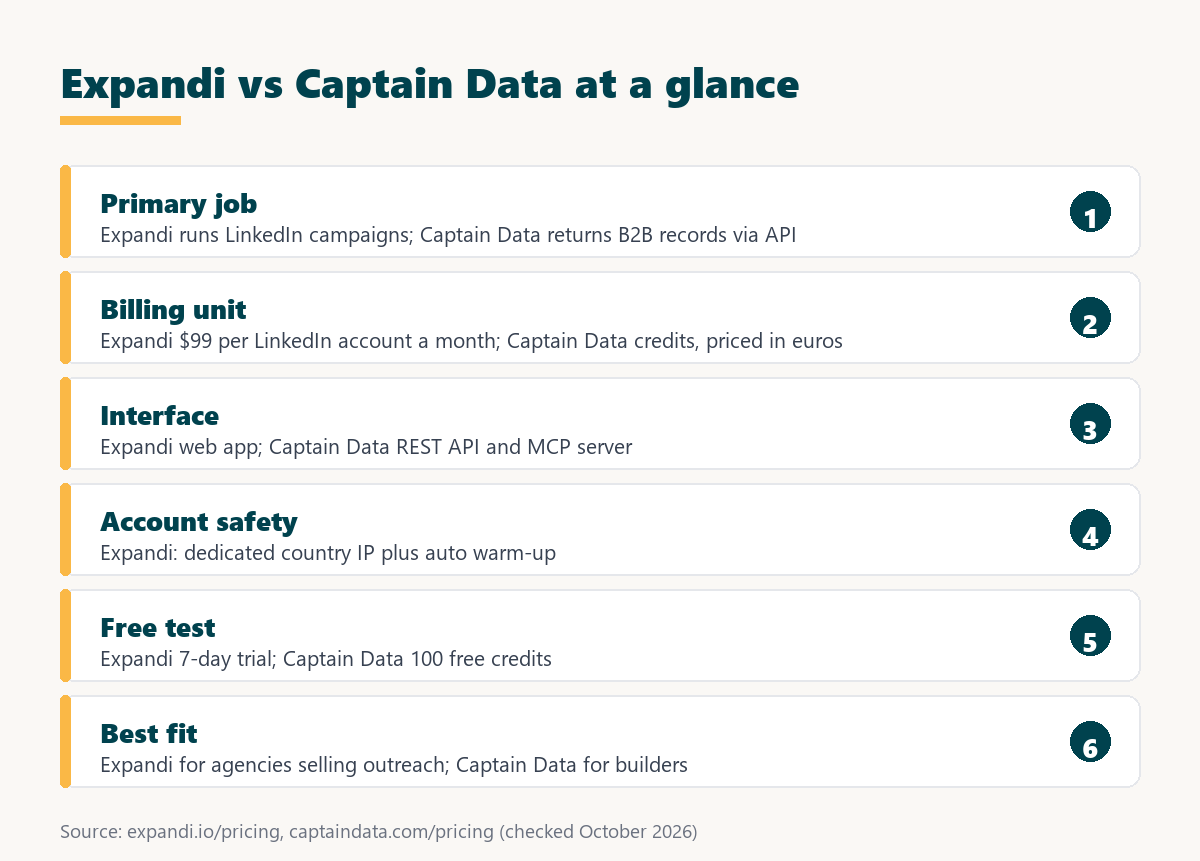
Expandi and Captain Data compare as an outreach application against a data source. Expandi offers a campaign interface, LinkedIn sending, and safety settings, while Captain Data offers endpoints, documentation, and compliance statements, and neither product tries to cover the other one’s core job in any meaningful way.
Source: expandi.io/pricing and Expandi help center, checked October 2026; captaindata.com/pricing and captaindata.com, checked October 2, 2026.
The comparison shows two products built for different operators, with Expandi serving people who run campaigns and Captain Data serving developers who need records delivered to their own systems.
Seen side by side, the overlap is almost empty, which is why the useful question is whether an agency needs one layer, the other, or both.
Who Controls Account Safety in Each Setup?
Account safety control is the question of who decides pacing, IP, and limits for a LinkedIn profile. In Expandi the vendor sets defaults and the user adjusts them. In a pipeline built on a data API, no LinkedIn profile sends anything, so outreach safety moves to whichever sending tool comes next in the stack.
Expandi’s help center describes the IP side of that responsibility directly:
“Everyone in Expandi gets their personal dedicated IP address.”
Expandi Help Center, IP Address
The warm-up guide adds that staying within 100 actions per week is recommended because LinkedIn enforces a weekly cap of 100 connection requests. Why a fixed address matters is covered in the explainer on what a dedicated IP is. LinkedIn’s own help center still says third-party automation is not permitted and that accounts using it risk restriction, so safety settings reduce exposure rather than remove it.
Agencies handling client profiles should treat safety as a vendor feature worth paying for, because a restricted client account costs more than the subscription that might have prevented it.
How Much Technical Skill Does Each Option Require?
Technical skill is the gap between buying a product and getting value from it. Expandi needs an operator who can connect an account, import a list, and write messages. Captain Data needs someone who can call a REST API, handle JSON responses, and store the results somewhere useful.
- Campaign operator: Expandi setup runs through a web interface where one person connects a profile, picks a campaign type, and activates it without code.
- API developer: Captain Data requires an API key and code that calls each endpoint, which means a developer or a technical operator on the team.
- Data storage: API responses arrive as JSON and need a database, spreadsheet, or CRM destination before the records become a usable prospect list.
- Credit monitoring: metered usage has to be tracked, because unused credits expire monthly and heavy searches can drain an allowance quickly.
- Ongoing maintenance: a self-built pipeline needs someone to fix errors, update field mappings, and adjust logic whenever the data or the goal changes.
Expandi needs campaign skills and patience through warm-up, while Captain Data needs engineering time, so the right option depends on which kind of hours an agency already has.
How Do the Free Trials Differ?
A free trial is a limited test before the first payment. Expandi offers seven days that apply only to the first subscription, while Captain Data offers 100 free credits with no credit card, which measures a test in records returned rather than in days on the calendar.
Expandi’s checkout asks for card details, and its FAQ says no charge is made until the seven days are up. Captain Data describes its offer as “No credit card required, 100 free credits to start.” A hundred credits covers up to 100 enrichment calls or 50 find calls at the published rates. The SaaS free trial guide covers how to plan any short evaluation.
A week of Expandi tests whether campaigns get replies, while 100 Captain Data credits test whether the records are good enough, so each trial answers a different question.
Want managed safety on a real client profile? Connect one LinkedIn account and run the seven-day Expandi trial.
Try Expandi for 7 Days →Checkout asks for card details · no charge until the seven days are up
Can Captain Data Feed an Expandi Campaign?
Captain Data can feed an Expandi campaign indirectly, because enriched records can be exported to a CSV file that Expandi imports as a lead list. Neither vendor documents a native connection to the other, so the handoff runs through files or custom code written by the agency’s own team.
- Record enrichment: the data API returns structured profiles that a developer filters down to the agency’s target accounts and decision makers.
- CSV export: the filtered records leave the agency’s own system as a CSV file with LinkedIn profile URLs and the fields used for personalization.
- Lead list import: Expandi accepts the CSV as a lead list, and its help center recommends assigning one lead list to one campaign at a time.
- Campaign execution: Expandi sends connection requests and follow-ups inside the warm-up schedule and limit ranges set for the connected profile.
- Event webhooks: Expandi fires events such as contact replied or connection request accepted back to the agency’s system for logging and follow-up.
The webhook side is documented in Expandi’s webhooks and integrations section, and the general mechanism is explained in the guide to how webhooks pass data between apps.
A file handoff is simple and reliable, although it means two products, two bills, and someone responsible for the export step between them.
When Is Captain Data the Better Pick?
Captain Data is the better pick when the goal is data inside a product or internal system rather than messages in an inbox. Teams building GTM software, AI agents, or large enrichment jobs need endpoints, compliance statements, and volume pricing far more than a campaign builder.
- Product builders: software teams embedding B2B data into an application need API access and predictable JSON rather than an outreach interface for operators.
- AI agent developers: the MCP server lets an assistant call people and company data as a tool, a job a LinkedIn sending platform does not attempt.
- High-volume enrichment: the configurator’s per-thousand rate falls as volume rises, which favors teams enriching hundreds of thousands of records each month.
- Compliance-led buyers: Captain Data states SOC 2 Type II certification and GDPR compliance, which matters to procurement teams reviewing data vendors.
- Multi-user teams: pricing scales with volume rather than people, so adding analysts or engineers to the account does not raise the bill.
HubSpot’s guide to APIs explains why builders reach for this kind of product:
“an API serves as a bridge that allows two software to communicate with each other”
HubSpot, Application Programming Interface
Naming where Captain Data wins keeps the comparison honest, since an agency buying Expandi to solve a data-infrastructure problem would be paying for campaigns it never needed.
When Is Expandi the Better Pick?
Expandi is the better pick when an agency needs prospects contacted on LinkedIn with safety handled by the platform. Operators without developers, with client profiles at stake, get campaigns, warm-up, and a dedicated IP in one per-account fee instead of a build project.
The per-account model maps onto agency retainers, and the Agency tier from ten accounts adds a dedicated Customer Success Manager and white-label use. According to Expandi’s platform data from May 2025 to April 2026, 28.5% of connection requests were accepted and 10.4% of outbound messages received a reply, figures from one vendor rather than a LinkedIn standard. Expandi also holds 4.3 out of 5 from 162 reviews on G2, checked October 2, 2026.
Expandi earns its fee when sending capacity and account protection are the constraint, which describes most agencies that sell LinkedIn outreach as a service.
How Should an Agency Evaluate Both Options?
An evaluation is a short structured test that checks each option against the agency’s real deliverable. Running the Expandi trial on one profile and the Captain Data free credits on one segment shows whether the need is outreach, data, or both before any money is committed to either vendor.
- Name the deliverable: deciding whether clients pay for conversations or for data determines which product is even relevant to the agency’s offer.
- Check developer capacity: confirming whether anyone on the team can call an API and maintain code decides whether Captain Data is realistic at all.
- Spend the free credits on one segment: 100 Captain Data credits are enough to judge record quality for a small target segment before buying volume.
- Run the Expandi week: the seven-day Expandi trial on one connected profile covers warm-up and a short Connector sequence on a prepared list.
- Compare twelve-month cost: tool fees plus developer or operator hours give the true annual cost of each path before either subscription renews.
A structured test replaces vendor positioning with the agency’s own evidence, which matters because Expandi states that subscription fees are nonrefundable once paid.
Verdict: Managed Safety or Pipeline Control?
The verdict is that Expandi suits agencies that sell LinkedIn outreach and want safety managed, and Captain Data suits technical teams that want control of a data pipeline. The two are complements more often than rivals, with data work upstream and Expandi campaigns downstream in the same stack.
Growth Hack Suite’s guide to go-to-market automation frames the same idea:
“Automating the glue between revenue tools is what lets a small team run like a large one.”
Growth Hack Suite, What Is GTM Automation?
Most agencies can settle the choice by asking what clients pay for, conversations or data, and then running the matching trial first.
Expandi vs Captain Data: Frequently Asked Questions
The 12 most-asked questions about Expandi vs Captain Data.
Is Expandi better than Captain Data for agencies?
For agencies that sell LinkedIn outreach, yes, because Expandi runs campaigns with warm-up and a dedicated IP. Captain Data suits technical teams that need B2B data delivered through an API.
What is Captain Data?
Captain Data describes itself as AI data for AI products: a REST API and MCP server that return people and company records for product builders, GTM platforms, and AI agents.
Does Captain Data send LinkedIn messages?
Captain Data’s official home and pricing pages, read on October 2, 2026, do not describe sending LinkedIn messages or connection requests.
How much does Expandi cost per account?
Expandi costs $99 per connected LinkedIn account per month, or $79 per account per month billed annually. Agencies with ten or more accounts get a custom quote.
How is Captain Data priced?
By credits. The configurator runs from 2,500 to 50 million credits a month, and the published example is 20,000 credits for EUR 600 a month billed monthly.
Do Captain Data credits roll over?
No. Captain Data’s pricing FAQ says unused credits do not roll over from one month to the next.
Does Captain Data charge for each user?
No. Captain Data says pricing scales with volume rather than features and has no fees tied to the number of users.
How do the free tests differ?
Expandi offers a seven-day trial on the first subscription. Captain Data offers 100 free credits with no credit card, so its test is measured in records rather than days.
Does Expandi include a dedicated IP?
Yes. Expandi’s help center says everyone in Expandi gets a personal dedicated IP address, assigned by the country chosen for the account.
Can Captain Data records be used in Expandi?
Yes, through a file. Records pulled from the API can be exported as a CSV and imported into Expandi as a lead list. No native connection between the two is documented.
Does Expandi have webhooks?
Yes. Expandi’s help center documents webhook events such as contact replied and connection request accepted, plus a reversed webhook for adding or pausing leads.
Which option needs a developer?
Captain Data, because it is used through a REST API or MCP server. Expandi is run from a web interface by a campaign operator.
Selling LinkedIn outreach without a developer on the team? Start the seven-day Expandi trial on one account.
Start Your 7-Day Expandi Trial →Seven-day trial on the first subscription · cancel anytime · paid fees are nonrefundable
Growth Hack Suite Editorial, Outbound Sales Team
How we compared: every Expandi figure was read from expandi.io pricing, FAQ, and Terms and from the Expandi help center articles on campaign limits, warm-up, IP addresses, and webhooks. Captain Data figures were read from captaindata.com and its pricing configurator on October 2, 2026, in euros. No paid Captain Data plan was tested, so its capabilities are described only as its official pages describe them.
Last checked: October 2026. When either vendor changes its prices or product, this page is updated first.
Affiliate disclosure: this page contains an affiliate link to Expandi. If a subscription is purchased through it, Growth Hack Suite may earn a commission at no extra cost to the buyer. No other tool on this page pays Growth Hack Suite, and the assessment does not change either way.