

Table of Contents
Expandi vs TexAu is a choice between a finished LinkedIn campaign tool and a build-it-yourself lead table. Expandi costs $99 per LinkedIn account per month and ships campaign types, warm-up, and a dedicated IP ready to run. TexAu starts at $79 a month billed yearly for 2,500 credits and focuses on finding, enriching, and scoring leads before another tool sends anything.
Last checked: October 2026. Expandi figures come from expandi.io pricing, FAQ, Terms, and help center; TexAu figures come from texau.com and texau.com/pricing, read on October 2, 2026. Prices change, so confirm both pages before buying.
Want LinkedIn campaigns that run without assembling a stack first? Test Expandi on one account for seven days.
Start Your 7-Day Expandi Trial →Seven-day trial on the first subscription · dedicated country-based IP for each account · cancel anytime
Expandi vs TexAu: Which One Fits an Agency Workflow?
Expandi vs TexAu is a decision between running LinkedIn outreach and preparing lead data. Expandi fits agencies that need client campaigns sending this week with safety controls included, while TexAu fits agencies that want one credit-based table to find, enrich, verify, and score leads before another tool does the sending.
The two products were often grouped together a few years ago, when TexAu marketed itself as an automation builder with LinkedIn recipes. The current TexAu site describes something different. Its tagline reads “The GTM spreadsheet engine for agencies and SaaS teams,” and its pricing page talks about credits, enrichment waterfalls, and CRM sync rather than connection requests or message sequences.
That change matters for an agency deciding where to spend setup hours. Expandi asks for a LinkedIn account, a lead list, and a sequence, and then it runs. TexAu asks for data sources, enrichment columns, scoring rules, and a destination, and then it hands the cleaned list to something else. The two tools sit at different stages of the same pipeline.
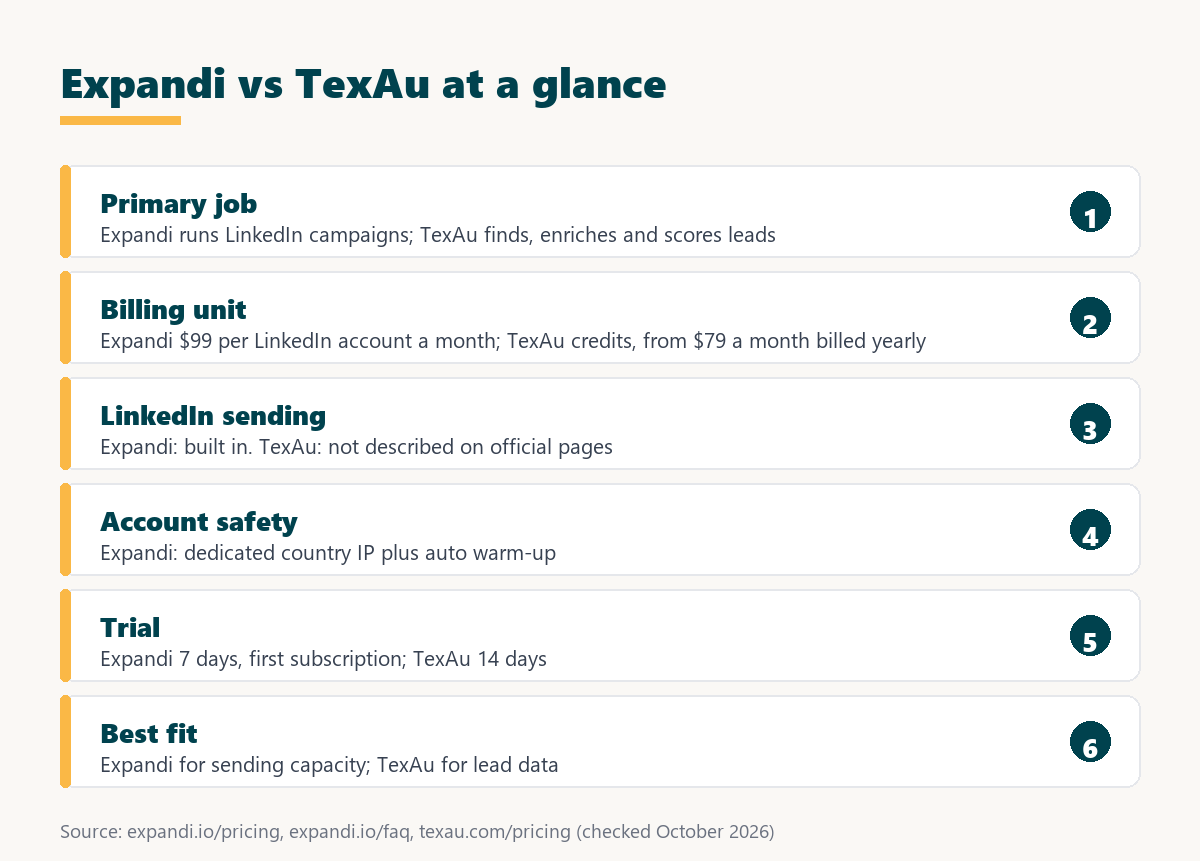
The short answer depends on the bottleneck: agencies short on outreach capacity lean toward Expandi, and agencies short on clean lead data lean toward TexAu or run both side by side.
What Is the Core Difference Between Ready-Made Campaigns and a DIY Builder?
A ready-made campaign is a prebuilt outreach flow where the vendor supplies the steps, limits, and safety settings. A DIY builder is a toolkit where the operator assembles data sources, actions, and destinations. Expandi follows the first model for LinkedIn, and TexAu follows the second model for lead data.
Five traits separate the two models in daily agency work:
- Prebuilt campaign types: Expandi lists Connector, Messenger, Mobile Connector, and other campaign types that start from a defined sequence instead of a blank canvas or an empty table.
- Spreadsheet-style lead table: TexAu organizes work as rows and columns, so each lead gains enrichment, verification, and scoring fields as the operator adds steps to the table.
- Credit-based actions: TexAu deducts a credit for each successful lookup, which ties cost to data volume instead of to the number of LinkedIn profiles an agency manages.
- Destination tools: TexAu pushes finished leads into a CRM or a separate sending platform, which means outreach itself happens in another product chosen by the agency.
- Vendor-set safety defaults: Expandi ships warm-up and limit ranges as part of each connected account, so operators adjust defaults rather than designing account protection from scratch.
Wikipedia describes the concept TexAu now builds around in one line:
“orchestrated and repeatable patterns of activity, enabled by the systematic organization of resources”
Wikipedia, Workflow
The broader idea of chaining revenue tools together is covered in the Growth Hack Suite explainer on GTM automation and how go-to-market workflows connect.
Ready-made tools trade flexibility for speed, while DIY tools trade speed for control, so the right pick depends on how much assembly time an agency can bill or absorb.
What Does Expandi Deliver Out of the Box?
Expandi is a cloud-based LinkedIn automation platform that delivers finished campaign types, a sequence builder, and account-safety settings from the first login. Each connected account receives a dedicated country-based IP, an automatic warm-up, and multichannel steps that combine connection requests, LinkedIn messages, and email inside one sequence.
- Campaign types: the help center lists Connector, Mobile Connector, Messenger, Open InMail, Group, Event Invite, Company Follow Invite, and Inbound campaigns ready to configure.
- Sequence builder: an If/Action builder adds conditions between steps, so a follow-up only fires after a connection is accepted or a defined delay has passed.
- Profile auto warm-up: the gradual option starts at 5 actions per day and adds 3 more every two days until it reaches a ceiling of 21 daily actions.
- Dedicated country-based IP: Expandi states that every user gets a personal dedicated IP address, assigned from the country selected when the LinkedIn account is connected.
- Campaign limits: the help center caps one campaign at 5,000 leads and allows 15 active campaigns at a time, with up to 500 campaigns per account.
Expandi removes most build decisions, which is why agencies can launch a client campaign quickly but cannot reshape the platform into a general data tool.
What Does TexAu Do Today?
TexAu is a credit-based GTM spreadsheet that finds leads, enriches them, verifies emails, scores them, and pushes them to a CRM or sending tool. Its own tagline calls it a spreadsheet engine for agencies and SaaS teams, and its official pages do not describe sending LinkedIn messages or connection requests.
The home page summarizes the flow as finding leads, enriching them, scoring them, and pushing them to a CRM from a familiar table (texau.com). The pricing page lists the components that sit inside each plan:
- Lead search: TexAu prices lead search in the same credits as enrichment, so list building and data cleanup draw from one shared monthly balance.
- Waterfall enrichment: the pricing page lists a waterfall across 12 data sources, which tries providers in sequence until one returns a match for the lead.
- Email verification: TexAu states a 97% verification figure for its own checker, a vendor claim that has not been tested independently for this comparison.
- AI lead scoring: scoring columns rank enriched leads so an agency can push only the strongest segment into the outreach tool that runs the campaign.
- CRM sync: Solo and Starter sync to a CRM one way on a daily schedule, while Teams adds bidirectional hourly sync with the connected CRM.
TexAu explains its billing unit plainly on the pricing page:
“One successful email find is one credit. One verified email is one credit.”
TexAu pricing page
TexAu now sits upstream of outreach, preparing and routing lead data, so an agency still needs a separate sending tool before any prospect receives a message.
How Does Expandi Pricing Work?
Expandi pricing is a per-account model where each connected LinkedIn profile costs $99 per month, or $79 per account per month when billed annually. Every account gets the full Business feature set, and agencies running ten or more accounts move to an Agency tier priced by custom quote instead of a listed rate.
Expandi’s FAQ states the headline figure without qualification:
“Expandi costs 99 USD per account per month.”
Expandi FAQ
Taxes are added by billing country, and the Terms state that subscription fees are nonrefundable unless required by law (Expandi Terms and Conditions). Image and GIF personalization and video personalization through Sendspark are paid add-ons with no published price.
The Expandi bill grows in a straight line with client accounts, which makes pass-through billing simple but gives no volume break below the ten-account Agency threshold.
How Does TexAu Pricing Work?
TexAu pricing is a credit model where plans bundle monthly credits and team members. Solo costs $79 a month billed yearly for 2,500 credits, Starter costs $199 a month billed yearly for 8,000 credits and three members, and Teams costs $549 a month billed yearly for 25,000 credits and five members.
An Enterprise tier sits above Teams on custom pricing. Extra members cost $99 per member per month on Starter and Teams, credits roll over up to twice the monthly balance from Starter upward, and TexAu says yearly billing saves about 17%. The monthly toggle could not be read reliably on October 2, 2026, so only yearly figures appear here. The concept behind this model is explained in the guide to credit-based pricing for sales tools.
Source: expandi.io/pricing, expandi.io/faq and Expandi help center, checked October 2026; texau.com/pricing, checked October 2, 2026. TexAu figures are yearly-billing rates.
Expandi charges per LinkedIn account with no usage meter, while TexAu charges per credit bundle with included team members, so the two prices measure different things and cannot be compared seat for seat.
TexAu adds context on what the entry bundle buys, stating that 2,500 credits often covers roughly 450 to 500 enriched leads depending on the waterfall and verification mix.
TexAu costs scale with lookup volume rather than with LinkedIn profiles, which rewards agencies that enrich selectively and penalizes those that push every raw list through the waterfall.
How Do Expandi and TexAu Compare Feature by Feature?
Expandi and TexAu compare as an outreach engine against a data workbench. Expandi covers LinkedIn sending, warm-up, IP assignment, and campaign statistics, while TexAu covers lead search, waterfall enrichment, email verification, scoring, and CRM sync, with few features that overlap directly between the two products.
Source: expandi.io/pricing, Expandi help center and Expandi IP article, checked October 2026; texau.com/pricing and texau.com, checked October 2, 2026.
The feature table shows two tools with little overlap: Expandi owns the LinkedIn sending and safety rows, while TexAu owns the lead data and CRM sync rows.
Because the feature sets barely overlap, most agencies are really choosing which job to solve first rather than choosing one vendor to replace the other.
How Much Setup Work Does Each Tool Require?
Setup work is the time between signing up and the first prospect receiving a message. Expandi needs a connected LinkedIn account, a lead list, and a campaign, then waits through warm-up. TexAu needs sources, enrichment columns, and a connected sending tool before any outreach happens at all.
The steps that consume time look different in each product:
- Account connection: Expandi links a LinkedIn profile through its Chrome extension or login details and assigns a country-based IP during that same connection step.
- Campaign activation: Expandi notes that a newly activated campaign can take up to 45 minutes before the first action is sent from the connected account.
- Warm-up ramp: the gradual warm-up runs over 14 days, starting at 5 actions daily and climbing toward 21, which stretches the first sending week.
- Table design: TexAu requires choosing data sources, enrichment columns, verification, and scoring rules before a list is ready to leave the spreadsheet.
- Destination wiring: TexAu output has to reach a CRM or a separate sending platform, which adds an integration or export step before outreach begins.
Expandi front-loads waiting through warm-up, while TexAu front-loads design decisions, so agencies should budget calendar time for the first and operator hours for the second.
How Does Each Tool Handle LinkedIn Account Safety?
LinkedIn account safety is the set of controls that keep automated activity within limits the platform tolerates. Expandi documents a dedicated IP for each account, a gradual warm-up, and limit ranges. TexAu publishes no comparable LinkedIn safety documentation on its pricing or home pages, which fits its data-first positioning.
Expandi’s warm-up guide adds a weekly reminder: it recommends staying within 100 actions per week because LinkedIn enforces a weekly cap of 100 connection requests. A fixed address also matters, and the explainer on what a dedicated IP is and why it matters covers why a shared pool raises risk.
No tool removes the underlying policy risk. LinkedIn’s own help center says it does not permit third-party software that automates activity on its website, and members who use such tools risk having their accounts restricted (LinkedIn Help, prohibited software). Safety settings reduce exposure; they do not make automation compliant.
Safety documentation matters most to agencies handling client profiles, because a restricted client account costs far more than any monthly subscription saved.
How Do the Free Trials Differ?
A free trial is a time-limited test of a paid plan before the first charge. Expandi offers seven days that apply only to the first subscription, while TexAu offers fourteen days with no credit card and states that the trial includes full access to the workflow and its features.
Expandi’s checkout asks for card details, and its FAQ says no charge is made until the seven days are up. The Terms limit that trial to the first subscription on a user account. TexAu describes its trial as “No credit card. Full access to the workflow.” How to structure any short evaluation is covered in the SaaS free trial guide.
The longer TexAu trial suits data experiments, while the Expandi week is short enough that a lead list and message draft should be ready before the account connects.
Prefer campaigns that are ready on day one? Connect one LinkedIn account and run the seven-day Expandi trial.
Try Expandi for 7 Days →Checkout asks for card details · no charge until the seven days are up
Can Expandi and TexAu Work Together in One Stack?
Expandi and TexAu can work together as two stages of one pipeline, with TexAu preparing lead lists and Expandi running the LinkedIn outreach. Expandi imports leads through CSV files and Sales Navigator URLs, and its webhooks pass campaign events such as replies and accepted connections to other tools.
No native integration between the two is listed on TexAu’s home page, so the handoff is a file or a webhook rather than a one-click connection. A practical pipeline has five stages:
- List building stage: TexAu searches and enriches prospects inside its table, producing a cleaned file with verified emails, scores, and LinkedIn profile URLs for each row.
- CSV handoff: the finished segment is exported from TexAu and imported into Expandi as a lead list, one list assigned to one campaign at a time.
- Campaign stage: Expandi runs connection requests, messages, and email follow-ups on the warmed-up account, inside the limits set for that profile.
- Event webhooks: Expandi fires webhook events such as contact replied or connection request accepted, which other tools can catch and act on.
- CRM record: replies and outcomes land in the CRM through TexAu sync or the Expandi webhook, keeping one record of each prospect’s history.
Expandi documents its event and reversed webhooks in the webhooks and integrations section of its help center, and the general mechanism is explained in the guide to how webhooks pass data between apps.
Running both tools avoids forcing either one outside its design, although it means two subscriptions and a manual or webhook-based handoff between them.
When Is TexAu the Better Pick?
TexAu is the better pick when the agency problem is lead data rather than LinkedIn sending. Teams that already own an outreach tool, need verified emails, and want pay-on-match credits with included team members get more from TexAu than from a second sending platform.
- Email-first agencies: teams sending through a cold email platform need enriched and verified addresses far more than LinkedIn campaign types or account warm-up.
- Data-quality projects: cleaning a client’s existing database is a table job, and a credit model charges only for the records that come back matched.
- Pay-on-match budgets: TexAu states that failed lookups are not charged, so wasted spend on unmatched records stays low compared with flat per-record pricing.
- Multi-member teams: Starter includes three members and Teams includes five, which suits agencies where several analysts share one data workspace.
- CRM-centric workflows: bidirectional hourly sync on Teams keeps records current in the CRM without a separate integration layer between the two systems.
HubSpot’s glossary defines the job TexAu is built around:
“Lead enrichment is the process of gathering additional data about prospects to transform basic contact information into comprehensive customer profiles.”
HubSpot, What Is Lead Enrichment?
Naming where TexAu wins keeps the comparison honest, since an agency buying Expandi to fix a data problem would pay for campaigns it cannot fill.
When Is Expandi the Better Pick?
Expandi is the better pick when the agency needs LinkedIn outreach running under documented safety controls. Agencies with ready lead lists, client profiles to protect, and no wish to assemble a stack get campaigns, warm-up, and a dedicated IP inside one per-account price.
The per-account model also maps cleanly onto agency billing. One client profile equals one fee, which can be passed through in the retainer, and the Agency tier opens at ten accounts with a dedicated Customer Success Manager and white-label use. According to Expandi’s platform data from May 2025 to April 2026, 28.5% of connection requests were accepted and 10.4% of outbound messages received a reply, figures from one vendor rather than a LinkedIn standard.
Independent reviewers are broadly positive too: Expandi holds 4.3 out of 5 from 162 reviews on G2, checked October 2, 2026.
Expandi earns its fee when sending capacity and account protection are the constraint, which describes most agencies selling LinkedIn outreach as a service.
How Should an Agency Test Both Tools Before Paying?
A side-by-side test is a short trial run that sends the same client segment through each tool during its trial window. Running it shows real setup hours, data quality, and outreach readiness before Expandi fees become nonrefundable or TexAu credits start billing on the yearly plan.
- Define the bottleneck: writing down whether the agency lacks lead data or sending capacity decides which trial deserves attention first and which one can wait.
- Enrich one segment in TexAu: the fourteen-day TexAu trial is long enough to build, enrich, verify, and score a single client segment end to end.
- Export the cleaned list: the finished rows leave TexAu as a CSV with profile URLs, ready to become one Expandi lead list for one campaign.
- Run the Expandi week: the seven-day Expandi trial on one connected account covers warm-up and a short Connector sequence using the imported list.
- Compare hours and readiness: setup hours, match rates, and campaign status are logged for both tools before either subscription reaches its first invoice.
A structured test replaces vendor claims with the agency’s own numbers, which matters because Expandi states that subscription fees are nonrefundable once paid.
Verdict: Which Tool Should an Agency Choose?
The verdict is that Expandi wins for agencies that sell LinkedIn outreach and want it running fast, and TexAu wins for agencies that need a lead data workbench. Many agencies will pair them, using TexAu upstream for lists and Expandi downstream for LinkedIn campaigns on client profiles.
Growth Hack Suite’s guide to coordinated outreach makes the same point about combining channels rather than relying on one:
“A coordinated mix of touches consistently outperforms any single channel used alone.”
Growth Hack Suite, What Is Multichannel Outreach?
Most agencies can decide by asking which is scarcer today, clean leads or sending capacity, and then confirming that answer inside the two trials.
Expandi vs TexAu: Frequently Asked Questions
The 12 most-asked questions about Expandi vs TexAu.
Is Expandi better than TexAu for agencies?
It depends on the job. Expandi is better for agencies selling LinkedIn outreach because it runs campaigns with warm-up and a dedicated IP. TexAu is better for agencies whose main need is finding, enriching, and verifying lead data.
What is TexAu used for now?
TexAu describes itself as a GTM spreadsheet engine for agencies and SaaS teams. It finds leads, enriches them through a waterfall of sources, verifies emails, scores leads, and pushes them to a CRM.
Does TexAu send LinkedIn messages?
TexAu’s official home and pricing pages, read on October 2, 2026, do not describe sending LinkedIn connection requests or messages. Teams that need that capability should confirm it with TexAu directly.
How much does Expandi cost per account?
Expandi costs $99 per connected LinkedIn account per month, or $79 per account per month when billed annually. The Agency tier for ten or more accounts is quoted by sales.
How much does TexAu cost?
Billed yearly, TexAu Solo costs $79 a month for 2,500 credits, Starter costs $199 a month for 8,000 credits, and Teams costs $549 a month for 25,000 credits. Enterprise is custom.
What is a TexAu credit?
A credit is TexAu’s billing unit. Its pricing page says one successful email find is one credit and one verified email is one credit.
Does TexAu charge for failed lookups?
No. TexAu states that credits are deducted only when a successful match comes back, so lookups that return nothing are not charged.
How long are the trials?
Expandi’s trial lasts seven days and applies only to the first subscription. TexAu’s trial lasts fourteen days and, according to TexAu, needs no credit card.
Does Expandi include a dedicated IP?
Yes. Expandi states that every user gets a personal dedicated IP address, assigned by the country chosen when the LinkedIn account is connected.
Can Expandi and TexAu be used together?
Yes, as two stages of one pipeline. TexAu prepares and exports a cleaned lead list, and Expandi imports it as a CSV and runs the LinkedIn campaign. No native integration between them is listed.
Can Expandi fees be refunded?
No. Expandi’s Terms state that subscription fees are nonrefundable unless required by law, which is why using the trial week well matters.
Which tool needs less setup?
Expandi needs less design work because campaign types and safety settings are prebuilt, although warm-up stretches the first weeks. TexAu needs more upfront design of sources, columns, and destinations.
Lead lists ready and client profiles to protect? Start the seven-day Expandi trial on one LinkedIn account.
Start Your 7-Day Expandi Trial →Seven-day trial on the first subscription · cancel anytime · paid fees are nonrefundable
Growth Hack Suite Editorial, Outbound Sales Team
How we compared: every Expandi figure was read from expandi.io pricing, FAQ, and Terms and from the Expandi help center articles on campaign limits, warm-up, and IP addresses. TexAu figures were read from texau.com and texau.com/pricing on October 2, 2026. No paid TexAu plan was tested, so TexAu capabilities are described only as its official pages describe them.
Last checked: October 2026. When either vendor changes its prices or product, this page is updated first.
Affiliate disclosure: this page contains an affiliate link to Expandi. If a subscription is purchased through it, Growth Hack Suite may earn a commission at no extra cost to the buyer. No other tool on this page pays Growth Hack Suite, and the assessment does not change either way.