Table of Contents
A credit based pricing model charges for software by consumable units called credits instead of a flat seat fee, so each action a user takes spends from a monthly pool. Email finder tools use it because finding and verifying an address is a measurable event: Hunter spends 1 credit to find an email and 0.5 credit to verify one. The model ties cost to usage, which rewards efficient teams and penalizes wasteful ones.
What Is a Credit-Based Pricing Model? Core Definition for B2B Buyers
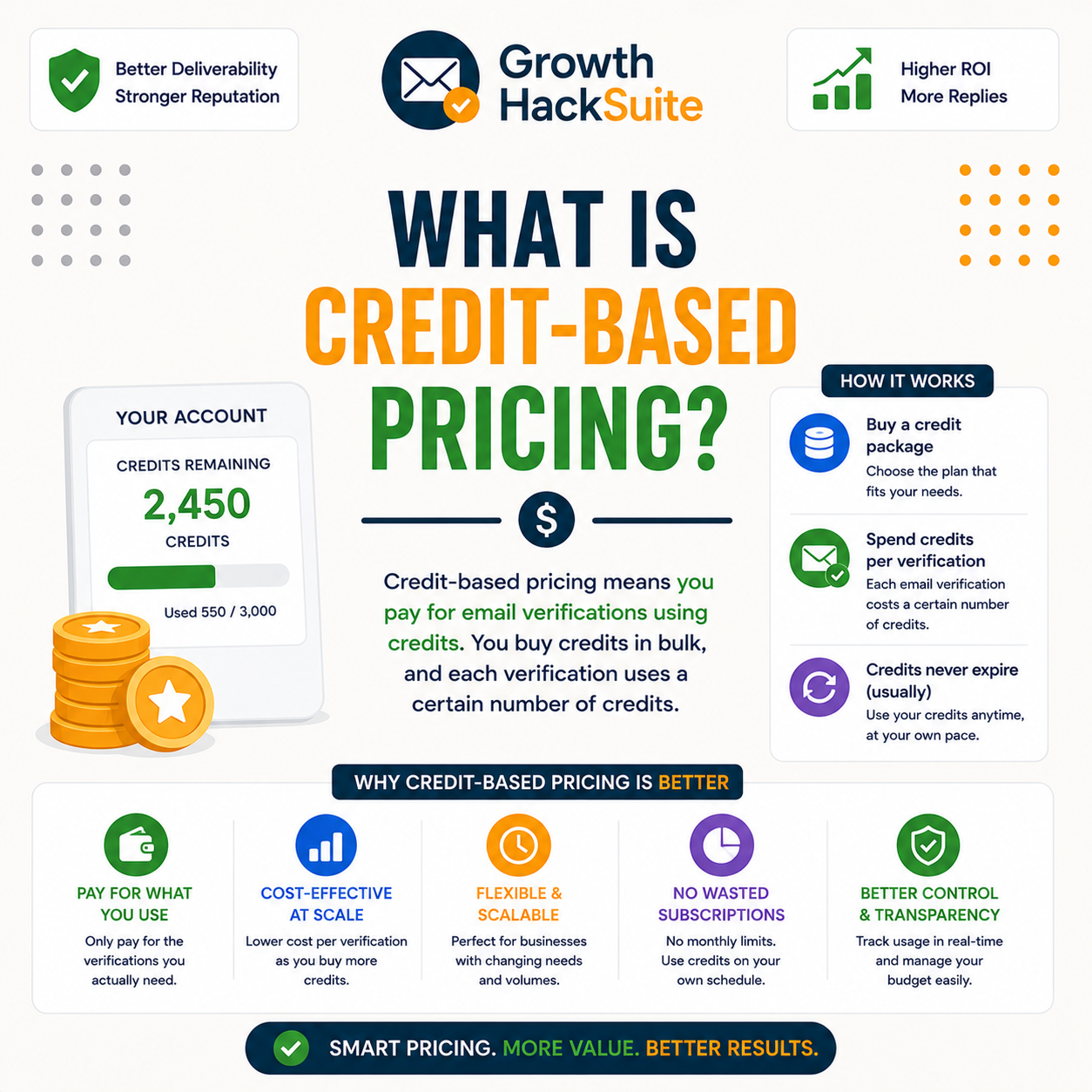
A credit-based pricing model is a consumption model where a subscription includes a fixed allowance of credits each billing cycle, and every chargeable action draws down that allowance. One credit equals one defined unit of work, such as finding an email address. When the pool runs out, the user buys more or waits for the monthly reset. Cost scales with how much work is done, not how many people are on the account.
It sits between two other common models. Flat-rate pricing charges one price for unlimited use, and per-seat pricing charges per user regardless of activity. Credit-based pricing instead meters the work itself, which is why data and API tools favor it: the vendor’s own cost rises with each lookup, so passing that through as credits keeps pricing fair on both sides.
In short, credit-based pricing meters the work rather than the headcount or the calendar. That makes it the natural fit for email finders, where every lookup has a real data cost behind it.
How Does Credit-Based Pricing Work in Email Finder Tools?
In an email finder, one credit buys one defined action and the plan tier sets the monthly pool. Hunter spends 1 credit to find an email and 0.5 credit to verify one, drawn from a single shared pool. Free includes 50 credits, Starter 2,000, Growth 10,000, and Scale 25,000 per month. The same search is counted only once per billing period, and annual billing discounts every tier by a flat 30 percent.
- Action-to-credit mapping: each chargeable action has a fixed credit cost, so a find at 1 credit and a verification at 0.5 credit let teams predict burn before they run a campaign.
- Shared monthly pool: finds and verifications draw from one allowance, so a verification-heavy month depletes the same pool that funds new lookups, which changes how a plan should be sized.
- Tier sets the allowance: moving from Starter to Growth to Scale raises the credit pool, not the feature set, so the upgrade decision is mostly a volume calculation.
- Reset and rollover rules: most credit plans reset monthly without rollover, so unused credits expire, which means buying far above real usage wastes money every cycle.
- Top-up packs: when the pool runs dry, extra credit packs cost more per credit than in-plan credits, signaling it may be cheaper to move up a tier.
For the exact credit mechanics on one tool, see how Hunter credits are counted and spent, and the full Hunter pricing model breakdown for per-credit math across tiers.
“Pricing is the process whereby a business sets and displays the price at which it will sell its products and services, and may be part of the business’s marketing plan.”
Wikipedia, Pricing : credit-based pricing is one such method, setting price per unit of work consumed rather than per user or per month.
What Are the Top 5 Reasons SaaS Tools Use Credit-Based Pricing?
Vendors adopt credit pricing because it aligns revenue with their own data costs and gives buyers a low entry point. Five reasons explain why email finders, enrichment tools, and AI products keep choosing this model over flat or per-seat plans.
- Cost alignment: each lookup carries a real data-sourcing cost for the vendor, so charging per credit passes that cost through fairly instead of subsidizing heavy users with light ones.
- Low entry barrier: a small credit allowance lets a solo founder start cheaply and scale spend only as usage grows, widening the top of the vendor’s funnel.
- unlimited team members become possible: because cost rides on credits, vendors like Hunter can include unlimited team members, removing the per-seat tax that blocks team adoption.
- Natural upgrade path: a team that consistently exhausts its pool has a clear, usage-driven reason to move up a tier, making expansion revenue predictable for the vendor.
- Fair handling of spiky demand: campaigns and list-builds come in bursts, and a monthly pool plus top-ups absorbs spikes better than a flat plan sized for peak load.
The model wins when usage is variable and teams are multi-person, which describes most outbound sales orgs. That is why credit pricing dominates the email finder category.
What Are the 5 Limitations of Credit-Based Pricing for Buyers?
Credit pricing is fair in theory but has real downsides buyers must plan around. Five limitations cause most budget surprises, and each is manageable with forecasting and workflow hygiene.
- Mid-month exhaustion: a credit pool can run dry before the cycle ends, stalling outreach unless the team buys top-ups at a higher per-credit rate.
- No rollover waste: credits that reset without rollover punish months of light use, so a plan sized for peak demand quietly wastes spend in slow periods.
- Hidden double-spend: verifying addresses a finder already returned, or re-running duplicate rows, burns credits twice for the same contact and inflates real cost per lead.
- Forecasting difficulty: teams new to a tool struggle to estimate credit demand, leading to over-buying for safety or under-buying that interrupts campaigns.
- Top-up premium: extra credit packs almost always cost more per credit than the tier rate, so frequent top-ups are a signal the team is on the wrong plan.
“As covered in our Hunter.io pricing analysis, the real cost levers in a credit model are monthly credit volume and the annual discount, not seat count, so plans must be sized to typical usage rather than peak demand.”
Growth Hack Suite, Hunter.io pricing breakdown
None of these limitations is a dealbreaker, but each rewards teams that forecast demand and keep credit waste low. Translating credits into cost per lead is the cleanest way to compare plans, as shown in our Hunter cost-per-lead breakdown.
How Do You Estimate Credit Needs and Avoid Overpaying in 5 Steps?
Right-sizing a credit plan is a five-step forecast: count your monthly actions, convert them to credits, add headroom, pick the matching tier, and review quarterly. Done once, it prevents both mid-month stalls and the slow bleed of unused credits.
- Step 1, count monthly actions: estimate how many addresses you need to find and how many to verify each month, based on your outreach volume and list-building cadence.
- Step 2, convert to credits: apply the tool’s rates, for example finds at 1 credit plus verifications at 0.5 credit, to turn raw actions into a total monthly credit figure.
- Step 3, add 20 to 50 percent headroom: build in buffer for campaign spikes so a busy month does not force premium top-ups, but avoid buying so far ahead that credits expire unused.
- Step 4, match the tier and billing: pick the smallest tier that covers your buffered demand, then choose annual billing if 12-month usage is confident, capturing the flat 30 percent discount.
- Step 5, review quarterly: compare actual credit burn to your estimate every quarter, moving up if you repeatedly top up or down if you leave large balances unused.
Want to see how a credit pool feels before you pay? Start on Hunter free with 50 monthly credits and watch how finds and verifications draw down in real use.
Try Hunter.io Free →Free plan, no credit card, unlimited team members
Forecast once, size the tier to typical usage, and the credit model becomes predictable instead of surprising. The teams that win on credit pricing are the ones that measure burn and clean their inputs.
Want the full picture before you commit? Read the full Hunter.io email finder review for real pricing, accuracy, and who it fits.
Credit-Based Pricing: Frequently Asked Questions
The 12 most-asked questions about credit-based pricing for email finder and B2B data tools.
The 12 most-asked questions about credit-based pricing.
What is a credit-based pricing model?
A model where a subscription includes a fixed allowance of credits per cycle, and each chargeable action spends from that pool. One credit equals one defined unit of work, such as finding an email. Cost scales with usage rather than with the number of users.
How many credits does an email finder action cost?
It varies by tool. Hunter spends 1 credit to find an email and 0.5 credit to verify one, from a single shared pool. Always check whether finding and verifying draw from the same allowance, because that changes how large a plan you need.
Why do email finder tools use credits instead of flat pricing?
Each lookup carries a real data cost for the vendor, so credits pass that cost through fairly. Credits also enable a cheap entry point and let vendors include unlimited team members, since cost rides on usage rather than headcount.
Do unused credits roll over to the next month?
Usually not. Most credit plans, including Hunter, reset monthly without rollover, so unused credits expire. That makes it important to size a plan to typical usage rather than to peak demand you rarely hit.
What happens when I run out of credits?
You either buy a top-up pack, upgrade to a higher tier, or wait for the monthly reset. Top-up packs usually cost more per credit than in-plan credits, so frequent top-ups signal you should move up a tier instead.
How is credit-based pricing different from per-seat pricing?
Per-seat pricing charges per user regardless of activity, so cost rises with headcount. Credit-based pricing charges for work consumed, so a five-person team on shared credits can cost the same as one person doing the same volume.
Is credit-based pricing cheaper than flat-rate?
It depends on usage. For variable or light usage, credits are usually cheaper because you only pay for what you use. For heavy, predictable, unlimited use, a flat-rate plan can be cheaper per action. Forecast your volume to compare.
How do I estimate how many credits I need?
Count monthly finds and verifications, convert each to its credit cost, then add 20 to 50 percent headroom for spikes. Match the smallest tier that covers that buffered figure, and review actual burn each quarter to adjust.
Does verifying an email cost a separate credit?
On Hunter, verification costs 0.5 credit from the same pool that funds finds. On paid plans, emails returned by Email Finder arrive auto-verified, so you avoid paying twice for the same contact. Re-verifying those wastes credits.
What is the most common mistake with credit pricing?
Wasting credits through duplicate lookups and redundant verifications, then over-buying a tier to compensate. Deduplicating lists and skipping re-verification of already-verified finds recovers a meaningful share of the monthly pool.
Can I share credits across my team?
On credit models with unlimited team members, like Hunter, the whole team shares one monthly pool at no extra per-user cost. This is a core advantage over per-seat tools, where every added rep raises the bill.
How does annual billing affect credit pricing?
Annual billing typically discounts the effective monthly price; Hunter applies a flat 30 percent across all paid tiers. The credit allowance stays the same, so annual billing lowers your cost per credit when 12-month usage is confident.
Credit-based pricing meters the work itself, which is why it fits email finders so well. Read it as a usage forecast, not a sticker price: estimate your monthly actions, size the tier to typical demand, keep waste low, and the model turns predictable and fair.
See how a credit pool works on real lookups
Start on Hunter free with 50 monthly credits, watch finds and verifications draw down, and forecast the tier you actually need before paying.
Try Hunter.io Free →Free plan, no card, unlimited team members.