The Hunter.io pricing model is a consumption-based subscription built on one shared monthly credit pool per plan, where 1 credit finds an email and 0.5 credit verifies one. Cost per email found ranges from 0.0245 dollars on Starter monthly (49 dollars / 2,000 credits) to 0.0084 dollars on Scale annual (209 dollars / 25,000 credits), a 66 percent drop from the entry tier to high-volume annual billing. Annual billing applies a flat 30 percent discount across every paid tier, and unlimited team members are included on all plans, so credits, not seats, drive cost.
Table of Contents
What Is the Hunter.io Pricing Model and How Does It Work?
The Hunter.io pricing model is a consumption-based subscription where every plan includes one shared monthly credit pool. One credit finds an email through Domain Search or Email Finder, and 0.5 credit verifies an email through the Email Verifier. The same search or verification is counted only once per billing period.
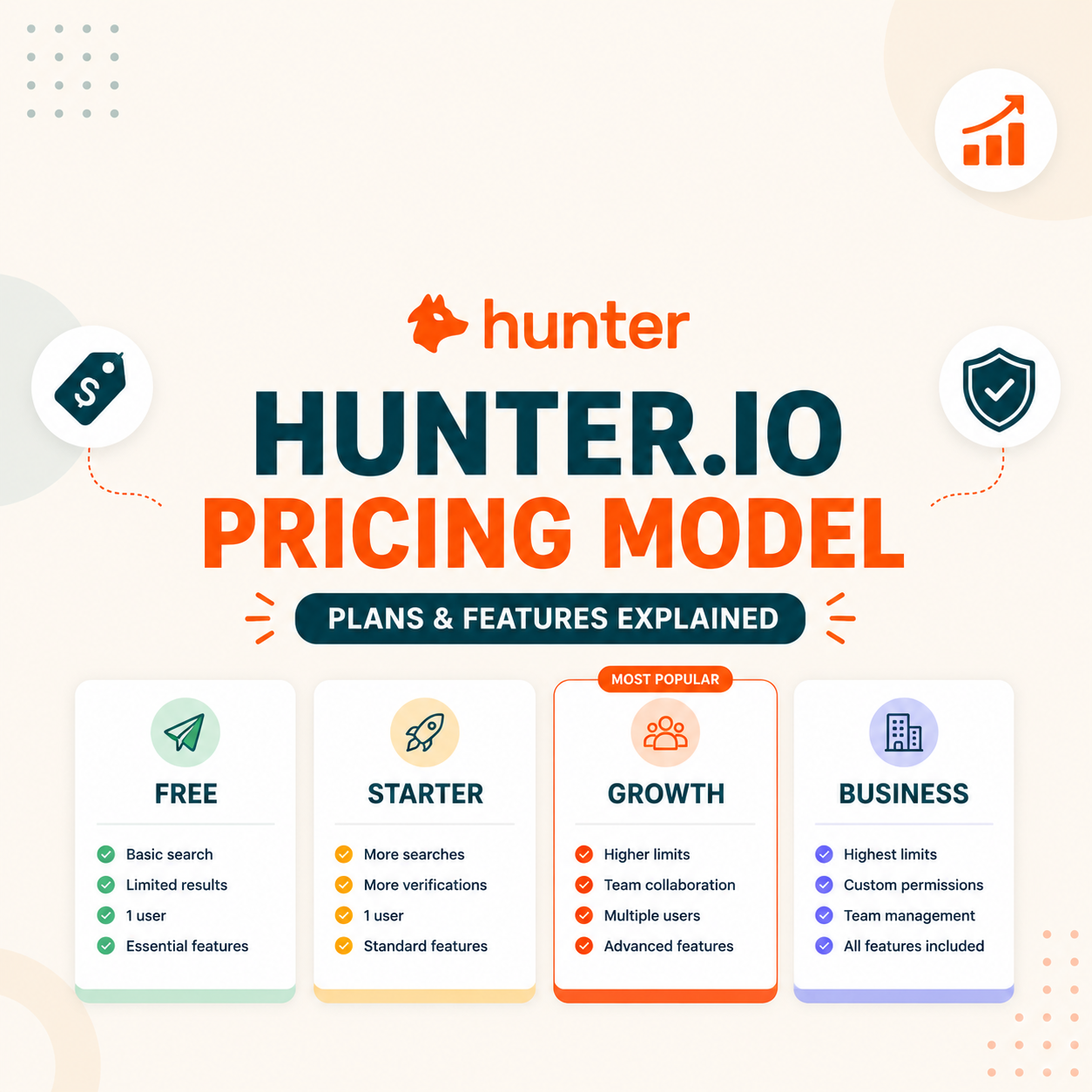
Free includes 50 credits a month. Starter is 49 dollars a month (34 billed annually) with 2,000 credits and 3 connected email accounts. Growth is 149 (104 annually) with 10,000 credits and 10 accounts. Scale is 299 (209 annually) with 25,000 credits and 20 accounts. Enterprise is custom-quoted.
Every plan includes unlimited team members, and annual billing applies a flat 30 percent discount. See the full Hunter.io pricing breakdown across every plan tier for the complete feature matrix.
Source: Hunter.io official pricing page (hunter.io/pricing). Every plan includes unlimited team members. Annual billing is 30 percent cheaper than monthly. Verification costs 0.5 credit from the same pool.
“Pricing is the process of establishing the value a producer will receive in exchange for goods or services.”
Wikipedia, Pricing : the consumption-based subscription model Hunter applies, matching one shared credit allocation per tier to actual usage rather than to seat count.
Hunter pricing follows a standard B2B SaaS consumption model: the plan tier sets the monthly credit pool, annual billing discounts the rate by 30 percent, and unlimited users share the same quota. The plan decision is about credit volume and sending inboxes, not the number of people on the account.
How Does the Hunter.io Per-Credit Pricing Math Actually Work Across Tiers?
Three rules define Hunter per-credit cost. Cost per email found equals the monthly plan cost divided by the monthly credit pool, so Starter runs 0.0245 dollars (49 / 2,000), Growth 0.0149 (149 / 10,000), and Scale 0.012 (299 / 25,000). A verification costs 0.5 credit from the same pool, so the cost per verification is half the per-email rate. Annual billing then removes a flat 30 percent, dropping Scale to 0.0084 dollars per email found, about 66 percent below Starter monthly.
- Rule 1, cost per email found: monthly plan cost divided by the monthly credit pool gives the unit cost. Starter 49 dollars / 2,000 credits equals 0.0245 dollars per email. Growth 149 / 10,000 equals 0.0149. Scale 299 / 25,000 equals 0.012.
- Rule 2, verification is half a credit: verifying one email through the Email Verifier costs 0.5 credit from the same pool, so the cost per verification is half the per-email rate. Emails found on paid plans arrive auto-verified, so Email Finder results do not spend an extra verification credit.
- Rule 3, annual billing is a flat 30 percent off: billed yearly, Starter drops to 34 dollars, Growth to 104, and Scale to 209 effective per month. Combined with tier volume, Scale annual reaches 0.0084 dollars per email found, roughly a 66 percent reduction versus Starter monthly.
Per-email found = plan cost / monthly credits. Verification = 0.5 credit, so half these rates. Annual billing is a flat 30 percent discount on every paid tier.
Per-credit math compounds tier volume with the annual discount. Scale annual delivers 0.0084 dollars per email found versus Starter monthly at 0.0245, about a 66 percent total reduction at high volume. Plan tier drives unit economics more than the billing choice, but the 30 percent annual discount is the simplest single lever to pull.
What Are the Top 5 Angles to Evaluate Hunter.io Email Finder Pricing?
Five angles cover the full Hunter pricing evaluation. Cost per email found reveals unit economics at your monthly volume. Total monthly subscription cost reveals budget fit. Annual versus monthly billing reveals the 30 percent commitment saving. Find plus verify behavior reveals true credit burn, since verification spends 0.5 credit from the same pool. Hidden cost factors reveal total ownership beyond the sticker price. Each angle informs tier selection based on volume predictability over 12 months.
The five evaluation angles below cover the full Hunter cost framework beyond the sticker price.
Full pillar guide
Compare every Hunter.io pricing tier side by side
The complete feature matrix across Free, Starter, Growth, Scale and Enterprise, plus real cost per lead and the hidden costs each tier carries.
- Cost per email found: evaluate the unit cost at your monthly volume; Starter monthly at 0.0245 dollars drops to 0.0084 on Scale annual, so predictable high-volume teams should weight this angle most heavily when choosing a tier.
- Total monthly subscription cost: evaluate against budget; Starter at 49 dollars (34 annually) fits SMB use, Growth at 149 (104 annually) fits active teams, Scale at 299 (209 annually) fits high-volume Sales Ops, and all carry unlimited users.
- Annual versus monthly billing: the 30 percent annual discount pays for itself once a team stays past roughly month 8 of a 12-month commitment; weigh commitment confidence over the year against the saving.
- Find plus verify credit burn: found emails are auto-verified on paid plans, but verifying an imported list costs 0.5 credit each from the same pool, so a find-only estimate understates real monthly burn for verification-heavy workflows.
- Hidden cost factors: evaluate extra connected email accounts (from 10 dollars per month), credit top-up packs priced above in-plan credits, preventable credit waste, and annual lock-in flexibility; together these set true total ownership cost.
“You can invite as many team members as you’d like at no extra cost. Everyone added will share the same pool of credits included in your plan.”
Hunter.io Pricing FAQ : the official confirmation that every Hunter plan carries unlimited users on one shared credit pool, so cost scales with credits, not seats.
Hunter pricing evaluation requires looking past the sticker price to per-credit unit economics plus hidden cost factors. Sticker price favors Starter, unit economics favor Scale at volume, and total ownership cost depends on workflow predictability over 12 months.
What Are the 5 Hidden Cost Factors in the Hunter.io Pricing Model?
Five hidden cost factors inflate total Hunter ownership beyond the sticker price, and none of them is seat count, since every plan includes unlimited users. Verification spends 0.5 credit from the same pool. Extra sending inboxes cost from 10 dollars per month each. Credit top-up packs cost more per credit than in-plan credits. Preventable credit waste drains the monthly pool. Annual lock-in limits mid-year flexibility. All five are manageable through planning and operational hygiene.
The five hidden cost factors below shape real budget exposure. See Hunter discount and total cost optimization strategies for practical savings tactics.
- Verification draws from the same pool: each verification costs 0.5 credit from the one monthly pool, so a plan sized only for finds runs short for teams that also verify imported lists; budget for finds plus 0.5 times expected verifications.
- Additional connected email accounts: tiers include 3, 10, and 20 sending inboxes on Starter, Growth, and Scale; teams running more inboxes for Sequences add accounts from 10 dollars per month each, a real cost beyond the headline price.
- Credit top-up packs cost more: extra credit packs are sold as add-ons priced higher per credit than in-plan credits, so recurring top-ups are a signal that moving up a tier or to annual billing is cheaper long term.
- Preventable credit waste: duplicate Bulk Task rows, re-verifying emails already found by Email Finder, and Domain Search on tiny companies with only generic addresses can drain a meaningful share of the monthly pool; dedup and workflow hygiene recover most of it.
- Annual lock-in flexibility: annual subscribers can downgrade only at renewal, not mid-year, and canceling early forfeits the 30 percent benefit, so commit annually only when 12-month usage confidence is high.
“As covered in our Hunter.io Email Finder review, Hunter runs on one shared credit pool with unlimited team members on every plan, so the real cost levers are monthly credit volume and the 30 percent annual discount, not seat count.”
Growth Hack Suite, Hunter.io Email Finder review
Hidden cost factors are predictable once you account for verification burn, extra inboxes, top-up pricing, waste, and annual lock-in. Right-sizing the tier plus operational hygiene removes most of the exposure that sits beyond the sticker price. To test whether a tier pays back for your own pipeline, use the Hunter.io ROI calculator.
Top 5 Email Finder Pricing Models Compared: Hunter, Apollo, Snov, ZoomInfo, ContactOut
Five pricing models cover the B2B email tool category. Hunter uses a tiered subscription with one shared monthly credit pool, unlimited users, and a 30 percent annual discount. Apollo uses per-user subscription pricing. Snov.io uses a tiered subscription on lower base pricing. ZoomInfo uses enterprise-only annual contracts. ContactOut uses per-user subscription pricing aimed at PR and journalist outreach. The structural difference that matters most is flat-team pricing (Hunter) versus per-seat pricing (Apollo, ContactOut).
The table below compares the five pricing models. For a full feature comparison, see our Hunter alternatives comparison.
Hunter figures verified against hunter.io/pricing. Competitor figures are indicative entry pricing and should be confirmed on each vendor’s current pricing page.
Hunter wins for SMB to mid-market teams on flat, unlimited-seat tier pricing. Apollo and ContactOut suit teams already on per-user economics. Snov competes on a low entry price. ZoomInfo fits enterprise orgs needing the broadest data and feature breadth. For any multi-person team, Hunter cost stays flat as headcount grows, while per-seat tools rise with every hire.
How Do You Optimize Hunter.io Pricing for Your Team in 5 Steps?
Five steps optimize Hunter pricing selection and ongoing cost. Project 12-month credit demand, counting finds plus 0.5 credit per verification. Select the tier matching projected volume (Starter 2,000, Growth 10,000, Scale 25,000) with headroom. Choose annual billing for the 30 percent discount when 12-month confidence is high. Prevent credit waste through dedup and weekly balance checks. Re-evaluate the tier every quarter against real usage.
The five steps below optimize Hunter pricing across the team lifecycle. See the Hunter getting started full guide for initial setup.
- Step 1, project 12-month credit demand: review the past 90 days of Hunter usage or estimate from your planned outreach motion, then project forward 12 months counting one credit per email found plus 0.5 credit per verification, including seasonality.
- Step 2, select the tier by credit volume: Starter for up to 2,000 credits a month, Growth for up to 10,000, Scale for up to 25,000; choose a tier with 20 to 50 percent headroom above projected volume to absorb spikes without top-ups.
- Step 3, choose annual versus monthly: if 12-month confidence is high, annual billing captures the flat 30 percent discount and pays for itself after roughly month 8; if confidence is lower, keep monthly billing for flexibility.
- Step 4, prevent credit waste: dedup Bulk Task CSVs before upload, skip re-verifying emails Email Finder already returns auto-verified, focus Domain Search on larger companies, and check the credit balance weekly.
- Step 5, re-evaluate every quarter: compare actual usage with projection each quarter, move up a tier if you consistently approach the cap, and downgrade if you underuse capacity, remembering annual plans downgrade only at renewal.
Choose the Hunter Plan tier that matches your monthly credit volume. The free tier covers 50 credits a month with no credit card to validate your workflow first. Starter is 49 dollars a month (34 billed annually) with 2,000 credits, and annual billing cuts 30 percent across every paid tier.
Choose your Hunter Plan →Free tier validates workflow first • Unlimited team members • 30% annual discount
Five steps, quarterly re-evaluation, optimized Hunter pricing across the team lifecycle. The free tier validates the workflow first, then right-sizing the tier, the annual 30 percent discount, and credit-waste hygiene compound into a meaningful total cost reduction versus unoptimized adoption.
Hunter.io Email Finder Pricing Model: Frequently Asked Questions
The 12 questions below cover what RevOps Leads and Founders search when evaluating the Hunter pricing model: per-credit cost across tiers, comparison versus Apollo or Snov, plan selection logic, total ownership cost, and optimization tactics.
How does the Hunter.io pricing model work?
Consumption-based subscription on one shared monthly credit pool per plan. One credit finds an email, 0.5 credit verifies one, and the same search or verification is counted once per billing period. Free includes 50 credits, Starter 2,000, Growth 10,000, Scale 25,000, Enterprise custom. Every plan includes unlimited team members, and annual billing applies a flat 30 percent discount.
What is the cheapest Hunter Plan per email found?
Scale annual at 209 dollars effective per month for 25,000 credits equals about 0.0084 dollars per email found, the lowest Hunter unit cost. Enterprise is custom-quoted for very high volume. For smaller teams, Starter annual at 0.017 dollars per email is the cheapest entry point. Plan tier drives unit economics more than the billing choice alone.
How does Hunter pricing compare to Apollo pricing model?
Hunter uses a tiered subscription with one shared credit pool and unlimited users (49 to 299 dollars a month total, or 34 to 209 annually). Apollo prices per user. For a 5-person team, Hunter Growth at 149 dollars total (104 annually) compares against roughly 5 times Apollo’s per-user fee. Hunter cost stays flat as the team grows, while per-user cost rises with each rep. See our Hunter vs Apollo comparison.
Does Hunter offer custom pricing for enterprise teams?
Yes, through the Enterprise tier with custom annual contracts. Enterprise adds a custom credit volume, a custom number of connected email accounts, an account manager, and priority support. Contact Hunter sales for a quote based on volume and team needs. Most teams under 25,000 monthly credits fit the Scale tier rather than Enterprise.
How much can I save optimizing Hunter pricing selection?
Annual billing alone cuts a flat 30 percent across every paid tier. On top of that, right-sizing the tier avoids paying for unused credits, and preventing credit waste (dedup, skipping redundant verifications) recovers more of the monthly pool. Combined, these levers compound into a meaningful reduction in total subscription cost over 12 months.
Will the Hunter Scale Plan pay back at my volume?
Scale fits teams needing more than about 10,000 credits a month. Scale at 299 dollars (209 annually) delivers 25,000 credits at roughly 0.012 dollars each monthly, or 0.0084 annually, versus Growth at 10,000 credits and 0.0149 each. Below 10,000 monthly credits, Growth is cheaper in absolute terms; above it, Scale is the next step since Growth caps at 10,000.
Can I downgrade my Hunter Plan if I overestimate volume?
Yes. On monthly billing you can change or cancel anytime, effective at the end of the current cycle. Annual subscribers can downgrade at the renewal point only, with no mid-year downgrade. Hunter does not charge downgrade fees. Plan against typical monthly usage rather than peak demand so you do not overbuy capacity on an annual commitment.
Does Hunter pricing include all features at every plan tier?
Core discovery and outreach features (Email Finder, Domain Search, Email Verifier, Bulk tasks, Sequences) are available across paid tiers. What scales with the tier is monthly credits, connected email accounts, recipients per sequence, Signals and AI search limits, and advanced Discover filters. Enterprise adds an account manager and custom terms. Check the pricing page feature matrix for plan-specific details.
What is the Hunter.io Email Finder pricing model?
A consumption-based subscription on one shared monthly credit pool per plan, where 1 credit finds an email and 0.5 credit verifies one. Free 50 credits, Starter 2,000, Growth 10,000, Scale 25,000, Enterprise custom. Annual billing applies a flat 30 percent discount, and every plan includes unlimited team members.
How much does Hunter.io cost per email found?
Monthly billing: Starter 0.0245 dollars (49 / 2,000), Growth 0.0149 (149 / 10,000), Scale 0.012 (299 / 25,000). Annual billing drops these by 30 percent to 0.017, 0.0104, and 0.0084 respectively. A verification costs 0.5 credit, so it is half these rates.
Does Hunter.io offer annual pricing discounts?
Yes, a flat 30 percent discount on annual billing across all paid tiers. Starter drops from 49 to 34 dollars effective per month, Growth from 149 to 104, and Scale from 299 to 209. Annual billing pays for itself once a team stays past roughly month 8 of the 12-month term.
What is included in the Hunter.io free tier?
The free tier includes 50 credits a month with no credit card required, one connected email account, up to 500 recipients per sequence, basic Discover filters, and unlimited team members. It is designed to validate the find, verify, and outreach workflow before committing to a paid plan.
The Hunter pricing model is a consumption-based subscription on one shared monthly credit pool per plan, with unlimited team members and a flat 30 percent annual discount. Right-sizing the tier, choosing annual billing, and keeping credit waste low compound into a meaningful total cost reduction across the team lifecycle.
Try Hunter.io free, then pick the tier that matches your monthly credit volume
The free tier covers 50 credits a month with no credit card. Starter is 49 dollars a month (34 billed annually) with 2,000 credits at about 0.017 dollars per email found. Annual billing cuts 30 percent across every paid tier, and all plans include unlimited team members.
Choose your Hunter Plan →7M+ professionals use Hunter. No card. Cancel anytime.