Table of Contents
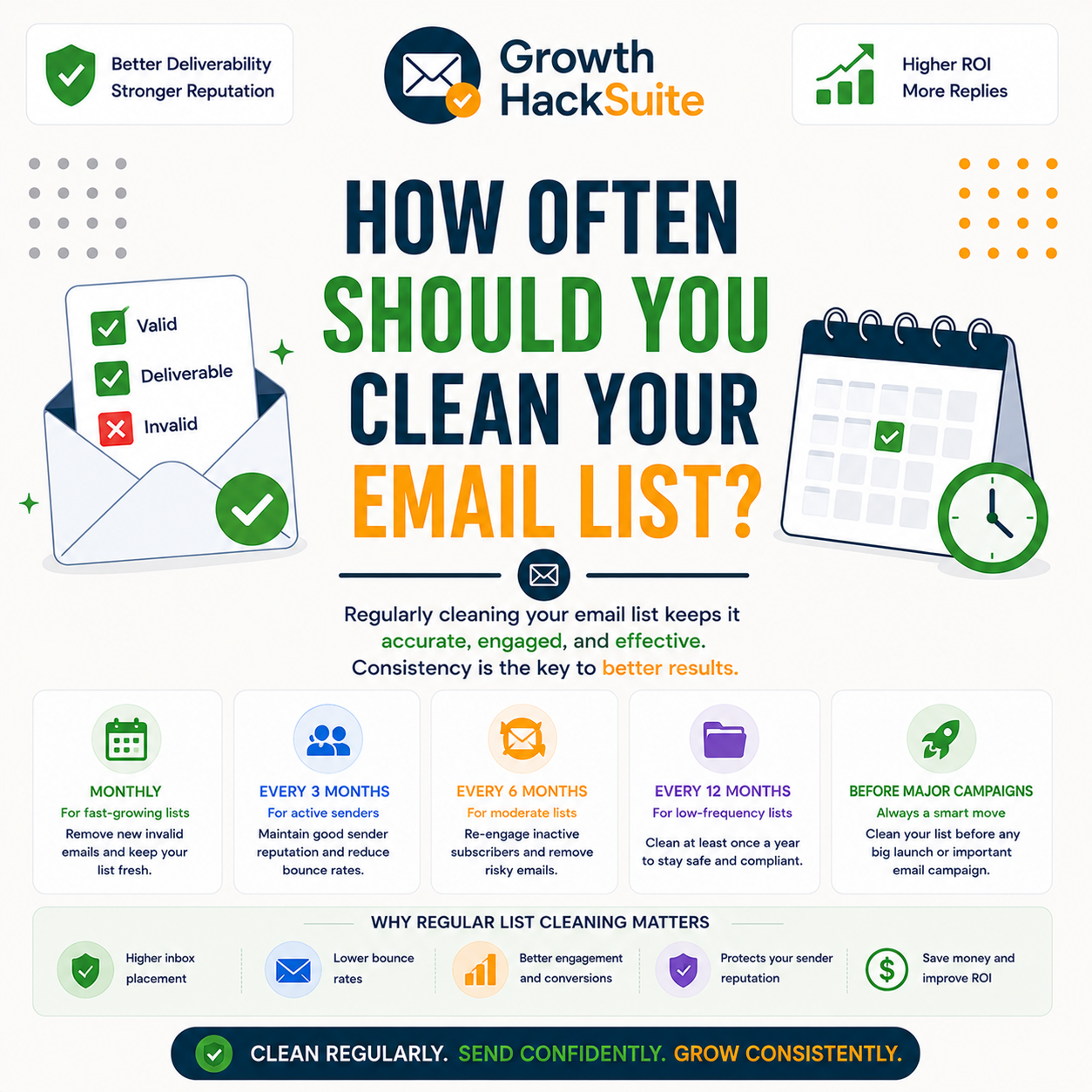
How often clean email list data is best answered by a cadence, not a single event: verify active lists roughly every quarter, refresh high-churn segments more often, and always re-verify before sending to a dormant list. Because contact data decays continuously, a one-time clean drifts stale within weeks. This guide explains how often to clean your email list and what sets the right cadence.
Clean on cadence — verify your list free before the next send.
Verify Your List Free →Free plan included · No credit card · Full status and scoring
How Often Clean Email List Data? The Cadence Answer
How often clean email list data is best set as a cadence: verify active lists roughly every quarter, refresh high-churn segments more often, and always re-verify before sending to a list untouched for months. There is no single date that fits every sender; the right frequency tracks how fast your specific data decays over the year.
- Quarterly for active lists: Regularly mailed lists benefit from a verification pass roughly every three months, which removes the steady trickle of newly invalid addresses before bounce rate climbs past safe limits and damages sender reputation.
- More often for high-churn: Segments built from fast-moving B2B roles, sales contacts or purchased data drift stale faster, so monthly or bi-monthly cleaning keeps the invalid share low where job changes happen constantly.
- Always before dormant sends: Any list left untouched for several months accumulates significant decay, making a fresh verification mandatory before the next campaign rather than risking a spike of hard bounces.
- Tighter for purchased data: Bought or scraped lists arrive carrying many invalid addresses and decay quickly, so an immediate clean plus a monthly cadence keeps such weak-source data deliverable rather than reputation-damaging over repeated sends.
- Looser for small opt-in: Tight, freshly confirmed opt-in lists decay slowly and surface few bounces, so a verification every three to six months usually suffices without spending credits on passes that find almost nothing new.
Clean on a cadence tied to decay, not a calendar habit, with quarterly as the baseline for active lists and tighter cycles for high-churn data.
Why a Cadence and Not a One-Time Clean?
Because contact data decays continuously, a list cleaned once drifts stale within months as people change jobs and mailboxes close. A cadence keeps the invalid share low over time, while a single clean only fixes the list at one moment and ignores the steady erosion that follows. Ongoing hygiene beats a one-off pass every time.
- Continuous decay: B2B contact data degrades roughly 22 to 30 percent every year as employees switch roles and domains retire, so a list that was clean in January carries meaningful rot by spring without intervention.
- Drifts stale fast: A single verification captures the list at one instant, but new invalids appear monthly, meaning the benefit of a one-time clean erodes steadily until the next pass restores accuracy again.
Verifying a list before the first send is the cheapest way to protect a sending domain.
— Growth Hack Suite, pre-send verification workflow
A one-time clean drifts stale fast, and only a repeating cadence keeps the invalid share low against the constant pull of data decay.
What Factors Set Your Cleaning Frequency?
Cleaning frequency depends on list age, source quality, send frequency, and the churn rate of your audience. High-churn B2B roles, purchased data and frequent sending all demand more frequent cleaning, while small opt-in lists need it less often. Match the cadence to your measured decay rate rather than a fixed rule borrowed from someone else.
- Churn rate: Audiences in fast-moving industries or junior roles change jobs often, accelerating address decay and pushing the cleaning cadence tighter than slower, stable audiences whose contacts stay put for years.
- Source quality: Purchased, scraped or aging lists carry far more invalid addresses than fresh opt-in signups, so weaker sources need an immediate clean and a tighter ongoing schedule to stay deliverable.
- Send frequency: Lists mailed weekly surface bounces quickly and need cleaning often, while a list mailed twice a year mainly needs a thorough verification right before each infrequent campaign goes out.
- List age: Older databases have weathered more job changes and domain retirements than recently built ones, so an aging list demands more frequent verification to clear the invalids that accumulate steadily across the months.
- Audience industry: Sectors with high turnover such as tech startups and agencies decay faster than stable fields like government or established enterprise, so the same baseline cadence should tighten where the audience moves jobs most.
Source: cadence guidance derived from B2B data decay of ~22–30% per year (HubSpot Database Decay; Cleanlist, 2026) and the ~2% bounce-rate threshold (industry deliverability standard). Adjust to your own measured decay rate.
B2B contact data decays at roughly 2.1 percent every month through job and role changes.
— HubSpot, Database Decay research
Churn, source quality and send frequency set the cadence together, and faster decay always means more frequent cleaning is required.
What Signs Mean You Should Clean Now?
Clean immediately if bounce rate climbs toward or past two percent, engagement drops, spam complaints rise, or you are about to email a list dormant for months. These signals mean decay has already accumulated and the list needs verification before the next send, regardless of where you sit in the regular cadence.
- Rising bounce rate: A bounce rate creeping toward the two percent threshold is the clearest decay alarm, since hard bounces signal dead mailboxes that drag sender reputation down with every campaign sent.
- Falling engagement: Sudden drops in open and click rates often trace back to invalid or abandoned addresses inflating the denominator, so a verification pass can restore both deliverability and accurate reporting.
- Before dormant sends: Any list ignored for several months has silently accumulated invalids, making a clean mandatory before re-engagement rather than gambling reputation on a sudden spike of hard bounces.
- Rising spam complaints: An uptick in complaints often signals stale recipients or spam-trap addresses sitting inside the list, so verification becomes urgent before mailbox providers throttle delivery and the sender reputation suffers lasting damage.
- Recent list import: Adding a bulk import, an event list or an acquired segment introduces unverified addresses at once, making an immediate clean wise before that fresh batch contaminates the deliverability of the wider existing list.
Rising bounces or an upcoming dormant send are signals to clean now, whatever the calendar says about your next scheduled pass.
How Does Decay Drive the Cadence?
Since lists lose a meaningful share of valid addresses each year, the cadence exists to offset that loss before it inflates bounce rate. Faster-decaying lists need cleaning more often, and slower ones less. In practice the cleaning schedule is really a decay-management schedule dressed up as a calendar reminder.
Decay vs Cleaning Cadence
- Offsets annual loss: Because a database can shed a fifth or more of its valid addresses yearly, scheduled cleaning replaces removal of invalids that would otherwise compound into a serious deliverability problem over time.
- Faster decay, more often: Segments with rapid job turnover decay quicker than stable ones, so the cleaning interval should shorten precisely where churn is highest rather than applying one blanket schedule everywhere.
The cleaning cadence is really decay management, tuned to offset the steady monthly loss before bounces climb past safe limits.
How Common Is Over- or Under-Cleaning?
Under-cleaning is far more common than over-cleaning. Many senders verify once and never again, letting decay accumulate until bounces force a reaction. Over-cleaning is rare and mostly wastes verification credits. The practical risk is neglect, which is why a set cadence matters more than achieving perfect timing on every pass.
- Under-cleaning common: Most teams treat verification as a one-time setup task, so lists quietly rot between rare cleans until a deliverability scare finally prompts an overdue and often urgent verification pass.
- Over-cleaning rare: Verifying more often than decay warrants happens occasionally but causes little harm beyond extra credit spend, making it a minor inefficiency rather than a genuine risk to list health.
Neglect is the real risk, since most senders under-clean, so any consistent cadence comfortably beats none at all.
Cleaning Cadence vs Verifying at Signup: How Do They Differ?
Verifying at signup prevents bad data from entering the list, while periodic cleaning removes decay from data already inside it. They are complementary rather than competing: signup verification slows the inflow of invalids, and the cleaning cadence handles the natural decay of addresses over time. The table below contrasts the two practices directly.
Source: standard email hygiene practice; signup verification prevents inflow, periodic cleaning manages decay (deliverability best-practice consensus, 2026).
Signup verification stops new bad data entering while the cadence handles ongoing decay, so the strongest hygiene runs both together, not one alone.
Can You Clean Too Often?
Cleaning too often is rarely a real problem. Verifying more frequently than needed mainly costs extra verification credits without harming the list itself. The honest caveat is diminishing returns: beyond your actual decay rate, extra cleaning adds very little. Match the cadence to measured decay rather than over-investing in passes that find almost nothing.
- Mostly cost: Extra verification passes spend credits to confirm addresses that were already valid, so over-cleaning shows up as a line on the bill rather than as any damage to list quality or deliverability.
- Diminishing returns: Once cleaning frequency exceeds the rate at which addresses actually decay, each additional pass surfaces fewer new invalids, making the marginal benefit shrink toward zero past a sensible interval.
Over-cleaning mostly wastes credits, so match the cadence to decay rather than cleaning for its own sake.
How Do You Set a Cleaning Cadence?
Set a cadence by measuring your decay rate through periodic re-verification, scheduling a baseline quarterly clean, tightening it for high-churn segments, and always cleaning before dormant sends. Add signup verification to slow the inflow of new invalids. Then adjust the interval as your measured decay rate reveals how fast your data actually ages.
- Measure the decay: Re-verify a sample of the list at intervals to learn how many addresses turn invalid per month, giving a real decay figure instead of a guessed one to anchor the schedule.
- Schedule a quarterly baseline: Set a recurring full verification roughly every three months for active lists as the default, since quarterly cleaning offsets typical decay before bounce rate approaches the two percent ceiling.
- Tighten for high-churn: Shorten the interval to monthly for segments built from purchased data or fast-moving roles, where decay outpaces the quarterly baseline and demands more frequent verification to stay deliverable.
- Add signup verification: Layer a real-time check at the point of capture so new invalid addresses never enter the list, which slows the inflow and lets the scheduled clean focus only on genuine decay.
- Review and adjust: Track bounce rate and the share of invalids each clean removes, then lengthen or shorten the interval as the data shows whether the current cadence is keeping pace with real decay.
Start your cadence today — verify your list free.
Verify Your List Free →Free plan · No credit card · Full status and scoring
Measure decay, set a quarterly baseline, tighten for high-churn segments, then adjust the cadence to whatever your own numbers show.
What Tools Support a Cleaning Cadence?
A bulk verifier handles scheduled cleans, real-time verification handles signups, and decay tracking sets the rhythm. Hunter covers verification with a recurring free tier and an API for both checks. The table below compares the capabilities that matter when a tool has to support ongoing list hygiene over time.
Source: hunter.io/pricing and hunter.io/api-documentation/v2, verified 2026-06-29. Confirm current free-tier allowance on the provider site before relying on it.
Hunter.io exposes a verification API that returns a deliverability status and confidence score per address.
— Hunter.io, API documentation v2
A verifier handles both scheduled cleans and signup checks, making it the engine behind any sustainable cleaning cadence.
Verdict: How Often to Clean Your Email List
Clean your email list on a cadence, not once: quarterly for active lists, more often for high-churn data, and always before a dormant send. Because data decays continuously, the schedule is really decay management. Add signup verification to slow the inflow, and adjust the cadence to your own measured decay rate over time.
Verdict: Run a quarterly baseline clean for active lists, monthly for high-churn or purchased data, and a fresh verification before any dormant send. Treat it as decay management matched to ~22–30% annual loss, keeping bounce rate under the ~2% threshold.
Email marketing is directing commercial messages to people using electronic mail.
— Wikipedia, Email marketing
Keep your list clean on cadence — verify it free.
Verify Your List Free →Free plan · No credit card · Results decide the cadence
Related Tools in the Hunter Stack
A cleaning cadence ties directly to data decay and verification. The Hunter Email Verifier accuracy benchmark covers the engine that runs each clean, and the bounce-rate guide explains why cadence protects deliverability in the first place.
- Hunter Email Verifier: The validation engine behind every scheduled clean, tested for accuracy on real lists — see the Hunter Email Verifier accuracy benchmark.
- Bounce-rate reduction: The reason a cadence matters, since cleaning keeps hard bounces below safe limits — read how to reduce your email bounce rate with Hunter.
How Often to Clean Your Email List: Frequently Asked Questions
The 12 most-asked questions about how often to clean an email list.
How often should I clean my email list?
Clean active lists roughly every quarter as a baseline, high-churn or purchased segments monthly, and always re-verify before sending to a list dormant for months. There is no single date that fits everyone, because the right frequency tracks how fast your specific data decays over the year.
Why a cadence and not a one-time clean?
Because contact data decays continuously, a single clean fixes the list only at one moment and drifts stale within months as people change jobs and mailboxes close. A repeating cadence keeps the invalid share low over time, while a one-off pass ignores the steady erosion that follows it.
What factors set my cleaning frequency?
List age, source quality, send frequency and audience churn all set the right frequency. High-churn B2B roles, purchased data and frequent sending push the cadence tighter, while small opt-in lists need cleaning less often. Match the interval to your measured decay rate rather than a borrowed rule.
What signs mean I should clean now?
Clean immediately if bounce rate climbs toward or past two percent, engagement drops, complaints rise, or you are about to email a list dormant for months. These signals mean decay has already accumulated and the list needs verification before the next send, whatever the regular schedule says.
How does decay drive the cadence?
Lists lose a meaningful share of valid addresses each year, so the cadence exists to offset that loss before it inflates bounce rate. Faster-decaying lists need cleaning more often and slower ones less, which means the cleaning schedule is really a decay-management schedule in disguise.
How common is under-cleaning?
Under-cleaning is very common because many senders verify once and never again, letting decay accumulate until bounces force a reaction. Over-cleaning is rare and mostly wastes credits. The practical risk is neglect, so any consistent cadence beats the far more typical pattern of doing nothing.
Cleaning cadence vs verifying at signup?
Signup verification prevents bad data from entering the list, while periodic cleaning removes decay from data already inside it. They are complementary, not competing: signup checks slow the inflow of invalids and the cleaning cadence handles natural decay over time. The strongest hygiene runs both together.
Can I clean too often?
Cleaning too often is rarely a problem. Verifying more frequently than your decay rate warrants mainly costs extra verification credits without harming the list. The honest caveat is diminishing returns, since past a sensible interval each additional pass surfaces fewer new invalids and adds little value.
How do I set a cleaning cadence?
Measure your decay rate through periodic re-verification, schedule a baseline quarterly clean, tighten it for high-churn segments, and always clean before dormant sends. Add signup verification to slow the inflow, then adjust the interval as your measured decay reveals how fast your data actually ages.
What tools support a cadence?
A bulk verifier runs scheduled cleans, real-time verification handles signups, and confidence scoring segments risky addresses. Hunter covers verification through CSV and API with a recurring free tier, so the same tool can power both the scheduled clean and the signup check behind a cadence.
Should I clean before a dormant send?
Always clean before emailing a list left dormant for months. Months of silence mean significant accumulated decay, so a fresh verification is mandatory before re-engagement rather than gambling sender reputation on a sudden spike of hard bounces that can push bounce rate well past safe limits.
Is quarterly cleaning enough?
Quarterly cleaning is a solid baseline for active, well-sourced lists, but high-churn or purchased segments often need monthly passes to stay deliverable. Whether quarterly is enough depends on your decay rate, so measure it and tighten the interval wherever bounces or churn show the baseline is slipping.