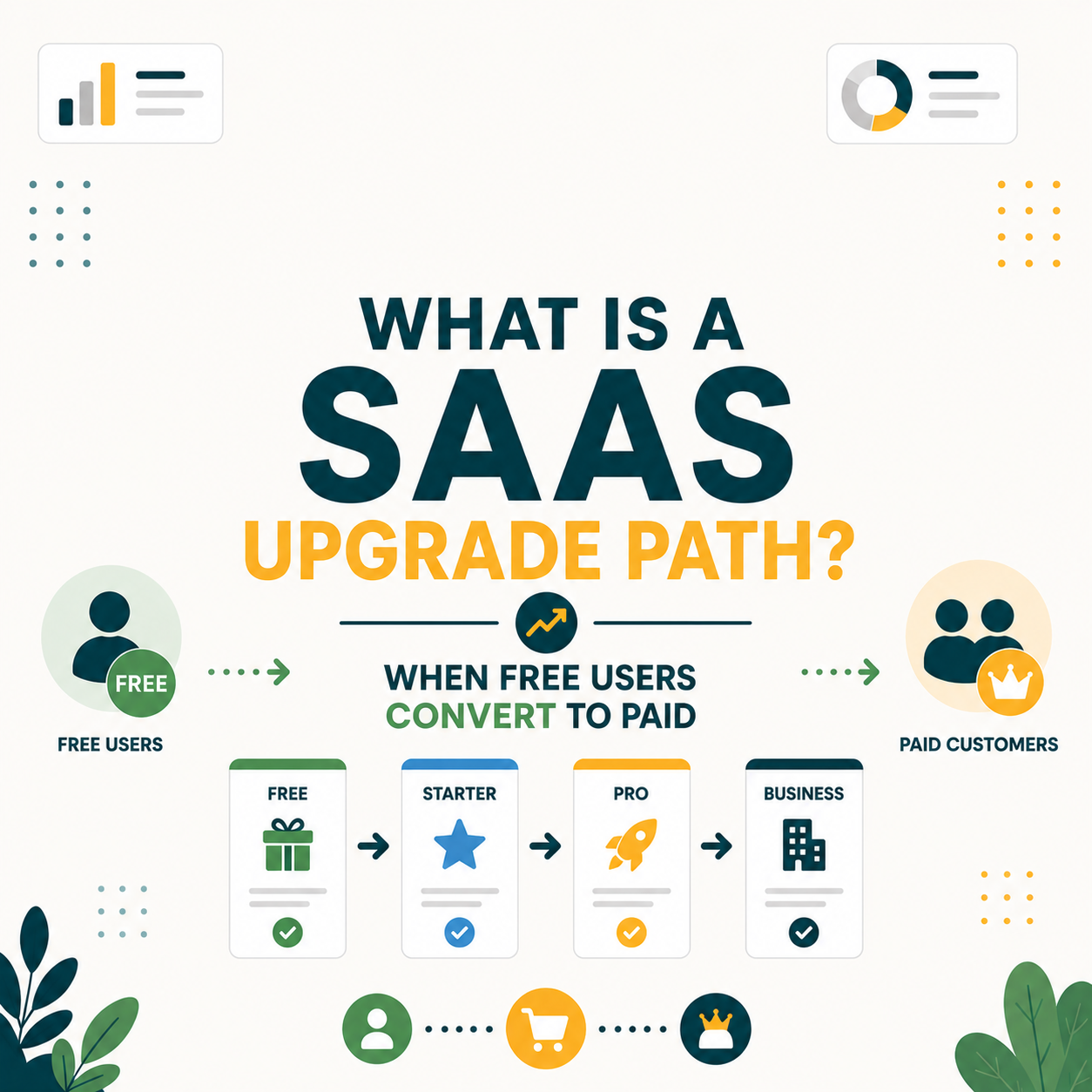
A SaaS upgrade path is the structured journey where free-tier users hit usage limits, searches, verifications, or seat counts, and convert to paid plans. Hunter.io’s free plan grants 50 credits per month, where finding an email costs 1 credit and verifying one costs 0.5 credits; once SDRs exhaust those limits, the Starter plan at $49/month becomes the logical next step. Understanding this path helps sales teams time upgrade decisions and maximize tool ROI.
Table of Contents
What Is SaaS Upgrade Path? Core Definition for B2B Sales and Marketing Teams
A SaaS upgrade path is the defined sequence of friction points, feature walls, and usage caps that guide a free or trial user toward a paid subscription. In B2B email tools, upgrade paths are typically triggered by monthly search exhaustion, team seat expansion, or campaign feature access requirements that exceed free plan capabilities.
Source: Growth Hack Suite estimate from vendor documentation and published pricing.
“Freemium is a pricing strategy by which a basic product or service is provided free of charge.”
: Wikipedia, Freemium
In practice, the SaaS upgrade path is a vendor-designed funnel. Free users receive limited but functional access, enough to generate genuine results, before hitting a ceiling that makes paid tiers attractive. Hunter.io’s Hunter.io Email Finder review shows how this model plays out: SDRs complete their first domain searches on the free plan and convert to Starter once they exhaust the monthly allocation.
The SaaS upgrade path differs from a paywall in that it requires genuine value discovery before the conversion trigger fires, users must first see ROI from free features before the paid tier becomes compelling.
How Does SaaS Upgrade Path Actually Work? The Technical Mechanism Explained
A SaaS upgrade path operates through five sequential mechanics: free-tier onboarding, limit exposure, value confirmation, upgrade nudge, and payment conversion. Each stage requires the tool vendor to engineer friction at the right moment. Too early and users churn, too late and conversion rates suffer without adding incremental value.
Five core mechanics define how upgrade paths function in B2B SaaS products.
- Free-Tier Onboarding: Initial product access delivers a functional but constrained experience, enough to demonstrate core value without revealing the full feature set available at paid tiers.
- Usage Limit Exposure: Credit or seat exhaustion surfaces the ceiling. Dashboards display usage counters, and “upgrade to continue” prompts appear when limits are reached within a billing cycle.
- Value Confirmation Signal: Behavioral data, such as three consecutive months of limit exhaustion, confirms the user derives enough ROI to justify the paid tier, triggering the upgrade nudge sequence.
- Upgrade Nudge Delivery: In-app banners, email drip sequences, and pricing page redirects activate during the high-intent window, typically within 48 hours of a limit hit, to reduce decision latency.
- Payment Conversion Gate: Checkout presents clear plan comparisons, annual discount incentives, and one-click card capture, minimizing friction at the moment when purchase intent peaks.
The mechanism works only when value confirmation precedes the upgrade nudge. Teams that receive the nudge before experiencing genuine ROI from free features convert at rates significantly lower than users who have exhausted limits across multiple billing cycles.
What Are the Top 5 Use Cases for SaaS Upgrade Path in B2B Sales?
Five use cases drive the majority of SaaS upgrade path conversions in B2B sales tooling: outbound prospecting scale-up, team expansion beyond free seat limits, campaign automation activation, API integration projects, and compliance-sensitive email verification. Each use case targets a different persona and maps to distinct upgrade triggers in the product funnel.
Five use cases below show where the SaaS upgrade path delivers measurable ROI for B2B teams.
- Outbound Prospecting Scale-Up: SDRs exhaust free search credits within the first 2-3 weeks of active outreach, triggering the upgrade to access 500+ monthly searches on Starter-tier plans.
- Team Seat Expansion: Sales teams growing from 1 to 3+ SDRs hit multi-seat access restrictions on free plans, making a paid team plan the cost-effective solution for shared domain search access.
- Campaign Automation Activation: Email sequence and campaign features are gated behind Starter or Growth tiers in most tools, requiring an upgrade before automated outreach workflows can run.
- API Integration Projects: CRM integrations, Zapier workflows, and custom pipeline builds require API key access, a feature restricted to paid tiers in nearly every email finder platform.
- Compliance-Sensitive Verification: Teams sending to regulated verticals (finance, healthcare, legal) require bulk verification with GDPR-compliant data handling, a feature set typically available only at paid tiers.
“The average conversion rate for a freemium plan typically falls between 2-5%.”
: HubSpot Sales Blog
Each use case maps to a persona-specific upgrade trigger: outbound scale-up (SDRs), team seats (sales managers), campaigns (marketers), API (ops teams), and compliance (legal or IT buyers). Matching upgrade timing to the primary use case produces the fastest path to paid conversion.
What Are the 5 Limitations of SaaS Upgrade Path Every Buyer Should Know?
Five limitations constrain how effectively SaaS upgrade paths serve B2B buyers: reset cycle inflexibility, credit rollover absence, seat-count pricing friction, vendor lock-in risk, and overage charge exposure. Understanding these limitations before committing to an annual plan prevents budget overruns and ensures upgrade timing aligns with actual team growth curves.
- Reset Cycle Inflexibility: Monthly credit resets mean unused searches and verifications expire at month-end, a structural waste for teams with uneven outreach cadences across weeks.
- Credit Rollover Absence: Most email tool free and starter plans do not roll over unused credits, a team that exhausts 80% of monthly verifications must still start at zero the following cycle.
- Seat-Count Pricing Friction: Per-seat pricing at higher tiers creates budget unpredictability as sales teams grow, a team adding two SDRs mid-quarter faces a mid-billing-cycle tier jump.
- Vendor Lock-In Risk: Annual billing discounts create 12-month commitments that make switching costs concrete, exported data formats and integration dependencies add further lock-in beyond the subscription itself.
- Overage Charge Exposure: Flat credit tiers with no overage protection force teams to either over-provision (pay for unused credits) or under-provision (stop outreach mid-month when credits run out).
“Hunter.io’s free plan is designed as a genuine starting point, the 50 monthly credits deliver enough domain coverage to validate Hunter’s accuracy before the Starter upgrade at $49/month becomes a compelling ROI decision for active SDRs.”
: Growth Hack Suite, Hunter.io Email Finder Review
Buyers who audit these five limitations before committing to an annual plan reduce churn risk and align their upgrade timeline to genuine usage growth rather than vendor sales pressure. The Hunter.io free plan vs Starter upgrade guide covers the credit reset and rollover dynamics specific to Hunter’s billing model.
Top 5 Tools Compared by SaaS Upgrade Path Approach: Hunter, Apollo, Snov, ZeroBounce, NeverBounce
Five email finder and verification tools dominate B2B upgrade path design: Hunter.io, Apollo.io, Snov.io, ZeroBounce, and NeverBounce. Hunter.io’s upgrade path stands out for its gradual credit ramp-up and transparent pricing tiers. Starter at $49/month delivers 10x the free plan search volume with no seat restrictions at the entry tier.
Source: Vendor pricing pages, all figures verified July 2026.
Hunter.io’s upgrade path is particularly well-suited for SDR-led outbound teams because the free plan delivers genuine domain search functionality, not a preview, before the Starter tier’s 2,000-credit allocation removes the primary constraint. For a detailed pricing breakdown, see the Hunter.io pricing guide.
How Do You Apply SaaS Upgrade Path in 5 Steps with Hunter.io (Free Workflow)?
Applying Hunter.io’s upgrade path in five steps delivers measurable SDR productivity gains within the first billing cycle. The workflow moves from free account validation through domain search testing, verification credit monitoring, team Starter upgrade, and campaign feature activation, each step building on the previous to ensure the $49/month investment produces ROI within 3-7 days.
- Step 1, Account Creation and ICP Setup: Create a free Hunter.io account and configure domain search filters for the target ICP, company size, industry, and seniority level, to maximize credit efficiency from day one.
- Step 2, Domain Search Testing and Accuracy Benchmarking: Run domain searches against 5-10 target accounts and verify accuracy against LinkedIn profiles, a process that typically consumes 8-12 of the free plan’s 50 monthly credits.
- Step 3, Credit Burn Rate Monitoring: Track search and verification credit consumption weekly. The dashboard displays remaining credits prominently, signaling the upgrade window when 60-70% of monthly allocation has been consumed.
- Step 4, Starter Plan Upgrade and Team Seat Activation: Upgrade to Starter at $49/month once the free plan validates Hunter’s accuracy for the target ICP, the upgrade delivers 2,000 monthly credits plus campaign access.
- Step 5, Campaign and Integration Activation: Launch Hunter Campaigns for automated outreach sequences and connect to CRM via native integrations or API, unlocking the full upgrade path ROI beyond basic email finding.
Ready to start the Hunter.io upgrade path with 50 free credits?
Try Hunter.io Free →No credit card required. Free plan includes 50 credits per month.
This five-step process typically requires 2-4 weeks on the free plan before upgrade conditions are met, the natural validation window before the Starter commitment becomes risk-free. For a comparison of annual vs monthly billing at upgrade time, see the Hunter.io annual vs monthly billing analysis.
How Has the Concept of SaaS Upgrade Path Evolved Across the B2B Email Tool Category?
The SaaS upgrade path concept evolved from rigid trial-then-buy models in the early 2000s to today’s freemium-first, usage-triggered architectures. B2B email tools in particular moved from 30-day time trials to credit-based free tiers around 2015, driven by tools pioneering the “find value first, pay for scale” model that now defines the category standard.
Three evolutionary phases define the upgrade path’s development in B2B SaaS: the trial era (2000-2012), the freemium era (2012-2018), and the usage-based era (2018-present). The trial era required users to commit before experiencing value, churn rates ran high as purchasing decisions preceded ROI validation. The freemium era removed the time gate but retained feature walls. The usage-based era, now dominant, allows open access to core features while metering volume, a model that aligns upgrade incentives with genuine usage growth.
Hunter.io’s upgrade path sits squarely in the usage-based era. The free tier never expires, so the conversion trigger is a credit ceiling rather than a countdown, and the upgrade decision arrives only after a user has already produced results with the tool.
What Are the Real Cost Implications of Implementing SaaS Upgrade Path at SDR Team Scale?
Cost implications of the SaaS upgrade path depend on three variables: team size, monthly search volume per SDR, and desired verification accuracy. At 5 SDRs each processing 100 domain searches monthly, Hunter.io Starter at $49/month covers the team fully, producing a cost-per-SDR of under $10/month at that scale.
Source: Hunter.io pricing page (hunter.io/pricing), verified July 2026. Credits are shared across unlimited team members within one account.
The cost-efficiency sweet spot for Hunter.io’s upgrade path is the 3-5 SDR team range. Starter at $49/month delivers enough credit volume for the entire team at under $17 per SDR per month. At that price point, a single booked meeting from Hunter-sourced leads covers the monthly cost in full.
What Are the 5 Common Mistakes B2B Teams Make With SaaS Upgrade Path?
Five common mistakes derail B2B teams navigating the SaaS upgrade path: upgrading before verifying ROI, choosing annual billing without testing monthly first, ignoring credit rollover policies, failing to consolidate team accounts before upgrading, and overlooking integration costs that emerge post-upgrade. Each mistake compounds the sunk-cost risk of a premature paid commitment.
- Premature Upgrade Before ROI Validation: Upgrading to Starter before exhausting the free plan’s 50 credits wastes the validation window, active SDRs should consume free credits fully before committing to $49/month.
- Annual Billing Commitment Without Monthly Testing: Jumping to annual billing for the 30% discount before verifying consistent monthly usage locks teams into a 12-month commitment before usage patterns stabilize.
- Ignoring Credit Rollover Policy: Assuming unused credits carry over to the next billing cycle leads to wasteful over-consumption in the last week of each month. Most SaaS tools, including Hunter.io, reset credits at the start of each billing cycle.
- Multiple Individual Free Accounts Instead of One Shared Paid Account: Teams creating separate free accounts for each SDR instead of sharing one paid account pay more per search and lose team-level usage visibility and collaboration features.
- Overlooking Post-Upgrade Integration Costs: CRM integration, Zapier workflow builds, and API development add implementation time and cost after the Starter upgrade, teams should budget for 4-8 hours of setup time to activate the full upgrade path ROI.
Avoiding these five mistakes reduces upgrade path churn by ensuring the paid commitment is made at the right time, on the right billing cadence, and with realistic expectations about post-upgrade workflow setup. See the Hunter.io Starter plan breakdown for details on what the first upgrade tier unlocks and how to maximize its credit allocation.
How Do SDRs, Email Marketers, and Founders Each Apply SaaS Upgrade Path Differently?
Three B2B personas approach the SaaS upgrade path with distinct timing triggers and success metrics. SDRs upgrade on search volume exhaustion, typically within 30-60 days. Email marketers upgrade on verification accuracy thresholds, typically when list size exceeds 2,000 contacts. Founders upgrade on API access requirements, typically when integrating with CRM or outreach workflows.
- SDRs: Upgrade trigger is credit exhaustion within the first 2-3 weeks of active prospecting. Success metric is meetings booked per $1 spent, a good SDR books 1 meeting per 15-20 Hunter searches, making the Starter plan cost-positive within the first week of paid use.
- Email Marketers: Upgrade trigger is list quality degradation, bounce rates above 3% signal a need for bulk verification at scale. Hunter.io’s Starter and Growth credit pools cover roughly 4,000 and 20,000 verifications respectively.
- Founders: Upgrade trigger is API access for CRM sync or outbound automation. Starter tier unlocks the Hunter.io API for Salesforce, HubSpot, and Pipedrive, enabling automated list building as part of a GTM workflow without manual export/import cycles.
Each persona requires a different success framing at upgrade time: SDRs need meeting volume data, email marketers need bounce rate improvement evidence, and founders need API capability confirmation. Aligning the upgrade conversation to persona-specific metrics reduces upgrade hesitation and accelerates the commitment decision.
What Are the Best Practices for Implementing SaaS Upgrade Path?
Five best practices define effective SaaS upgrade path implementation for B2B sales teams: start free and measure ROI before committing, align upgrade timing with billing cycles, use monthly billing for the first 3 months, consolidate team accounts before upgrading, and negotiate annual discount only after verifying monthly consistent usage.
- Start Free and Measure ROI Before Any Commitment: Free plan usage generates baseline data on search accuracy, credit consumption rate, and match rate for the target ICP, data that justifies the paid upgrade with concrete numbers rather than assumptions.
- Align Upgrade Timing with the Start of a New Billing Month: Upgrading mid-month wastes partial billing cycle credits, upgrading on the first day of a new month maximizes the full credit allocation from day one of the paid tier.
- Use Monthly Billing for the First 3 Months Before Switching to Annual: Monthly billing at $49/month for 3 months ($147 total) provides the usage data needed to justify the annual commitment, a 30% discount on confirmed consistent usage beats a discount on uncertain future use.
- Consolidate All Team Members Into One Shared Account Before Upgrading: A single shared Starter account delivers more searches per dollar than individual free accounts, and gives the account admin team-level credit visibility and usage reporting.
- Negotiate Annual Discount Only After 3 Months of Consistent Monthly Usage: Annual billing discounts reward committed users, but the data from 3 months of monthly billing confirms both usage consistency and ROI, making the annual commitment a calculated decision rather than an optimistic bet.
These five practices reduce the financial risk of the SaaS upgrade path by ensuring the paid commitment is data-driven and timed to maximize credit utilization from the first billing cycle forward.
What Industry Trends Are Reshaping SaaS Upgrade Path Going Into Late 2026?
Three industry trends are reshaping SaaS upgrade paths in 2026: AI-driven personalized upgrade nudges, usage-based pricing replacing seat-based models, and API-first architectures lowering the barrier to enterprise-tier features. These trends favor tools with credit-based consumption models over per-seat restrictions, a structural advantage for tools like Hunter.io.
AI-driven upgrade nudges personalize the conversion moment, rather than generic “you’ve hit your limit” banners, modern SaaS tools deliver upgrade prompts calibrated to individual usage patterns, role signals, and purchase intent indicators. Teams that hit limits on Thursdays (pre-weekend pipeline prep) receive different nudge copy than those that hit limits on the 28th of the month (end-of-month push). The result is measurably higher conversion rates at the upgrade gate.
Usage-based pricing eliminates the per-seat friction that historically made team-scale upgrades expensive, credits shared across a team allow smaller teams to access Starter-tier functionality at per-SDR costs that rival free-plan alternatives. API-first architectures allow Starter-tier users to integrate without Enterprise-tier commitments, reducing the upgrade path length from free to fully integrated from months to days.
These three trends collectively reduce the friction cost of each upgrade path stage, onboarding, validation, and conversion all become faster and less costly as SaaS infrastructure matures toward usage-aligned pricing models.
SaaS Upgrade Path: Frequently Asked Questions
Which tool has the best SaaS upgrade path for SDR teams?
Hunter.io offers the most SDR-optimized upgrade path in the email finder category. The free plan delivers 50 real credits, not a preview, and the Starter plan at $49/month unlocks 2,000 credits and full campaign functionality. Apollo.io offers a broader feature set but a more complex upgrade path with export restrictions at the free tier.
How does Hunter.io’s upgrade path compare to Apollo.io?
Hunter.io’s upgrade path is credit-volume-triggered, users hit a search ceiling and upgrade for more searches and verifications. Apollo.io’s upgrade path is feature-triggered, users hit export limits, advanced filter restrictions, and CRM sync gates before upgrading. Hunter’s path is faster and simpler; Apollo’s path unlocks a broader platform.
Does a free plan or a free trial suit an upgrade path better?
A free plan suits a longer upgrade path because it gates by volume rather than by time, so the conversion trigger fires only once real usage outgrows the cap. A trial compresses the same path into a fixed window. Hunter.io runs a free plan, 50 credits per month with no expiry. The full model comparison sits in our free trial vs freemium guide.
How long does it typically take to see ROI before upgrading?
For Hunter.io, active SDRs typically see ROI evidence within 2-3 weeks of free plan usage, one booked meeting from Hunter-sourced contacts produces enough pipeline value to justify the $49/month Starter upgrade. Teams that use free credits across 20+ domain searches before upgrading show higher 90-day retention on paid plans than those who upgrade without exhausting the free allocation.
How much does Hunter.io Starter cost and what does it include?
Hunter.io Starter costs $49/month (monthly billing) or approximately $34/month on annual billing, a 30% discount for the annual commitment. Starter includes 2,000 monthly credits shared across unlimited team members, full Campaigns access, CRM integrations, and API key generation. The annual billing option requires a $408/year upfront commitment.
Will upgrading to Hunter.io Starter improve my outreach results?
Upgrading to Starter improves outreach results in three measurable ways: 2,000 credits vs 50 enables 40x more domain coverage per month, Campaigns feature enables automated 3-5 touch sequences replacing manual sends, and API access enables CRM sync eliminating manual data entry. Verified, sequenced outreach consistently outperforms unverified ad-hoc sending, though actual reply rates vary widely by list quality, offer strength, and industry.
Can I test Hunter.io’s paid features before committing to a plan?
Hunter.io does not offer a traditional trial of paid features, the free plan provides access to core search and verification functionality with usage limits, not a time-gated preview of Starter features. The most effective way to test the upgrade path is to exhaust free credits across 15-20 domain searches, validate accuracy for the target ICP, and then upgrade on the first day of a new billing month.
Does Hunter.io integrate with Salesforce or HubSpot after upgrading?
Hunter.io integrates with Salesforce, HubSpot, Pipedrive, Zoho CRM, and 5,000+ apps via Zapier, all integrations become available at the Starter tier ($49/month) and above. The native CRM integrations sync domain search results and campaign contact data directly, eliminating CSV export/import cycles. API access also unlocks at Starter for custom pipeline builds.
What is a SaaS upgrade path?
A SaaS upgrade path is the designed sequence of product experiences, usage limits, and conversion triggers that move a free or trial user to a paid subscription. The path includes free-tier onboarding, limit exposure, value confirmation, upgrade nudge, and payment conversion stages. In B2B email tools, upgrade paths are primarily triggered by monthly search credit exhaustion and feature gate exposure.
How does the SaaS upgrade path work technically?
Technically, the SaaS upgrade path functions through five mechanics: (1) free-tier access with usage counters, (2) limit enforcement with upgrade prompts on credit exhaustion, (3) behavioral trigger detection identifying high-intent users, (4) personalized nudge delivery via in-app banners and email sequences, and (5) streamlined checkout with plan comparison and annual discount incentives. Credit reset cycles (typically monthly) create recurring upgrade decision points.
Is the Campaigns feature included in Hunter.io’s free plan?
No. Hunter.io’s Campaigns feature, which enables automated email sequences with follow-up scheduling, reply detection, and CRM sync, is restricted to Starter tier and above. The free plan provides domain search and email verification only. This feature gate is the second most common upgrade trigger after search credit exhaustion, particularly for SDRs who need sequence automation beyond one-off sends.
What search volume does each Hunter.io plan include?
Hunter.io’s monthly credit allowance per plan (2026): Free gives 50 credits; Starter at $49/month gives 2,000 credits; Growth at $149/month gives 10,000 credits; Scale at $299/month gives 25,000 credits; Enterprise is custom. Every tier shares one pool across unlimited team members, and each tier raises bulk task capacity and connected email accounts.
Start Hunter.io’s Upgrade Path Today
50 free credits per month. No credit card. Upgrade only when you’ve exhausted the free allocation and verified the ROI.
Try Hunter.io Free →Starter plan from $49/month. Annual billing saves 30%. Cancel anytime on monthly billing.