Table of Contents
What is email list hygiene? Email list hygiene is the ongoing practice of keeping your subscriber list clean, accurate and engaged by removing invalid, inactive and risky addresses and verifying new ones. Good hygiene protects deliverability, sender reputation and the return on every campaign, and verification is its core tool. This guide explains the practices it involves and why it matters for everyone who sends.
Start good list hygiene the right way — verify your list free.
Verify Your List Free →Free plan included · No credit card · Full status and scoring
What Is Email List Hygiene?
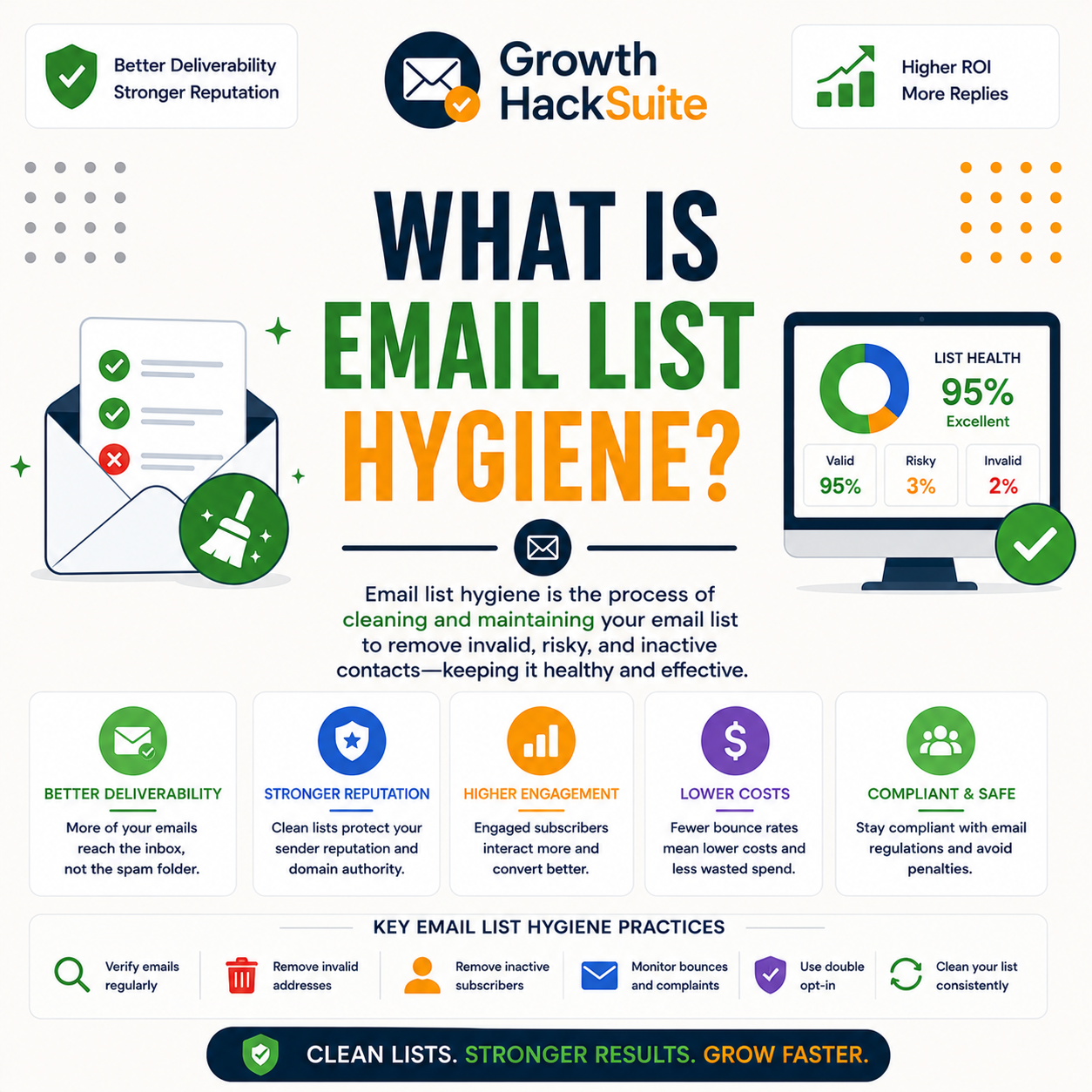
Email list hygiene is the ongoing practice of keeping a subscriber list clean, accurate and engaged: removing invalid, inactive and risky addresses, and verifying new ones before they get used. It is preventive maintenance for a mailing list, protecting deliverability and the value of every send rather than fixing damage after it lands in the spam folder.
- Ongoing maintenance: List hygiene is a continuous routine, not a one-time cleanup. Contacts decay as people change jobs and abandon inboxes, so a list needs regular attention to stay accurate rather than a single pass at import.
- Remove bad addresses: Hygiene strips out hard bounces, invalid syntax, disposable accounts and long-dead mailboxes. Removing these addresses cuts the bounce and complaint signals that mailbox providers use to judge a sender and decide inbox placement.
- Keep it engaged: Beyond removing invalids, hygiene also suppresses subscribers who never open or click. Pruning disengaged contacts raises average engagement, which mailbox providers reward with better placement for the addresses that remain on the list.
- Verify new entries: Hygiene checks every fresh signup before it joins the active list. Catching typos, fakes and disposable addresses at the point of entry stops bad data from accumulating quietly between scheduled cleanings of the wider list.
- Preventive, not reactive: The whole point of hygiene is to act before deliverability drops rather than after. Steady maintenance keeps reputation intact, which is far cheaper than rebuilding sender standing once mailbox providers start filtering the mail.
List hygiene is preventive maintenance, keeping a list clean, accurate and engaged over time rather than reacting after deliverability already drops.
What Does Email List Hygiene Include?
Email list hygiene includes verifying addresses, removing hard bounces and invalids, suppressing long-inactive subscribers, flagging role and disposable addresses, and verifying new signups in real time. Together these practices keep the list deliverable and the metrics honest, so each campaign reaches real, reachable people instead of dead or risky mailboxes.
- Verify addresses: Verification checks syntax, domain records and mailbox response to confirm an address can receive mail. It is the foundation practice, identifying the invalid and risky addresses that every other hygiene step then acts on across the list.
- Remove bounces and invalids: Hard bounces and confirmed invalids leave the list immediately, because repeated sends to dead addresses damage sender reputation. Pruning them protects the placement of the genuine subscribers who still want and open the email.
- Suppress inactives: Subscribers who stop opening or clicking move to a suppression segment under a sunset policy. Removing chronically disengaged contacts lifts average engagement, a signal mailbox providers weigh heavily when deciding inbox versus spam folder.
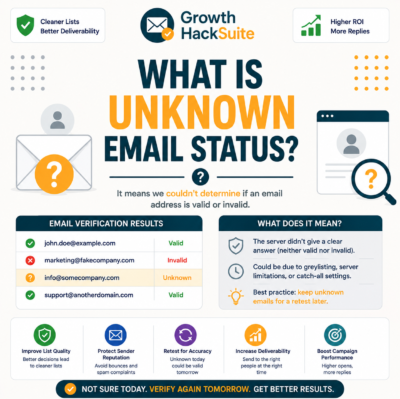
- Flag risky addresses: Role accounts, disposable mailboxes and accept-all domains get flagged for segmentation rather than blind sending. Treating these riskier addresses separately reduces complaints and protects the reputation that governs placement for the whole list.
- Check new signups: Real-time validation at the form blocks invalid and fake addresses before they enter the list at all. Stopping bad data at entry is the cheapest hygiene step, preventing problems instead of cleaning them up later.
Hygiene bundles verification, bounce removal, suppression and signup checks into one ongoing routine that keeps the whole list healthy.
Why Does Email List Hygiene Matter?
Email list hygiene matters because it protects sender reputation and deliverability, the factors that decide whether mail reaches the inbox at all. A clean list bounces less, draws fewer complaints, and engages more, which lifts the return on every campaign. Neglect does the opposite, pushing more messages quietly into the spam folder over time.
- Protects reputation: Mailbox providers track bounces, complaints and spam-trap hits to score each sender. Clean lists keep those signals low, preserving the reputation that determines whether future campaigns land in the inbox or get filtered before anyone sees them.
- Lifts engagement: Removing dead and disengaged contacts raises average open and click rates, because the remaining subscribers actually want the mail. Higher engagement reinforces reputation, creating a compounding loop that keeps deliverability strong campaign after campaign.
Sender reputation and clean lists are the strongest levers a sender controls over inbox placement.
— Hunter.io, Email Verifier API documentation
Hygiene protects the reputation and engagement that decide inbox placement, and neglect erodes both at once.
What Are the Core List Hygiene Practices?
The core list hygiene practices are verifying before sending, removing hard bounces immediately, running a sunset policy for inactives, segmenting role and accept-all addresses, and verifying signups in real time. Done consistently on a schedule, these five practices keep a list permanently healthy instead of letting decay accumulate unnoticed between campaigns.
- Verify before sending: Running the list through a verifier before each major send catches invalids and bounces that crept in since the last check. This single habit prevents most reputation damage by stopping bad addresses from ever receiving a message.
- Sunset inactives: A sunset policy suppresses subscribers who have not opened or clicked within a set window, often 90 to 180 days depending on send frequency. Pruning them keeps engagement rates high and protects placement for active contacts.
- Verify signups: Real-time verification at the signup form blocks typos, fakes and disposable addresses before they enter the list. Catching bad data at entry prevents the slow accumulation of invalids that quietly degrades a list between cleanings.
- Remove hard bounces: Confirmed hard bounces leave the list the moment they occur, because resending to a dead address signals carelessness to mailbox providers. Immediate removal keeps the bounce rate low and the sending reputation intact.
- Segment risky addresses: Role accounts and accept-all domains move into a separate segment rather than the main send. Isolating uncertain addresses limits their reputational drag while still letting a sender reach them deliberately and at lower frequency.
Verify, remove bounces, sunset inactives, segment risk and verify signups: that is the core hygiene routine in five steps.
What Are the Benefits of Good Hygiene?
Good list hygiene yields lower bounce and complaint rates, stronger sender reputation, higher inbox placement, cleaner analytics and lower send costs. The benefits compound over time: a healthy list keeps performing and reinforcing itself, while a neglected one decays steadily into the spam folder and drags every metric down with it.
- Lower bounces and complaints: Removing invalids and disengaged contacts cuts the hard bounces and spam complaints that damage reputation. Lower negative signals translate directly into better standing with mailbox providers and more messages reaching the primary inbox.
- Better inbox placement: A clean, engaged list earns higher inbox placement because providers favour senders whose recipients open and reply. Improved placement means more of every campaign is actually seen, lifting clicks, replies and revenue downstream.
- Cleaner analytics: When dead addresses leave the list, open and click rates reflect real subscriber behaviour rather than being diluted by mailboxes no one reads. Honest metrics make testing and optimization decisions far more reliable.
- Lower send costs: Most email platforms and verifiers charge by contact or volume, so removing dead weight cuts the bill directly. Paying to send to mailboxes that bounce or never open is pure waste a clean list eliminates.
- Compounding gains: Each cleanup strengthens reputation, which improves placement, which lifts engagement, which reinforces reputation again. The benefits of hygiene stack over time into a durable advantage that a neglected list can never match.
Hygiene compounds: lower bounces, better placement and cleaner data all reinforce each other into a stronger sending program.
How Does Verification Fit Into Hygiene?
Verification is the core hygiene tool: it identifies the invalid, risky and undeliverable addresses that every other practice then acts on. Without verification, a sender cannot reliably know which addresses to remove or suppress, which makes it the foundation the whole hygiene routine rests on rather than just one optional step among many.
Verifying a list before the first send is the cheapest way to protect a sending domain.
— Growth Hack Suite, reduce email bounce rate with Hunter.io
Verification is the foundation of hygiene, telling a sender exactly which addresses every other practice should act on. For the basics, see what email verification is.
How Common Is Poor List Hygiene?
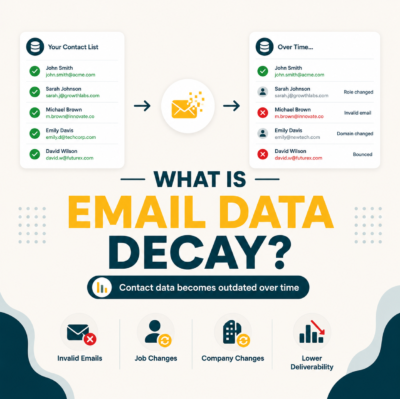
Poor list hygiene is widespread because email data decays fast and most senders never re-verify after the first import. Industry research puts average list decay near 22.5% per year, so a neglected list loses roughly a fifth of its accuracy annually while the damage hides as gradually falling engagement that is easy to miss.
Source: HubSpot database decay research and aggregated B2B data-decay reporting, verified 2026-06. The ~22.5% annual / ~2.1% monthly figure is an industry average; high-turnover sectors decay faster. Confirm against your own bounce data.
Poor hygiene is common and hidden, because its damage shows up only as slowly falling engagement long after decay begins.
List Hygiene vs Verification: What’s the Difference?
Verification is a specific check that confirms whether an address can receive mail; list hygiene is the broader, ongoing practice that uses verification plus suppression, segmentation and signup checks. In short, verification is a tool, and hygiene is the routine built around it. The table below contrasts the scope and role of each.
Source: Growth Hack Suite definition framework, aligned with standard deliverability documentation, 2026-06.
Verification is a tool and hygiene is the routine around it: one check versus the whole ongoing practice.
Is Some List Shrinkage From Hygiene Normal?
Yes, and it is healthy. Removing invalids and disengaged subscribers shrinks list size but raises quality, so metrics and deliverability improve even as the headcount drops. The honest reframe is that a smaller, clean list outperforms a large, decayed one, which makes shrinkage from hygiene a feature rather than a loss to fear.
- Quality over size: A list of engaged, valid addresses delivers more opens, clicks and revenue than a bloated list padded with dead contacts. Vanity in raw subscriber count costs nothing if those subscribers never receive or read the mail.
- Healthy shrinkage: Watching the number fall during a cleanup feels like a loss, but the contacts removed were already not contributing. Deliverability and engagement climb afterward, proving the smaller list is the stronger asset.
Hygiene shrinks the list but raises quality, and a smaller clean list beats a large decayed one on every metric that counts.
How Do You Practice Good List Hygiene?
Practice good list hygiene by verifying before every major send, removing hard bounces immediately, running a sunset policy, verifying signups in real time, and re-verifying on a regular cadence to offset ongoing decay. Make verification the routine spine and the other practices follow naturally, turning hygiene into a habit instead of an emergency cleanup.
- Verify before send: Run the active list through a verifier ahead of each major campaign to catch addresses that decayed since the last check. This habit stops most bounces before they reach a mailbox and damage standing.
- Sunset and re-verify: Suppress contacts inactive past the chosen window, then re-verify the surviving list on a quarterly or semi-annual cadence. Regular re-verification offsets the steady decay that erodes accuracy between full cleanups across the year.
- Verify signups: Add real-time verification to signup forms so typos, fakes and disposable addresses never enter the list. Stopping bad data at the door is far cheaper than removing it after it has already harmed deliverability.
Verify your list free to build good hygiene from day one.
Verify Your List Free →Free plan · No credit card · Status and confidence scoring
Make verification the spine of the routine and the rest of hygiene follows naturally as a steady habit. The reduce email bounce rate workflow shows the full sequence.
How Do the Hygiene Practices Fit Together?
The hygiene practices form a connected loop: verify, remove, suppress, then re-verify on a cadence. Each step feeds the next, and verification anchors the whole cycle. The diagram below shows how the routine repeats over time to hold accuracy steady against the constant pull of list decay.
The List Hygiene Loop
The loop is what makes hygiene work: each step feeds the next, and the cycle repeats to keep accuracy from slipping.
What Tools Support List Hygiene?
List hygiene runs on a verifier for cleaning, real-time verification for signups, and an ESP for suppression and engagement tracking. Hunter covers the verification core with an honest free tier, while the ESP handles sunset segments and inactive tracking. The table compares the tool types that together support an ongoing hygiene routine.
Source: hunter.io free tier and standard ESP feature documentation, verified 2026-06. Free-tier details vary by provider; confirm current allowances before relying on them.
A verifier is the hygiene core; pair it with an ESP for suppression and engagement tracking to cover the whole routine.
Verdict: What Email List Hygiene Means for You
Email list hygiene is the ongoing practice of keeping a list clean, accurate and engaged, and it protects the reputation and deliverability your results depend on. Verification is its foundation. Build a routine of verifying, suppressing and re-verifying, and accept healthy shrinkage as the fair price of a list that actually performs in the inbox.
Verdict: Email list hygiene is an ongoing routine, not a one-time fix. Verification is its core tool, lists decay around 22.5% a year without it, and healthy shrinkage is a feature. Verify, suppress and re-verify on a cadence to protect reputation and inbox placement.
Email marketing involves sending commercial messages to a group of people using email.
— Wikipedia, Email marketing
Verify your list free and start good hygiene today.
Verify Your List Free →Free plan · No credit card · Clean, accurate, engaged
Related Tools in the Hunter Stack
List hygiene is built on verification, so the tools that support it sit in the same stack. The Hunter verifier covers the core cleaning tool, the accuracy benchmark shows how reliable it is, and the finder builds the lists worth keeping clean in the first place.
- Hunter Email Verifier: The validation tool at the centre of hygiene, with documented accuracy and status flags — see the Hunter Email Verifier accuracy benchmark.
- What it is: A plain definition of the verifier and what it checks — read what the Hunter Email Verifier is for the basics.
- Hunter Email Finder: The other half of the stack that builds the lists hygiene keeps clean — read the Hunter.io email finder review.
Email List Hygiene: Frequently Asked Questions
The 12 most-asked questions about email list hygiene.
What is email list hygiene?
Email list hygiene is the ongoing practice of keeping a subscriber list clean, accurate and engaged. It means verifying addresses, removing invalids and hard bounces, suppressing long-inactive subscribers, and checking new signups. The goal is to protect deliverability and sender reputation so each campaign reaches real, reachable people.
What does list hygiene include?
List hygiene includes verifying addresses, removing hard bounces and invalids, suppressing inactive subscribers under a sunset policy, flagging role and disposable addresses, and verifying new signups in real time. These practices run together as one continuous routine rather than as separate, occasional tasks.
Why does list hygiene matter?
List hygiene matters because it protects sender reputation and deliverability, the factors mailbox providers use to decide inbox placement. A clean list bounces less, draws fewer complaints and engages more, lifting the return on every campaign. Neglect pushes more messages quietly into the spam folder.
What are the core hygiene practices?
The core practices are verifying before sending, removing hard bounces immediately, running a sunset policy for inactives, segmenting role and accept-all addresses, and verifying signups in real time. Done consistently on a schedule, these five keep a list permanently healthy instead of letting decay build up.
What are the benefits of good hygiene?
Good hygiene yields lower bounce and complaint rates, stronger reputation, higher inbox placement, cleaner analytics and lower send costs. The benefits compound: a healthy list keeps performing and reinforcing its own deliverability, while a neglected list decays steadily and drags every metric down with it.
How does verification fit into hygiene?
Verification is the core hygiene tool. It identifies the invalid, risky and undeliverable addresses that every other practice then acts on. Without verification, a sender cannot reliably know which addresses to remove or suppress, which is why it is the foundation the whole routine rests on.
How common is poor list hygiene?
Poor hygiene is widespread because email data decays around 22.5% per year and most senders never re-verify after the first import. The damage hides as gradually falling engagement, so neglected hygiene is common and frequently undiagnosed until deliverability has already dropped noticeably.
List hygiene vs verification?
Verification is a specific check that confirms whether an address can receive mail. List hygiene is the broader, ongoing practice that uses verification plus suppression, segmentation and signup checks. Verification is a tool; hygiene is the whole routine built around it and the other maintenance steps.
Is list shrinkage from hygiene normal?
Yes, and it is healthy. Removing invalids and disengaged subscribers shrinks list size but raises quality, so deliverability and engagement improve. A smaller, clean list outperforms a large, decayed one, which makes shrinkage from hygiene a feature to expect rather than a loss to avoid.
How do I practice good list hygiene?
Verify before every major send, remove hard bounces immediately, run a sunset policy for inactives, verify signups in real time, and re-verify the surviving list on a quarterly or semi-annual cadence. Making verification the routine spine keeps the other practices simple and consistent over the long run.
What tools support list hygiene?
List hygiene runs on a verifier for cleaning and real-time signup checks, plus an ESP for suppression and engagement tracking. A tool like Hunter covers the verification core with a recurring free tier, while the email platform handles sunset segments and inactive tracking on the list.
Does hygiene improve deliverability?
Yes. Removing invalids and disengaged contacts lowers bounces and complaints while raising engagement, all signals mailbox providers use to grant inbox placement. Improvement often appears within a few weeks of cleaning a neglected list, because the negative signals that suppressed placement fall away quickly.
Email deliverability & verification glossary
The full library of email verification and deliverability guides on Growth Hack Suite, grouped by topic.
Email verification basics
- Email validation vs verification
- What is an SMTP check?
- What is email syntax validation?
- What is real-time email verification?
- What is an MX record?
- Does email verification send an email?
- Is email verification legal?
- What is an unknown email status?
- What is greylisting?
- Accept-all vs catch-all
- What is a role-based email address?
List quality problems
- What is an invalid email address?
- What is a disposable email address?
- What is a gibberish email address?
- What is a honeypot email address?
- What is a spam trap?
- Recycled vs pristine spam traps
- What is an email blocklist (RBL)?
Bounces & deliverability
- What is an email bounce?
- What causes email bounces?
- What is a good bounce rate?
- How bounces hurt sender reputation
- What is an email deliverability score?
- What is a spam complaint rate?
- What are SPF, DKIM and DMARC?
- How fast do email lists decay?
Cleaning and verifying your list
- How to verify an email address
- How to bulk verify an email list
- How to clean your email list
- How to remove invalid emails
- How to reverify old email list data
- Verify an email list before import
- How to verify a purchased email list
- Is purchased email data accurate?
- Vet data provider email quality
- How often to clean your email list
- Single vs double opt-in
- Email verification for signup forms