Table of Contents
An unknown email status means a verifier could not confirm whether an address is deliverable. It is not the same as invalid; an unknown email status means undetermined. The usual causes are catch-all domains and greylisting, where the receiving server hides the truth from the probe. This guide explains what an unknown email status means, why it happens, and how to handle it safely.
Cut unknowns to a minimum — verify your list free.
Verify Your List Free →Free plan included · No credit card · Confidence score on every unknown
What Does an Unknown Email Status Mean?
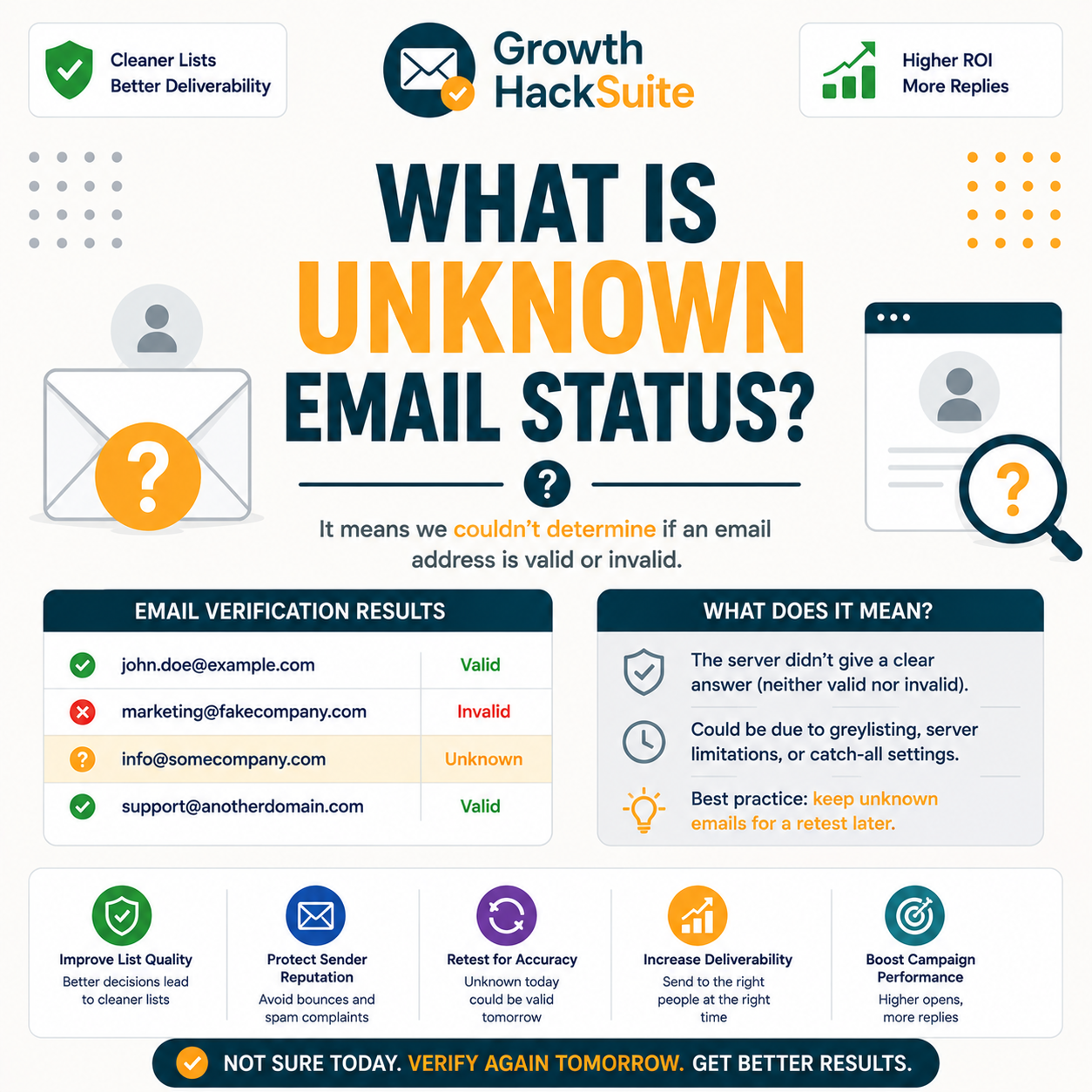
An unknown email status means the verifier could not determine whether the address accepts mail. The receiving server gave an ambiguous answer or no answer at all, so the result is undetermined rather than valid or invalid. Unknown is an honest in-between status, not a failure of the address and not proof that a mailbox is dead.
- Undetermined, not invalid: An unknown status records that the verifier ran out of evidence, not that the mailbox failed a check. The address stays unconfirmed in either direction, which keeps a likely valid contact safe from being deleted by mistake.
- Server gave no clear answer: The receiving mail server returned an ambiguous reply or deferred the probe, so the verifier had nothing definitive to record. That silence describes the server’s caution, not a defect in the recipient address itself.
- A third bucket beyond yes and no: Verification produces three outcomes, and unknown is the honest middle one between valid and invalid. The status exists precisely because some servers refuse to commit to either verdict during a probe.
- Often paired with a confidence score: Good verifiers attach a numeric confidence figure to each unknown so the result carries useful information. That score ranks how likely the hidden mailbox is to deliver, turning a vague label into a graded signal.
- Resolvable on a second pass: Many unknowns clear once the verifier retries later or the greylisting delay expires. The status describes one moment in time rather than a permanent verdict, so re-verification frequently converts it into a definitive result.
Unknown means undetermined — the verifier is being honest that the server would not say yes or no on that attempt.
What Causes an Unknown Status?
Two causes dominate unknown results: catch-all domains that accept every address without revealing which mailboxes are real, and greylisting that temporarily defers the verifier’s probe. Less often, a server blocks SMTP verification entirely or times out. In each case the truth stays hidden from the probe, so the verifier honestly returns an unknown email status.
- Catch-all domains: A catch-all server accepts mail to every address, real or not, so the probe always gets a yes. The verifier cannot separate a genuine mailbox from a non-existent one and returns accept-all or unknown instead of a false valid.
- Greylisting: Greylisting answers a first-contact probe with a temporary deferral rather than a clear verdict, so the verifier gets no usable result on that attempt. The deferred reply leaves the mailbox undetermined until a later retry can clear the delay.
- Blocked or timed-out probes: Some servers refuse SMTP verification, throttle connections, or drop the probe before answering. When the connection yields no reliable signal, the verifier records unknown rather than guessing a status the server never actually provided.
- Rate limiting and tarpitting: Cautious mail systems slow or delay incoming connections to deter bulk probing, which starves the verifier of a clean answer. The throttled session ends without a verdict, so the result lands as unknown rather than valid.
- Server policy variation: Mail servers differ in how they respond to verification attempts, and some answer every probe ambiguously by design. That inconsistency means an identical address can resolve differently depending on the receiving domain’s configuration.
The verifier returns accept-all when a domain accepts every address it receives.
— Hunter, Email Verifier API documentation
Most unknowns trace to catch-all domains or greylisting — the receiving server simply will not reveal the truth to a single probe.
Why Do Catch-All Domains Cause Unknowns?
A catch-all domain accepts mail to any address, real or not, so the SMTP probe always receives a yes. Because the server confirms everything, the verifier cannot tell a real mailbox from a fabricated one and honestly returns accept-all or unknown rather than a false valid. The yes carries no information about the specific address tested.
- Accepts everything: A catch-all server answers yes to every recipient by design, often to avoid bouncing mail aimed at typo addresses. That blanket acceptance strips the probe of any signal that would distinguish one mailbox from another.
- Real and fake look identical: Since both genuine and invented addresses earn the same acceptance, the verifier sees no way to separate them on that domain. An honest tool labels the result accept-all or unknown instead of fabricating a confident valid verdict.
A catch-all says yes to everything, so the verifier cannot distinguish a real mailbox from a fake one — hence an unknown email status.
Is an Unknown Status the Same as Invalid?
No. Invalid means the address definitely does not exist, while unknown means it could not be confirmed either way. Many unknowns are perfectly valid mailboxes hidden behind catch-all domains or greylisting. Treating unknown as invalid throws away reachable contacts, while treating it as valid risks bounces, so the two statuses demand very different handling.
- Invalid equals confirmed dead: An invalid status means the server explicitly rejected the address as non-existent, so a real send would bounce. Removing invalids protects sender reputation because the evidence against the mailbox is definitive and verified.
- Unknown equals not confirmed: An unknown status means the server gave no usable verdict, so the address remains a question mark rather than a known failure. Deleting unknowns wholesale discards mailboxes that may deliver perfectly once the obstacle clears.
- Different bounce risk profile: Invalid addresses bounce reliably, while unknowns split between deliverable and dead. Lumping the two together overstates the danger of unknowns and prunes contacts that would have reached the inbox without issue.
- Different correct response: Invalids warrant immediate removal, whereas unknowns warrant a retry and a confidence check. Applying the invalid playbook to unknown addresses destroys reach, while applying the unknown playbook to invalids invites bounces.
- Different source of the verdict: An invalid comes from a hard server rejection, but an unknown comes from server silence, deferral, or a catch-all yes. The underlying cause differs, so the two statuses should never be collapsed into one bucket.
Unknown is not invalid — many unknowns are real mailboxes the server simply would not confirm on the probe. For the matching definitions, see what email validation is and how email verification works.
How Does Hunter Report Unknown Results?
Hunter labels addresses it cannot confirm as accept-all or unknown and pairs each one with a confidence score, so a sender can judge risk instead of guessing. This honesty is deliberate: a false valid would be worse than an admitted unknown, because a fabricated yes silently inflates bounce rates and damages sender reputation.
Verifying before a send keeps unknown and accept-all statuses from quietly inflating bounce rates.
— Growth Hack Suite, pre-send verification workflow
Hunter reports an unknown email status honestly with a confidence score — a transparent risk signal rather than a guess dressed up as a verdict.
Unknown vs Valid vs Invalid: How Do They Compare?
Valid means confirmed deliverable, invalid means confirmed undeliverable, and unknown means undetermined. Each status calls for a different action: send to valids, drop invalids, and decide on unknowns by confidence and risk tolerance. The table below compares the three statuses on what each means and what to do with it.
Source: status definitions per hunter.io/api-documentation/v2, verified 2026-06-27.
Three statuses, three actions — unknown is the one that needs a judgment call, not a fixed rule.
How Risky Is It to Email Unknown Addresses?
Emailing unknowns carries moderate risk: some are valid and deliver, others bounce. The exact risk depends on the confidence score attached to each address and on how much sender reputation headroom a sender holds. Conservative senders exclude unknowns entirely, while those with strong reputation may send to high-confidence unknowns cautiously and in small batches.
- Mixed outcomes: An unknown batch contains both deliverable mailboxes and dead ones, so sending blind produces an unpredictable bounce rate. Confidence scoring narrows that uncertainty by ranking which unknowns are most likely to deliver.
- Depends on reputation headroom: A sender with a clean reputation absorbs a few extra bounces, while a strained domain cannot. The same unknown address therefore poses different risk depending on the sending reputation behind it.
Unknowns are a calculated risk — the confidence score and reputation headroom together decide whether sending is worth it.
How Should You Handle Unknown Addresses?
Re-verify unknowns later to clear greylisting cases, segment the rest by confidence score, and send only to high-confidence unknowns when reputation allows. Keep low-confidence unknowns out of important sends, but do not delete them outright, since many addresses behind catch-all domains are valid and reachable once tested again.
- Re-verify later: Queue unknowns for a second verification pass after a short wait, which clears most greylisting deferrals once the sending IP has aged past the delay. A later attempt frequently returns a definitive valid status the first probe could not capture.
- Segment by confidence: Split unknowns into high and low confidence bands using the verifier’s score, then treat each band differently. Ranking by confidence turns one ambiguous bucket into a graded list that supports clear sending decisions.
- Send cautiously: Mail high-confidence unknowns in small, monitored batches only when sender reputation has headroom to absorb a few bounces. Holding low-confidence unknowns back protects deliverability while preserving the option to test them later.
- Monitor the bounce response: Watch how a test batch of unknowns performs before scaling up, since real bounce data beats any prediction. A clean test run signals that the remaining high-confidence unknowns are safe to include in larger sends.
- Keep them out of cold outreach: Reserve unknowns for warmer, lower-risk campaigns rather than aggressive cold sequences that punish every bounce. Cold sending already strains reputation, so adding undetermined addresses compounds the deliverability risk unnecessarily.
Verify your list free and minimize unknowns.
Verify Your List Free →Free plan · No credit card · Confidence score on each unknown
Re-verify, segment by confidence, and send cautiously — never blanket-delete unknowns that may still be reachable. For full cleanup steps, see how email list cleaning works.
What Tools Minimize Unknown Results?
Verifiers with retry logic and strong catch-all handling return fewer unknowns and label the rest with a confidence score. Hunter does both on a recurring free tier; basic free checkers mark more addresses unknown without scoring them. The table below compares how different tool categories handle an unknown result during verification.
Source: hunter.io/pricing, verified 2026-06-27 (free plan 50 credits/mo = ~100 verifications at 0.5 credit each). Other rows describe common tool categories; confirm each provider’s behavior before buying.
Better tools turn more unknowns into resolved statuses and score the rest — fewer blind spots in the final list. The Hunter verifier accuracy benchmarks show how retry and scoring shrink the unknown band.
How Common Are Unknown Results in a List?
The unknown share depends on how many catch-all and greylisting domains a list contains, often a meaningful minority of B2B data. A high unknown rate usually signals many corporate catch-all domains rather than a verifier weakness, which is exactly why confidence scoring matters more than chasing a zero-unknown result.
- Driven by catch-all share: Lists heavy with corporate domains carry more catch-all addresses, which automatically raises the unknown count regardless of which verifier runs. The unknown rate tracks the data more than the tool that processes it.
- Higher in B2B than consumer: Business domains adopt catch-all and greylisting far more than large consumer webmail providers, so B2B lists surface more unknowns. Consumer-heavy lists answer probes immediately and show a noticeably smaller unknown band.
What an Unknown Status Actually Reflects
A high unknown rate usually means many corporate catch-all domains, not a weak verifier behind the numbers.
Verdict: What to Do With Unknown Statuses
An unknown email status means undetermined, not invalid. Caused mostly by catch-all domains and greylisting, unknowns include many valid mailboxes that a single probe could not confirm. Re-verify them, segment by confidence, and send cautiously to high-confidence ones. Never treat unknown as a reason to delete a contact outright.
Verdict: An unknown email status means undetermined, never invalid. It is caused mostly by catch-all domains and greylisting, so many unknowns are valid mailboxes. Re-verify, segment by confidence score, and send cautiously to the high-confidence ones rather than deleting them all.
Email validation checks whether an address exists and can receive mail.
— Wikipedia, Email address
Verify your list free and clear up unknowns.
Verify Your List Free →Free plan · No credit card · Retries deferrals, scores unknowns
Related Tools in the Hunter Stack
Unknown status ties directly to catch-all domains and greylisting, the two main reasons a verifier cannot confirm an address. The Hunter Email Verifier guide covers how every status is set, while the finder review covers building the lists worth verifying on the same shared credit pool. Catch-all and greylisting are covered in their own dedicated guides.
- Hunter Email Verifier: The validation layer that decides each status, including how it labels accept-all and unknown results — start with what the Hunter Email Verifier is.
- Hunter Email Finder: The list-building half of the bundle that shares the same credit pool — read the Hunter.io email finder review for sourcing costs.
- Deliverability foundation: Unknowns matter because they affect inbox placement — see what email deliverability is for the wider context.
Unknown Email Status: Frequently Asked Questions
The 12 most-asked questions about unknown email status.
What does an unknown email status mean?
An unknown email status means the verifier could not determine whether the address accepts mail. The receiving server gave an ambiguous reply or deferred the probe, so the result is undetermined rather than valid or invalid. It is an honest in-between, usually caused by a catch-all domain or greylisting hiding the true answer.
What causes an unknown status?
Two causes dominate: catch-all domains that accept every address without revealing which mailboxes are real, and greylisting that temporarily defers the probe. Less often, a server blocks SMTP verification or times out. In every case the receiving server hides the true answer, so the verifier honestly records the result as unknown.
Why do catch-all domains cause unknowns?
A catch-all domain accepts mail to any address, real or not, so the probe always gets a yes. Because the server confirms everything, the verifier cannot tell a real mailbox from a fabricated one and returns accept-all or unknown instead of a false valid. The acceptance carries no information about the specific address tested.
Is unknown the same as invalid?
No. Invalid means the address definitely does not exist, while unknown means it could not be confirmed either way. Many unknowns are valid mailboxes behind catch-all domains or greylisting. Treating unknown as invalid discards reachable contacts, and treating it as valid risks bounces, so the two statuses need different handling.
How does Hunter report unknown results?
Hunter labels addresses it cannot confirm as accept-all or unknown and pairs each with a confidence score, so a sender can judge risk instead of guessing. The honesty is deliberate: a fabricated valid would silently inflate bounce rates, while an admitted unknown gives a transparent signal that supports a careful sending decision.
Unknown vs valid vs invalid?
Valid means confirmed deliverable, invalid means confirmed undeliverable, and unknown means undetermined. Send to valids, drop invalids, and decide on unknowns by confidence and risk tolerance. Only the unknown bucket requires a judgment call, because the other two carry a definitive answer from the receiving server.
How risky is it to email unknown addresses?
Emailing unknowns carries moderate risk: some deliver and some bounce. The risk depends on each address’s confidence score and on how much sender reputation headroom exists. Conservative senders exclude unknowns entirely, while those with a strong reputation may send to high-confidence unknowns cautiously and in small, monitored batches.
How should I handle unknown addresses?
Re-verify unknowns later to clear greylisting, segment the rest by confidence score, and send only to high-confidence ones when reputation allows. Keep low-confidence unknowns out of important sends, but do not delete them, since many addresses behind catch-all domains turn out valid once they are tested a second time.
What tools minimize unknowns?
Verifiers with retry logic and strong catch-all handling return fewer unknowns and score the rest. Hunter does both on a recurring free tier of 50 credits a month, roughly 100 verifications. Basic free checkers often mark more addresses unknown and add no confidence score, leaving the sender to guess at the real risk.
Should I delete unknown addresses?
No. Unknown addresses are often valid mailboxes hidden behind catch-all domains or greylisting, so deleting them removes reachable contacts for no real deliverability reason. The correct response is to keep the address, re-verify it after a delay, and let confidence scoring guide whether it is safe to send.
Can an unknown address be valid?
Yes, frequently. An unknown status means the server gave no clear answer, not that the mailbox failed a check. Many unknowns sit behind catch-all domains that accept every address, or behind greylisting that simply deferred the probe. A later re-verification often turns the unknown into a confirmed valid result.
Does greylisting cause unknown status?
Yes. Greylisting answers a first-contact probe with a temporary deferral instead of a clear verdict, so the verifier gets no usable result on that attempt and records unknown. The deferral reflects server caution rather than a dead mailbox, and a later retry usually resolves the address into a definitive valid status.