
Table of Contents
Email validation vs verification confuses many marketers, but the two differ in depth. Validation checks whether an address is formatted and structured correctly; verification confirms the mailbox actually exists and can receive mail. Validation is a quick structural filter; verification is the real existence test. This guide explains both, what each one catches, and when each applies.
Go beyond validation — verify your emails free.
Verify Emails Free →Free plan included · No credit card · Real mailbox status
Email Validation vs Verification: What’s the Core Difference?
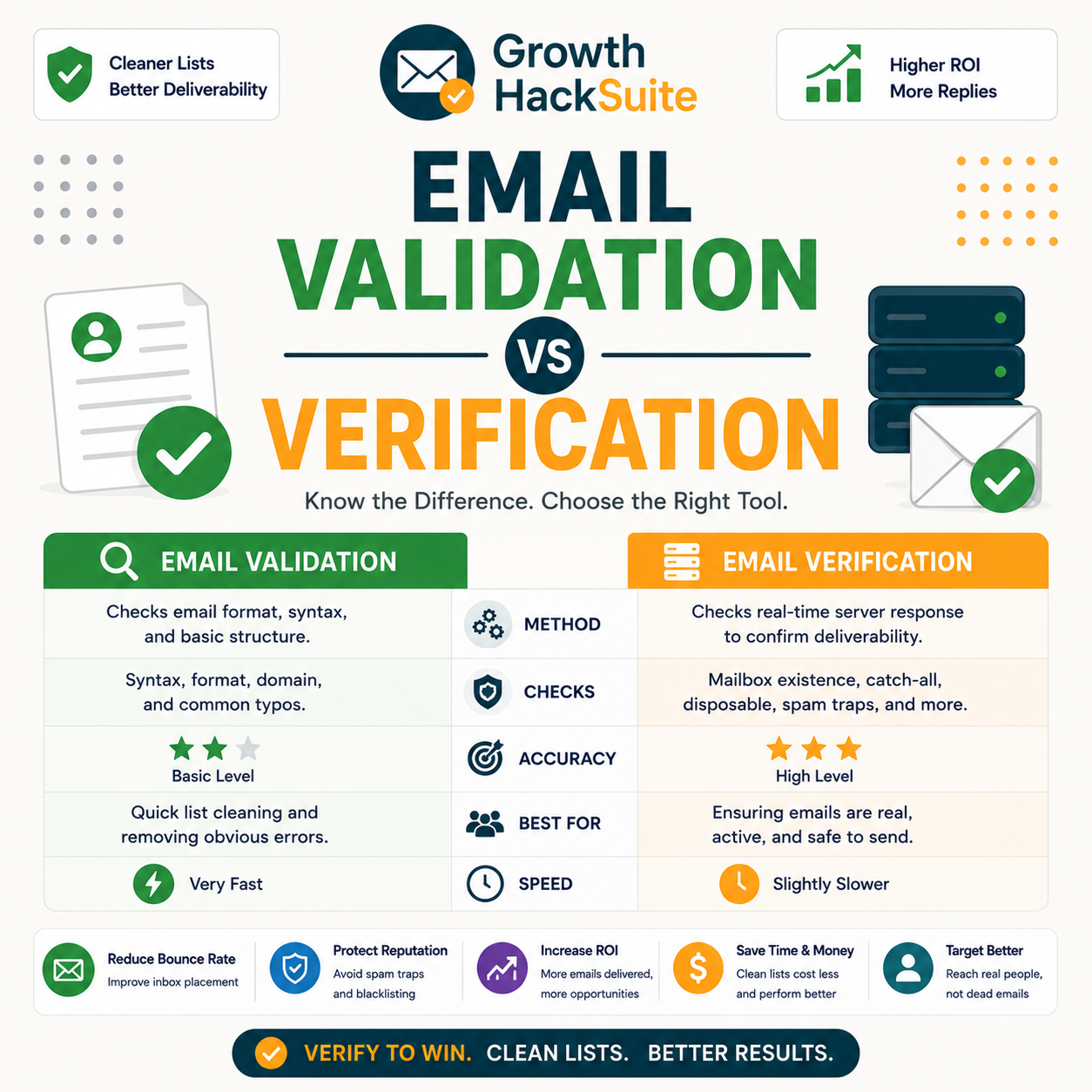
Email validation vs verification comes down to depth. Validation confirms an address is correctly formatted and that its domain can receive mail; verification goes further and confirms the specific mailbox exists on the live server. Validation is a structural check on shape and domain records, while verification is an existence check that queries the mailbox itself before you ever send.
- Validation, the structure test: A structural test confirms the address follows correct email syntax and that the domain has valid mail records. It runs instantly without contacting the mailbox, catching typos and dead domains, but it cannot prove the individual inbox is real.
- Verification, the existence test: A live server query confirms the exact mailbox accepts mail, usually through an SMTP existence check plus risk signals. It is slower and deeper than validation, and it provides the deliverability proof that a structural check alone can never deliver.
- Depth of the check: Validation inspects only the address string and its domain records, while verification reaches the destination server itself. That difference in depth is what separates a plausible address from a confirmed, deliverable one.
- Cost and speed: Validation is instant and effectively free because it never opens a connection, whereas verification trades a little time and a credit per address for a definitive existence answer at the server level.
- The shared goal: Both methods exist to keep bad addresses off a sending list, but only verification removes the well-formed addresses whose mailboxes were closed, never created, or quietly abandoned.
Validation checks form; verification checks reality. That depth gap between structure and existence is the whole distinction between the two.
What Is Email Validation?
Email validation checks that an address follows correct syntax and that its domain has valid mail records. It catches typos, missing @ signs and dead domains instantly and cheaply, without any contact with the recipient server. What it cannot do is confirm whether the actual mailbox exists behind a perfectly valid domain, which is the gap verification later fills.
- Syntax check: A format test confirms the address has a local part, an @ symbol and a structured domain, catching malformed entries before any network call. It is the fastest filter and runs entirely offline, but it judges shape rather than existence.
- Domain and MX check: A records lookup confirms the domain resolves and publishes mail-exchange records, proving a server exists to receive mail. This step rejects dead or fake domains, yet it stops short of confirming any specific mailbox on that domain.
- Typo detection: Common misspellings of major providers, such as a missing letter in a popular domain, fall out at the validation stage. Catching these early prevents guaranteed bounces from reaching the verification step or the send.
- Offline speed: Validation completes in milliseconds because it never opens a network connection, making it ideal for real-time form fields. That speed is its main advantage and the reason it sits first in the cleaning pipeline.
- Structural limit: The hard ceiling of validation is that a perfectly formatted address at a live domain still passes, even when no mailbox exists there. Confirming that gap requires the deeper verification layer.
Validation is the fast structural filter: correct shape and a live domain, and nothing deeper than that.
What Is Email Verification?
Email verification confirms the individual mailbox can actually receive mail, usually through an SMTP check against the destination server, plus risk signals for catch-all, disposable and role addresses. It is slower and deeper than validation, querying the server directly rather than inferring an answer from format. This existence proof is what actually protects deliverability before a campaign.
- SMTP existence check: A live connection to the recipient server names the address and reads the accept-or-reject reply without sending a message. That direct query is the strongest deliverability signal available, confirming the mailbox is present rather than merely possible.
- Risk signals: Additional flags identify catch-all domains, disposable addresses, role inboxes and known spam traps that a clean format hides. These quality signals turn a raw existence answer into a graded status that guides whether an address is safe to email.
- Confidence scoring: Many verifiers return a percentage alongside the status, reflecting how clear the server reply was for that address. The score helps separate a confident valid result from a borderline one worth treating with caution.
- Catch-all handling: Accept-all servers respond positively to every recipient, so a verifier flags those addresses as catch-all rather than confirming them valid. Honest handling here is what keeps a verification result trustworthy.
- Bounce protection: Removing the non-existent and high-risk addresses a verification pass surfaces keeps bounce rates low, which protects the sending domain reputation that inbox placement depends on across every campaign.
Hunter’s own verifier review found accuracy holds strong on standard domains, with valid-status addresses bouncing under 2% across a 2,000-email benchmark, proof of the existence check that separates verification from validation alone.
Verification confirms the mailbox itself exists. It is the deep test that validation only sets up but never completes.
Validation vs Verification: Side-by-Side Comparison
Validation is fast, cheap and structural; verification is deeper, confirms existence, and protects deliverability. The table below contrasts what each method checks, how fast it runs, what it catches and what it protects, so the distinction becomes concrete rather than a matter of semantics. The two do genuinely different jobs in a list-cleaning workflow.
Source: Distinction reflects standard email-hygiene practice — validation = syntax and domain checks, verification = SMTP mailbox-existence check (Hunter Email Verifier docs and RFC 5321 reply-code semantics), verified 2026-06-28.
Side by side, validation is the quick gate and verification is the deep proof. They are different jobs entirely, not two names for the same step.
What Does Each Method Catch?
Validation catches malformed addresses and dead domains; verification catches non-existent mailboxes, catch-alls, disposables and role accounts that hide behind valid domains. A typo or a fake domain is caught by validation, but a perfectly formatted address pointing at a mailbox that does not exist is caught only by verification at the server level.
- Validation catches: Malformed syntax, missing symbols, obvious typos and domains with no mail server fall out at this stage. These structural errors are cheap to detect and would otherwise bounce immediately, so removing them first keeps the verification step efficient.
- Verification catches: Non-existent mailboxes on live domains, catch-all servers, disposable addresses and role inboxes surface only when the server is queried. These addresses pass every format test, which is exactly why a structural check alone leaves them on the list.
- Disposable addresses: Temporary inboxes from throwaway-mail providers look perfectly formatted yet expire within hours, so only verification with risk flags identifies and removes them before they bounce or inflate engagement metrics.
- Role accounts: Generic addresses such as info or sales point at shared inboxes rather than a real person, and verification risk signals flag them so senders can decide whether to keep or drop them.
- Spam traps: Recycled or pristine trap addresses exist specifically to catch unhygienic senders, and a quality verifier flags known traps that a structural validation pass would wave straight through to the send.
Validation stops obvious errors; verification stops the dangerous addresses that look perfectly valid on paper.
Validation vs Verification at a Glance
Why Are Validation and Verification So Often Confused?
The terms are used interchangeably across marketing copy, and some tools label a basic syntax check as full verification. The confusion matters because relying on validation alone leaves non-existent mailboxes on the list, and those addresses still bounce when emailed. Knowing the difference prevents a false sense of a clean list that has only been structurally filtered.
Verification confirms a mailbox exists; validation only confirms an address is well formed.
— Hunter, Email Verifier API documentation
The mix-up is genuinely risky: calling syntax-only checks verification leaves real bounces sitting on a list that looks clean.
Is Verification More Accurate Than Validation?
Yes, for deliverability. Validation only confirms an address could exist, while verification confirms it actually does. Validation will happily pass a well-formed address that points at a non-existent mailbox, whereas verification queries the server and rejects it. For the single job of protecting bounce rate, verification is decisively the more accurate of the two methods.
- Validation accuracy: A format pass means an address is plausible, not present, so accuracy is limited to ruling out impossible entries. A well-formed address at a typo-free but non-existent mailbox slips straight through, which caps how much validation can protect a send.
- Verification accuracy: A server query returns a definitive accept or reject for most standard domains, confirming existence rather than assuming it. Accuracy drops only on catch-all and greylisting servers, where an honest verifier reports unknown instead of guessing valid.
For deliverability, verification wins on accuracy. It confirms the existence that validation can only assume from a correct format.
Should You Use Validation, Verification, or Both?
Use both, in order: validate first to strip malformed addresses cheaply, then verify the survivors to confirm they exist. Good verifiers run validation as their first internal layer, so a single verification pass usually covers both steps for you. Validation alone is never enough before sending, because it leaves real but non-existent mailboxes intact.
- Validate first: A structural pass discards malformed addresses and dead domains before any server contact, keeping the costly verification step efficient. This cheap filter removes the obvious garbage that would otherwise waste verification credits and time.
- Verify the rest: An SMTP existence check then confirms which of the surviving, well-formed addresses actually accept mail. This deeper pass catches the non-existent mailboxes and catch-alls that validation cannot detect on its own.
- One verifier does both: A quality verification tool runs validation internally as its first layer, so a single pass validates and verifies together. Choosing one good verifier removes the need to stitch a separate validator into the workflow.
Verify your emails free — validation included.
Verify Emails Free →Free plan · No credit card · Validate and verify in one pass
Validate then verify. A single quality verifier runs both layers in one pass, so you rarely need a standalone validator.
What Tools Do Validation and Verification?
Basic validators only check syntax and domain; full verifiers add the SMTP existence check and risk flags on top. Hunter performs full verification with validation built in, on a recurring free tier. The table below contrasts validation-only tools with full verifiers on the checks each one actually runs.
Source: Hunter Email Verifier docs and hunter.io/pricing, verified 2026-06-28 (Hunter free plan 50 credits/mo = ~100 verifications at 0.5 credit each). Other rows describe common tool categories; confirm each provider’s current features before buying.
Choose a full verifier, not a validator. It covers structure and existence in one tool, while a validator stops at the surface.
When Is Validation Alone Enough?
Validation alone suffices only for instant, low-stakes checks, such as blocking obvious typos on a signup form before a deeper verify runs later. For any list you intend to actually email, validation is never enough by itself. The honest exception is using it as a first-pass filter feeding verification, not as a final check.
- Validation-only is fine for: Instant form-field checks, blocking clearly malformed input at the point of entry, and trimming a list cheaply before a verification pass. In these low-stakes spots, speed matters more than confirmed existence.
- Validation is never enough for: Any list headed for an actual send, where non-existent mailboxes still bounce despite passing every format test. Cold outreach, newsletters and reactivation campaigns all require verification before the first message goes out.
Validation alone is fine only as a first-pass filter. It is never the final check before a list is sent.
Verdict: Validation vs Verification — Which Do You Need?
You need verification, with validation as its first step. Validation alone confirms form, not existence, so it leaves bouncing addresses on the list even when every entry looks perfect. A full verifier validates and then verifies, giving the clean, deliverable list that validation by itself can never guarantee before a campaign.
Verdict: Validation checks form, verification checks existence. For protecting bounce rate, verification wins decisively, because it confirms the mailbox is real rather than merely well formed. Use both in order — validate to filter, then verify to confirm — and one good verifier runs both layers in a single pass.
Verification confirms a thing is true; validation confirms it meets a requirement.
— Wikipedia, Verification and validation
Verify your emails free — not just validate them.
Verify Emails Free →Free plan · No credit card · Real mailbox existence confirmed
Related Tools in the Hunter Stack
Validation and verification are two layers of one process, not separate products. The concepts split into what email validation means and what email verification means, while the finder review covers building the lists worth verifying in the same connected stack.
- Email verification explained: The deep existence test that confirms a mailbox is real — start with what email verification means before cleaning a list.
- Email validation explained: The fast structural filter that catches typos and dead domains — see what email validation means for the first-pass step.
- Hunter Email Finder: The list-building half of the bundle that shares the same credit pool — read the Hunter.io email finder review for sourcing costs.
Validation vs Verification: Frequently Asked Questions
The 12 most-asked questions about email validation vs verification.
What’s the difference between email validation and verification?
Validation checks whether an address is correctly formatted and its domain can receive mail, catching typos and dead domains instantly. Verification goes deeper, querying the server through an SMTP check to confirm the specific mailbox actually exists. Validation tests structure; verification tests existence, which is the real protection against bounces.
What is email validation?
Email validation is a structural check that confirms an address follows correct syntax and that its domain publishes valid mail records. It runs instantly and offline, catching missing @ signs, malformed addresses and dead domains. What it cannot do is confirm that the actual mailbox exists behind an otherwise valid domain.
What is email verification?
Email verification confirms that an individual mailbox can receive mail, usually through an SMTP check against the destination server plus risk signals for catch-all, disposable and role addresses. It is slower and deeper than validation, querying the server directly to prove existence rather than inferring it from format alone.
What does validation catch?
Validation catches malformed addresses, missing symbols, obvious typos and domains that have no mail server at all. These structural errors are cheap to detect and would bounce immediately if sent. Validation does not catch a well-formed address pointing at a non-existent mailbox, which only verification can flag.
What does verification catch?
Verification catches non-existent mailboxes on live domains, catch-all servers, disposable addresses and role inboxes that hide behind a perfectly valid format. These addresses pass every validation test, so they survive a structural filter. Querying the server is the only way to surface them before a send.
Why are the terms confused?
The terms are used interchangeably in marketing, and some tools label a basic syntax check as verification. The confusion is risky because relying on validation alone leaves non-existent mailboxes on the list, and those still bounce. Knowing the difference prevents a false sense of a clean, send-ready list.
Is verification more accurate than validation?
For deliverability, yes. Validation only confirms an address could exist, while verification confirms it actually does by querying the server. Validation passes well-formed addresses to non-existent mailboxes; verification rejects them. Verification accuracy drops only on catch-all and greylisting servers, where an honest tool reports unknown.
Should I use both?
Yes, in order: validate first to strip malformed addresses cheaply, then verify the survivors to confirm they exist. Good verifiers run validation as their first internal layer, so a single verification pass usually covers both steps. Validation alone is never enough before an actual send.
Is validation enough before sending?
No. Validation confirms form, not existence, so well-formed addresses at non-existent mailboxes pass straight through and bounce on send. For any list headed to an inbox, verification is required. Validation alone is acceptable only as an instant first-pass filter on a form, never as the final check.
What tools do verification?
Every reputable email verifier performs SMTP verification under the hood, including bundled platforms like Hunter and dedicated pure-play verifiers. Validation-only tools stop at syntax and domain. Hunter pairs full verification with built-in validation on a recurring free tier of about 100 verifications a month at 0.5 credit each.
Does a verifier include validation?
Yes. A quality verifier runs validation as its first internal layer, discarding malformed addresses before the costly SMTP existence check. That ordering keeps the process efficient and means a single verification pass validates and verifies together, so you rarely need a standalone validator alongside it.
Which do I need?
You need verification, with validation as its first step. Validation alone leaves bouncing addresses on the list because it confirms form, not existence. A full verifier validates and then verifies, producing the clean, deliverable list that protects sender reputation. For any send, verification is the answer.