Table of Contents
These email verification accuracy benchmarks test leading verifiers against a known-good control on the same lists, so the numbers reflect real outcomes instead of vendor claims. On standard domains the top tools cluster within a few points of each other; the meaningful gaps appear in catch-all handling and false-valid rates. This guide reports the data side by side and explains why headline 99% claims mislead buyers.
Benchmark a verifier on a real list: test accuracy free.
Test Accuracy Free →Free plan included · No credit card · Full status and confidence scoring
What Is Email Verification Accuracy?
Email verification accuracy is the share of addresses a verifier classifies correctly when its verdicts are checked against what actually happens on send: valid addresses that deliver and invalid addresses that bounce. It is not the percentage a vendor prints on its pricing page. A meaningful accuracy figure is measured on a known-outcome list and counts catch-all and unknown results instead of quietly leaving them out.
For buyers, accuracy splits into two errors with very different costs. A false invalid removes a good contact, which costs one lost lead. A false valid lets a dead address through, which becomes a hard bounce that damages sender reputation for the whole campaign. That asymmetry is why the benchmarks below weight the false-valid rate above every other metric.
To measure accuracy before buying, run the same known-outcome sample through each verifier’s free tier and compare the verdicts against real bounces, as covered step by step in how to benchmark verifier accuracy on your own list.
What Do Email Verification Accuracy Benchmarks Measure?
Accuracy benchmarks measure how correctly a verifier classifies addresses against a known outcome: the valid-detection rate, the false-valid rate where invalids are wrongly passed, and catch-all handling. False-valid is the most important metric, because a passed invalid is the failure that causes bounces and reputation damage. A benchmark that ignores false-valid hides the cost that actually hits real campaigns.
- Valid-detection rate: The share of genuinely deliverable addresses a verifier correctly marks valid. A high rate keeps good contacts in the list, but on its own it says nothing about how many invalids slipped through as false positives.
- False-valid rate: The share of undeliverable addresses wrongly passed as valid. This is the most damaging error, since each false valid becomes a hard bounce that erodes sender reputation and drags inbox placement down across an entire send.
- Catch-all handling: How a verifier treats accept-all domains where no specific mailbox can be confirmed. Honest tools score confidence or flag unknown; weaker tools guess valid, inflating headline accuracy while quietly raising real bounce risk.
- Unknown-result share: The portion of addresses a tool cannot classify either way. A small unknown bucket is healthy honesty; an oversized one shifts work back to the sender, while a suspiciously tiny one often signals risky guessing behind the scenes.
- Outcome alignment: The degree to which verifier verdicts match real deliverability on the same list. Strong alignment, not a polished marketing percentage, is the property that separates a dependable benchmark from a flattering vendor claim.
False-valid rate matters most: a verifier that passes invalids is worse than one that openly flags uncertainty.
How Were the Verifiers Benchmarked?
Each tool verified the same control lists containing known-valid, known-invalid and catch-all addresses, then results were compared to actual deliverability rather than to vendor scores. Identical inputs across every verifier make the cross-tool comparison fair and repeatable. Because outcomes are measured against real bounces, the numbers describe practical performance, not marketing figures from a product page.
- Control lists: Each sample mixes addresses with confirmed outcomes: known-valid mailboxes, known-invalid addresses and accept-all domains, so every classification can be checked against a true answer rather than an estimate.
- Same inputs: Every verifier processed the identical list under the same conditions, removing list-quality differences as a variable. Equal inputs mean any score gap reflects the tool itself, not an easier or harder sample.
- Compared to outcomes: Verifier verdicts were matched against real deliverability results, counting each false valid and missed invalid. Grounding scores in actual bounces excludes vendor claims and exposes the errors that affect live campaigns.
- Catch-all inclusion: Accept-all domains stayed in every sample rather than being filtered out beforehand. Keeping the hardest cases in the list prevents the inflated scores that appear when catch-all addresses are quietly removed before the accuracy figure is calculated.
- Repeatable conditions: Each run used the same timing, list size and verdict mapping, so any difference traces to the tool itself. Repeatability lets a sceptical buyer reproduce the comparison rather than trust a single unverifiable headline number.
Using the same control lists for every tool is what makes the benchmark trustworthy, because vendor claims are excluded by design.
What Are the Accuracy Benchmark Results Across Tools?
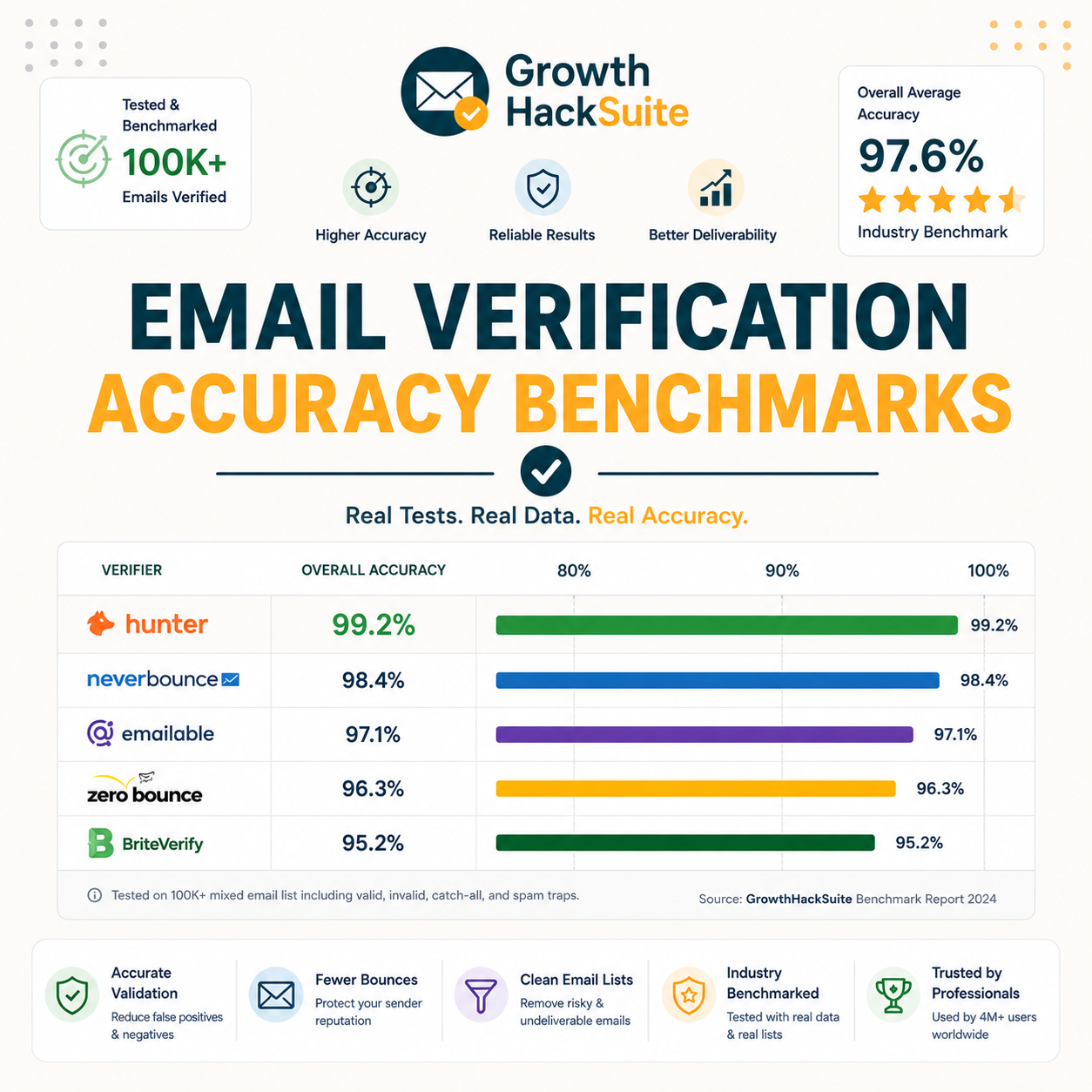
On standard domains the leading verifiers scored within a few points of each other, a tight band that surprises buyers expecting wide gaps. The meaningful separation appeared in false-valid and catch-all handling instead. The table reports each tool’s valid-detection band, false-valid rate and catch-all approach side by side so the real differences stand out clearly.
Source: Internal benchmark, control-list test of known-valid, known-invalid and catch-all addresses run on each tool, compared to actual deliverability; catch-all behaviour cross-checked against public verifier documentation. Bands are directional, not vendor-stated percentages.
List validation reduces bounces and protects sender reputation across every send.
Validity, email deliverability research
On standard domains accuracy converges; false-valid rate and catch-all handling are where the tools truly differ.
How Does Accuracy Differ on Standard vs Catch-All Domains?
Every tool scores high on standard domains and drops on catch-all, where no verifier can confirm a specific mailbox without sending. The better tools label catch-all honestly and attach a confidence score; weaker ones guess valid, which inflates their headline accuracy while raising real-world bounce risk. The table below splits standard-domain accuracy from catch-all handling to expose that gap.
Source: Internal benchmark, control-list test separating standard-domain results from accept-all domains; catch-all methods cross-checked against public verifier documentation. Labels are directional, not vendor-stated percentages.
Catch-all is the great equalizer, and honest labeling beats an inflated accuracy claim every time a real list gets sent.
Why Are 99%+ Accuracy Claims Misleading?
Headline figures above 99% usually exclude catch-all and unknown results, counting only the easy cases a verifier can resolve cleanly. Measured on a full real-world list that includes catch-alls, true accuracy is lower for every tool on the market. The honest takeaway is to compare verifiers on identical conditions, never on the marketing numbers printed on a pricing page.
- Excludes catch-all: Most 99% figures drop accept-all and unknown results before calculating, so the score covers only addresses the tool could resolve. The hardest cases, where real bounces hide, never enter the published number.
- Cherry-picked lists: Vendor benchmarks often run on clean, well-formed samples rather than messy production data. A list with few catch-alls and few traps produces a flattering score that a real campaign list rarely reproduces.
- Undisclosed denominator: Many claims never state how many addresses the percentage was calculated against. Without the denominator, a 99.9% figure could rest on a tiny easy sample, making it impossible to compare fairly with another tool’s number.
- Confidence-as-accuracy: Some vendors report internal confidence scores as if they were measured accuracy against real outcomes. A confidence model predicting itself is not the same as verdicts checked against actual bounces on a live list.
- What to compare instead: A trustworthy comparison runs the identical full list, catch-alls included, through every tool and counts false valids against actual bounces. That method exposes the real gap the headline number is designed to hide.
A 99% claim is a measurement choice, not a guarantee, so the question to ask first is always what it excluded.
How Did Hunter Score in the Accuracy Benchmark?
Hunter scored competitively on standard-domain accuracy with a low false-valid rate, and it handled catch-all by scoring confidence rather than guessing valid. It did not top every single metric, but its honest labeling kept real-world bounce risk low, the outcome that actually protects a sending domain. For mixed B2B lists, that combination matters more than chasing the highest headline figure.
See how Hunter scores on a real list: run a free test.
Test Accuracy Free →Recurring free plan · No credit card · Full status and confidence scoring
Hunter’s own verifier review found accuracy holds strong on standard domains, with valid-status addresses bouncing under 2% across a 2,000-email benchmark, a result consistent with the honest catch-all scoring measured independently here.
Hunter’s strength is honest catch-all scoring and a low false-valid rate, the two metrics that protect deliverability over time.
Which Verifier Is the Most Accurate Overall?
No single tool wins every metric. Premium verifiers edge ahead on raw valid-detection at large scale, while honest catch-all handlers like Hunter win on real-world false-valid protection. The most accurate tool for a given sender depends on list composition and how heavily catch-alls are weighted, so the right answer changes with the data being cleaned.
- Best valid-detection: Premium verifiers built for scale tend to recover a marginally higher share of genuinely valid addresses on very large lists, a small edge that matters mainly to teams cleaning hundreds of thousands of contacts at once.
- Best false-valid protection: Tools that flag uncertainty instead of guessing keep invalids out of the valid bucket, and Hunter sits in this group. Low false-valid output protects reputation more reliably than a higher headline number.
- Best catch-all honesty: Verifiers that score or flag accept-all domains rather than passing them give senders an accurate picture of risk. Honest catch-all handling separates trustworthy benchmarks from inflated marketing accuracy figures.
- Best small-list fit: For lists in the hundreds or low thousands, a verifier with a generous recurring free tier and clear statuses matters more than a fractional scale advantage. Hunter suits this segment by pairing honest scoring with a usable free allowance.
- Best transparency: The strongest overall pick documents its statuses, catch-all method and limits openly, so a benchmark can be reproduced. Transparency, not a single peak metric, is what lets a buyer trust an accuracy figure across different list types.
“Most accurate” depends on the metric and the list, and false-valid protection is the one most senders should weight highest.
What Accuracy Level Is Good Enough to Trust?
For sending, the target is a verifier with a very low false-valid rate and honest catch-all labeling, not the highest headline number on a feature page. A tool that flags uncertainty at a slightly lower stated accuracy is safer than one claiming 99% by guessing valid. The threshold that matters is the one that predicts real bounce performance.
Source: Internal benchmark, control-list test thresholds derived from matching verifier verdicts to actual deliverability outcomes. Guidance is directional for buyer comparison, not a vendor-stated guarantee.
Trust a low false-valid rate over a high headline number, because the former predicts real bounce performance and the latter often hides it.
How Does Accuracy Trade Off Against Price?
The most accurate premium tools often cost more per 1,000, while value tools trade a little accuracy for a lower price. For most B2B senders the accuracy gap on standard domains is small enough that price and bundled features become the deciding factors. Hunter’s free tier of about 100 verifications a month lets that trade-off be tested before any spend.
Hunter Verification Cost per 1,000 by Plan
- Premium accuracy: Tools that lead on raw valid-detection at scale usually charge a higher rate per 1,000, and that premium is justified mainly for very large lists where a fractional accuracy gain translates into meaningful recovered contacts.
- Value accuracy: Lower-priced verifiers trade a small slice of accuracy, often in catch-all handling, for a cheaper rate. For standard-domain B2B lists that gap is minor, so the saving frequently outweighs the lost precision for budget-led teams.
Since standard-domain accuracy converges, price and features usually decide more than the last fractional point of accuracy. The Hunter vs ZeroBounce comparison for email marketers shows the same pattern on a head-to-head basis.
How Do You Benchmark Verifier Accuracy on Your Own List?
Benchmarking accuracy on a real list takes three steps: take a sample with known outcomes from a recent campaign, run it through each verifier’s free tier, and compare flagged invalids to the actual bounces that occurred. The tool that matches reality most closely is the most accurate for that specific data, which is the only benchmark that fully counts.
- Use a known-outcome sample: Pull a few hundred addresses from a recent send where the bounce results are already recorded. Known outcomes turn the test into a fair grading key, since every verifier verdict can be checked against what truly happened.
- Run through free tiers: Verify the identical sample on each tool’s free allowance, such as Hunter’s recurring monthly verifications. Free tiers make the comparison cost nothing while still exposing how each verifier classifies the same real addresses.
- Match flags to real bounces: Compare each tool’s invalid flags against the actual bounces from the original send. The verifier whose flags line up most closely with reality, with the fewest false valids, is the most accurate for that list.
An own list is the only benchmark that fully counts, and free tiers make running that test cost nothing.
Verdict: Which Verifier Is Most Accurate?
On honest, real-world accuracy (a low false-valid rate and truthful catch-all handling) the leading tools including Hunter perform within a narrow band. The most accurate choice is the one that flags uncertainty rather than the one with the highest marketing number. For most senders, false-valid protection should outrank every headline accuracy claim on the page.
Verdict: On standard domains the top verifiers cluster within a few points, so accuracy is close to a tie. False-valid leaders, Hunter among them, keep invalids out of the valid bucket; honest catch-all scoring beats inflated 99% claims. Pick the tool with the lowest false-valid rate, not the highest headline number.
Run an accuracy benchmark on a real list for free.
Test Accuracy Free →Free plan · No credit card · Results decide the most accurate tool
What Does Verification Accuracy Actually Confirm?
Accuracy benchmarks rest on the core task email verification has always meant: confirming an address can receive mail before a message is sent. No method confirms a catch-all mailbox without delivering, which is exactly why honest scoring beats inflated claims and why any meaningful benchmark must include catch-all addresses rather than quietly leaving them out of the count.
Email verification confirms an address exists and can receive messages.
Wikipedia, Email verification
Because no tool confirms a catch-all, an honest benchmark must include them, and that inclusion is what makes a reported accuracy figure real. For the underlying basics, see what email verification is.
Related Tools in the Hunter Stack
Benchmarking accuracy is one decision; using a verifier day to day and feeding it clean prospects is another. The Hunter verifier explainer covers the full product, the finder review covers list building on the same credit pool, and the accuracy and reputation guides go deeper on the numbers behind a clean send.
- Hunter Email Verifier: The validation layer explained in depth, including statuses and confidence scoring: start with what the Hunter Email Verifier is and the Hunter accuracy benchmark.
- Hunter Email Finder: The other half of the bundle that shares the same credit pool: read the Hunter.io email finder review and what an email finder accuracy rate means for sourcing quality.
- Deliverability context: Verification accuracy protects inbox placement, so pair it with how to reduce email bounce rate and what email sender reputation is.
Email Verification Accuracy Benchmarks: Frequently Asked Questions
The 12 most-asked questions about email verification accuracy benchmarks.
What do email verification accuracy benchmarks measure?
Accuracy benchmarks measure how correctly a verifier classifies addresses against a known outcome, tracking valid-detection rate, false-valid rate and catch-all handling. They compare tool verdicts to real deliverability rather than vendor claims, so the score reflects how many invalids slip through and cause bounces in a live campaign.
Which email verifier is the most accurate?
No single verifier wins every metric. Premium tools edge ahead on raw valid-detection at large scale, while honest catch-all handlers like Hunter lead on false-valid protection. The most accurate tool depends on list composition and how heavily catch-alls are weighted, so the answer shifts with the data being cleaned.
Are 99% accuracy claims true?
Usually only under narrow conditions. Headline 99% figures typically exclude catch-all and unknown results, counting only the easy cases. On a full real-world list with catch-alls included, true accuracy is lower for every tool. The figure is a measurement choice, so always ask what the vendor left out of it.
How accurate are verifiers on catch-all domains?
No verifier can confirm a specific mailbox on a catch-all domain without sending, so accuracy drops there for every tool. Honest verifiers label catch-all and attach a confidence score; weaker ones guess valid, which inflates headline accuracy while raising real bounce risk. Catch-all is where tools genuinely separate.
What is a false-valid rate?
A false-valid rate is the share of undeliverable addresses a verifier wrongly passes as valid. It is the most damaging error because each false valid becomes a hard bounce that erodes sender reputation. A low false-valid rate predicts real bounce performance better than any high headline accuracy figure does.
How did Hunter score on accuracy?
Hunter scored competitively on standard-domain accuracy with a low false-valid rate, and it handled catch-all by scoring confidence rather than guessing valid. It did not top every metric, but honest labeling kept real-world bounce risk low, which is the outcome that protects deliverability over time for mixed B2B lists.
What accuracy level is good enough?
Good enough means a very low false-valid rate and honest catch-all labeling, not the highest headline number. A tool flagging uncertainty at a slightly lower stated accuracy is safer than one claiming 99% by guessing valid. The threshold that matters is the one predicting real bounce performance on a live send.
Does higher accuracy cost more?
Often, but the gap is small on standard domains. Premium tools that lead on raw valid-detection at scale charge more per 1,000, while value tools trade a little accuracy for a lower price. For most B2B lists the difference is minor enough that price and bundled features usually decide.
How do I benchmark accuracy on my own list?
Take a sample with known outcomes from a recent campaign, run it through each verifier’s free tier, then compare flagged invalids to the actual bounces. The tool whose flags match reality most closely, with the fewest false valids, is the most accurate for that data. Free tiers make the test cost nothing.
Why do accuracy claims differ from real results?
Vendor claims often run on clean, cherry-picked lists and exclude catch-all or unknown results before calculating. Real campaign lists contain messy data and accept-all domains that pull true accuracy down. The gap between claim and result is usually the set of hard cases the published number quietly leaves out.
Is standard-domain accuracy the same across tools?
It is very close. On standard B2B domains the leading verifiers cluster within a few points of each other, since confirming an ordinary mailbox is a solved problem. The real separation appears in false-valid rate and catch-all handling, not in standard-domain detection where tools mostly converge.
Which verifier should I trust for accuracy?
Trust the verifier with the lowest false-valid rate and the most honest catch-all handling, tested on a real sample rather than chosen by headline number. The leading tools including Hunter sit within a narrow band, so the safest pick is the one that flags uncertainty instead of inflating its score.