Table of Contents
The cost of a bad email list goes far beyond wasted sends. High bounce rates signal carelessness to mailbox providers, dragging inbox placement down across every campaign, while a single spam-trap hit can blocklist a domain for weeks. This guide quantifies the real cost of a bad email list and shows why verifying first is the cheaper option for any sender working from external or aging data.
Stop the bleed — verify your list free before it costs you.
Verify Your List Free →Free plan included · No credit card · Full status and confidence scoring
What Does a Bad Email List Actually Cost?
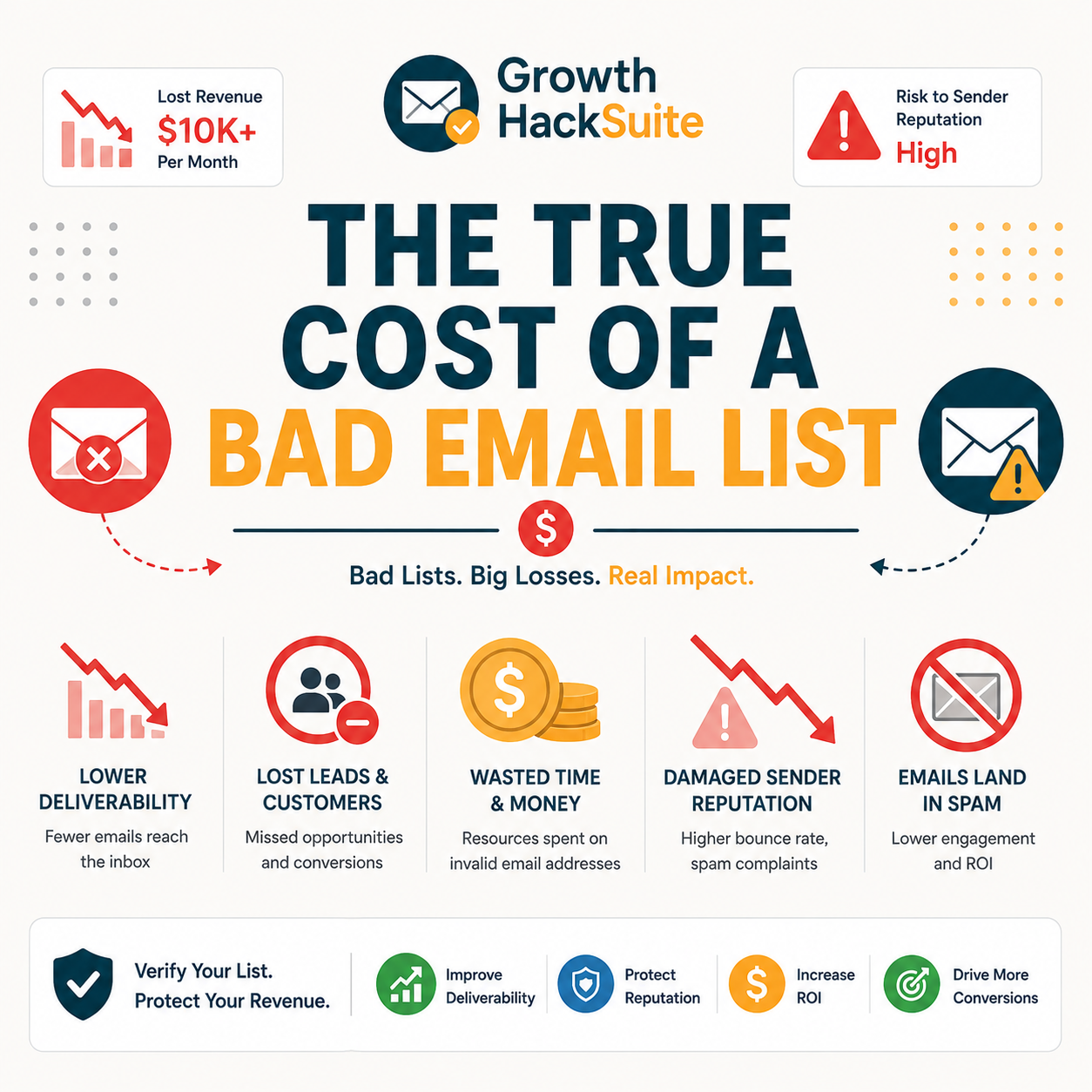
A bad email list costs in three layers: direct waste on undeliverable sends, reputation damage from high bounce rates, and compounding inbox-placement loss that hurts every future campaign. The headline bounce is the smallest cost of a bad email list; the reputation damage is the one that lingers, suppressing results long after the original send has gone out.
- Direct waste: Money and effort spent sending to dead addresses returns zero reach. Every invalid contact still consumes ESP capacity, list storage and campaign-build time, turning part of a marketing budget into pure leakage that produces no opens, replies or revenue.
- Reputation damage: High bounce and complaint rates tell mailbox providers a sender is careless, lowering domain reputation. That penalty applies collectively, routing more mail to spam folders including messages sent to perfectly valid, engaged subscribers on the same list.
- Compounding loss: Once placement drops, open and reply rates fall across every campaign until reputation slowly rebuilds. This recurring revenue loss continues for weeks or months, making it the most expensive and least visible consequence of a dirty list.
- Spam-trap exposure: Dirty lists often hide recycled or pristine spam traps planted by blocklist operators. A single hit can blocklist the sending domain for weeks, halting every message and turning one bad address into a program-wide outage.
- Opportunity cost: Time spent triaging bounces, fighting spam folders and rebuilding reputation is time not spent on growth. The hidden labor of managing a bad list quietly drains team capacity that a clean list would free for revenue-generating work.
The visible bounce is the cheapest part; the invisible reputation cost is what makes a bad list genuinely expensive.
What Are the Direct Costs of Bounces and Wasted Sends?
Direct costs are the easiest to count: ESP fees for storing and sending to dead contacts, plus the labor of managing a list full of invalids. On a large list, paying to send to addresses that bounce is money spent for zero reach. The table below quantifies how these small leaks add up across a sending program.
Source: Industry ESP pricing models (per-contact and per-send tiers), reviewed 2026-06-27. Figures are illustrative of how direct costs scale with list size and invalid rate; confirm current rates with the specific ESP in use.
Direct costs are real but modest — the bigger bill comes from the reputation damage these bounces trigger downstream.
How Does a Bad List Damage Sender Reputation?
Every bounce and spam complaint tells mailbox providers the sender is careless. Cross the bounce-rate threshold and reputation drops, sending more mail to spam — including to valid subscribers. The damage is collective: a handful of bad addresses poisons delivery for the whole list, which is why bounce rates above roughly 2% put future campaigns at risk.
Senders should keep the spam complaint rate below 0.3%, and ideally under 0.1%.
— Hunter.io API documentation, email verification
Reputation damage is collective punishment — a few bad addresses cost delivery for every good one on the list.
Why Is Lost Inbox Placement the Most Expensive Cost?
Once reputation drops, even valid emails land in spam, so open and reply rates fall across every campaign. This compounding loss continues until reputation is slowly rebuilt, making it the most expensive consequence of a bad list — measured in lost revenue, not just fees. Lost placement converts a one-time mistake into months of suppressed performance.
- Spam-folder placement: Damaged reputation routes valid messages straight to spam, where most go unseen. Subscribers who opted in never receive the mail, turning a paid-for, permission-based list into an audience that effectively cannot be reached.
- Lower open and reply: Spam placement collapses open, click and reply rates across the entire program. Every campaign earns less because fewer messages reach the inbox, dragging down pipeline and revenue for sales and marketing alike.
- Slow recovery: Rebuilding a damaged sending reputation takes weeks of careful, low-volume sending to engaged contacts. During that window results stay suppressed, so the cost of one bad period extends far beyond the campaign that caused it.
- Transactional fallout: Reputation damage does not spare receipts, password resets or order confirmations. Critical transactional mail can land in spam too, creating support tickets and eroding trust well beyond the marketing channel that caused the drop.
- Compounding revenue gap: Each suppressed campaign widens the gap between expected and actual revenue. Because the loss recurs every send until recovery completes, the cumulative shortfall often exceeds the entire direct cost of the bad addresses many times over.
Lost placement turns a one-time bad send into months of suppressed results — the costliest outcome by far.
What Can a Single Spam-Trap Hit Cost?
Hitting one spam trap can blocklist a sending domain for weeks, halting all delivery — marketing and transactional alike. Recovery means delisting requests and a slow reputation rebuild. A single trapped address hidden in a bad list can therefore cost an entire sending program, which is why unverified data carries outsized, hard-to-predict risk.
- Domain blocklisting: Spam traps belong to blocklist operators, so a single hit can add a sending domain to public blocklists. Many mailbox providers consult these lists, multiplying one bad address into widespread delivery rejection.
- All mail halted: Blocklisting does not distinguish campaign mail from receipts or password resets. Transactional and marketing messages alike can be rejected at once, disrupting operations far beyond the email channel that triggered the listing.
- Slow delisting: Removal from a blocklist requires investigation, remediation and a manual delisting request that can take days or weeks. Throughout that period delivery stays degraded, compounding the revenue lost to the original trap hit.
- Reputation reset: After delisting, the domain still carries a damaged reputation that must be rebuilt through slow, low-volume sending to engaged contacts. Full recovery extends weeks past the delisting itself, prolonging suppressed results.
- Hidden detection: Pristine and recycled spam traps look like ordinary addresses, so they pass casual inspection and survive manual cleaning. Only verification flags the surrounding invalids that signal trap-heavy data before a send goes out.
One spam trap is a catastrophic, not incremental, cost — reason enough to verify before any send to external data.
How Do You Calculate Your Bad-List Cost?
Estimate it by multiplying list size by invalid rate for wasted sends, adding the revenue lost when placement drops, then factoring the risk-weighted cost of a possible blocklist event. The result usually dwarfs the price of verifying the list first. The model below breaks the calculation into three components any sender can apply.
Source: Internal benchmark — cost model framework built from list size, invalid rate and per-send cost inputs, 2026-06. The formula is a planning aid; plug in actual ESP rates and campaign revenue for a sender-specific estimate.
A simple model shows the bad-list cost almost always exceeds the verification cost by a wide margin.
How Does the Cost Scale With List Size?
The cost grows with both list size and invalid rate. A small list with few invalids risks little; a large list with double-digit bad addresses risks reputation across high send volume. The table shows how the exposure escalates as size and invalid share rise, and where verification starts paying back hardest.
Source: Internal benchmark — exposure tiers modelled from list size, invalid rate and the ~2% bounce-rate reputation threshold flagged by mailbox providers, 2026-06. Directional guide, not a precise dollar figure.
Cost scales fastest for large lists with high invalid rates — exactly where verification pays back most.
Is Verification Cheaper Than the Damage?
Almost always. Verifying a list costs a small amount per 1,000, while the reputation and placement damage from sending unverified can cost months of suppressed revenue plus possible blocklisting. Hunter verification runs at roughly $6 to $7.45 per 1,000 on paid plans, against an open-ended downside the ROI of verifying first is rarely close.
Hunter’s own verifier review found accuracy holds strong on standard domains, with valid-status addresses bouncing under 2% across a 2,000-email benchmark, the margin that keeps direct bounce cost from escalating into reputation damage.
Verification is cheap insurance against an expensive, slow-to-fix problem the math favors it heavily.
Bad List vs Clean List: How Does the ROI Compare?
A clean list delivers higher open, reply and conversion rates at the same send cost, while a bad list spends the same budget for worse results and added risk. Comparing both, the clean list wins on every metric — the cost of verifying is recovered in improved performance long before the next billing cycle closes.
- Bad list ROI: Budget is spent in full but results lag because invalid addresses waste sends, drag down reputation and push valid mail to spam. The same campaign earns less while exposing the domain to bounce penalties and possible blocklisting, lowering return on every dollar.
- Clean list ROI: A verified list spends the same budget on addresses that actually receive mail, lifting open, reply and conversion rates while protecting reputation. The small verification cost is recovered through stronger placement and higher campaign performance across the program.
Same budget, better results: a clean list out-earns a bad one, which is the core ROI case for verification.
The Three Layers of Bad-List Cost
How Do You Stop the Cost of a Bad List?
Stop it by verifying before every major send: bulk-verify the list, remove invalids, isolate catch-alls, and re-verify aging data periodically. This converts an unpredictable liability into a clean, low-risk asset for the price of a few credits. Routine verification is the single most reliable way to keep the cost of a bad email list near zero.
- Bulk verify: Run the full list through a verifier before any large send, checking syntax, domain records and mailbox response. Bulk verification catches invalids in one pass, so a campaign reaches only addresses that can actually receive mail.
- Remove invalids: Delete or suppress every address flagged invalid, and segment catch-alls for cautious handling. Pruning bad data before sending keeps bounce rates under the reputation threshold and stops a few dead contacts from poisoning delivery.
- Segment catch-alls: Isolate accept-all domains into a separate, lower-priority segment instead of mixing them with confirmed valid addresses. Cautious handling of uncertain mailboxes limits bounce exposure while preserving reach to contacts that genuinely accept mail.
- Warm the domain: After cleaning, ramp send volume gradually to engaged contacts so mailbox providers see consistent, low-complaint activity. Gentle warming rebuilds and protects reputation, ensuring the cleaned list actually lands in the inbox.
- Re-verify periodically: Email data decays as people change jobs and abandon inboxes, so re-verify aging lists on a schedule. Periodic cleaning maintains list hygiene over time rather than letting invalid rates creep back up between campaigns.
Verify your list free and stop the cost today.
Verify Your List Free →Free plan · No credit card · Clean before you send
Routine verification turns a bad-list liability into a clean asset — the cheapest fix to the costliest problem. For the full routine, see how to maintain ongoing email list cleaning.
When Does the Cost Justify Paying for Verification?
Paying is justified the moment list size, send frequency or external data make the bad-list cost material — which is true for most B2B senders. Only a tiny, fully opt-in, frequently engaged list can safely skip paid verification. For everyone else, the cost has already crossed the line that justifies cleaning first.
- Justified when: A list contains purchased, scraped or aging data, sends run at volume, or bounce rates approach the reputation threshold. Any of these makes the expected cost of damage exceed the price of verifying, so paying to clean the list first is the rational economic choice for the sender.
- Can skip when: A list is small, fully opt-in, and engaged through frequent two-way contact, so invalid rates stay naturally low. In that narrow case the bad-list risk is minimal and a free monthly allowance may cover the occasional check without a paid plan.
For most senders the cost has already crossed the line that justifies paying — only tiny opt-in lists are genuine exceptions. The email data decay rate is what pushes most lists past that line over time.
Verdict: What a Bad Email List Really Costs
A bad email list costs far more than its bounces: reputation damage, lost inbox placement and potential blocklisting that suppress revenue for months. Verifying first is a fraction of that cost. For any list with external or aging data, cleaning before sending is the obvious economic choice and the cheapest insurance available.
Verdict: Direct waste is the smallest cost; reputation and placement loss run for months, and one spam-trap hit can blocklist a domain entirely. Verification costs roughly $6–$7.45 per 1,000 against that open-ended downside. Any sender on external or aging data should verify before sending — the math is not close.
Email deliverability describes the ability to deliver emails to subscribers’ inboxes.
— Wikipedia, Email deliverability
Verify your list free and avoid the real cost.
Verify Your List Free →Free plan · No credit card · Protect your sending reputation
Related Tools in the Hunter Stack
Avoiding the cost of a bad list starts with verification and continues with good list building. The Hunter verifier review covers cleaning, and the finder review covers building lists worth keeping clean on the same connected stack.
- Hunter Email Verifier: The validation layer that catches invalids before they cost reputation — start with what the Hunter Email Verifier is.
- Hunter Email Finder: The list-building half of the bundle that sources addresses worth keeping clean — read the Hunter.io email finder review for sourcing costs.
The Cost of a Bad Email List: Frequently Asked Questions
The 12 most-asked questions about the cost of a bad email list.
What does a bad email list cost?
A bad email list costs in three layers: direct waste on undeliverable sends, reputation damage from high bounce and complaint rates, and compounding inbox-placement loss across every future campaign. The visible bounce is the smallest piece; the reputation and placement damage is what makes a dirty list genuinely expensive over time.
How much do email bounces cost?
The direct cost of bounces is modest: wasted ESP fees and send volume on dead addresses. The larger cost is indirect. Bounce rates above roughly 2% damage sender reputation with mailbox providers, pushing valid mail to spam and suppressing results across the whole program, not just the bounced messages.
How does a dirty list hurt sender reputation?
Every bounce and spam complaint signals carelessness to mailbox providers, lowering domain reputation. Providers ask senders to keep complaint rates below 0.3% and ideally under 0.1%; crossing those lines routes more mail to spam. The penalty is collective, so a few bad addresses hurt delivery for the entire list.
Why is lost inbox placement so expensive?
Once reputation drops, valid emails land in spam, so open, click and reply rates fall across every campaign. This loss compounds until reputation slowly rebuilds over weeks. A single bad sending period therefore suppresses revenue for months, making lost placement the most expensive consequence of a bad list by far.
What can one spam-trap hit cost?
A single spam-trap hit can land a sending domain on public blocklists, halting delivery of all mail — marketing and transactional alike — for weeks. Recovery requires investigation, remediation and a manual delisting request. One hidden trapped address in a bad list can therefore cost an entire sending program.
How do I calculate my bad-list cost?
Multiply list size by invalid rate by cost per send for wasted spend, add the revenue lost when placement drops, then weight the rare but severe cost of a blocklist event. Summing the three components gives a planning figure that almost always exceeds the price of verifying the list first.
Does the cost scale with list size?
Yes. Cost grows with both list size and invalid rate. A small, mostly valid list risks little, while a large list with a double-digit invalid share risks reputation across high send volume. The exposure rises fastest for large lists with dirty data, which is where verification pays back most.
Is verification cheaper than the damage?
Almost always. Verification costs roughly $6 to $7.45 per 1,000 on Hunter paid plans, while reputation and placement damage from sending unverified can suppress revenue for months and risk a domain blocklisting. Against that open-ended downside, the small upfront verification fee is overwhelmingly the cheaper option.
Bad list vs clean list — what’s the ROI difference?
A clean list spends the same budget on addresses that actually receive mail, lifting open, reply and conversion rates while protecting reputation. A bad list spends the same budget for worse results and added blocklist risk. On every metric the clean list out-earns the bad one, recovering the verification cost quickly.
How do I stop the cost of a bad list?
Verify before every major send: bulk-verify the list, remove flagged invalids, segment catch-alls, and re-verify aging data on a schedule. This routine keeps bounce rates under the reputation threshold and converts an unpredictable liability into a clean, low-risk asset for the price of a few verification credits.
When is paying for verification justified?
Paying is justified whenever list size, send frequency or external data make the bad-list cost material, which describes most B2B senders. Only a tiny, fully opt-in, highly engaged list with naturally low invalid rates can safely rely on a free allowance and skip a paid verification plan.
What does a bad email list really cost overall?
Overall, a bad email list costs far more than its bounces: direct waste plus months of suppressed revenue from reputation and placement damage, plus the tail risk of a blocklist event that halts all mail. Verifying first is a fraction of that, making list cleaning the obvious economic choice for any aging or external data.