Table of Contents
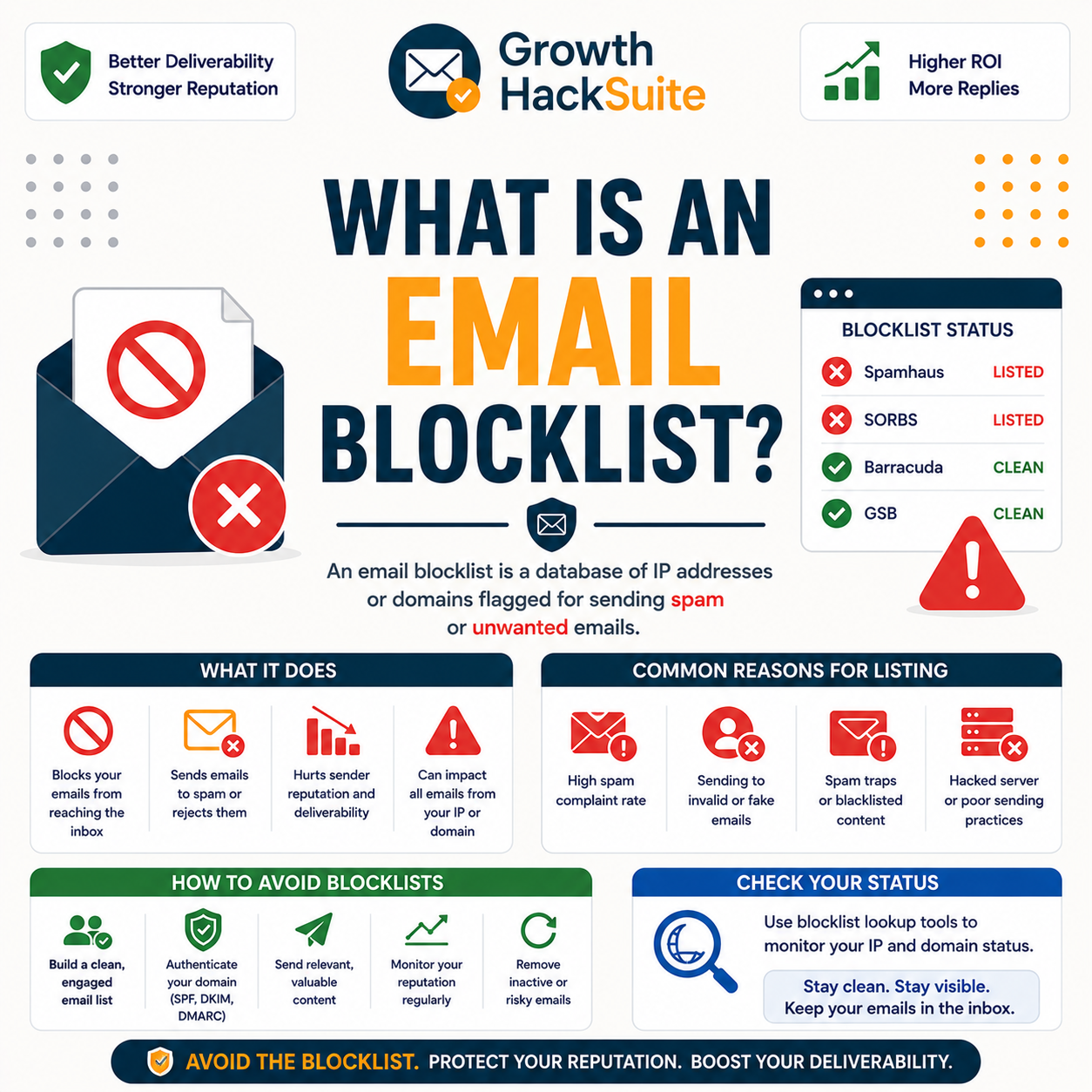
An email blocklist is a database of IP addresses and domains known for spam, which mail servers check to reject or filter incoming mail. Also called a blacklist or RBL, it can block messages across many providers at once. Senders usually land on one by hitting spam traps or generating complaints. This guide explains what an email blocklist is, how it works, and how to avoid one.
Stay off blocklists — verify your list free.
Verify an Email Free →Free plan included · No credit card · Cuts spam-trap hits before you send
What Is an Email Blocklist?
An email blocklist, also called a blacklist or RBL, is a database of IP addresses and domains identified as sources of spam. Mail servers check incoming mail against these lists and reject or filter anything from a listed sender. Landing on one can block your email across many providers at once, since most servers consult the same widely used lists.
- Spam-source database: An email blocklist catalogs IP addresses and domains that anti-spam operators have linked to spam, phishing, or abuse. The list functions as a shared reputation record that receiving servers query before deciding whether to accept incoming mail.
- Servers check it: Receiving mail servers look up the sending IP or domain against one or more blocklists during the delivery handshake. That real-time check happens before the message body is ever inspected, so a listing blocks mail at the connection stage.
- Mail rejected widely: A single listing on a popular blocklist affects every provider that subscribes to it, so the sender loses reach across many inboxes simultaneously. The penalty multiplies because so many servers consult the same handful of authoritative lists.
- Reputation, not content: A blocklist judges the sender’s IP or domain reputation rather than the wording inside any single message. That distinction means a listing blocks every message from a sender, including ones that contain no spam indicators at all.
- Shared and authoritative: Major blocklists act as community infrastructure that thousands of mail servers trust as a single source of truth. Their broad adoption is precisely what turns one entry into a deliverability problem felt across the entire email ecosystem.
How a Sender Ends Up Blocked
A blocklist is a spam-source database, so being on one gets your mail rejected across many providers at once rather than at just a single inbox.
How Does an Email Blocklist Work?
Anti-spam operators add IP addresses and domains that trigger spam signals, then publish the list for servers to query. Receiving mail servers check it in real time during delivery and refuse or filter mail from listed senders. Removal is not automatic; it requires fixing the cause of the listing and then requesting delisting from the operator that maintains the list.
- Operator lists the sender: An anti-spam organization detects abuse signals, such as spam-trap hits or complaint spikes, and adds the offending IP or domain to its published list. That entry becomes the authoritative record other servers rely on.
- List is published: The operator distributes the blocklist over DNS so that any mail server can query it instantly during a delivery attempt. Publishing via DNS is what makes lookups fast enough to run on every inbound connection.
- Servers query in real time: During the SMTP delivery handshake, the receiving server looks up the sender against the blocklist through a fast DNS query. The lookup returns a match or no match before the message is accepted into the inbox.
- Mail refused or filtered: A positive match prompts the receiving server to reject the connection outright or route the message to spam, depending on local policy. The sender loses inbox placement until the listing is cleared.
- Delisting clears the entry: Removal happens only after the sender fixes the cause and the operator processes a delisting request, dropping the entry from the published list. Until that point, every querying server keeps refusing the sender.
Operators list spam sources, servers check those lists live during delivery, and listed mail is refused or filtered until the sender fixes the cause and delists.
What Are the Types of Blocklist?
There are IP-based blocklists that list the addresses of sending servers, and domain-based blocklists that list sending or linked domains. Some are widely used and high-impact, blocking mail across most providers; others are niche and affect fewer servers. The table below outlines the two main types and the reach each one tends to have.
Source: blocklist behavior per Wikipedia, Domain Name System blocklist, verified 2026-06-29. Rows describe common blocklist categories; confirm each list’s exact scope before acting.
Blocklists target either IPs or domains, and the widely used ones can block mail across most providers, while niche lists affect a narrower set of servers.
How Do You End Up on a Blocklist?
You land on a blocklist by hitting spam traps, generating high complaint rates, sending to many invalid addresses, or pushing sudden volume spikes. Most of these triggers trace back to poor list hygiene rather than malicious intent. That connection is exactly why pre-send verification is a frontline defense against ever being listed in the first place.
- Spam-trap hits: Spam traps are addresses planted by anti-spam operators that should never receive mail, so any message reaching one signals scraped or stale data. A single recycled-trap hit can flag a sender for listing on strict lists.
- High complaint rates: Recipients marking mail as spam push the complaint rate above provider thresholds, which anti-spam systems treat as evidence of unwanted sending. Sustained complaints quickly escalate a sender toward a blocklist entry.
- Many invalid addresses: Repeatedly sending to nonexistent mailboxes produces hard bounces that signal a poorly maintained list. High bounce volume tells receiving servers the sender did not verify recipients, raising the listing risk.
- Sudden volume spikes: A sharp, unexplained jump in sending volume from a cold IP mimics the pattern of a compromised or abusive account. Anti-spam systems flag that anomaly and may list the sender before the legitimate campaign even finishes.
- Poor authentication: Missing or misconfigured SPF, DKIM, and DMARC records leave a sending domain looking unverified and easy to spoof. Receiving systems treat that gap as a risk signal that pushes a borderline sender toward listing.
Verifying addresses before a send removes the invalid and risky contacts that generate bounces and complaints.
— Hunter, Email Verifier API documentation
Most blocklist triggers trace to poor hygiene, including traps, complaints, and invalids, all of which verification can prevent before a single message goes out.
What Happens If You Are Blocklisted?
A blocklisting can block your mail at every provider that uses that list, halting marketing campaigns and sometimes transactional email such as receipts. The impact ranges from quiet filtering to full rejection, depending on the list and its reach. Recovery requires identifying and fixing the cause, then requesting delisting, which can take days.
- Mail blocked widely: Once a sender is listed on a major blocklist, every subscribing provider refuses or filters its mail at once, collapsing deliverability across the board. Both marketing and critical transactional messages can stop reaching recipients.
- Slow delisting: Removal depends on the operator’s process, which often requires proof the underlying problem is fixed before a request is granted. Delisting can stretch from hours to days, during which mail stays blocked.
A listing can block mail across providers at once, and recovery means first fixing the cause and then waiting through a delisting process that is rarely instant.
How Does Verification Help You Avoid Blocklists?
Verification removes invalid, disposable, and high-risk addresses before sending, cutting the spam-trap hits and bounce-driven complaints that lead to listing. By keeping the very signals that trigger blocklists low, pre-send verification works as prevention rather than cleanup. It is one of the most effective measures available for staying off the lists entirely.
Verifying addresses before a send keeps bounces and complaints low, removing the signals that lead to a listing.
— Growth Hack Suite, pre-send verification workflow
Verification cuts the trap hits and bounces that trigger listings, making it a frontline blocklist defense that prevents the problem instead of repairing it later.
How Do You Check If You Are Blocklisted?
Check your sending IP and domain against major blocklists using free lookup tools, and watch delivery metrics for sudden drops or rejection messages that cite a blocklist. Regular monitoring catches a listing early, before it does lasting damage to your sender reputation and inbox placement across the providers your recipients use.
- Blocklist lookup tools: Free multi-list checkers query dozens of blocklists at once for a given IP or domain and report any matches instantly. Running this lookup on a schedule surfaces a new listing soon after it happens.
- Watch rejection messages: Bounce and rejection notices often name the specific blocklist responsible, pointing directly to the source of a delivery failure. Reading these SMTP error strings identifies which list to address and delist from.
Check your IP and domain against blocklist lookups and watch for rejection notices that name a list, so listings are caught early rather than after lasting damage.
Blocklist vs Greylist vs Reputation: How Do They Differ?
A blocklist permanently refuses listed senders; greylisting temporarily defers unknown senders and accepts them on retry; reputation is a graded score that shifts with behavior. Blocklisting is the hardest penalty, while reputation is the most continuous control. The table below contrasts these three deliverability mechanisms on action and severity.
Source: blocklist behavior per Wikipedia, Domain Name System blocklist; greylisting and reputation behavior per general mail-filtering practice, verified 2026-06-29.
A blocklist is the hard wall, greylisting a temporary speed bump, and reputation a sliding scale, so the three controls send very different deliverability signals.
How Do You Avoid and Recover From Blocklisting?
Avoid listing by verifying lists, building with permission, authenticating with SPF and DKIM, and ramping volume gradually. If already listed, identify the cause, fix it, then submit a delisting request to the operator. Prevention through verification is far easier and faster than working through the slow, evidence-based delisting process after the fact.
- Verify and collect permission: Cleaning a list with a verifier and mailing only opted-in recipients removes the trap hits and complaints that cause listings. Permission-based sending keeps engagement high and abuse signals low from the start.
- Authenticate the domain: Configuring SPF, DKIM, and DMARC proves a sending domain is legitimate and harder to spoof, lowering the risk signals that contribute to listing. Strong authentication also speeds reputation recovery after any incident.
- Ramp volume gradually: Warming a new IP by increasing send volume slowly avoids the sudden spikes that anti-spam systems read as abuse. A measured ramp builds positive reputation instead of tripping anomaly detection on day one.
- Fix the underlying cause: Before requesting removal, the sender must resolve whatever triggered the listing, whether a leaked credential, a dirty import, or a complaint spike. Operators reject delisting requests when the root problem remains unaddressed.
- Request delisting: Once the cause is fixed, the sender submits a removal request through the operator’s process and waits for review. Honest disclosure and proof of remediation speed approval, though the wait can still span days.
Verify your list free to avoid blocklisting.
Verify an Email Free →Free plan · No credit card · Remove invalids before they trigger a listing
Prevent listing with verification and permission-based sending, because delisting after the fact is slow, evidence-based, and entirely avoidable with clean lists.
What Tools Help You Avoid Blocklists?
A verifier reduces the trap and bounce signals that cause listing, while blocklist monitors track your live status across the major lists. Hunter handles the verification side on a recurring free tier. The table below compares verification options that lower blocklist risk on the features that matter for prevention.
Source: hunter.io/pricing, verified 2026-06-29 (free 50 credits/mo = ~100 verifications). Other rows describe common tool categories; confirm each provider’s behavior before buying.
A verifier lowers the signals that cause listing while a monitor tracks status, so pairing the two is the most reliable way to stay off the blocklists.
Verdict: How to Stay Off Email Blocklists
An email blocklist can block your mail across many providers at once, usually triggered by spam traps, complaints, and invalid addresses. Verification removes those signals before they send, making it the single most effective prevention. Build with permission, authenticate your domain, and verify before every send to keep your IP and domain off the lists.
Verdict: A blocklist causes wide mail rejection, triggered mostly by spam traps, complaints, and invalids. Verification removes those signals before sending, so it is the strongest prevention. Delisting afterward is slow, which makes clean lists and permission-based sending the smarter path.
A DNSBL is a list of IP addresses published for mail-server spam filtering.
— Wikipedia, Domain Name System blocklist
Verify your list free and stay off blocklists.
Verify an Email Free →Free plan · No credit card · Prevention beats slow delisting
Related Tools in the Hunter Stack
Blocklists tie directly to spam traps and sender reputation, so prevention starts with clean lists. The Hunter Email Verifier review covers how it reduces the invalid and risky addresses that drive listings, while the finder review covers building the lists worth verifying in the same connected stack on one shared credit pool.
- Hunter Email Verifier: The validation layer that removes the invalids and high-risk addresses behind most listings — start with what the Hunter Email Verifier is.
- Hunter Email Finder: The list-building half of the bundle that shares the same credit pool — read the Hunter.io email finder review for sourcing costs.
Email Blocklists: Frequently Asked Questions
The 12 most-asked questions about email blocklists.
What is an email blocklist?
An email blocklist, also called a blacklist or RBL, is a database of IP addresses and domains identified as sources of spam. Mail servers check incoming mail against these lists and reject or filter anything from a listed sender. Landing on a widely used one can block email across many providers at once.
How does an email blocklist work?
Anti-spam operators add IPs and domains that trigger spam signals, then publish the list. Receiving mail servers query it in real time during the delivery handshake and refuse or filter mail from listed senders. Removal is not automatic and requires fixing the cause, then requesting delisting from the operator.
What are the types of blocklist?
There are IP-based blocklists that list the addresses of sending servers, and domain-based blocklists that list sending or linked domains. Some are widely used and high-impact, blocking mail across most providers, while others are niche and affect fewer servers. The type determines the reach of a listing.
How do you end up on a blocklist?
You land on a blocklist by hitting spam traps, generating high complaint rates, sending to many invalid addresses, or pushing sudden volume spikes. Most triggers trace back to poor list hygiene rather than malicious intent, which is why pre-send verification is a frontline defense against ever being listed.
What happens if you are blocklisted?
A blocklisting can block your mail at every provider that uses that list, halting marketing campaigns and sometimes transactional email. The impact ranges from quiet filtering to full rejection, depending on the list. Recovery requires identifying and fixing the cause, then requesting delisting, which can take days.
How does verification help avoid blocklists?
Verification removes invalid, disposable, and high-risk addresses before sending, cutting the spam-trap hits and bounce-driven complaints that lead to listing. By keeping the signals that trigger blocklists low, pre-send verification works as prevention rather than cleanup, making it one of the most effective measures for staying off the lists.
How do I check if I am blocklisted?
Check your sending IP and domain against major blocklists using free multi-list lookup tools, and watch delivery metrics for sudden drops or rejection messages that cite a blocklist. Regular monitoring catches a listing early, before it does lasting damage to sender reputation and inbox placement.
Blocklist vs greylist vs reputation?
A blocklist permanently refuses listed senders; greylisting temporarily defers unknown senders and accepts them on retry; reputation is a graded score that shifts with behavior. Blocklisting is the hardest penalty, while reputation is the most continuous control. The three send very different deliverability signals.
How do I avoid and recover from blocklisting?
Avoid listing by verifying lists, building with permission, authenticating with SPF and DKIM, and ramping volume gradually. If already listed, identify the cause, fix it, then submit a delisting request to the operator. Prevention through verification is far easier than the slow delisting process.
What tools help avoid blocklists?
A verifier reduces the trap and bounce signals that cause listing, while blocklist monitors track your live status across the major lists. Hunter handles the verification side on a recurring free tier of about 100 verifications a month. Pairing a verifier with a monitor covers both prevention and detection.
Do spam traps cause blocklisting?
Yes. Spam traps are addresses planted by anti-spam operators that should never receive mail, so reaching one signals scraped or stale data. Repeated trap hits are a leading trigger for blocklisting. Verifying a list before sending removes the invalid and risky addresses that are most likely to be traps.
How long does delisting take?
Delisting time depends on the operator and the list, ranging from a few hours on automatic lists to several days on manual ones. The process usually requires proof the underlying cause is fixed before removal is granted. Mail stays blocked throughout, which is why prevention beats waiting through delisting.