Table of Contents
A spam complaint rate is the percentage of recipients who mark your email as spam or junk. Once it climbs above roughly 0.1 percent, sender reputation suffers and mail starts landing in the spam folder. Complaints come from unwanted email sent to poorly maintained lists. This guide explains the safe threshold and how to lower it.
Keep complaints low — verify your list free before every send.
Verify Your List Free →Free plan included · No credit card · Removes risky addresses
What Is a Spam Complaint Rate?
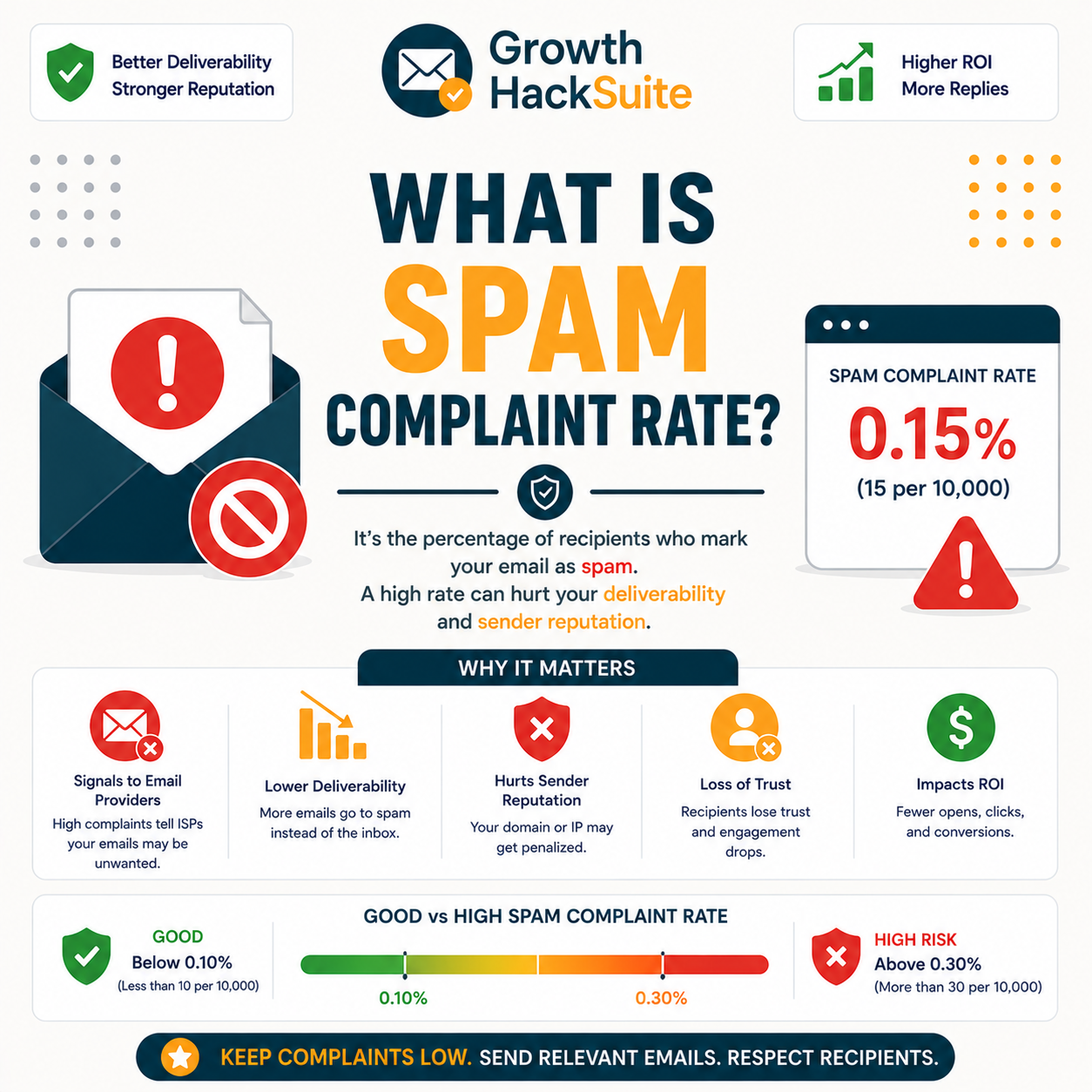
A spam complaint rate is the percentage of delivered emails that recipients mark as spam or junk. Mailbox providers treat it as a direct signal of whether people actually want your mail. A high complaint rate is one of the fastest ways to damage sender reputation and lose inbox placement, because it tells the provider that recipients are rejecting what arrives.
- Share marked spam: The metric counts the proportion of delivered messages that recipients flag as spam or junk, expressed as a percentage. It isolates the rejection behavior that providers care about most, separate from opens, clicks, or bounces.
- Wanted-mail signal: A complaint rate measures consent and relevance directly, since recipients only report mail they did not want or expect. Providers read it as the clearest available proof of whether an audience welcomes a sender.
- Reputation impact: A rising complaint rate erodes sender reputation faster than almost any other signal, pushing future mail toward the spam folder. Providers act on it quickly because complaints come straight from the people receiving the email.
- Provider-side metric: Mailbox providers calculate the figure on their own servers from recipient actions, so senders cannot edit or soften it. The number arrives as an external verdict on how an audience received recent campaigns.
- Per-domain visibility: Dashboards break the complaint rate down by sending domain, revealing which streams trigger the most spam reports. That granularity lets senders isolate a problem campaign instead of guessing across the whole program.
The complaint rate is the clearest signal of whether recipients want your mail, and providers weigh it heavily when deciding where future messages land.
How Is a Spam Complaint Rate Measured?
A spam complaint rate is complaints divided by delivered emails, expressed as a percentage. It is usually tracked through feedback loops that mailbox providers offer and through dashboards such as Google Postmaster Tools. Because the rate is measured against delivered mail rather than total sends, even a handful of complaints on a small campaign can push the percentage surprisingly high.
- Complaints over delivered: The calculation divides the number of spam reports by the count of delivered messages, then multiplies by one hundred. Measuring against delivered mail, not attempted sends, means bounced addresses never dilute the figure.
- Feedback loops: Mailbox providers expose complaint data through feedback loops that report when a recipient hits the spam button. Senders subscribe to these loops to receive the raw complaint signals that build an accurate rate.
- Postmaster dashboards: Google Postmaster Tools and similar provider dashboards calculate and publish a daily spam rate for authenticated domains. These dashboards turn scattered feedback signals into a single tracked percentage that senders can monitor over time.
The complaint rate is complaints over delivered mail, so small sends can spike it from just a few reports, which makes consistent monitoring essential.
What Is a Safe Spam Complaint Rate?
The safe threshold is roughly 0.1 percent, or about one complaint per thousand emails. Google asks bulk senders to keep the spam rate below 0.1 percent and to never reach 0.3 percent or higher, and Yahoo sets parallel expectations. Above 0.1 percent, providers begin penalizing reputation; around 0.3 percent risks serious deliverability damage.
Source: Google bulk sender guidelines / Google Postmaster Tools, 2024 (keep spam rate below 0.10%, never reach 0.30% or higher); Yahoo Sender Hub, 2024 (recommends below 0.1%, exceeding 0.3% risks restrictions). Verified 2026-06-29.
Keep complaints under 0.1 percent, roughly one per thousand, to stay in good standing, and treat 0.3 percent as a hard line you never want to cross.
What Raises Your Complaint Rate?
Complaints rise from emailing people who never opted in, sending too frequently, hiding the sender identity, burying the unsubscribe link, and shipping irrelevant content. Many of these trace back to poor list quality and weak acquisition, where recipients no longer recognize or want the sender. The fix usually starts with how the list was built.
- No opt-in: Mailing addresses that never granted permission produces complaints because recipients see the message as unsolicited intrusion. Purchased and scraped lists concentrate this problem, since the people on them never agreed to hear from the sender.
- Too frequent: Sending more often than recipients expect turns welcome mail into nuisance mail, prompting spam reports as a fast exit. Frequency that outpaces audience appetite reliably lifts the complaint rate even on permission lists.
- Hidden unsubscribe: Burying or omitting an unsubscribe link pushes frustrated recipients toward the spam button as the only available off switch. A visible one-click opt-out converts would-be complaints into harmless unsubscribes instead.
- Unclear sender: A from-name or address that recipients do not recognize triggers complaints because the mail looks deceptive or unfamiliar. Consistent, branded sender identity keeps recipients from flagging legitimate messages as spam.
- Irrelevant content: Messages that miss the recipient’s interests read as junk regardless of consent, nudging the complaint rate upward. Relevance and segmentation keep content aligned with why each subscriber joined the list.
Bulk senders should keep complaints below the threshold using a feedback loop.
— Hunter, Email Verifier API documentation
Complaints rise from unwanted, too-frequent, or unrecognized mail, which is mostly a list-quality problem solved at the point of acquisition.
How Does a High Complaint Rate Hurt You?
A high complaint rate lowers sender reputation, routes mail to the spam folder, and can trigger email service provider account reviews or suspensions. Because complaints are a strong, direct signal of unwanted mail, even a brief spike can have lasting deliverability consequences across multiple providers, long after the offending campaign has finished sending.
- Reputation drop: A surge in complaints lowers domain and IP reputation at mailbox providers, which then trust future mail less. Reputation recovers slowly, so a single bad campaign can suppress inbox placement for weeks.
- Spam-folder routing: Once reputation falls, providers route a growing share of mail to spam regardless of content quality. Legitimate, wanted messages then go unseen because the sender’s standing, not the message, decides placement.
- Account review risk: Email service providers monitor complaint rates and pause or suspend accounts that breach their limits. A sustained high rate invites manual review, sending throttles, or termination of the sending account entirely.
- Cross-provider spread: A complaint spike at one mailbox provider often signals broader list problems that depress placement everywhere mail is sent. Damage rarely stays confined to the single provider where the complaints first appeared.
- Slow recovery: Reputation rebuilds gradually through sustained low-complaint sending, so the cost of a spike outlasts the campaign that caused it. Weeks of careful list hygiene may be needed before placement returns to normal.
Complaints damage the sender reputation that decides whether future mail reaches the inbox.
— Growth Hack Suite, pre-send verification workflow
A complaint spike can have lasting reach, since it is one of the strongest negative reputation signals providers act on.
How Does Verification Help Lower Complaints?
Email verification keeps unengaged and risky addresses off your sends, indirectly lowering the spam complaint rate by reducing mail to people who did not want it or no longer recognize the sender. Combined with permission-based list building, verification keeps the complaint rate inside the safe zone by trimming the addresses most likely to complain.
- Removes risky addresses: Verification filters out invalid, role-based, and abuse-prone addresses before they receive mail, cutting the segment most likely to generate complaints. Cleaner sends reach engaged recipients who recognize the sender and rarely report the message.
- Supports permission lists: Verification reinforces consent-based acquisition by confirming that opted-in addresses are real and deliverable. A list that combines genuine permission with verified addresses keeps both bounces and complaints structurally low.
- Protects reputation: Trimming risky recipients before a send shields domain and IP reputation from the complaints those addresses would produce. Verification therefore acts as preventive maintenance for the sender standing that decides inbox placement.
- Flags spam traps: Verification catches recycled and pristine spam-trap addresses that quietly inflate complaint and abuse signals. Removing those hidden traps prevents the sharp reputation hits that a single seeded address can cause.
- Filters role accounts: Verification isolates shared role mailboxes such as info or support that complain or block at higher rates than individuals. Suppressing them concentrates sends on personal inboxes that engage rather than report.
Verification trims the risky, unengaged addresses behind many complaints, which is why it keeps the rate inside the safe zone alongside permission building. For the underlying mechanics, see what email verification is.
How Common Are High Complaint Rates?
High complaint rates cluster on purchased lists, re-engagement of old data, and over-frequent sending. Permission-based senders with clean, verified lists rarely cross the threshold, while bought-data senders frequently do. The pattern is consistent enough that the complaint rate often reveals how a list was acquired before any other metric does.
- High on bought data: Purchased and scraped lists generate elevated complaints because recipients never consented and do not recognize the sender. Senders relying on bought data routinely breach the 0.1 percent line and risk the 0.3 percent danger zone.
- Spikes on stale data: Re-engaging contacts who have not heard from a sender in months invites complaints, since recipients forget the original opt-in. Old, unverified data behaves much like bought data once it goes cold.
- Low on permission lists: Senders who mail only opted-in, verified recipients at a sensible cadence rarely approach the threshold. Genuine consent paired with list hygiene keeps the complaint rate structurally well under 0.1 percent.
- Spikes on frequency jumps: Sudden increases in send volume or cadence surprise subscribers and trigger complaint spikes even on consented lists. A gradual, predictable schedule keeps the rate stable as a program scales.
- Higher on cold outreach: Unsolicited cold campaigns draw more complaints than nurtured relationships, since recipients have no prior context for the sender. Warming the audience first reliably lowers the complaint rate that cold sends produce.
High complaint rates cluster on bought and stale data, while clean permission lists rarely cross the line, which is another reason to verify and source ethically.
Complaint Rate vs Bounce Rate: What’s the Difference?
Bounce rate measures undelivered mail from bad addresses, while the spam complaint rate measures delivered mail that recipients reject. Both damage sender reputation, but they signal different problems: bounces point to a list-hygiene issue, complaints to a relevance or consent issue. The table below contrasts the two on the points that matter for deliverability.
Source: complaint-rate thresholds per Google bulk sender guidelines and Yahoo Sender Hub, 2024 (below 0.1%, never 0.3%+); bounce-rate target is a widely cited deliverability rule of thumb, not a fixed provider limit. Verified 2026-06-29.
Bounces signal bad addresses and complaints signal unwanted mail, so both hurt reputation but for different underlying reasons. For the hygiene side, see how to reduce your email bounce rate.
How Do You Lower Your Complaint Rate?
Lower complaints by mailing only opted-in recipients, making unsubscribe easy, sending relevant content at a sensible frequency, verifying lists, and suppressing the unengaged. Removing people who do not want your mail is the surest way to cut complaints, because the metric ultimately measures unwanted email reaching the inbox.
- Opt-in only: Sending exclusively to recipients who explicitly subscribed removes the unsolicited mail that drives most complaints. Permission at acquisition prevents the problem rather than patching it after reputation has already fallen.
- Easy unsubscribe: A visible one-click opt-out gives frustrated recipients a harmless exit instead of the spam button. Honoring those requests promptly converts potential complaints into clean unsubscribes that protect reputation.
- Verify and suppress: Verifying lists and suppressing unengaged or risky addresses cuts mail to the recipients most likely to complain. Regular hygiene keeps the active list aligned with people who still want the messages.
- Sensible frequency: Matching send frequency to audience expectations stops fatigue from turning welcome mail into nuisance mail. A predictable cadence keeps engagement high and complaints low across the whole list.
Verify your list free to help cut complaints before they start.
Verify Your List Free →Free plan · No credit card · Suppress risky addresses first
Mail only those who want it, make leaving easy, and verify the list: together that is the surest path to a low complaint rate.
What Tools Help Manage Complaint Rate?
A verifier reduces risky sends, feedback loops surface complaints, and email service provider dashboards track the rate over time. Hunter handles the verification side with a recurring free tier. The table below compares verification options that support a low complaint rate, focusing on how each removes the addresses most likely to generate spam reports.
Source: hunter.io/pricing, verified 2026-06-27 (free plan 50 credits/mo = ~100 verifications at 0.5 credit each). Other rows describe common tool categories; confirm each provider’s behavior before buying.
A verifier plus feedback loops keeps complaints visible and low, since cleaner sends produce fewer reports in the first place. To see how one verifier scores addresses, read the Hunter email verifier accuracy breakdown.
Verdict: What a Safe Complaint Rate Is
A safe spam complaint rate is under 0.1 percent, about one complaint per thousand emails; above that line, reputation and deliverability suffer fast. Complaints come from unwanted mail, so the playbook is consistent: mail only opted-in recipients, verify lists, make unsubscribing easy, and keep frequency sensible to stay well under the threshold.
Verdict: A safe spam complaint rate is under 0.1 percent, roughly one per thousand, and 0.3 percent is the danger line. Complaints measure unwanted mail, so verify lists and mail only opted-in recipients to stay well below the threshold.
Spam is unsolicited messages sent in bulk to recipients who did not request them.
— Wikipedia, Email spam
Verify your list free and keep complaints under 0.1 percent.
Verify Your List Free →Free plan · No credit card · Clean sends, fewer complaints
Related Tools in the Hunter Stack
A spam complaint rate ties directly to sender reputation and list quality, so the tools that protect it sit in the same stack. The Hunter verifier review covers the verification that keeps risky addresses off your sends, while the finder review covers building the permission lists worth verifying in the first place, all on one shared credit pool.
- Hunter Email Verifier: The validation layer that removes risky and invalid addresses before a send, keeping complaints low — start with what the Hunter email verifier is.
- Hunter Email Finder: The list-building half of the bundle that shares the same credit pool — see the Hunter.io email finder review for sourcing details.
Spam Complaint Rate: Frequently Asked Questions
The 12 most-asked questions about spam complaint rates.
What is a spam complaint rate?
A spam complaint rate is the percentage of delivered emails that recipients mark as spam or junk. Mailbox providers read it as a direct signal of whether people want your mail, and a high rate damages sender reputation and inbox placement quickly.
How is it measured?
It is complaints divided by delivered emails, shown as a percentage. Senders track it through provider feedback loops and dashboards such as Google Postmaster Tools. Because it is measured against delivered mail, even a few complaints on a small send can push the rate high.
What is a safe spam complaint rate?
The safe threshold is roughly 0.1 percent, about one complaint per thousand emails. Google asks bulk senders to stay below 0.1 percent and never reach 0.3 percent, and Yahoo sets parallel expectations. Above 0.1 percent reputation suffers; around 0.3 percent risks serious deliverability damage.
What raises my complaint rate?
Complaints rise from emailing people who never opted in, sending too often, hiding the sender identity, burying the unsubscribe link, and shipping irrelevant content. Many of these trace back to poor list quality, where recipients no longer recognize or want the sender.
How does a high complaint rate hurt me?
A high complaint rate lowers sender reputation, routes mail to the spam folder, and can trigger ESP account reviews or suspensions. Because complaints are a strong, direct signal, even a brief spike can have lasting deliverability consequences across multiple mailbox providers.
How does verification help lower complaints?
Verification keeps invalid and risky addresses off your sends, indirectly lowering complaints by reducing mail to people who did not want it. Combined with permission-based building, it trims the addresses most likely to complain and keeps the rate inside the safe zone.
How common are high complaint rates?
High complaint rates cluster on purchased lists, re-engagement of old data, and over-frequent sending. Permission-based senders with clean, verified lists rarely cross the threshold, while bought-data senders frequently do. The complaint rate often reveals how a list was acquired.
Complaint rate vs bounce rate?
Bounce rate measures undelivered mail from bad addresses; complaint rate measures delivered mail recipients reject. Both damage reputation, but they signal different problems: bounces are a hygiene issue, complaints a relevance or consent issue. Verification helps with both.
How do I lower my complaint rate?
Mail only opted-in recipients, make unsubscribe easy, send relevant content at a sensible frequency, verify lists, and suppress the unengaged. Removing people who do not want your mail is the surest way to cut complaints, since the metric measures unwanted email reaching inboxes.
What tools help manage complaint rate?
A verifier reduces risky sends, feedback loops surface complaints, and ESP dashboards track the rate. Hunter handles the verification side with a recurring free tier of about 100 verifications a month. Pure-play verifiers help too, but often only on one-time trial credits.
Is 0.1% the safe threshold?
Yes. Google asks bulk senders to keep the spam rate below 0.1 percent and never reach 0.3 percent, and Yahoo recommends the same 0.1 percent target. Treat 0.1 percent as the goal and 0.3 percent as the hard line that triggers real deliverability penalties.
Does buying lists raise complaints?
Yes, sharply. Purchased and scraped lists generate elevated complaints because recipients never consented and do not recognize the sender. Bought-data senders routinely breach the 0.1 percent line and risk the 0.3 percent danger zone, which is why permission-based acquisition is the safer path.