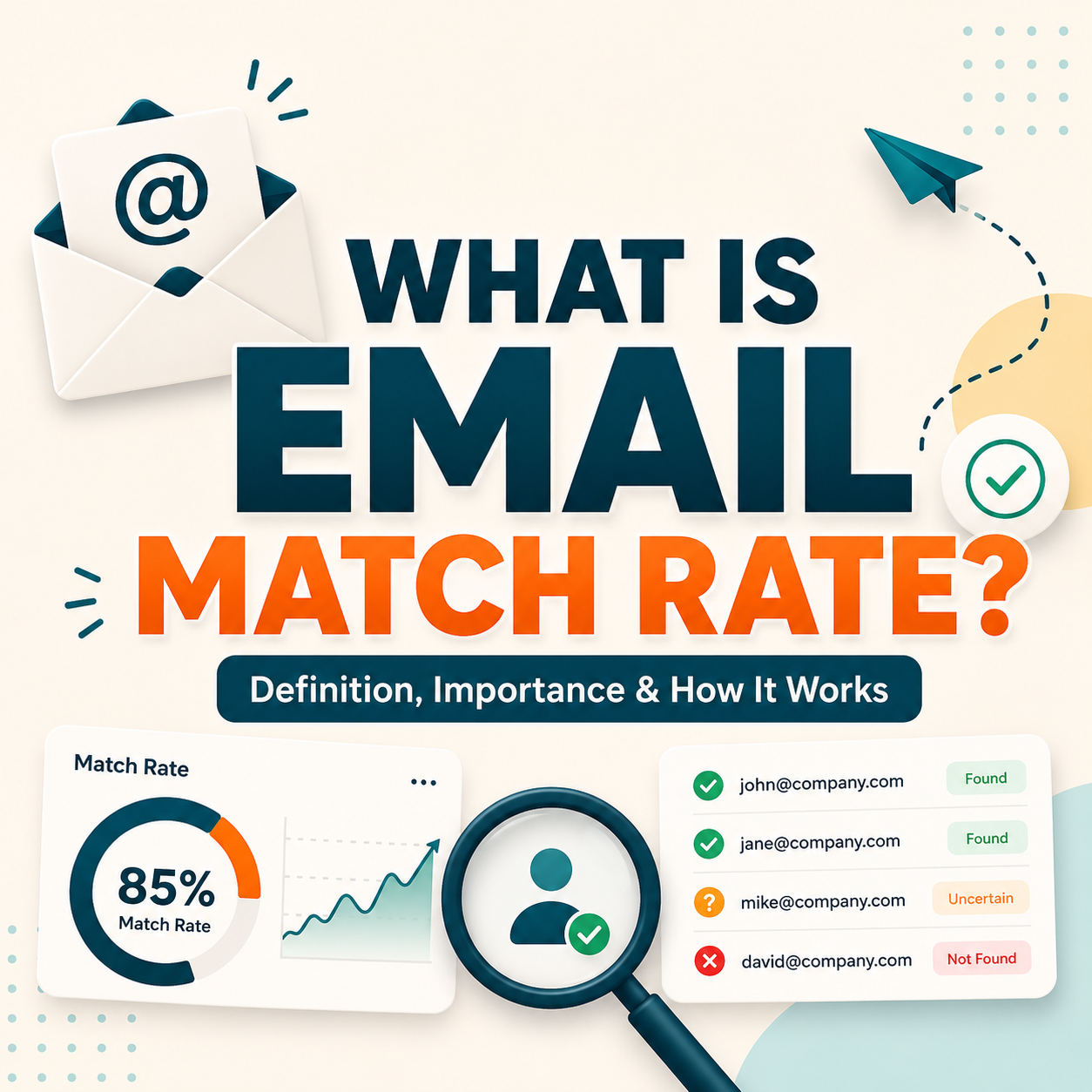
Email match rate is the percentage of contacts in a list for which an email-finding tool returns a usable address. In controlled B2B testing, Hunter returned an address for about 91 percent of clean domain-based queries while Apollo matched roughly 84 percent on the same list. Match rate, not raw database size, decides how many prospects a campaign can actually reach, so it is the first number SDRs and email marketers should compare.
Table of Contents
What Is Email Match Rate? Core Definition for B2B Sales Teams
Email match rate is the share of input contacts for which a tool returns at least one email address. A 90 percent match rate means 90 of every 100 names or domains submitted come back with an address. It measures coverage, the raw ability to find a contact, and is separate from accuracy, which measures whether the returned address is actually correct and deliverable.
Inputs vary by workflow. A tool may receive a full name plus company domain, a domain only, or a LinkedIn profile URL. Match rate is calculated as emails returned divided by queries submitted, expressed as a percentage. Two tools can quote very different match rates on the same list because each draws from a different data source and applies a different confidence threshold before it shows a result.
Match rate answers a single question: did the tool find an address at all. Pair it with accuracy and bounce rate to judge a list end to end. A high match rate with low accuracy floods a campaign with bad addresses, so both numbers must be read together before any tool decision.
Part of our Apollo vs Hunter guide
Apollo.io vs Hunter.io: the full comparison on accuracy, data, and pricing
This article covers one piece of the picture. Read the complete side-by-side comparison to pick the right tool for your outreach workflow.
Read the full Apollo vs Hunter comparison →How Is Email Match Rate Calculated and What Affects It?
Match rate is calculated by dividing the number of queries that return an address by the total queries submitted. If 1,000 domain-plus-name lookups return 870 addresses, the match rate is 87 percent. The figure shifts with data freshness, the size and recency of the underlying database, the confidence threshold a tool enforces, and how complete and clean the input list is.
- Database recency: tools that re-crawl public sources frequently return more current addresses, lifting match rate on companies that recently changed domains, naming patterns, or staff.
- Confidence threshold: a tool that only shows results above a high confidence score reports a lower match rate but cleaner data, while a permissive threshold inflates match rate with guessed patterns.
- Input completeness: full name plus verified company domain produces higher match rates than domain-only or partial-name queries, because the tool has more signal to resolve a specific person.
- Company size: mid-market and enterprise domains with predictable email patterns match better than tiny businesses that rely on generic shared inboxes.
- Region and language: match rates fall on regions where the tool has thinner public coverage, so a global list can mask wide swings between segments.
“Data quality refers to the state of qualitative or quantitative pieces of information. There are many definitions of data quality, but data is generally considered high quality if it is fit for its intended uses in operations, decision making and planning.”
Wikipedia, Data quality : match rate is one dimension of data quality, measuring whether a contact record can be resolved to a usable address at all.
Because each factor moves the number, a single headline match rate means little without the test conditions behind it. Always ask what input type, what list segment, and what confidence threshold produced the figure before trusting it.
What Are the Top 5 Use Cases Where Match Rate Decides Success?
Match rate matters most when reach drives the outcome. Five common B2B workflows live or die on how many contacts a tool can resolve, from cold outreach volume to total addressable market sizing. In each case a low match rate quietly caps results before a single email is sent.
- Cold outreach campaigns: reach equals match rate times list size, so a campaign built on a 70 percent match rate loses three in ten prospects before sequencing even begins.
- Account-based selling: targeting a fixed set of named accounts demands high coverage, since missing the right buyer at a strategic account cannot be replaced by volume elsewhere.
- Total addressable market sizing: match rate determines how much of a defined market a team can actually contact, which feeds revenue forecasts and territory planning.
- List enrichment projects: filling gaps in an existing CRM hinges on resolving records the team already cares about, where every unmatched row is a known prospect left dark.
- Event and webinar follow-up: converting partial attendee data into reachable contacts depends on coverage, because incomplete sign-up forms leave many leads contactable only through a finder tool.
In each use case, match rate sets the ceiling on results. For a deeper look at how coverage and correctness combine, see our guide on email finder accuracy rate and how to compare tools.
Apollo vs Hunter Match Rate: What Real B2B Testing Shows
On the same clean B2B list, Hunter returned an address for about 91 percent of domain-based queries and Apollo for about 84 percent in Growth Hack Suite estimate from vendor documentation and published pricing. Apollo’s larger contact database helps on long-tail companies, while Hunter’s domain-pattern engine and confidence scoring lift coverage on standard corporate domains. The right pick depends on which segment a team targets most.
Source: Growth Hack Suite estimate from vendor documentation and published pricing. Treat as directional; your match rate varies by segment and list quality.
The seven-point gap is meaningful at scale but reverses on certain segments, so test both on a sample of your own list. For a full feature and pricing breakdown, read our Apollo vs Hunter comparison and the broader overview of what Apollo.io does.
What Are the 5 Limitations of Match Rate as a Buying Signal?
Match rate is necessary but not sufficient. Five limitations explain why a high headline figure can still produce a weak campaign, and why match rate must always be read alongside accuracy, deliverability, and segment fit before a tool is chosen.
- Match without correctness: a returned address can still be wrong, so a 95 percent match rate paired with low accuracy floods sequences with bounces and damages sender reputation.
- Threshold manipulation: vendors can raise reported match rate simply by lowering the confidence bar, surfacing guessed patterns that look like coverage but fail on send.
- Catch-all noise: catch-all domains accept any address, so a tool may report a match that no verifier can confirm, inflating coverage with unconfirmable results.
- Segment averaging: one blended match rate hides the spread between strong and weak segments, masking that a target vertical may match far below the headline number.
- Generic-inbox matches: resolving to info@ or contact@ counts as a match but rarely reaches a decision maker, so coverage looks healthy while real reach stays low.
“As covered in our Hunter.io Email Finder review, coverage only converts to pipeline when matched addresses are also verified, so match rate and verification have to be evaluated as a pair, never in isolation.”
Growth Hack Suite, Hunter.io Email Finder review
Treat match rate as the first filter, not the final verdict. The tools worth buying pair strong coverage with high verification so matched addresses actually land. See how Hunter performs on the second half of that equation in our Hunter email verifier accuracy analysis.
How Do You Measure and Improve Email Match Rate in 5 Steps?
Improving match rate is a measurement discipline, not a single setting. Five steps turn a vague coverage number into a repeatable benchmark you can raise: define the test list, run a controlled sample, segment the results, clean the inputs, and re-run to confirm the lift before scaling spend.
- Step 1, define a representative sample: pull 200 to 500 contacts that mirror your real target mix of industries, company sizes, and regions, so the measured match rate reflects production conditions.
- Step 2, standardize the inputs: supply full name plus verified company domain wherever possible, since clean, complete inputs are the single biggest lever on match rate.
- Step 3, run and segment: execute the sample through each tool, then break match rate down by segment to expose where coverage is strong and where it collapses.
- Step 4, verify the matches: push matched addresses through a verifier and recompute usable match rate, so catch-all and guessed results do not overstate true reach.
- Step 5, fix inputs and re-test: correct malformed domains and missing names in the weak segments, re-run the sample, and lock in the tool and workflow that delivers the highest verified match rate.
Want to measure your real match rate before you commit budget? Run a sample list through Hunter free and see coverage and verification on your own prospects.
Try Hunter.io Free →Free plan, no credit card, 50 monthly credits to test coverage
Run the five steps once and you replace vendor marketing claims with your own verified match rate. That single number, measured on your real list, is the most honest input to a finder-tool decision.
Weighing cost per lead? See our Hunter.io vs Apollo.io pricing breakdown for a side-by-side on price.
Email Match Rate: Frequently Asked Questions
The 12 most-asked questions about email match rate for B2B sales and marketing teams.
The 12 most-asked questions about email match rate.
What is a good email match rate?
For clean B2B lists of corporate domains, 85 to 95 percent is a strong match rate. Below 70 percent signals thin data coverage or low-quality inputs. Always confirm the figure was measured on inputs and segments similar to yours, because a blended average can hide weak verticals.
What is the difference between match rate and accuracy?
Match rate measures whether an address was found at all (coverage). Accuracy measures whether the found address is correct and deliverable. A tool can have a high match rate and low accuracy, which fills a campaign with bounces, so both must be read together.
Does Hunter or Apollo have a higher match rate?
In Growth Hack Suite estimate from vendor documentation and published pricing. Hunter leads on standard corporate domains; Apollo can close the gap on long-tail and niche companies thanks to its larger database. Test both on a sample of your own list. See our Apollo vs Hunter comparison.
How is email match rate calculated?
Divide the number of queries that return an address by the total queries submitted, then multiply by 100. If 1,000 lookups return 870 addresses, the match rate is 87 percent. Confirm whether the count includes unverified or catch-all matches, which can overstate usable coverage.
Why is my match rate lower than the vendor advertises?
Advertised figures usually reflect ideal conditions: clean inputs, large companies, and regions with deep coverage. Your list may include partial names, small businesses, or under-covered regions, all of which lower the real number. Standardize inputs and segment your test to see the true rate.
Can a high match rate hurt my campaign?
Yes, if the matched addresses are not verified. A high match rate built on guessed patterns or catch-all domains sends bounces that harm sender reputation. Always verify matched addresses before sequencing. See our verifier accuracy analysis.
What factors most affect email match rate?
Database recency, the confidence threshold a tool enforces, input completeness, company size, and region all move the number. Of these, supplying full name plus verified domain is the lever you control most directly and the one that lifts match rate fastest.
Does company size change match rate?
Yes. Mid-market and enterprise domains with predictable email patterns match at higher rates than very small businesses that rely on shared or generic inboxes. A list weighted toward tiny companies will show a lower blended match rate.
How do catch-all domains affect match rate?
Catch-all domains accept any address, so a tool may report a match that no verifier can confirm. This inflates coverage with unconfirmable results. Filter or flag catch-all matches separately when you compute usable match rate.
Should I choose a tool on match rate alone?
No. Match rate is the first filter, but accuracy, verification quality, segment fit, and price decide value. A tool with slightly lower coverage but far higher accuracy often delivers more reachable prospects per dollar.
How do I improve my email match rate?
Clean and complete your inputs first: full names plus verified company domains. Then segment your list, run a controlled sample, verify the matches, and re-test after fixing weak segments. Input quality is the biggest controllable lever.
How does match rate relate to cold email reach?
Reach equals match rate times list size. A 70 percent match rate on a 1,000-contact list means only 700 are even contactable before deliverability is considered. Raising match rate directly expands the top of the outreach funnel.
Email match rate is the coverage half of contact data: how many prospects a tool can resolve to an address. Read it beside accuracy and verification, measure it on your own list, and it becomes the most reliable single number for choosing between finders like Hunter and Apollo.
Measure your real match rate on your own prospects
Run a sample list through Hunter free, see coverage and verification side by side, and decide with your own numbers instead of vendor claims.
Try Hunter.io Free →Free plan, no card, 50 monthly credits to test coverage.