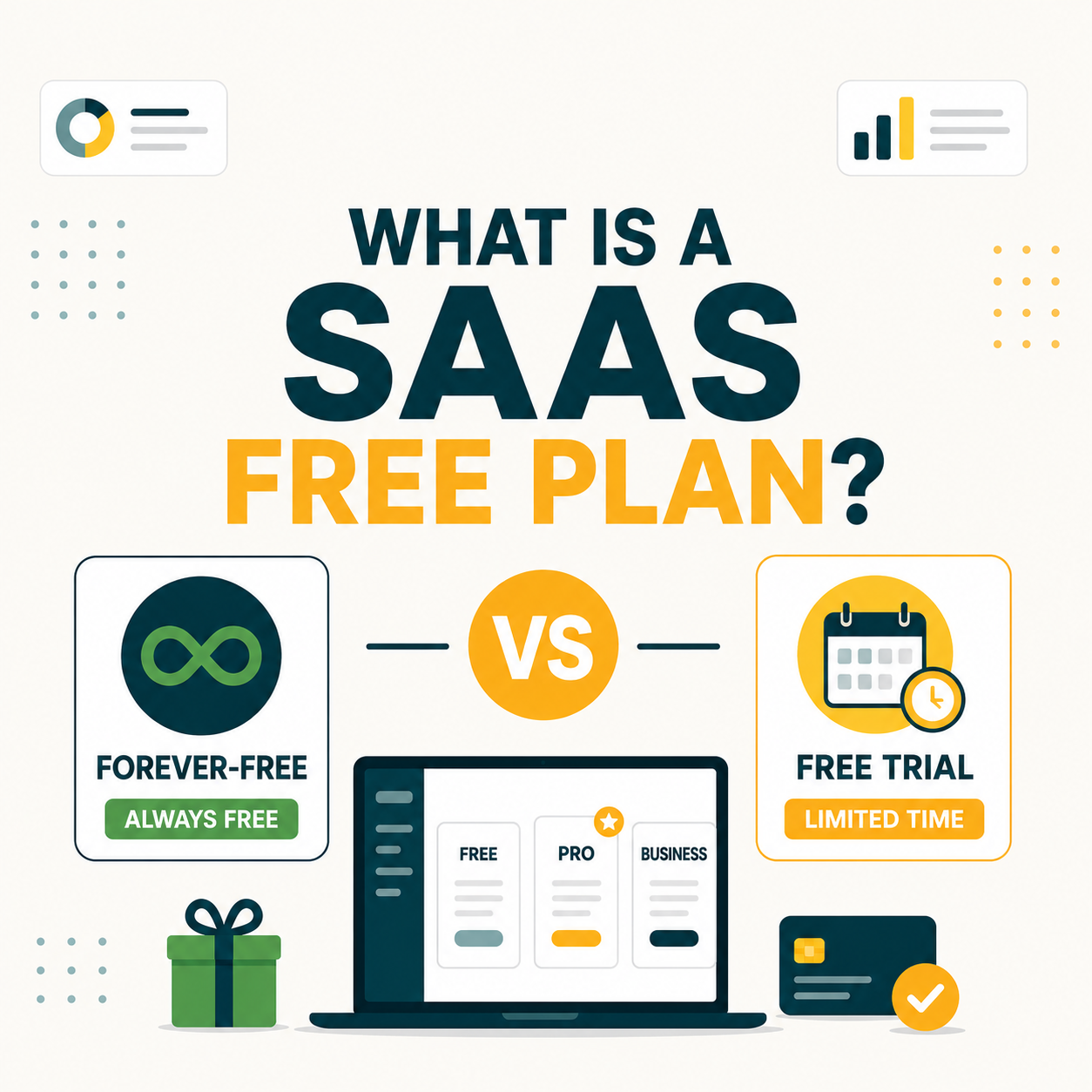
A SaaS free plan is a permanent, no-cost tier of a software product that gives users access to core features without requiring payment or a credit card. Unlike a free trial, which expires after 7 to 30 days, a forever-free tier persists indefinitely. Hunter.io’s free plan, for example, delivers 50 credits per month at zero cost, enough for 50 email lookups or 100 verifications.
Table of Contents
What Is SaaS Free Plan? Core Definition for B2B Sales and Marketing Teams
A SaaS free plan is a recurring, permanent access tier that requires no payment. Software vendors offer it to lower acquisition costs, attract a broad user base, and convert a subset to paid plans over time. The defining difference from a free trial is permanence: the free plan does not expire, while a trial counts down from day one.
“a pricing strategy by which a basic product or service is provided free of charge, but money (a premium) is charged for additional features”
Source: Wikipedia, Freemium
SaaS free plans eliminate purchase risk at the top of the funnel, enabling B2B buyers to validate fit before any budget conversation begins. For vendors, every active free-tier user is a potential upgrade opportunity. The two models are not interchangeable in practice, and the choice of which one a vendor runs shapes how long a buyer gets to evaluate: see Hunter.io free plan vs free trial for how one vendor resolved that trade-off.
How Does SaaS Free Plan Actually Work? The Technical Mechanism Explained
SaaS free plans operate through feature gating: the platform serves a subset of capabilities to unpaid users while locking higher-value features behind a paid tier. Vendors track usage in real time, enforce hard limits at thresholds, and surface upgrade prompts when users approach the ceiling. Five components make the free plan mechanism work in practice.
- Feature gating layer: The application server checks user plan status on every request and returns either the full result or a limited set, enforcing quota rules without exposing the underlying data architecture to the user.
- Monthly quota reset: Free-tier credits refresh at the start of each billing cycle, giving users a predictable replenishment window and encouraging consistent product usage without accidental overage charges.
- Upgrade prompt engine: When usage crosses 80 percent of the monthly limit, the platform surfaces contextual upgrade messages tied to the exact feature the user is consuming, increasing conversion intent at the point of friction.
- Data persistence across tiers: Contacts, campaigns, and verification results accumulated on the free plan remain accessible after a paid upgrade, removing the re-onboarding cost that would otherwise discourage conversion.
- Rate limiting at the API layer: For tools offering API access on paid tiers, the free plan enforces rate limits server-side, ensuring infrastructure costs scale only with revenue, not with the size of the free user base.
“a basic version of their product, hoping that users will eventually pay to upgrade”
Source: HubSpot Blog, Pricing Strategies
Feature gating and quota resets form the structural backbone of every SaaS free plan. Understanding these mechanisms helps B2B buyers predict exactly when a free tier will stop being sufficient for their workflow.
What Are the Top 5 Use Cases for SaaS Free Plan in B2B Sales?
SaaS free plans deliver the most ROI in five B2B scenarios: validating a new tool before a budget request, onboarding a small team without procurement, testing outbound accuracy before scaling, integrating a tool into a workflow before committing, and generating proof-of-concept data for a stakeholder presentation. Five use cases below show where free plans create measurable value for B2B teams.
- Solo SDR prospecting: A single SDR uses the free tier to verify up to 100 target contacts per month before booking discovery calls, eliminating bounce risk on a small targeted list without a paid subscription.
- Proof-of-concept for budget approval: A founder collects real deliverability and reply-rate data using the free tier, then presents those numbers to justify a paid upgrade request to a finance team or board.
- Tool evaluation before vendor selection: A marketing operations team runs the same target list through two competing tools on their free plans to compare accuracy rates before issuing a purchase order for the higher-performer.
- Side-project or low-volume outreach: A startup founder running outreach for a niche vertical with fewer than 30 contacts per month operates entirely on the free tier, avoiding software overhead at the pre-revenue stage.
- Supplemental verification layer: An email marketer already using a primary platform adds a second tool’s free plan to cross-validate catch-all addresses that the primary verifier flags as risky, at zero additional cost.
Each of these scenarios shares a common thread: the free tier reduces decision risk without requiring a financial commitment. B2B teams that treat the free plan as a structured evaluation period, rather than a workaround, extract the most value before upgrading.
What Are the 5 Limitations of SaaS Free Plan Every Buyer Should Know?
SaaS free plans impose hard constraints that create operational friction at scale: restricted monthly quotas, absent team collaboration, no API access, limited data export, and reduced support coverage. B2B buyers planning to scale outreach beyond a handful of contacts will typically outgrow the free tier within 30 to 60 days of active use.
- Monthly request quota: Free plans cap searches and verifications at a fraction of paid-tier limits, forcing high-volume users to spread operations across multiple accounts or upgrade to meet campaign demand.
- No team seats or shared workspaces: Most free plans are single-user accounts with no collaboration features, which prevents an SDR team from operating under a shared organization and consolidating reporting in one dashboard. Hunter.io is the exception in this category: it includes unlimited team members on every tier, including Free.
- API access restrictions: Free tiers typically exclude programmatic API access, blocking CRM automation workflows and requiring manual data export that adds operational overhead to every prospecting cycle.
- Limited export formats: Data exports on free plans are often restricted to CSV with fewer columns, stripping metadata such as confidence scores, source URLs, and verification timestamps that paid plans include.
- Community-only support: Free-tier support is typically limited to documentation and community forums, with no email, chat, or SLA-backed ticketing, which creates unacceptable risk for teams running live outreach campaigns.
“Hunter.io’s free plan is the starting point: 50 credits every month, with no credit card required.”
Source: Growth Hack Suite, Hunter.io Email Finder review
Knowing these five limitations before adopting a free plan prevents mid-campaign surprises. Teams that map their monthly contact volume against the free tier limits during evaluation avoid the costly disruption of upgrading under deadline pressure.
Top 5 Tools Compared by SaaS Free Plan Approach: Hunter, Apollo, Snov, ZeroBounce, NeverBounce
Five tools dominate the B2B email finder category, and each takes a different approach to its free tier. Hunter.io’s forever-free plan leads on verification accuracy and simplicity. Apollo offers a data-rich free tier with stricter export limits. Snov.io, ZeroBounce, and NeverBounce each optimize for different segment needs.
Source: official pricing pages for Hunter.io, Apollo.io, Snov.io, ZeroBounce and NeverBounce, verified July 2026. Apollo restructured its free tier in late 2025, cutting it from 10,000 to 100 email credits per month.
Hunter.io’s free plan stands out for accuracy-focused use cases because it combines domain search, email verification, and confidence scoring in a single free workflow. Teams that need raw data volume will favor Apollo’s free tier; teams that need verified accuracy favor Hunter.
How Do You Apply SaaS Free Plan in 5 Steps With Hunter.io?
Applying Hunter.io’s free plan to a cold outreach workflow takes five steps: create an account, define the target company list, run domain searches to surface verified emails, export results to a CRM, and set a monthly cadence that respects the 50-credit limit while building a pipeline of pre-verified leads.
- Create a free Hunter.io account: Sign up at hunter.io with a work email address. No credit card is required. The free plan activates immediately with 50 credits for the calendar month, drawn from one shared pool for finding and verification.
- Define a high-priority target company list: Select 20 to 25 target accounts from a CRM or spreadsheet. Focus on accounts with the highest ICP score first, since the free quota is best spent on contacts most likely to reply.
- Run domain searches for each target company: Enter each company domain into Hunter’s Domain Search. The tool returns all publicly sourced email addresses for that domain, with confidence scores and source links for each result. Domain Search charges 1 credit per email returned, so a domain that yields 15 contacts consumes 15 of the 50 monthly credits. Narrow results with role filters before running.
- Verify confidence-scored contacts: Spend remaining credits verifying contacts with confidence scores between 70 and 95 percent. A verification costs 0.5 credit, half the price of a lookup. High-confidence addresses rarely need verification; low-confidence ones benefit most from the SMTP check.
- Export verified contacts and launch sequence: Download results as CSV and import into your CRM or sequencing tool. Track open rates and replies to build a dataset that justifies upgrading to Starter at $49/month when volume outgrows the free quota.
Ready to validate your first 30 prospects for free?
Try Hunter.io FreeNo credit card. 50 credits per month, forever.
This five-step workflow turns a zero-cost tool into a structured prospecting process. Teams that follow it consistently build a monthly pipeline of verified contacts without incurring any software overhead during the evaluation phase.
How Has the Concept of SaaS Free Plan Evolved Across the B2B Email Tool Category?
SaaS free plans in the email tool category evolved from time-limited trials in the early 2010s to permanent free tiers after Mailchimp popularized the model in 2009. By 2020, every major B2B email finder offered a forever-free entry point. The competition shifted from “free versus paid” to “how generous is the free tier and how fast does friction force an upgrade.”
Hunter.io has run a permanent free tier since its early years, and the allowance has moved with the business. Hunter.io does not run a time-limited trial at all: it uses a permanent free tier instead, a distinction covered in full in Hunter.io free plan vs free trial. In February 2021 Hunter cut the free monthly search quota from 50 to 25 while doubling verifications on paid plans. In 2025 it retired the split searches-and-verifications model entirely, replacing it with a single credit pool: 50 credits a month on Free, where a lookup costs 1 credit and a verification costs 0.5. See the Hunter.io free plan vs Starter upgrade guide for a current breakdown of what each tier includes and when upgrading makes economic sense. Apollo, founded in 2015 as ZenProspect and rebranded in 2018, took the opposite path, leading with data breadth before cutting its own free tier from 10,000 to 100 email credits in late 2025.
The evolution of free plans in B2B SaaS reflects a broader shift toward product-led growth, where the free tier itself becomes the primary acquisition channel, replacing outbound sales and cold outreach at the vendor level.
What Are the Real Cost Implications of Implementing SaaS Free Plan at SDR Team Scale?
The true cost of a SaaS free plan at SDR team scale includes not just the zero monthly fee but also the opportunity cost of workarounds when monthly limits are hit mid-campaign. On Hunter.io the constraint is credits, not seats: a team of five SDRs shares one account at no extra seat cost, but 50 free credits cover roughly 33 contacts a month across the whole team, which one SDR can exhaust in a single afternoon.
Source: hunter.io/pricing, verified July 2026. Credits needed assumes 1.5 credits per contact, being 1 credit to find plus 0.5 to verify. Every Hunter tier includes unlimited team members, so seat count does not drive plan choice, credit volume does.
The break-even point between the free plan and Starter arrives at roughly 34 contacts found and verified per month, the point where 50 credits run out. At Starter, 2,000 credits cost $49 monthly or $34 annually, putting the cost per credit at $0.0245 and $0.017 respectively, or about $0.037 and $0.026 per contact found and verified.
What Are the 5 Common Mistakes B2B Teams Make With SaaS Free Plan?
Five mistakes consistently undermine SaaS free plan adoption in B2B teams: treating the free tier as a permanent solution for active campaigns, sharing one account across multiple SDRs, ignoring verification status in exports, failing to track monthly quota consumption, and skipping the upgrade path assessment during vendor evaluation. Five patterns below show the mistakes that cost teams the most time and pipeline quality.
- Permanent free-plan dependency: Teams that run ongoing campaigns on a free plan exhaust the monthly quota within the first week, then pause outreach for three weeks, creating a campaign rhythm that destroys pipeline consistency and reply rates.
- Shared account across SDRs: Multiple SDRs accessing one free account deplete the quota in days, produce overlapping prospect lists with no deduplication layer, and make it impossible to attribute results to individual SDR activity in reporting.
- Ignoring verification status on exports: Exporting all results from a domain search without filtering by verification status adds unverified addresses to sequences, inflating bounce rates above 5 percent and triggering ESP deliverability flags on cold sends.
- No quota tracking: Teams that do not monitor monthly credit consumption hit the limit unexpectedly mid-campaign, forcing a choice between pausing outreach or signing up for a paid plan under deadline pressure at full price.
- Skipping upgrade path evaluation: Buyers who adopt a free plan without reviewing the upgrade pricing structure discover at quota-exhaustion that the next tier is out of budget, requiring a vendor switch that wastes the workflow investment already built on the free plan.
Avoiding these five mistakes requires treating the free plan as a structured evaluation with defined success criteria, not an indefinite workaround. Teams that set a 30-day evaluation window with clear upgrade triggers make faster, better-informed buying decisions.
How Do SDRs, Email Marketers, and Founders Each Apply SaaS Free Plan Differently?
Three primary personas interact with SaaS free plans in distinct ways shaped by their specific workflow needs. SDRs use the free tier for targeted prospect validation before a campaign launch. Email marketers run verification tests to benchmark deliverability. Founders use free plans as a low-friction starting point to evaluate multiple tools before committing budget.
SDRs on Hunter.io’s free plan prioritize accuracy over volume. Because Domain Search bills 1 credit per email returned, the discipline is to run Email Finder on named contacts rather than pulling every address at a domain. Spending 30 credits on 30 named lookups and the remaining 20 on 40 verifications yields around 30 verified contacts a month, enough for a focused enterprise ABM sequence. For a full walkthrough of how SDRs scale from the free plan to a paid tier, see the Hunter.io Email Finder review covering accuracy benchmarks by use case.
Founders apply the free plan as a buy-before-you-build proof point. The zero-cost barrier means a founder can test outbound as a channel in week one without a software line item on the budget. The practical trigger to upgrade is the first month the 50-credit pool runs out before the target account list does.
What Are the Best Practices for Implementing SaaS Free Plan in B2B Sales?
Implementing a SaaS free plan effectively requires five discipline practices: setting a monthly quota tracker before the period starts, batching searches into high-priority campaign segments, verifying only confidence-scored contacts when approaching the limit, reviewing upgrade triggers monthly, and maintaining one complementary free tool as a supplement. Following these five practices extends the productive life of the free tier before an upgrade becomes necessary.
- Track quota consumption weekly: Set a calendar reminder at the end of week two to review credits used versus credits remaining. Teams that check mid-month have time to redirect remaining searches to the highest-priority accounts before the month resets.
- Batch searches by campaign segment: Group target accounts by ICP tier and use the monthly quota on the top tier first. Tier-1 accounts (highest ACV potential) should exhaust the free allowance before any Tier-2 accounts receive a search.
- Verify selectively on risky domains: Use verification credits on addresses from catch-all or generic domains, not on verified corporate domains where Hunter’s confidence scores are already above 90 percent.
- Define upgrade triggers before adopting: Before activating the free plan, document the exact conditions that will trigger an upgrade evaluation: monthly credits needed exceeds 50, sequences need more than 500 recipients, or a paid campaign requires API integration.
- Pair with one complementary free tool: Use Hunter.io’s free plan alongside a free email warmup or deliverability monitoring tool to build a zero-cost outreach stack during the evaluation phase, maximizing test coverage without layering multiple paid subscriptions.
Apply all 5 best practices starting today on Hunter.io’s free plan
Get Started Free50 credits/month. No credit card. Upgrade only when you need to.
These five best practices separate teams that extract measurable value from the free tier from teams that exhaust credits without results. The underlying principle: the free plan is most productive when treated as a structured campaign tool, not an open-ended exploratory resource.
What Industry Trends Are Reshaping SaaS Free Plan in B2B SaaS Right Now?
Three trends are redefining SaaS free plans in the B2B market: AI-powered usage analysis that personalizes upgrade prompts, usage-based pricing that extends free tiers while billing per outcome, and compliance-driven restrictions that tighten data access on free tiers to satisfy GDPR and CCPA requirements. Each trend reshapes the calculus of when a free plan is sufficient and when it creates more operational risk than it eliminates.
AI-powered usage personalization means that the upgrade prompts you see on a free plan are increasingly tailored to your specific usage pattern. Vendors track which features a free user accesses most frequently, then surface upgrade messages tied to the exact feature that is both heavily used and locked behind a paywall, at the moment the friction is felt rather than on a fixed schedule.
Product-led acquisition among surveyed B2B SaaS companies
These three trends collectively raise the quality floor of free plans while reducing their operational ceiling. B2B buyers who understand these forces can negotiate better free tier terms during vendor evaluation and time upgrades more strategically based on usage data rather than vendor pressure.
SaaS Free Plan: Frequently Asked Questions
What is a SaaS free plan?
A SaaS free plan is a permanent, no-cost subscription tier that gives users access to a limited set of core product features without requiring payment or a credit card. Unlike a free trial, it does not expire. Vendors use free plans to lower acquisition friction and build a pipeline of users likely to upgrade as their needs grow.
How is a SaaS free plan different from a free trial?
A free trial gives users full or near-full access to a product for a defined period, typically 7 to 30 days, before access is cut off or a payment is required. A free plan gives users a permanent but limited subset of features with no expiry date. Free trials optimize for feature exposure; free plans optimize for long-term retention and gradual upgrade conversion.
Does Hunter.io have a free plan?
Yes. Hunter.io offers a free forever plan that includes 50 credits per month with no credit card required. One credit finds an email and half a credit verifies one, so the pool covers 50 lookups, 100 verifications, or any mix of the two. The free plan includes Domain Search, Email Finder, Email Verifier, the browser extension, one connected email account, sequences up to 500 recipients, and unlimited team members.
What are the limitations of SaaS free plans for B2B sales teams?
The five main limitations are: monthly quota caps that restrict search and verification volume, restricted collaboration on most vendors’ free tiers, no API access for CRM automation, limited data export formats, and community-only support with no SLA. Most B2B sales teams with more than one active SDR will outgrow a free plan within 30 to 60 days of consistent use.
How much does Hunter.io cost after the free plan?
Hunter.io’s Starter plan begins at $49/month billed monthly or $34/month billed annually, and includes 2,000 credits per month, three connected email accounts, and priority support. Growth costs $149/month or $104 annually for 10,000 credits. Scale costs $299/month or $209 annually for 25,000 credits. Enterprise is custom-quoted. Annual billing applies a flat 30 percent discount across every tier.
Will a SaaS free plan improve cold email deliverability?
Yes, indirectly. Using Hunter.io’s free email verification feature to filter out invalid addresses before sending reduces hard bounce rates below 2 percent, which protects sender domain reputation. Verification acts on bounce rate and sender reputation rather than on open rate directly, so the benefit shows up as sustained inbox placement across successive sends rather than as an immediate open-rate jump.
Can I test Hunter.io’s full feature set on the free plan?
Partially. The free plan gives access to Domain Search, Email Finder, Email Verifier, and the Chrome extension, which covers the four core use cases. The free plan caps sequences at 500 recipients and one connected email account, and excludes Bulk Tasks, lead enrichment, auto-verification, and advanced Discover filters. These require a Starter or higher plan.
Does SaaS free plan integrate with CRM tools like HubSpot or Salesforce?
On free plans, most SaaS email tools do not offer native CRM integration. Hunter.io’s free plan provides manual CSV export, which can be imported into HubSpot, Salesforce, or any CRM with an import feature. Native two-way sync and API-based integrations are reserved for paid tiers. For teams needing automated CRM sync without a Hunter paid plan, Zapier can bridge the gap using Hunter’s free web interface as the trigger.
What is a SaaS free plan in the context of email verification?
In email verification, a SaaS free plan provides a monthly credit allowance for running SMTP checks, syntax validation, and DNS/MX lookups against a target list of email addresses. Hunter.io’s free plan includes 50 credits per month and a verification costs 0.5 credit, so the pool covers up to 100 verifications, classifying each address as valid, risky, or invalid, giving SDRs a confidence filter before sending.
How does SaaS free plan work for founders evaluating cold outreach tools?
Founders use SaaS free plans to generate proof-of-concept data before committing budget. A typical founder evaluation spends the 50 free credits on named-contact lookups at the highest ICP-fit companies, verifies the riskiest addresses, and sends a 3-touch sequence. If the sequence produces at least one meeting, the $408 annual cost of Starter becomes straightforward to justify against the value of a single closed deal.
Can multiple SDRs share one Hunter.io free plan account?
Yes. Hunter.io includes unlimited team members on every tier, including Free. Multiple SDRs can work under one account and draw from the same monthly credit pool, so seat count never forces an upgrade. What the free tier does limit is volume and sending: 50 credits split across a team goes quickly, and only one email account can be connected for sequences.
What features does a SaaS free plan typically require to deliver value?
A SaaS free plan delivers value when it includes at minimum: a core search or data retrieval feature, a result quality signal such as confidence score, a data export mechanism, and a quota refresh cycle. Hunter.io’s free plan meets all four requirements: Domain Search, confidence scoring, CSV export, and a 50-credit monthly refresh. Free plans lacking any of these four criteria deliver friction, not value.
Start verifying contacts on Hunter.io’s free plan today
50 credits every month, forever. Roughly 33 contacts found and verified.
Try Hunter.io FreeNo credit card required. Upgrade only when your monthly volume exceeds 50 credits.


