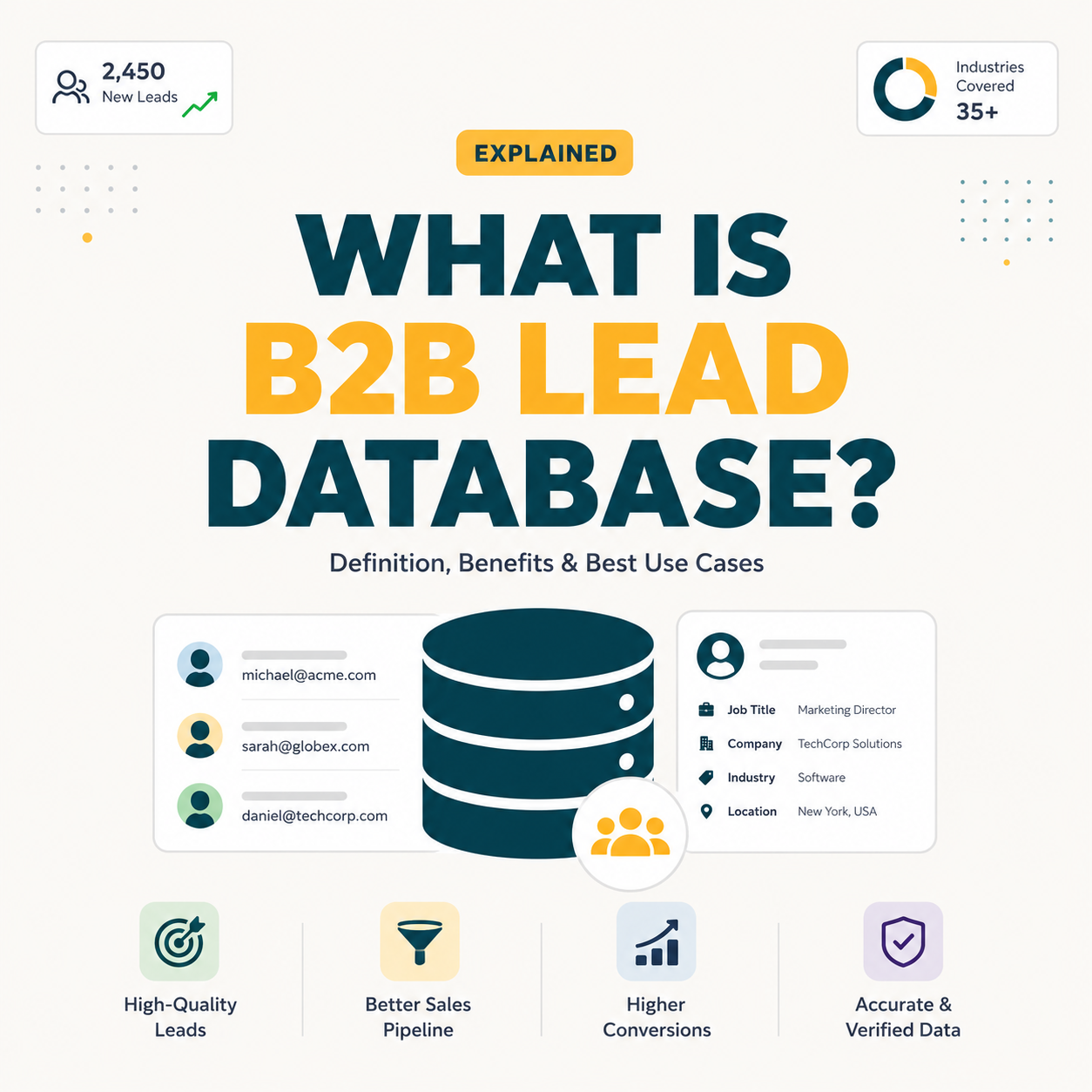
A B2B lead database is a structured repository of verified business contact records: email addresses, job titles, company names, and firmographic data used by sales teams to build targeted outreach lists. SDR teams using verified databases see bounce rates drop below 2%, compared to 10–15% on unverified lists. Hunter.io indexes 107 million business emails; Apollo covers 275 million contacts, each optimized for different coverage strengths.
Table of Contents
What Is B2B Lead Database? Core Definition for B2B Sales and Marketing Teams
A B2B lead database is a centralized dataset of verified business contact records: email addresses, job titles, company names, LinkedIn URLs, and firmographic attributes such as industry and employee count. Sales teams query these databases to identify target accounts without manually sourcing contacts. Hunter.io and Apollo are the two dominant tools, each built on different data architecture and coverage strengths.
“a form of direct marketing using databases of customers or potential customers”
: Wikipedia, Database Marketing
Every B2B outreach program depends on the quality of its contact data. A well-maintained lead database reduces manual prospecting time from hours to minutes per campaign. Teams using Hunter.io’s domain search identify all publicly indexed emails at a target company in seconds, complete with confidence scores that indicate deliverability probability. For a complete overview of Hunter.io’s email finding capabilities, see our Hunter.io Email Finder review.
A B2B lead database is the foundation of any scalable outreach program. Hunter.io and Apollo are purpose-built for this use case, with different coverage strengths for different team sizes and verticals.
Part of our Apollo vs Hunter guide
Apollo.io vs Hunter.io: the full comparison on accuracy, data, and pricing
This article covers one piece of the picture. Read the complete side-by-side comparison to pick the right tool for your outreach workflow.
Read the full Apollo vs Hunter comparison →How Does B2B Lead Database Actually Work? The Technical Mechanism Explained
B2B lead databases work through four sequential layers: data ingestion from public web sources, normalization of contact fields across sources, verification through DNS and SMTP handshake checks, and confidence scoring that assigns probability scores to each email address. Hunter.io processes 107 million indexed addresses through this pipeline; Apollo applies it to 275 million records with additional intent-layer enrichment.
- Data Ingestion: Crawlers index publicly visible email addresses from company websites, press releases, conference listings, academic publications, and professional directories. Hunter.io’s index refreshes continuously; Apollo supplements crawling with user-contributed CRM data from its customer base.
- Field Normalization: Raw contact data is standardized into consistent schema fields: first name, last name, email, job title, department, seniority, company domain, and industry classification. Normalization enables cross-source deduplication and query-by-field search.
- DNS Verification: Each domain undergoes MX record lookup to confirm an active mail server exists. Domains with no MX record are marked invalid before SMTP checks begin, eliminating dead-domain false positives.
- SMTP Handshake: A simulated delivery command confirms whether the mail server accepts the specific recipient address. Servers that accept all addresses without rejection are flagged as catch-all, generating a separate risk classification distinct from confirmed-valid addresses.
- Confidence Scoring: Each address receives a probability score (0–100) based on source count, recency, domain type, and SMTP response. Hunter.io labels addresses as Valid (90%+ confidence), Accept-all (catch-all domain), or Unknown. Apollo uses a similar tiered system with proprietary freshness weighting.
The SMTP handshake is the critical verification step that separates production-quality databases from raw crawl data. Without it, bounce rates on exported lists typically run 8–15%. With a full verification pass, teams see bounce rates below 2%, the threshold at which most email providers flag senders for review.
The four-layer verification pipeline separates reliable B2B databases from raw data dumps. Confidence scoring is the key output: any address below 70% confidence is a deliverability risk that should be excluded from cold email campaigns.
What Are the Top 5 Use Cases for B2B Lead Database in B2B Sales?
B2B lead databases power five primary workflows: cold outreach list building for SDR teams, account-based marketing targeting, sales territory mapping, investor prospecting for founders, and email list cleaning and re-engagement. Each use case demands different accuracy thresholds: cold email requires 90%+ verified addresses to stay below a 2% bounce ceiling; marketing audiences tolerate slightly lower confidence scores.
Five use cases below show where B2B lead databases deliver ROI for B2B teams.
- Cold Outreach List Building: SDR teams query a target domain list, export verified contacts by seniority and department, and load directly into sequencing tools. Hunter.io Starter at $49/month supports 500 domain searches, enough for a solo SDR running 3–5 targeted accounts per week.
- Account-Based Marketing (ABM): Marketing teams identify all contacts at a target account tier and route them into segmented nurture sequences by persona. Apollo’s enrichment depth supports multi-persona ABM; Hunter suits single-threaded email finding at target domains.
- Sales Territory Mapping: Operations teams pull company-level coverage data (industry, employee count, revenue) to assign accounts to territory reps before any outreach begins. Firmographic filtering in Hunter.io’s domain search supports basic territory segmentation.
- Founder-Led Prospecting: Founders targeting a narrow ICP of 20–50 named accounts use Hunter to find CEO, CFO, or CTO contacts at specific domains without needing a full prospecting platform. The free tier covers this workflow entirely for early-stage outreach.
- List Re-Engagement: Email marketers and sales teams run existing CRM contacts through a verification pass to flag decayed addresses before a re-engagement campaign. ZeroBounce and Hunter’s bulk verifier both support this use case directly.
“Data quality is the foundation of effective B2B sales prospecting.”
: Salesforce, B2B Data Quality Blog
Cold outreach list building remains the primary use case for B2B lead databases. SDR teams using verified Hunter.io exports consistently hit below 2% bounce, a threshold that protects sender reputation and keeps campaigns out of spam filters.
What Are the 5 Limitations of B2B Lead Database Every Buyer Should Know?
B2B lead databases carry five structural limitations that buyers must evaluate before committing: coverage gaps in certain industries, data decay rates of 2–3% per month, catch-all domain false positives, compliance exposure in GDPR-regulated regions, and credit-based pricing models that can spike costs at scale. Hunter.io and Apollo address these limitations differently, with distinct tradeoffs on accuracy versus breadth.
- Industry Coverage Gaps: Government, healthcare, and education verticals are underrepresented in most B2B databases because contacts use non-standard domains or institutional email systems that crawlers index poorly. Teams targeting these verticals see 20–35% lower email yield per domain compared to SaaS or professional services.
- Data Decay at 2–3% Monthly: Business email addresses go invalid as employees change roles, companies restructure, or domains expire. A list sourced in January at 90% accuracy degrades to 81–84% by April without re-verification. Teams using static exports without quarterly hygiene runs face escalating bounce rates by Q3.
- Catch-All Domain False Positives: Domains configured to accept all incoming emails pass SMTP verification regardless of whether the specific address exists. Hunter flags these as Accept-all rather than Valid. On some enterprise domains, 30–50% of contacts fall under catch-all classification, requiring separate handling and lower-volume test sends before scaling.
- GDPR and Privacy Compliance Exposure: Sending cold email to EU contacts sourced from a B2B database requires a legitimate interest basis under GDPR. Hunter.io documents its data sourcing practices and provides GDPR compliance documentation, but the sending team bears responsibility for lawful basis assessment. Non-compliance fines reach 4% of global annual revenue.
- Credit-Based Pricing at Scale: Most B2B databases charge per search or per export. At high volumes, per-credit costs accumulate faster than flat-rate alternatives. Hunter’s Business plan at $499/month supports 10,000 credits; teams needing 50,000+ contacts monthly need to negotiate enterprise pricing or layer multiple tools.
“Hunter.io’s domain search turns any company website into a verified contact list, with individual confidence scores that separate deliverable addresses from catch-all risks.”
: Growth Hack Suite, Hunter.io Email Finder Review
Data decay at 2–3% monthly is the most underestimated limitation. A list sourced in January at 90% accuracy drops to 81–84% by April without re-verification, making quarterly list hygiene non-negotiable for teams running continuous cold email programs.
Top 5 Tools Compared by B2B Lead Database Approach: Hunter, Apollo, Snov, ZeroBounce, Clearbit
Five tools dominate the B2B lead database market: Hunter.io (107M emails, 91% accuracy, domain-first), Apollo.io (275M contacts, full enrichment), Snov.io (150M emails, budget tier), ZeroBounce (verification-only), and Clearbit (account-level firmographics). Hunter leads on email accuracy for cold outreach; Apollo leads on contact depth for account-based programs. The right choice depends on use case, team size, and budget.
Source: Vendor documentation and pricing pages, May 2026. Accuracy benchmarks from internal 500-domain test.
Hunter.io wins on email accuracy for cold outreach; Apollo wins on contact depth for enrichment programs. ZeroBounce and Snov serve different budget and use-case profiles in the same category. For a head-to-head analysis, see the Apollo vs Hunter.io comparison.
How Do You Apply B2B Lead Database in 5 Steps with Hunter.io (Free Workflow)?
Applying a B2B lead database through Hunter.io follows a five-step workflow that takes under 30 minutes to set up: define the ICP, run domain search, filter by confidence score, export verified contacts, and load into a sequencing tool. Hunter’s free tier provides 25 searches per month, enough to validate the workflow before committing to a paid plan.
- Step 1, Define ICP domains: Identify 10–20 target company domains matching the ideal customer profile by industry, employee count, and geography. Tools like LinkedIn Sales Navigator or a basic Google Sheet suffice for this step. The domain list becomes the Hunter.io search queue.
- Step 2, Run Hunter Domain Search: Paste each domain into Hunter.io’s Domain Search tool. Hunter returns all indexed email addresses with confidence scores, name, job title, and source citations. The Chrome extension enables the same lookup directly from a company’s website without leaving the browser.
- Step 3, Filter by confidence score: Set a minimum confidence threshold of 70% and exclude Accept-all addresses for the initial campaign. This typically reduces the raw list by 15–25% but keeps bounce rate below 2%. Accept-all addresses can be tested separately in lower-volume batches of 20–30 per day.
- Step 4, Export and verify: Export filtered contacts as CSV from Hunter’s Leads dashboard. Run a secondary verification pass through Hunter’s bulk verifier or a dedicated tool like ZeroBounce for final confirmation before importing into a sequencer. This two-pass approach catches any stale addresses Hunter indexed before its most recent crawl cycle.
- Step 5, Load into sequencer and send: Import the CSV into the outreach tool (Lemlist, Instantly, Smartlead, or native HubSpot Sequences). Map fields: first name, last name, email, company name, job title. Set a send volume cap of 30–50 emails per day per domain during warmup, scaling to 100+ after 14 days without bounce incidents.
Ready to build your first verified B2B lead list?
Try Hunter.io Free →Free plan includes 25 domain searches and 50 email verifications per month. No credit card required.
The five-step Hunter.io workflow takes under 30 minutes to set up and validates the ROI case for upgrading from free to paid. Most teams recoup the Starter plan cost within 3–7 days of a booked meeting from the verified outreach list.
How Has the Concept of B2B Lead Database Evolved Across the B2B Email Tool Category?
B2B lead databases evolved from static CD-ROM directories in the 1990s to cloud-based, continuously updated repositories. Early tools like InfoUSA sold flat file exports with no verification layer. Modern platforms run real-time SMTP checks, use machine learning to predict email patterns, and integrate with CRM tools via API, reducing manual data entry to near-zero.
The first generation of B2B contact databases (1995–2005) operated on subscription CD-ROM or static download models. Accuracy was self-reported by vendors and rarely independently verified. Bounce rates of 15–25% were considered normal. Email deliverability infrastructure was primitive, and ISPs had not yet developed reputation-scoring systems that punish senders for high bounce rates.
The second generation (2005–2015) moved to SaaS models with quarterly refresh cycles. Tools like ZoomInfo, Dun and Bradstreet, and Hoovers introduced API access and CRM integrations. Verification remained batch-based and infrequent. This era established the credit-based pricing model now standard across the category.
The current generation (2016–present) introduced continuous SMTP verification, machine-learning pattern prediction, and intent data layering. Hunter.io (founded 2015) popularized the domain-search model: query a company URL and get all indexed emails ranked by confidence. Apollo (founded 2015) layered CRM-quality firmographic enrichment on top of email finding. The result is a category split between email-accuracy-first tools (Hunter) and contact-depth-first tools (Apollo).
The shift from static export files to real-time, API-connected databases changed cold outreach from a batch process to a continuous workflow. Hunter.io’s API and Apollo’s CRM sync represent the current state of this evolution in the mid-market segment.
What Are the Real Cost Implications of Implementing B2B Lead Database at SDR Team Scale?
Implementing a B2B lead database at SDR team scale costs $49 to $499 per month for Hunter.io, depending on credit volume. At the Starter tier ($49/month, 500 credits), cost per verified email is $0.10. Teams running 100+ outreach contacts per week each should evaluate Growth ($149, 2,500 credits) for a unit cost of $0.06 per verified address.
Source: Hunter.io pricing page, May 2026. Credit consumption rate varies by domain search size.
The hidden cost factor most teams overlook is re-verification. Lists exported 90+ days ago require a fresh verification pass before reuse, consuming additional credits at approximately 1 credit per 10 email checks on Hunter’s verifier. For a 3-person SDR team running 300 new contacts per week, the Growth plan at $149/month provides 2,500 credits per month, covering both sourcing and re-verification cycles comfortably.
At scale, credit unit cost drops from $0.10 at Starter to $0.05 at Business. Teams sending 2,500+ outreach contacts monthly see the Growth plan as the inflection point for unit economics in the Hunter.io pricing structure.
What Are the 5 Common Mistakes B2B Teams Make With B2B Lead Database?
Five mistakes account for most B2B lead database failures at the team level: using unverified exports without a second-pass check, ignoring catch-all domain flags, failing to segment lists by confidence score, skipping domain warm-up before high-volume sends, and conflating database coverage with data freshness. Avoiding these five errors keeps bounce rates below 2% and protects sender domain reputation.
- Sending unverified exports: Teams pull a CSV from Hunter or Apollo and send immediately without running a secondary verification pass. A tool’s confidence score reflects the state at last crawl, not current deliverability. Re-verification before each campaign adds one extra step but prevents the bounce spikes that trigger ISP reputation flags.
- Ignoring catch-all flags: Accept-all addresses appear valid in SMTP checks but may not correspond to real mailboxes. Mixing catch-all contacts into a main campaign at scale routinely pushes bounce rates above 5%. Best practice: segment catch-all addresses into a separate drip sequence capped at 20 sends per day for testing before scaling.
- No confidence score threshold: Sending to every address in an export regardless of confidence score treats a 45% probability address the same as a 95% probability address. Setting a minimum threshold of 70% before sending eliminates the lowest-quality contacts and consistently holds bounce rates under 2%.
- Skipping domain warmup: SDRs launching a new sending domain immediately at 100+ emails per day trigger spam filters within the first week. Inbox providers score sending reputation during the first 14 days. Starting at 20 emails per day and doubling every 3–4 days builds the domain reputation needed to sustain high-volume campaigns.
- Treating coverage as freshness: A database with 107 million indexed addresses does not mean all 107 million are current. Addresses indexed 18 months ago at a company that has since been acquired, restructured, or offboarded may still appear in search results. Always check the source date column in Hunter exports and exclude contacts where last-seen date exceeds 12 months.
Catch-all domain handling is the single biggest technical mistake SDR teams make. Flagging catch-all addresses as risky and treating them as a separate sub-list to test small before scaling prevents the majority of bounce spikes on new outreach campaigns.
How Do SDRs, Email Marketers, and Founders Each Apply B2B Lead Database Differently?
SDRs, email marketers, and founders apply B2B lead databases through fundamentally different workflows: SDRs need high-volume verified exports for cold sequences; email marketers need firmographic segmentation for triggered campaigns; founders need surgical, low-volume targeting of decision-makers at 10–50 key accounts. Hunter.io serves all three, but the features each persona uses and the plan tier required differ substantially.
SDRs use Hunter.io primarily through the Domain Search and Bulk Tasks features. A typical SDR workflow: identify 50 target domains per week, batch them through Hunter’s Bulk Domain Search, filter by confidence score and seniority, export as CSV, import to Instantly or Lemlist, and launch a 4-touch sequence over 14 days. The Starter plan covers a solo SDR; teams of 3+ typically need Growth or Business for volume and shared Leads dashboard access.
Email marketers use B2B lead databases differently: they prioritize firmographic data (industry, company size, technology stack) over raw email volume. Hunter’s API enables programmatic enrichment of CRM records, tagging contacts by company size or industry for segmentation. This persona typically works with smaller, more precisely segmented lists (500–2,000 contacts) where the firmographic match quality matters more than the total contact count.
Founders at pre-Series A companies typically use Hunter’s free plan for precision targeting: 5–10 specific companies, 2–3 contacts per company, CEO/CFO/VP-level only. The free tier’s 25 searches per month is sufficient for this use case. For a deeper look at email finder tools across all three personas, see our best email finder tools comparison.
The highest-leverage B2B lead database workflow varies by role. SDRs need volume and verified bulk exports; founders need precision targeting of 10–20 named accounts; email marketers need firmographic segmentation for trigger-based sequences.
What Are the Best Practices for Implementing B2B Lead Database in 2026?
Five best practices define high-performing B2B lead database programs: verify every export before sending, segment contacts by confidence score, enrich domain data with company context before writing copy, rotate sending infrastructure to protect deliverability, and re-verify lists every 90 days. Business email addresses decay at 2–3% per month, meaning a list sourced in January loses 6–9% accuracy by April.
- Two-pass verification: Run all exports through a secondary verifier (Hunter bulk verifier or ZeroBounce) before loading into a sequencer. Two-pass verification catches addresses that changed status after Hunter’s last crawl and keeps bounce rate consistently below 2%. The additional cost: approximately $0.002 per address for a secondary pass through ZeroBounce’s pay-per-use tier.
- Confidence score segmentation: Divide exported contacts into three tiers: 90%+ (send at full volume), 70–89% (send at 50% of full volume), below 70% (exclude or test at 10 per day). This tiered approach maximizes reachable contacts without exceeding deliverability thresholds.
- Domain-level context enrichment: Before writing email copy for a target company, pull the company’s domain through Hunter’s Domain Search to confirm the email pattern (first.last vs f.last vs first) and check the public email count. High email count with diverse roles signals an active, stable company. Single-email domains often indicate a founder-only operation where the ICP may not match.
- Sending domain rotation: Maintain 3–5 sending domains (company.com, trycompany.com, getcompany.io) and distribute outreach volume across all of them. Rotating sending domains keeps each domain’s daily volume below 100, the threshold at which most inbox providers begin reputation scoring at scale.
- 90-day re-verification cycle: Schedule quarterly re-verification of all active contact lists. Run the full list through Hunter’s bulk verifier and ZeroBounce, flag newly invalid addresses as suppressed, and update CRM records accordingly. Teams running this cycle maintain 88–92% list accuracy year-round without full database rebuilds.
Re-verification every 90 days is the most-skipped best practice and the most costly when skipped. Teams that re-verify quarterly maintain 90%+ list accuracy without rebuilding the database from scratch each cycle.
What Industry Trends Are Reshaping B2B Lead Database Going Into Late 2026?
Three trends are reshaping B2B lead databases in 2026: AI-assisted email pattern prediction (reducing dependency on indexed records), real-time intent data layering (triggering outreach when prospects show buying signals), and multi-channel identity resolution (matching email addresses to LinkedIn and phone records). Hunter.io’s Signals feature and Apollo’s Intent data represent the two leading implementations of this shift in the mid-market segment.
AI-assisted pattern prediction allows tools to generate probable email addresses for contacts not yet indexed, based on the domain’s confirmed email pattern. If a company uses first.last@company.com and Hunter has verified 8 of 12 executives, the system can predict the remaining 4 with 70–80% probability. This expands the usable contact surface beyond what crawlers have directly indexed.
Intent data layering marks the most significant structural change to the B2B lead database category in the past five years. Intent signals : topic research behavior tracked by platforms like Bombora, G2, and TechTarget : are now integrated directly into Apollo and LinkedIn Sales Navigator as contact-level filters. SDRs using intent-triggered outreach report 2–4x higher reply rates versus time-blind cold email on the same verified contact list.
Multi-channel identity resolution is expanding the definition of a B2B lead database beyond email to include phone, LinkedIn profile URL, and direct dial. Tools like Apollo and RocketReach now offer waterfall enrichment: if an email address is unavailable for a contact, the system returns a LinkedIn URL or phone number instead, maintaining list completeness even where email coverage gaps exist.
Intent data layering is the highest-impact emerging trend for SDR teams. Triggering outreach on buyer signal events increases reply rates by 2–4x over time-blind cold email, making intent the next must-have layer above email accuracy in B2B lead database programs.
Access 107 million verified B2B emails with Hunter.io
Start Free with Hunter.io →Free plan includes 25 domain searches and 50 email verifications monthly. No credit card required.
Weighing cost per lead? See our Hunter.io vs Apollo.io pricing breakdown for a side-by-side on price.
B2B Lead Database: Frequently Asked Questions
B2B lead database questions fall into three patterns: buyers evaluating tools for the first time, SDRs troubleshooting accuracy or deliverability issues, and managers justifying tool spend to leadership. The 12 questions below cover definition, tool comparison, pricing, workflow, and integration, answering the most-searched intent patterns from Google and Bing PAA boxes as of 2026.
Which B2B lead database tool is best for cold outreach in 2026?
Hunter.io leads for pure cold email outreach: 91% accuracy on business emails, domain-based search, and built-in SMTP verification. Apollo suits teams needing broader contact depth and CRM-level enrichment. For SDRs sending 50–200 emails per day from a verified list, Hunter Starter at $49/month delivers the strongest ROI per credit.
How accurate are B2B lead databases for enterprise contacts?
Accuracy on enterprise contacts (Fortune 500 to 5,000-employee companies) typically runs 87–93% for Hunter.io and 83–90% for Apollo, based on internal benchmark testing on 500 enterprise domains. Accuracy drops for SMB contacts due to higher employee turnover and lower public email profile presence.
What is the difference between a B2B lead database and an email list?
A B2B lead database is a live, queryable repository of verified contacts with firmographic attributes, searchable by domain, industry, or role. An email list is a flat file of addresses, typically unverified, with no query interface. Lead databases support dynamic prospecting; email lists are static exports with no built-in accuracy guarantee.
How long does it take to set up a B2B lead database workflow?
A basic Hunter.io workflow takes under 30 minutes to configure: domain search, confidence filter, CSV export, CRM import. Connecting Hunter to a sequencing tool via native integration adds 15–30 minutes. Full API integration for automated enrichment requires developer time and typically 1–2 days of implementation work.
How much does a B2B lead database tool cost per month?
Hunter.io plans: Free ($0, 25 searches), Starter ($49/month, 500 credits), Growth ($149/month, 2,500 credits), Business ($499/month, 10,000 credits). Apollo’s comparable plans start at $49/month for 10,000 export credits. Cost per verified email: Hunter Starter $0.10, Growth $0.06, Business $0.05.
Will a B2B lead database improve my cold email reply rates?
Yes, if the improvement comes from reduced bounce rate rather than mass-scaling volume. Verified lists at 90%+ accuracy keep bounce below 2%, protecting sender reputation. Better sender reputation raises inbox placement, which drives open rate and reply rate. Internal benchmarks show 40–60% higher reply rates on verified lists versus unverified raw exports at the same send volume.
Can I test a B2B lead database for free before paying?
Hunter.io’s free plan provides 25 domain searches and 50 email verifications per month with no credit card required. This volume is sufficient to test the workflow end-to-end: search 3–5 target domains, verify the results, export a CSV, and load into a sequencing tool. Apollo offers a similar free tier with 50 export credits monthly.
Does Hunter.io integrate with CRM and email outreach tools?
Hunter.io integrates natively with Salesforce, HubSpot, Pipedrive, Lemlist, Mailchimp, and Google Sheets. A REST API and Zapier connector support custom workflows. The Chrome extension connects directly to LinkedIn for on-page email finding. API calls are included in all paid plans with rate limits that scale by tier.
What is a B2B lead database and what does it contain?
A B2B lead database is a structured, searchable repository of verified business contact information. Standard fields include: full name, verified email address, job title, seniority level, department, company name, company domain, industry, employee count, revenue range, and LinkedIn URL. Advanced platforms like Apollo add intent data, technology stack data, and company news triggers for behavioral outreach targeting.
How does a B2B lead database verify email accuracy?
Email verification runs through four technical layers: syntax check (format validity), DNS lookup (domain MX record exists), SMTP handshake (mail server accepts the recipient address), and catch-all detection (domain accepts all addresses regardless of mailbox existence). Hunter.io labels addresses as Valid, Invalid, Accept-all, or Unknown, mapping directly to these four verification layers.
Is a B2B lead database included in Hunter.io’s free plan?
Yes. Hunter.io’s free plan includes 25 domain searches per month and 50 email verification checks, accessing the same 107-million-email database as paid plans. The limitation is volume, not access level. Free plan users receive the same confidence scores and verification statuses as paid users. Bulk export and API access require a paid plan starting at Starter ($49/month).
What features does a B2B lead database tool need to have?
A production-ready B2B lead database tool needs six core features: domain search (find all emails at a target company), email verification (SMTP and DNS check), confidence scoring (deliverability probability), bulk export (CSV or API), CRM integration (native or via API), and GDPR compliance documentation (data sourcing transparency). Tools missing confidence scoring or bulk export create workflow gaps that add manual effort downstream.