Table of Contents
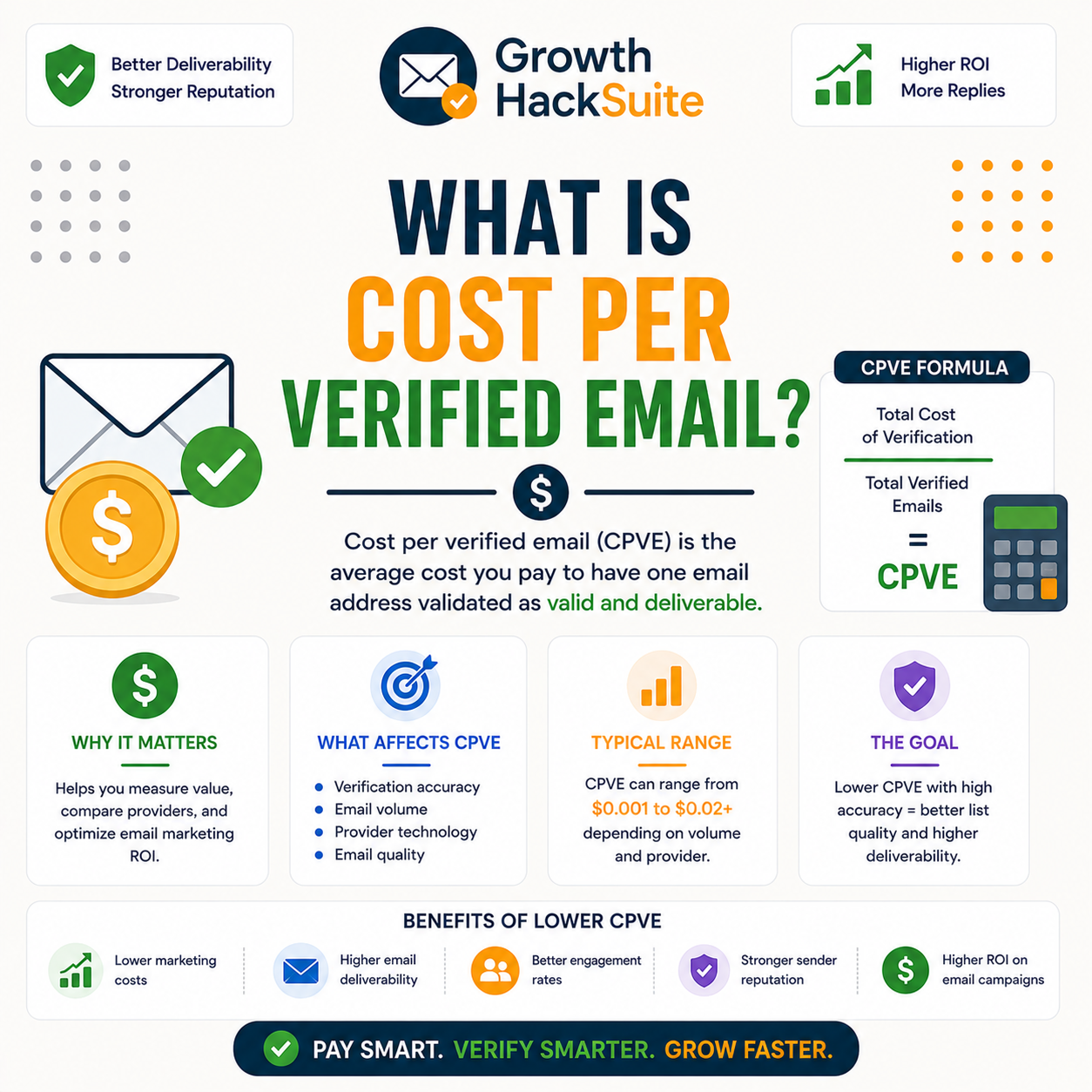
Cost per verified email is the total money spent on an email tool divided by the number of valid, deliverable addresses it produces. It is the truest unit cost in outbound, because a cheap plan that returns many invalid addresses can cost more per usable contact than a pricier one. The formula is simple: tool cost divided by verified emails, and it lets founders compare any two tools on the same honest basis.
What Is Cost Per Verified Email? Core Definition for B2B Teams
Cost per verified email (CPVE) is the amount you pay for each address that is confirmed deliverable. It differs from the headline plan price and from cost per credit, because it counts only addresses that survive verification. An address that bounces has zero value, so CPVE measures spend against results that can actually be emailed, not against raw lookups.
The metric matters because two tools can look equally priced yet differ sharply in usable output. A tool at a lower sticker price with a 70 percent valid rate can deliver fewer reachable contacts per dollar than a tool priced higher with a 95 percent valid rate. CPVE folds price and quality into one number, which is exactly the comparison a buyer needs.
CPVE is the metric that survives marketing spin. It rewards tools that return clean, deliverable data and penalizes those that pad output with addresses that bounce.
How Do You Calculate Cost Per Verified Email?
Divide total tool spend for a period by the number of verified, deliverable emails produced in that period. If a $49 plan yields 1,800 verified addresses in a month, CPVE is about $0.027. The figure depends on the tier price, how credits split between finding and verifying, and the valid rate of the returned data, so all three inputs must be tracked together.
- Total spend: use the effective monthly cost, applying any annual discount, so the numerator reflects what you actually pay rather than the list price.
- Verified count: count only addresses confirmed deliverable after verification, excluding catch-all and unknown results that cannot be safely emailed.
- Credit split: on credit tools, finding and verifying share one pool, so the more you verify, the fewer finds you fund, which changes the verified output per dollar.
- Valid rate adjustment: multiply returned addresses by the valid rate to get the verified count, since a 90 percent valid rate on 2,000 finds yields 1,800 usable emails.
- Period consistency: measure spend and output over the same window, ideally a full billing cycle, so a partial month does not distort the ratio.
On Hunter, a verification costs 0.5 credit from the same pool a find draws from, so per-tier credit cost sets the floor. For the full per-credit math, see the Hunter pricing breakdown, and translate it into pipeline terms with our Hunter cost-per-lead analysis.
“Email deliverability, or simply deliverability, is a measure of the success rate of getting emails into the recipients’ inboxes.”
Wikipedia, Email deliverability : verification protects deliverability, which is why cost per verified email, not cost per raw lookup, is the number that maps to real outreach results.
What Are the Top 5 Reasons Cost Per Verified Email Matters?
CPVE is the decision metric for anyone buying contact data. Five reasons make it more useful than sticker price or cost per credit when comparing tools or justifying spend to a founder or finance team.
- True cost comparison: CPVE normalizes price and data quality into one figure, so two tools at different sticker prices can be compared on usable output per dollar.
- Deliverability protection: tracking verified output discourages buying cheap, dirty lists, because the bounces they cause damage sender reputation and inflate the real cost of every send.
- Budget justification: a clear cost per usable contact gives founders a defensible number to approve, replacing vague tool-fee debates with a concrete unit economic.
- Plan right-sizing: CPVE exposes whether a higher tier actually lowers unit cost at your volume, guiding the upgrade or downgrade decision with math instead of guesswork.
- Pipeline forecasting: knowing cost per verified email lets a team model how much budget converts into reachable prospects, feeding accurate campaign and revenue projections.
In every case, CPVE turns a fuzzy tool decision into a unit-economics comparison. That is why finance-minded buyers anchor on it.
Cost Per Verified Email Across Hunter Tiers: A Worked Example
Because a Hunter verification costs 0.5 credit, the illustrative cost per verification falls as tier volume rises and as annual billing applies its 30 percent discount. The table below shows the per-verification floor by tier; real cost per verified email is slightly higher once the valid rate and any find credits are included, but the relative ranking holds: higher tiers and annual billing always lower unit cost.
Source: derived from Hunter list pricing (hunter.io/pricing); a verification costs 0.5 credit. Figures assume credits spent on verification only and are illustrative; real cost per verified email rises with your valid rate and any find credits used.
The pattern is consistent: volume plus annual billing lowers cost per verified email. To judge whether the returned addresses are actually clean enough to count, read our Hunter email verifier accuracy analysis and the overview of what the Hunter Email Verifier does.
What Are the 5 Limitations of Cost Per Verified Email?
CPVE is powerful but not complete. Five limitations explain why it should sit alongside reply rate and lead quality rather than replace them when judging a tool’s real value.
- Ignores relevance: a verified address is deliverable but not necessarily the right person, so a low CPVE on poorly targeted contacts still wastes outreach effort.
- Valid-rate dependence: CPVE swings with the valid rate you assume, so an optimistic estimate understates true cost and an outdated one overstates it.
- Catch-all ambiguity: catch-all domains return unknown statuses that are hard to classify, so counting or excluding them shifts CPVE without changing the underlying data.
- Credit-split sensitivity: on shared-pool tools, the find-versus-verify mix changes verified output per dollar, so two teams on the same plan can report very different CPVE.
- No reply signal: CPVE measures reachable contacts, not interested ones, so it must be paired with reply and conversion rates to reflect real pipeline value.
“As covered in our Hunter.io Email Finder review, the cheapest sticker price rarely wins on cost per verified email, because data quality and valid rate decide how many addresses you can actually use.”
Growth Hack Suite, Hunter.io Email Finder review
Treat CPVE as the cost backbone of a tool decision, then layer targeting and reply quality on top. Alone it is necessary but not sufficient.
How Do You Lower Cost Per Verified Email in 5 Steps?
Lowering CPVE is about raising verified output per dollar: right-size the tier, cut wasted credits, lift the valid rate, choose annual billing, and re-measure. Five steps deliver the bulk of the savings without sacrificing data quality.
- Step 1, measure your baseline: calculate current CPVE over a full billing cycle so every later change can be compared against a real starting number.
- Step 2, cut credit waste: deduplicate lists and skip re-verifying addresses that arrive auto-verified, freeing credits to produce more verified emails per dollar.
- Step 3, raise the valid rate: feed cleaner inputs and target domains with predictable patterns, which lifts the share of returned addresses that verify as deliverable.
- Step 4, right-size and commit annually: move to the tier whose per-credit cost matches your volume and switch to annual billing for the flat 30 percent discount when usage is steady.
- Step 5, re-measure and lock in: recompute CPVE after the changes, keep the configuration that produces the lowest cost per usable email, and review again each quarter.
Want to measure your real cost per verified email? Find and verify a sample list on Hunter free, then divide spend by deliverable addresses.
Try Hunter.io Free →Free plan, no credit card, find and verify on the same credits
Run the five steps and CPVE drops without buying dirtier data. The lowest cost per verified email almost always comes from cleaner inputs and the right tier, not the cheapest sticker price.
Cost Per Verified Email: Frequently Asked Questions
The 12 most-asked questions about cost per verified email for B2B sales and marketing teams.
The 12 most-asked questions about cost per verified email.
What is cost per verified email?
It is total tool spend divided by the number of confirmed deliverable addresses produced. Unlike sticker price or cost per credit, it counts only emails that survive verification, so it reflects usable output per dollar.
How do I calculate cost per verified email?
Divide your effective monthly spend by the count of verified, deliverable addresses for the same period. If a $49 plan yields 1,800 verified emails, CPVE is about $0.027. Use a full billing cycle so the ratio is not distorted.
Why is cost per verified email better than cost per credit?
Cost per credit ignores data quality. A tool can have cheap credits but a low valid rate, so it returns many addresses that bounce. Cost per verified email folds in quality, measuring only addresses you can actually email.
What is a good cost per verified email?
It varies by tool and volume. On Hunter, illustrative per-verification cost ranges from roughly $0.004 on Scale annual to about $0.012 on Starter monthly. Compare tools on the same list and valid-rate assumptions rather than chasing a single benchmark.
Does verification cost extra on Hunter?
A verification costs 0.5 credit from the same monthly pool a find uses. Emails returned by Email Finder on paid plans arrive auto-verified, so you do not pay a second time to verify them. Re-verifying those wastes credits.
How does valid rate affect cost per verified email?
Directly. CPVE equals spend divided by valid emails, so a lower valid rate raises cost per usable address. A 95 percent valid rate produces more deliverable emails per dollar than a 70 percent rate at the same price.
How do I lower my cost per verified email?
Cut credit waste, feed cleaner inputs to raise the valid rate, right-size your tier, and switch to annual billing for the discount. Re-measure after each change and keep the configuration with the lowest cost per usable email.
Should I count catch-all addresses as verified?
Generally no. Catch-all domains accept any address, so verification returns an unknown status that is risky to email. Excluding them gives a more honest CPVE, even though it raises the number, because it reflects truly safe-to-send addresses.
Does cost per verified email include the cost of finding?
It can, depending on how you scope it. On shared-pool tools, finds and verifications draw from the same credits, so a complete CPVE counts both the find and the verify spend behind each deliverable address.
Is a lower cost per verified email always better?
Not by itself. A low CPVE on poorly targeted or irrelevant contacts still wastes outreach. Pair CPVE with targeting quality and reply rate, so you optimize for reachable and relevant contacts, not just cheap deliverable ones.
How does annual billing change cost per verified email?
Annual billing lowers the effective price; Hunter applies a flat 30 percent across paid tiers. Since the credit allowance is unchanged, the lower price reduces cost per verified email proportionally when 12-month usage is confident.
How does cost per verified email relate to cost per lead?
Cost per verified email is an input to cost per lead. Verified addresses become leads only after qualification and reply, so cost per lead is always higher. Tracking CPVE first isolates the data-quality portion of your funnel economics. See our cost-per-lead breakdown.
Cost per verified email is the honest unit cost of contact data: spend divided by addresses you can actually email. Measure it on your own list, lower it with cleaner inputs and the right tier, and it becomes the clearest number for comparing email tools and defending the budget behind them.
Measure your real cost per verified email
Find and verify a sample list on Hunter free, then divide your spend by deliverable addresses to get a number you can compare across tools.
Try Hunter.io Free →Free plan, no card, find and verify on the same credits.