Hunter.io annual billing cuts the price about 30% versus monthly: Starter drops from $49 to $34 per month, Growth from $149 to $104, and Scale from $299 to $209. The discount applies automatically at checkout with no promo code, but the trade-off is a twelve-month commitment with no mid-term pause, which is worth it only when outreach runs at steady volume for six months or longer.
Table of Contents
How Much Does Hunter.io Annual Billing Save?
Annual billing saves about 30% on every paid Hunter.io tier, which works out to $180 a year on Starter, $540 on Growth, and $1,080 on Scale. The headline rate is the same across plans, but the absolute dollar saving grows with tier size because the percentage applies to a larger base price.
Source: hunter.io/pricing verified June 2026.
Higher tiers see bigger absolute savings, which is why annual is almost always the chosen billing mode for Growth and Scale buyers.
Annual vs Monthly: The Core Trade-Off
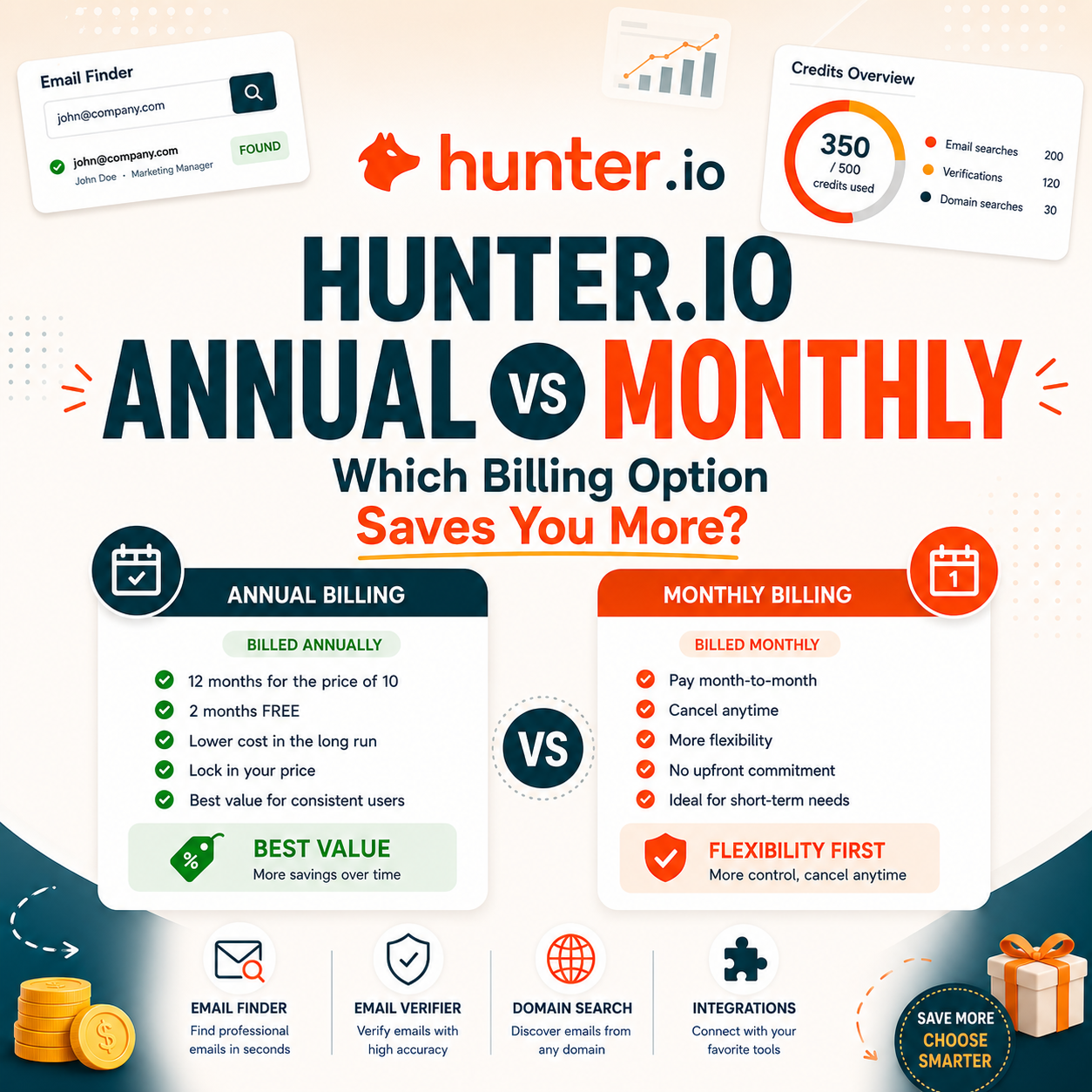
The trade-off is simple: annual billing is cheaper but locks twelve months of budget upfront, while monthly billing is more expensive but preserves the freedom to pause, downgrade, or cancel at any cycle. Most pricing decisions live in that single choice, and the right answer depends on commitment confidence rather than feature needs.
- Price per month: Annual is 30% cheaper across all paid tiers, while monthly carries the full headline rate as published on the Hunter.io pricing page.
- Total commitment: Annual locks twelve months of payment upfront, where monthly only locks the current cycle and renews at the end of each one.
- Budget flexibility: Monthly allows pause, downgrade, or cancellation at every cycle boundary, while annual restricts mid-term changes by contract.
- Cancellation impact: Cancelling annual mid-term forfeits unused months under standard refund policy, while monthly cancellation simply ends the next renewal.
- Best-fit volume: Annual suits steady consistent volume, while monthly fits variable, seasonal, or evaluation use where consumption may not match a full year.
The choice between annual and monthly is essentially a confidence test about how long Hunter will actually stay in the stack.
Who Should Choose Annual Billing?
Annual billing fits teams committed to running outreach for at least six months, with steady monthly volume and a budget already locked in. The 30% discount converts directly into lower cost per lead, which makes annual the default for any organization treating Hunter as core operational infrastructure rather than a temporary tool.
- Committed founder: Founders running consistent outbound as a primary growth channel where the annual saving directly compounds with steady weekly cadence.
- Steady-volume team: Sales and marketing teams whose monthly Hunter usage stays predictable across the year, with no seasonal pause that would waste prepaid credits.
- Agency on retainer: Agencies running client outreach on multi-month engagements where the annual lock matches the contract length already in place with clients.
- Budget-locked organization: Companies whose finance teams prefer annual contracts for vendor planning, treating the prepaid commitment as a feature rather than a constraint.
- Long-term outbound program: Teams whose outbound program is a multi-quarter investment rather than a campaign test, where annual savings directly offset other tool costs.
Annual is the right pick when continued use is already a certainty; the discount is the bonus, not the reason.
Who Should Stay on Monthly?
Monthly billing fits anyone still testing Hunter, running seasonal campaigns, or unsure whether the platform will remain in the stack. The 30% premium over annual is the price of optionality, and it almost always pays for itself when there is real uncertainty about long-term use.
- First-time tester: New buyers still validating Hunter’s accuracy and workflow fit on the team, where annual commitment would precede real usage data.
- Seasonal sender: Teams running concentrated outbound during certain quarters with quiet months in between, where prepaid annual credits would expire unused.
- Short campaign owner: Marketers running a single defined campaign with a clear end date, where a twelve-month commitment outlasts the actual project.
- Cash-flow-sensitive solo operator: Solo founders or freelancers managing variable income, where monthly billing matches actual revenue cycles better than upfront annual.
- Tool-evaluating buyer: Organizations comparing Hunter against alternative platforms, where monthly preserves the option to switch without contractual penalty.
Monthly is the right pick whenever flexibility is more valuable than the headline discount; the premium is rational insurance.
Hunter.io Annual Savings by Plan
The percentage saving stays steady at about 30% across every paid tier, but the absolute saving grows with tier size. Starter saves $180 a year, Growth saves $540, and Scale saves $1,080, which makes the annual decision more financially meaningful as plan size climbs.
Source: hunter.io/pricing verified June 2026.
The percentage is constant, but the dollar saving compounds, which is why Scale annual is the most rewarded commitment Hunter offers on the published list.
The Hidden Cost of Annual: Locked Budget and No Pause
Annual billing carries real downsides beyond the headline discount: a full twelve-month prepayment, no mid-term pause, no credit rollover even on annual contracts, restricted refund eligibility, and difficulty downgrading mid-cycle. None of these are deal-breakers, but each one is the real reason monthly stays the safer choice for uncertain buyers.
- Twelve-month upfront payment: The full annual fee is charged at signup, which ties up working capital that would otherwise stay liquid under monthly billing.
- No mid-term pause: Annual contracts cannot be paused for quiet months, so seasonal teams may pay for periods when no outreach is actually running.
- Credits still do not roll over: Annual billing reduces the price but not the rollover rule, so unused monthly credits expire each cycle regardless of contract length.
- Restricted refund eligibility: Mid-term cancellations forfeit unused months under standard Hunter.io refund policy, with case-by-case exceptions rather than a blanket guarantee.
- Hard to downgrade mid-cycle: Moving to a lower tier mid-contract usually waits for renewal, which removes flexibility if monthly volume drops below the chosen plan.
The discount is real; so is the lock. The right call depends on which side carries more weight for the team’s actual situation.
Break-Even: How Long Until Annual Pays Off?
Annual billing is cheaper than monthly from the very first month if Hunter stays in the stack for the full year. The break-even point against the cumulative monthly cost lands around eight to nine months of continuous use, which means cancelling earlier than that erases the discount and leaves the buyer worse off than monthly.
Annual billing applies a 30 percent discount automatically at checkout, available on every paid tier without a promotional code.
Hunter, Hunter.io pricing page
The break-even rule of thumb is simple: commit to annual only when continued use beyond eight months is genuinely certain.
Is the 30% Annual Discount Worth It?
The 30% annual discount is worth it for any buyer planning to run Hunter for six months or longer, since it pays off in under nine months. For shorter or uncertain horizons monthly is safer despite the higher rate, because the prepaid annual fee becomes a sunk cost the moment outreach stops earlier than planned.
Verdict: Annual saves 30% and pays off in under nine months. Worth it only if outreach will continue for six months or longer straight.
The right Hunter.io billing mode is the one that matches commitment confidence, with annual rewarding steady use and monthly preserving optionality.
Growth Hack Suite, Hunter.io pricing guide
Treat the annual decision as a forecast about commitment rather than a pure cost calculation; the discount only matters if usage actually continues.
Annual vs Buying Extra Credit Packs: Which Is Cheaper?
Annual billing is cheaper than buying repeated extra credit packs whenever shortfalls happen monthly, because annual lowers the base cost while packs raise per-credit price. Credit packs only make sense for occasional one-off spikes; any recurring shortage is the signal to either upgrade the tier or commit to annual.
The mistake most teams make is buying packs three months in a row rather than recognizing that pattern as a plan-sizing problem the annual or upgrade path solves more cheaply.
What Happens If You Cancel an Annual Plan?
Cancelling an annual Hunter.io plan typically preserves access through the end of the period already paid for, with refund eligibility for unused months handled case by case under Hunter’s standard policy. The exact terms depend on how far through the contract the cancellation happens and the reason behind it.
For the precise refund mechanics and any exceptions before signing annual, see the full Hunter.io refund policy breakdown.
How to Switch From Monthly to Annual
Switching from monthly to annual happens inside Hunter’s billing settings: select the annual option, confirm the new 30%-discounted rate, and the new pricing applies from the next billing cycle. There is no penalty for the switch itself, only the standard twelve-month commitment that activates from the moment annual starts.
- Open billing settings: Navigate to the billing panel inside the Hunter.io workspace, where current plan and cycle settings are visible together.
- Choose annual billing: Select the annual option for the current plan tier, which surfaces the discounted rate alongside the monthly equivalent.
- Confirm the discounted rate: Review the new per-month price and the total annual commitment before approving, so the lock and the saving are both explicit.
- Apply on next cycle: The annual rate takes effect at the start of the next billing cycle, with the twelve-month clock running from that date forward.
- Verify the saving on the invoice: Confirm that the first annual invoice reflects the 30 percent discount and matches the per-month rate displayed before checkout, catching any pricing mismatch early.
Lock the annual rate now and save up to 30%.
Try Hunter.io Free →Validate volume first, then commit annual when ready
The switch itself is friction-free; the real decision is whether the team is ready to lock the next twelve months at the moment the toggle gets flipped.
How to Lock the Hunter.io Annual Discount
Locking the annual discount is best done after a few months of steady monthly use confirm the plan tier and credit volume match real workflows. Some current promotions stack with annual at signup, so timing the commitment around an active deal can compound the saving beyond the standard 30%.
Start free, then commit annual when you are ready.
Start Hunter.io Free →No card · Annual saves up to $1,080 a year on Scale
The subscription business model is a business model in which a customer must pay a recurring price at regular intervals for access to a product or service.
Wikipedia, Subscription business model
Hunter’s billing fits the standard SaaS subscription model, and annual is the version where Hunter and the buyer both benefit when commitment is real.
Related: Billing and Discount Guides
Annual billing is the largest structural discount Hunter publishes, but other deal mechanisms exist alongside it. The active deal page captures any current seasonal or nonprofit reduction available on top of the standard annual rate, which is worth checking before any commitment.
For currently active offers and the nonprofit pathway, see the full Hunter.io discount guide.
Want the full picture before you commit? Read the full Hunter.io email finder review for real pricing, accuracy, and who it fits.
Hunter.io Annual vs Monthly: Frequently Asked Questions
How much does Hunter.io annual billing save?
About 30 percent on every paid tier. Starter drops from $49 to $34 per month, Growth from $149 to $104, and Scale from $299 to $209 when billed annually.
Is Hunter.io annual billing worth it?
Yes if outreach will continue for six or more months. The discount pays off in under nine months of continuous use, but cancelling earlier erases the saving.
How much do I save per year on annual?
Roughly $180 a year on Starter, $540 on Growth, and $1,080 on Scale compared with paying monthly across the full twelve months.
Can I switch from monthly to annual any time?
Yes. Change the option in billing settings; the discounted annual rate applies from the next billing cycle and locks the twelve-month commitment from that date.
What happens if I cancel an annual Hunter.io plan?
Access typically continues through the end of the period already paid for. Refund eligibility for unused months follows the standard Hunter.io refund policy.
Do annual plans include more credits?
No. Credit allowances are identical on monthly and annual; the annual option only reduces the price. Credits still reset monthly without rollover regardless of billing mode.
Who should stay on monthly billing?
Anyone still testing Hunter, running seasonal campaigns, or wanting the ability to pause or downgrade between cycles. The 30 percent premium pays for genuine optionality.
Is annual cheaper than buying extra credit packs?
Yes when shortfalls happen monthly. Annual lowers the base cost across the year, while one-time packs only suit occasional spikes rather than recurring overruns.
When does the annual discount pay off?
Annual is cheaper than monthly from month one if usage continues all year. Break-even against cumulative monthly cost lands at roughly eight to nine months of use.
Does annual billing lock my budget?
Yes. The full twelve months are prepaid at signup and the contract cannot be paused mid-term, which is the main trade-off against the cheaper monthly rate.
Can I get annual plus a promo discount?
Sometimes. Annual is the main structural saving, but seasonal or nonprofit deals can stack with it at signup. Check the current Hunter.io discount guide before committing.
Which plan saves the most on annual?
Scale saves the most in absolute terms at $1,080 a year, although every paid tier in the full Hunter.io pricing breakdown sees the same 30 percent discount.
Start Free, Then Lock the Annual Rate When Committed
The cleanest path to the annual discount is to start on the free plan, validate Hunter’s accuracy and workflow fit on real prospects, run a few months of monthly billing to confirm volume, and only switch to annual once continued use is genuinely certain. That sequence captures the 30% saving without taking on the lock-in risk too early.
Start free, validate volume, then lock annual when you are committed.
Annual saves $180 on Starter, $540 on Growth, and $1,080 on Scale per year.
Start Hunter.io Free →No card · See the full Hunter.io pricing breakdown
Affiliate disclosure: links to Hunter.io on this page are affiliate links. The price is the same for you, and Growth Hack Suite may earn a commission if you sign up through them.