
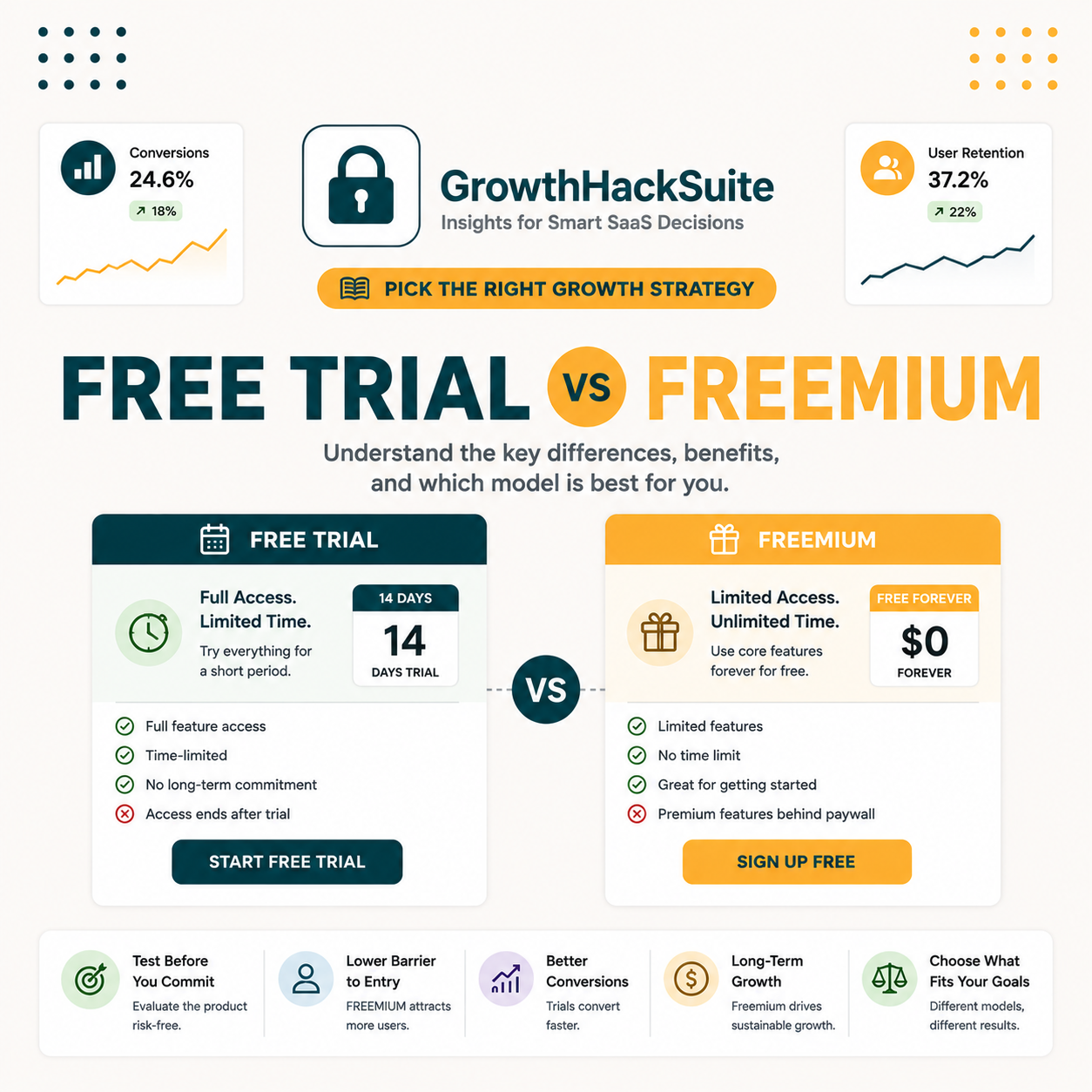
A free trial gives full product access for a fixed window, then forces a paid decision when the clock runs out. A freemium plan gives limited access forever at zero cost, with paid tiers unlocking more features or higher caps. The two models carry different risk profiles, cost exposure, and commitment pressure for the buyer. For cautious first-time users, freemium usually wins on safety; for committed teams, a trial unlocks the full product fastest.
Table of Contents
What Is the Difference Between Free Trial and Freemium?
A free trial unlocks full or near-full product access for 7 to 30 days, then requires payment or a downgrade to keep using the tool. A freemium plan gives a permanent limited tier at zero cost, with paid plans unlocking more features or higher caps. Trial creates urgency; freemium reduces friction. The structural difference shapes how each model handles buyer risk and how each company drives paid conversion.
Freemium is a pricing strategy by which a basic product or service is provided free of charge, but money is charged for additional features.
Wikipedia, Freemium
Trial equals full access, time-bounded, urgency-led. Freemium equals limited access, permanent, friction-free. The model a tool picks shapes the buying journey more than any feature list.
How Does a Free Trial Work?
A free trial unlocks the full product for a fixed period, often 7 to 30 days. Some vendors require a credit card at signup and auto-charge at expiry; others ask only for an email and lock or downgrade the account when the clock runs out. The deadline is the defining trait, and the credit card requirement is the single biggest variable separating low-risk from high-risk trials.
- Full access window: Trials grant every feature for the period so buyers can evaluate the complete product, not a stripped-down version, before committing to pay.
- Credit card variation: Card-required trials auto-convert to paid unless cancelled; card-free trials simply lock or downgrade, which removes the forgotten-cancellation risk entirely.
- Hard expiry: Access ends on a set date, forcing a yes-or-no purchase decision rather than allowing indefinite evaluation across a real sales cycle.
- Auto-convert exposure: Card-required trials charge the card unless the buyer cancels in time, which traps anyone who forgets the deadline mid-evaluation.
- Fixed evaluation runway: A 7 to 14 day window rarely covers a real workflow or sales cycle, so buyers judge the tool on incomplete data and risk rushing the decision.
A trial trades time-limited full access for a forced decision. The credit card requirement decides whether the trial is genuinely low-risk or quietly an auto-billing trap.
How Does a Freemium Plan Work?
A freemium plan grants permanent free access to a limited tier, with paid plans unlocking more features or higher caps. There is no deadline and no credit card. The free tier is designed to deliver genuine value indefinitely while nudging heavy users toward an upgrade when they outgrow the limits naturally rather than at a calendar deadline.
- Permanent free tier: The free plan stays available at no cost with no expiry date, which distinguishes freemium from time-limited trials that lock access after the window closes.
- Usage or feature cap: The free tier caps either consumption volume or advanced capabilities, giving paid plans a clear reason to exist beyond marketing differentiation.
- No card upfront: Genuine freemium does not require payment information at signup, which keeps the no-obligation promise that drives the conversion funnel honestly.
- Self-served upgrade path: Paid tiers are visible and easy to choose once usage demands grow, with transparent pricing that makes the upgrade decision a clean self-serve action.
- Conversion via natural limits: A meaningful share of free users eventually pay when they hit the cap, which is how freemium economics work commercially over the long run.
Freemium removes the deadline and the card. Users self-select an upgrade trigger instead of being pushed by an expiring clock, which builds slower but more durable conversion.
Free Trial vs Freemium: Side-by-Side Comparison
Free trial wins on full-feature access during the trial window; freemium wins on cost, time pressure, and payment safety. Five axes settle the comparison cleanly: time limit, credit card requirement, feature scope, expiry behavior, and exit cost. The same product can fit either model depending on which axis matters most to the buyer.
Source: SaaS pricing industry patterns, verified 2026-06.
The table reduces the choice to five concrete trade-offs. When all five lean the same direction for a given buyer, the model decision is straightforward; when they split, the next sections settle the priority.
Want a freemium tool that proves accuracy before you pay?
Try Hunter.io Free →50 monthly credits, no card, no expiry.
Why Do SaaS Companies Choose One Model Over the Other?
Trials suit sales-led products that need fast paid conversion within a quarter; freemium suits self-serve products that scale through habit and referral. The choice reflects the company’s go-to-market motion more than the product itself. Enterprise tools with high contract values usually pick trials; usage-based tools with low individual contracts usually pick freemium.
Freemium succeeds when the free tier delivers genuine value and the paid tiers solve real problems that emerge as customers grow, which is the model usage-based SaaS platforms typically follow.
HubSpot, HubSpot guide to freemium
The go-to-market motion drives the model choice. Trials optimize for short-term paid revenue; freemium optimizes for long-term adoption flywheel. Both work, but they fit different products and different buyer journeys.
What Are 5 Hidden Costs of a Free Trial?
Trials carry five hidden costs that the free label hides: credit card lock-in, evaluation pressure, mistimed deadlines, forgotten cancellations, and rushed feature comparisons. Freemium avoids all five by design, which is why cautious buyers default to freemium when both options exist for the same workflow.
- Credit card lock-in: Card-required trials store payment details before any decision is made, which creates passive auto-billing exposure that ends only when the buyer remembers to cancel.
- Evaluation pressure: A 14-day window rarely covers a full workflow or sales cycle, so buyers judge the tool on incomplete data and either rush a yes or abandon a tool that would have fit.
- Mistimed deadlines: Trials force a decision on the vendor’s calendar, not the buyer’s. A deadline that expires during a busy week defaults to no, even for a good-fit tool.
- Forgotten cancellations: The most common trial trap is forgetting the expiry date and being charged for a tool the buyer never decided to keep, often only spotted after the first invoice cycle.
- Rushed comparisons: Running two or three trials in parallel multiplies cancellation reminders and compresses real testing into a single hectic fortnight, which favors familiar names over best-fit tools.
Three of the five costs stem from the credit card; two stem from the deadline. Both are absent in a true freemium plan, which is why the model carries structurally less risk for first-time buyers.
What Are 5 Limits Every Freemium Plan Has?
Every freemium plan caps usage, scope, or features in five common ways: volume cap, feature gating, brand attribution, team-size limit, and support tier. Buyers who hit any of these limits face the upgrade decision the model is built around. Knowing the caps before signing up prevents wasted evaluation on a tier that cannot cover the actual workflow.
- Volume cap: Most freemium tiers limit credits, monthly sends, contacts, or task runs, with the cap sized to allow a meaningful test but not a full production workload.
- Feature gating: Advanced features such as automation sequences, A/B testing, or integrations sit behind paid tiers, which keeps the free experience focused on the core use case.
- Brand attribution: Some freemium tools include vendor branding on outbound communications or hosted pages, which paid plans remove for buyers who need white-label output.
- Team-size limit: Free tiers usually limit seats or connected accounts to one, with paid plans unlocking multi-user collaboration and team-wide reporting.
- Support tier: Free users typically get documentation and community support only; paid plans add email, chat, or priority support depending on the tier.
The five limits are how the model converts free users to paid plans without forcing the decision. Reading them carefully before signup turns the free tier into honest evaluation instead of unpleasant surprise.
Which Cold Email Tools Use Free Trial vs Freemium?
Cold email and sales-outreach tools split between the two models. Mailshake, Lemlist, and Outreach use 14 to 30 day trials. Hunter.io, GMass, and Mailmeteor use freemium tiers with permanent free access. For a worked example of the distinction, our breakdown of Hunter.io free plan vs free trial shows what 50 permanent monthly credits unlock and why no countdown ever applies. The split mirrors how each tool sells: outreach trials drive fast paid conversion, freemium tools build long-term adoption through real product use.
Source: Vendor pricing pages, verified 2026-06.
Gmail-native and usage-based tools cluster around freemium; sales-led outreach platforms cluster around trials. The model a category picks reveals how it expects buyers to evaluate and commit.
Which Model Is Lower Risk for First-Time Buyers?
Freemium carries less risk for first-time buyers because it costs zero, requires no card, and imposes no deadline. A free trial risks an accidental charge and pressures a decision within days. For cautious buyers evaluating their first tool in a category, freemium removes nearly every commitment friction that a trial introduces.
- Zero payment exposure: A freemium tier at zero cost cannot generate a surprise charge, so buyers test without any financial commitment or cancellation reminder to track on their calendar.
- Unlimited evaluation time: Freemium lets buyers test across a full sales cycle or several campaigns, gathering real performance data instead of a rushed two-week impression.
- Reversible upgrade: Moving from free to paid is a deliberate choice the buyer makes when ready, not a default triggered by an expiring clock or a stored card on file.
- No cancellation tracking: There is no deadline to remember and no calendar reminder needed, which eliminates the most common trial trap of forgotten cancellations.
- Buyer-led timing: The upgrade happens when usage justifies it, not when the vendor’s clock runs out, which aligns commitment with real workflow value rather than artificial urgency.
Freemium is the lower-risk model on every axis that matters to a first-time buyer: cost, time pressure, and payment exposure. Trial risk is manageable but never zero.
Sending cold email from Gmail and want a freemium tool?
Try GMass Free →50 emails per day forever, no credit card required.
How to Evaluate Any Free Plan in 5 Steps
Five steps turn any free tier into a useful evaluation rather than a wasted signup: test the core feature on real workflow data, measure the actual usage cap, check the upgrade price, compare to one or two alternatives, and read the cancellation policy before committing. Skipping any step turns evaluation into guessing rather than measurement.
- Test the core feature on real data: Use the free tier on actual prospects or workflow tasks rather than synthetic samples, since real data is the only honest accuracy test.
- Measure the actual usage cap: Track how quickly the free allowance gets consumed during normal use, which produces a real picture of where the cap binds in production.
- Check the upgrade price: Review the paid tier pricing and feature differences before testing, so the upgrade decision is informed rather than reactive when the cap arrives.
- Compare to alternatives: Run the same workflow on one or two competing free tiers and compare usable output per credit or per limit unit, which surfaces real value differences.
- Read the cancellation policy: Review refund eligibility and lock-in terms before paying, since these decide whether the upgrade is reversible if usage drops later in the year.
Five steps and a week of real use produce a more reliable evaluation than any amount of marketing copy or reviewer benchmarks. The work pays off the first time a tool decision avoids a refund cycle.
When to Pick Free Trial Over Freemium
Pick a free trial when the buyer is already committed to the category and needs full-feature evaluation within a quarter. Pick freemium when the buyer is uncertain, low-volume, or unwilling to enter a card. The decision turns on commitment readiness, volume needs, timeline, and willingness to handle cancellation timing if the trial does not convert.
The right tier is the one whose ceiling sits just above real monthly usage, which is exactly the comparison a freemium tier surfaces honestly before any commitment.
Growth Hack Suite, Hunter.io pricing guide
When uncertain, freemium wins. When committed and needing full features inside a deadline, a trial wins. Five quick checks on commitment, card, volume, feature gaps, and timeline settle which side of the line a workflow falls on.
Start with a freemium tool, upgrade only on real usage.
50 monthly credits, no card, no expiry, no obligation.
Try Hunter.io Free →See the full Hunter.io pricing breakdown before upgrading.
Related: Free Plan and Pricing Guides
Free trial and freemium decisions connect directly to plan choice, credit math, and tool comparison. Working through the related guides usually settles the full pricing picture rather than leaving the model decision in isolation. The two clusters below cover the most common follow-up questions after the trial vs freemium call.
For the freemium concept itself, the deeper freemium model guide covers the conversion mechanics in detail. For a worked example, the Hunter.io free plan vs Starter upgrade guide shows how a freemium tier converts to paid in practice, while the GMass free plan review walks through a different freemium implementation. The Hunter.io pricing breakdown sets the full tier picture, and the cold email benchmarks guide grounds either model in realistic reply-rate expectations before any tool commitment.
Free Trial vs Freemium: Frequently Asked Questions
The 12 most-asked questions about free trial vs freemium for SaaS buyers.
What is the main difference between free trial and freemium?
A free trial grants full access for a fixed window then forces a paid decision. Freemium grants limited access forever at zero cost with paid tiers unlocking more.
Is freemium safer than a free trial?
Yes. Freemium has no deadline and no credit card, which removes the auto-charge and forgotten-cancellation risks that trials carry.
Why do some companies use trials instead of freemium?
Trials drive faster paid conversion through forced commitment. Freemium drives slower but more durable conversion because users upgrade after hitting a real limit.
Does a free trial always require a credit card?
No. Some trials require a card upfront and auto-charge at expiry; others ask only for an email and lock or downgrade the account when the period ends.
Does freemium mean lower product quality?
No. The free tier uses the same product engine as paid plans; it is limited in volume or scope rather than crippled in capability or accuracy.
How do freemium plans make money?
By converting a meaningful share of free users to paid plans as usage outgrows the free cap or as advanced features become necessary for the workflow.
Which cold email tools use freemium?
Freemium tools include Hunter.io with 50 monthly credits, GMass with 50 emails per day, and Mailmeteor with 75 emails per day. All three have no expiry and no card requirement.
Which cold email tools use free trials?
Mailshake, Lemlist, and Outreach use 14 to 30 day trials. Buyers usually need a credit card at signup, and the account either locks or drops to a limited state if no payment occurs.
When should I pick a free trial over freemium?
Pick a trial when committed to the category and needing full-feature evaluation within a quarter. Pick freemium when uncertain, low-volume, or unwilling to enter a card.
Can I upgrade from a freemium plan anytime?
Yes. Freemium upgrades are self-served and reversible. Most tools let users upgrade without re-onboarding, and downgrade or cancel at any monthly cycle.
What is the most common trial trap?
Forgetting the expiry date and being auto-charged for a tool the buyer never decided to keep. Card-required trials should always be on a calendar reminder.
How do I evaluate any free plan before paying?
Test the core feature on real data, measure the actual cap, check the upgrade price, compare alternatives, and read the cancellation policy. See the pricing breakdown for a worked tier-choice example.
Affiliate disclosure: links to Hunter.io and GMass on this page are affiliate links. The price is the same for you, and Growth Hack Suite may earn a commission if you sign up through them.


