Table of Contents
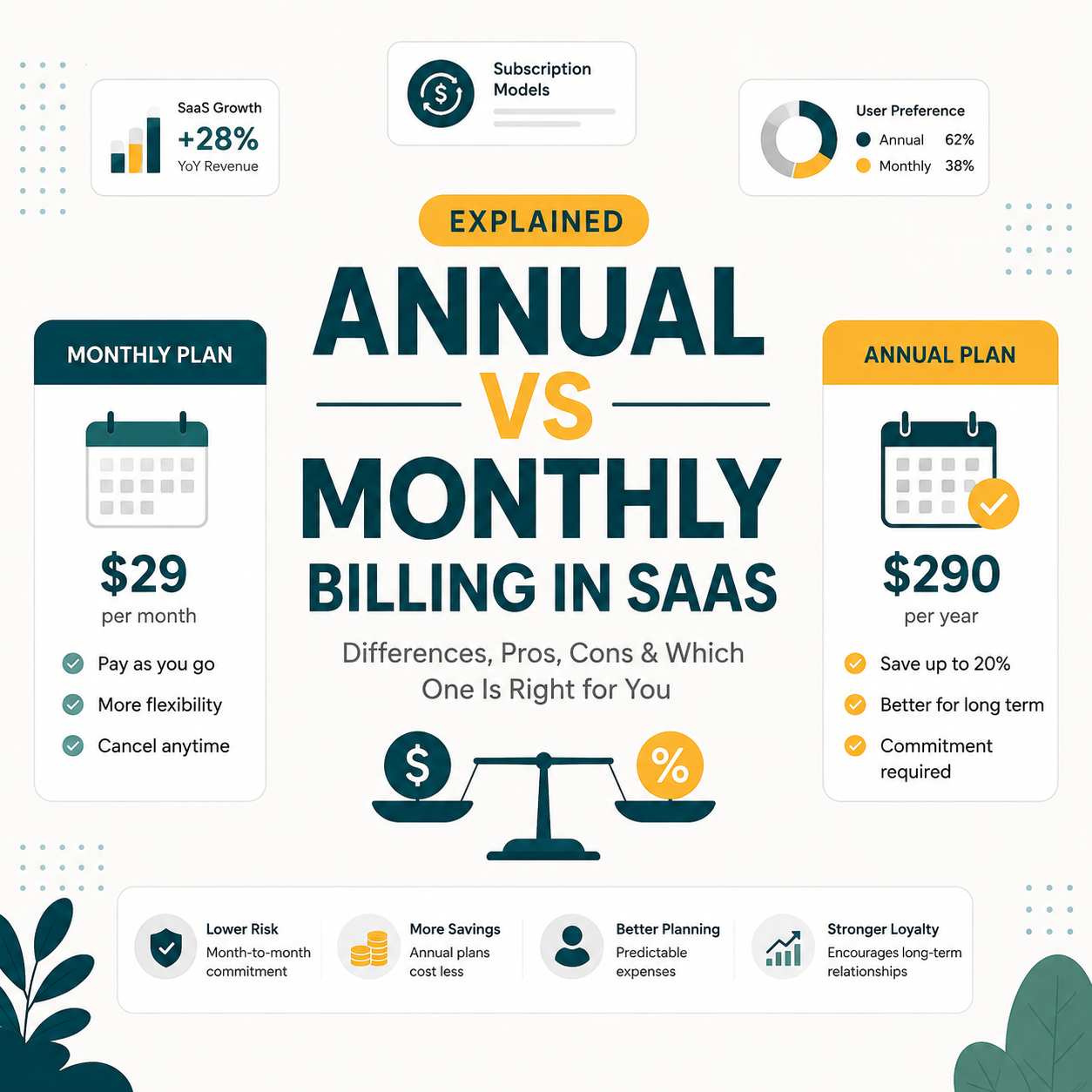
Annual vs monthly billing defines how SaaS vendors charge for tool access: monthly plans offer flexibility at full price, while annual plans lock 12 months upfront for a 20-30% discount. For B2B email and outreach teams, this decision affects cash flow, credit costs, and vendor switching risk. Hunter.io’s annual Starter plan cuts the monthly rate from $49 to $34, or $408 for the year against $588 on monthly billing.
What Is Annual vs Monthly Billing? Core Definition for B2B Sales and Marketing Teams
Annual billing charges the full 12-month cost upfront, typically at a 20-30% discount. Monthly billing charges the standard rate each month with no commitment. The choice is not about preference: it is a financial calculation. Teams with stable tool usage and predictable budgets almost always recover the discount faster than they expect.
Source: Hunter.io, Apollo.io and Snov.io official pricing pages, verified July 2026.
“Subscribers pay recurring fees at regular intervals for continued access to a product or service.”
Source: Wikipedia: Subscription Business Model. Annual billing is the 12-month interval variant of this model, priced at a discount to reduce vendor churn.
Annual billing saves 20-30% for teams with stable usage; monthly billing trades rate premium for flexibility. The right choice depends on whether the team has validated usage for at least 60 days.
How Does Annual vs Monthly Billing Actually Work? The Technical Mechanism Explained
Annual billing works by collecting 12 months of subscription fees in one transaction. The vendor applies a discount, typically 17-31%, and locks the account into a fixed plan tier for the billing year. Monthly billing processes one payment per cycle and keeps the account tier-flexible at the cost of a 20-30% rate premium.
Four components determine how annual billing functions at the account level:
- Upfront payment collection: The full annual fee is charged on day one of the billing year. Vendors use Stripe or Paddle to process, and receipts arrive as a single invoice, not 12 monthly charges.
- Plan tier lock-in: The account tier, whether Starter, Growth or Business, is fixed for 12 months. Upgrading mid-year is possible but triggers a pro-rated charge at the new tier’s annual rate, eliminating part of the original discount.
- Credit allocation per cycle: Credits typically reset monthly within the annual plan, not annually. Hunter.io Starter annual delivers 2,000 credits per month across 12 months, not 24,000 upfront.
- Cancellation and refund window: Most vendors offer a 14-30 day refund window after annual payment. After that window, cancellation ends access at the end of the billing year with no refund on remaining months.
- Auto-renewal default: Annual plans auto-renew at the current listed price, which may differ from the price locked at initial signup. Renewal notifications arrive 30 days before the charge under most SaaS terms.
Annual billing locks plan tier and rate for 12 months; monthly lets teams upgrade or cancel at each billing cycle at a 20-30% cost premium.
What Are the Top 5 Use Cases for Annual vs Monthly Billing in B2B Sales?
Five use cases below show where annual billing delivers measurable ROI for B2B teams. Each case involves a team that has already validated the tool for 60+ days on monthly billing, confirmed usage patterns, and calculated the break-even point before committing to the annual rate.
Five use cases confirm annual billing ROI for B2B teams with validated usage data:
- SDR teams hitting monthly credit ceiling: Teams consistently using 90%+ of monthly credits benefit most: annual locks a lower rate per search for 12 months of guaranteed demand.
- Email marketing teams running recurring list verification: Quarterly list hygiene at consistent volumes creates predictable monthly credit demand, the exact condition annual billing rewards with a 20-31% discount.
- Agencies with multi-client outreach obligations: Agencies running outreach for 5+ clients each month have high, consistent credit usage that makes annual billing a straightforward cost reduction with no usage variability risk.
- Founders building a cold email acquisition channel: Startups in a defined 12-month growth phase with a cold email strategy find annual billing aligns with the strategic time horizon of the outreach program.
- CRM-embedded workflow teams: Once a tool is embedded in Zapier, HubSpot, or Salesforce workflows, switching cost rises and annual billing becomes the rational choice for continuous access without disruption.
“Annual contracts provide SaaS buyers with predictable costs and vendors with reduced churn, creating a pricing structure that aligns incentives on both sides of the deal.”
Source: HubSpot Sales Blog: SaaS Pricing Models
Five use cases confirm annual billing ROI when teams already have validated usage data and a predictable outreach volume above the plan’s credit threshold.
What Are the 5 Limitations of Annual vs Monthly Billing Every Buyer Should Know?
Annual billing introduces five buyer risks that monthly billing avoids. Each limitation matters most to teams with variable usage, uncertain headcount, or tools that compete with newer alternatives. Evaluating these constraints before committing prevents the most common annual billing mistake: locking into a plan tier that no longer fits within six months.
- Budget lock-up for 12 months: Annual billing commits capital that cannot be reallocated if team priorities shift, headcount reduces, or a better tool enters the market mid-year.
- Plan tier ceiling during growth phases: Teams that scale faster than expected hit the credit ceiling of their locked plan, forcing a mid-year upgrade at pro-rated annual rates that reduce the original discount value.
- Refund limitations after the initial window: Most SaaS vendors offer 14-30 day refund windows. After that, cancellation ends access but does not recover remaining months of the annual fee.
- No flexibility for credit carry-forward: Monthly credit allocations within annual plans typically do not roll over. Teams that underuse in January cannot apply those credits in June, meaning credit value is lost, not saved.
- Vendor dependency during product transitions: Locking annual billing just before a vendor releases a major pricing restructure or product pivot can leave teams paying for a plan tier that no longer matches their workflow needs.
“Hunter.io’s annual plan delivers a 31% discount off the monthly Starter rate, making it one of the steeper annual discounts in the email finding tool category.”
Source: Hunter.io Email Finder review, Growth Hack Suite
The five limitations of annual billing all point to the same root cause: committing before usage validation is complete. Sixty days of monthly data eliminates most annual billing regret.
Top 5 Tools Compared by Annual vs Monthly Billing Approach: Hunter.io, Apollo, Snov.io, ZeroBounce, Clearbit
Five email tools offer distinct annual billing structures: Hunter.io delivers the steepest discount at 31%, while Apollo.io and Snov.io sit at 17-15%. Discount percentage is not the only variable: credit allocation, rollover policy, and upgrade flexibility all affect total annual value for SDR teams scaling from 500 to 5,000 contacts per month.
Source: Official pricing pages for Hunter.io, Apollo.io, Snov.io, ZeroBounce and Clearbit, verified July 2026. Hunter.io row highlighted as highest annual discount in category.
Annual Discount by Tool
Hunter.io offers the steepest annual discount at 31%, making it the strongest value case for SDR teams that have validated usage on the Starter monthly plan. For an independent comparison of email finder pricing across more tools, see the email finder pricing comparison.
How Do You Apply Annual vs Monthly Billing in 5 Steps with Hunter.io (Free Workflow)?
Applying annual billing correctly requires validating usage data before committing. Five steps below walk through the evaluation process using Hunter.io’s free plan, moving through the Starter monthly trial, and calculating the annual break-even before switching. Each step produces a concrete data point that informs the final commitment decision.
- Step 1, run free tier for 30 days: Hunter.io’s free plan delivers 50 credits per month, enough for 50 email searches or 100 verifications. Track exact credit usage daily to establish a demand baseline before spending a dollar.
- Step 2, start Starter monthly at $49/month: Once the free tier consistently hits the ceiling, move to Starter monthly. Run for 60 days and log actual monthly searches used, not just the ceiling.
- Step 3, calculate the annual break-even point: Monthly Starter at $49 for 12 months costs $588. Annual Starter at $34/month costs $408. The $180 difference is the annual saving, accruing at $15 per month from month one. If the 12-month outlook is confirmed, annual billing pays.
- Step 4: headcount stability check: Annual billing locks the account, not the team. If headcount drops or the outreach program pauses, the committed annual fee continues. Confirm the team and program are stable before switching.
- Step 5: annual switch and calendar: After switching, set a calendar reminder 45 days before the annual renewal to review usage and decide whether to stay on the same tier, upgrade, or let the auto-renewal proceed.
Ready to validate your Hunter.io usage before committing annual?
Try Hunter.io FreeFree plan: 50 credits per month. No credit card required.
Five steps from free trial to annual commitment reduce the risk of locking into a mismatched plan tier and maximise the credit value of the annual discount.
How Has the Concept of Annual vs Monthly Billing Evolved Across the B2B Email Tool Category?
Annual billing in B2B SaaS evolved from enterprise software licensing in the 1990s, when perpetual licenses transitioned to subscription models. The 20-30% annual discount emerged as a vendor strategy to reduce churn and improve revenue predictability. By 2020, nearly every B2B email tool offered annual pricing as the default path for teams post-trial.
In the early 2010s, tools like Mailchimp introduced monthly billing for email marketing at scale, normalising the idea of paying by volume without commitment. By 2015, email finding tools like Hunter.io adopted the same model. The annual discount option appeared as these tools matured and vendor churn data showed that month-to-month customers churned at 3-4x the rate of annual subscribers. Vendors responded by widening the annual discount from 10-15% to 20-31% to shift more customers onto predictable annual contracts. For context on how Hunter.io’s annual vs monthly billing decision has evolved specifically for their plans, that breakdown covers the current structure in detail.
Annual billing emerged as the default post-trial path for B2B email tools after 2020, driven by vendor churn reduction goals and SDR team demand for predictable per-credit costs.
What Are the Real Cost Implications of Implementing Annual vs Monthly Billing at SDR Team Scale?
Scaling annual billing from 1 to 10 SDRs changes the per-seat economics significantly. Hunter.io Growth annual at $104/month per seat becomes $1,248 per year. At 10 seats, that is $12,480 committed annually. The cost implication is not just the rate: it is the capital lock-up and upgrade ceiling for the full billing year.
Source: Hunter.io pricing page, $34/mo Starter annual and $104/mo Growth annual, verified July 2026. Seat counts are approximations; Hunter.io charges per account, not per seat on standard plans.
At SDR team scale, the annual commitment decision shifts from a per-seat discount question to a capital allocation and upgrade ceiling question that requires finance approval above 5 seats. For a detailed look at all Hunter.io plan tiers, the Hunter.io pricing breakdown covers credit allocations and team plan options.
What Are the 5 Common Mistakes B2B Teams Make With Annual vs Monthly Billing?
Five mistakes recur across B2B teams that commit to annual billing without completing the pre-commitment validation. Each mistake is predictable and avoidable. The most expensive pattern is committing annual on a plan tier that the team outgrows in month three, forcing an upgrade that eliminates the original discount savings.
- Premature annual commitment: Teams that switch to annual after 2-4 weeks of monthly billing lack enough usage data to choose the correct plan tier, leading to under-tier or over-tier lock-in.
- Aspirational tier selection: Selecting Growth annual because the team plans to burn 10,000 credits per month, but currently averages 1,500, locks capital into a tier that may never be utilised.
- Ignoring the upgrade pro-rata cost: Mid-year plan upgrades on annual billing trigger pro-rated charges at the new tier’s annual rate. Teams that do not calculate this upfront often pay more than monthly billing would have cost.
- Missing the refund window after payment: Annual billing refund windows close within 14-30 days of payment. Teams that discover a poor fit at week 5 have no recourse, unlike monthly billing where the next month is simply not renewed.
- Failing to calendar the renewal date: Auto-renewal on annual billing at the listed price, which may have increased, is the most common surprise charge in B2B SaaS. A 45-day advance calendar reminder prevents an unplanned annual commitment.
Five common annual billing mistakes are all preventable with 60 days of monthly usage data and a written break-even calculation before the annual commitment is made.
How Do SDRs, Email Marketers, and Founders Each Apply Annual vs Monthly Billing Differently?
SDRs, email marketers, and founders each apply the annual vs monthly billing decision differently based on usage volume, budget authority, and tool dependency. SDRs optimise for credit cost per booked meeting. Marketers weigh tool stack overlap. Founders calculate total annual SaaS spend against revenue impact before committing any recurring subscription to an annual cycle.
SDRs focus on credits-per-booked-meeting math. A solo SDR sending 100 cold emails per day at a 10% open rate and 3% reply rate needs roughly 3,000 verified emails per month. Hunter.io Starter annual at 2,000 credits per month supports roughly 1,300 contacts found and verified, since a find costs 1 credit and a verification costs 0.5. At that volume, SDRs run both finding and verification from the same credit pool. The 31% annual discount directly reduces cost per booked meeting.
Email marketers evaluate annual billing differently: their usage spikes around campaign launches, not consistently every month. Quarterly list hygiene for a 50,000-address list might consume 1,000 verifications, or 500 credits, in one month and zero in the next three. For these teams, monthly billing often wins because credit usage is too variable to justify the annual lock-in.
Founders making the annual billing decision treat it as a capital allocation question. At $408-$1,248 per year for Hunter.io Starter-to-Growth annual, the decision requires confirming that cold email outreach is a core channel for the next 12 months, not just a tactical experiment. Founders with a clear 12-month outreach roadmap find the ROI obvious; those still testing channels stay monthly.
SDRs, email marketers, and founders apply annual billing logic at different scales; SDR teams with above-threshold monthly usage consistently report the fastest annual discount payback.
What Are the Best Practices for Implementing Annual vs Monthly Billing?
Five best practices below apply to any B2B team evaluating annual billing for email tools. Each practice reduces the risk of committing to a plan that misaligns with actual usage within six months of the annual commitment start date, which is when most regret decisions occur.
- 60-day monthly validation: Two full billing cycles establish a realistic usage baseline: month one is often exploratory, month two reflects actual workflow credit demand.
- Written break-even calc: Document: monthly spend × 12 = annual monthly-rate cost. Subtract annual rate total. Divide by monthly savings to get break-even months. If break-even is under 6 months, annual billing is a clear win.
- Current-usage tier match: Annual billing locks the tier. Committing to Growth annual at $104/month when current usage is Starter-level wastes $840 per year in unused capacity.
- Renewal date calendar: Annual billing auto-renews. A 45-day lead time allows a proper usage review, tier reconsideration, and budget approval before the next annual charge lands.
- Quarterly plan review: If usage patterns shift significantly after month three, explore mid-year upgrade options early, before approaching the upgrade deadline at the end of the annual term.
Five best practices reduce annual billing regret by separating the discount decision from the plan tier decision and requiring usage validation before any 12-month commitment.
What Industry Trends Are Reshaping Annual vs Monthly Billing Going Into Late This Year?
Three trends are reshaping the annual vs monthly billing decision for B2B email tools in the second half of this year. AI-enhanced credit scoring, quarterly upgrade windows, and usage-based pricing are reducing the penalty for choosing monthly, while annual commitments gain new perks like dedicated support and priority API access.
Usage-based pricing layers: Vendors like Hunter.io are adding credit rollover and top-up options that reduce the historical waste problem of monthly credits expiring. As rollover credits become standard, the credit efficiency argument for annual billing weakens slightly, and monthly billing becomes more attractive for variable usage teams.
Quarterly upgrade windows on annual plans: Some vendors are piloting quarterly upgrade windows that allow plan tier changes at Q1, Q2, Q3, or Q4 intervals without full pro-rata charges. This makes annual billing more flexible and reduces the risk of committing to a tier that becomes too small mid-year.
AI-driven credit optimisation: Tools like Hunter.io are integrating AI features such as Signals and Discover that change how credits are consumed. AI-assisted prospecting can reduce search volume needed to fill the same pipeline, potentially shifting usage patterns below the current plan tier threshold and making monthly billing the more efficient choice for AI-heavy workflows.
Three trends are reducing the annual vs monthly billing trade-off: AI credit scoring, quarterly upgrade windows, and usage-based pricing that benefits teams with variable monthly volumes. For the broader benchmarks on cold email performance that drive credit demand, see cold email benchmarks.
Start with Hunter.io free, validate your usage, then decide annual vs monthly.
Get Started Free50 free credits per month. No credit card. Annual plan available when you’re ready.
Annual vs Monthly Billing: Frequently Asked Questions
What is the difference between annual and monthly billing in SaaS?
Annual billing charges 12 months of subscription fees in one upfront payment, typically at a 20-31% discount off the monthly rate. Monthly billing charges the full standard rate each month with no commitment and full flexibility to cancel or change plan tiers at each billing cycle. The trade-off is predictability and cost savings vs flexibility and cash flow control.
How much does Hunter.io save on annual billing?
Hunter.io Starter annual saves 31% off the monthly rate: $34/month billed annually ($408/year) vs $49/month on monthly billing ($588/year). The annual savings is $180 per year on the Starter plan. Growth annual saves a similar percentage: $104/month annually vs $149/month monthly, saving $540 per year. Business plan follows the same discount structure.
Is annual billing better than monthly for small SDR teams?
Annual billing is better for small SDR teams that have validated their usage patterns for at least 60 days on monthly billing and consistently use 80%+ of monthly credits. Teams that are still testing outreach cadences, experimenting with ICPs, or expecting significant headcount changes in the next 12 months should stay on monthly billing until usage stabilises.
Can I upgrade my Hunter.io plan mid-annual cycle?
Yes, upgrading mid-annual cycle is possible on Hunter.io. The upgrade triggers a pro-rated charge for the remaining months of the billing year at the new tier’s annual rate. Teams that upgrade from Starter to Growth mid-year pay the difference between the two annual rates for the remaining months, which reduces the effective discount on the new tier.
What happens if I cancel a Hunter.io annual plan early?
Cancelling a Hunter.io annual plan after the initial refund window (typically 30 days) ends access at the end of the current billing year. No refund is issued for remaining months. The account retains full access to all plan features until the annual billing period expires. After cancellation, the account can be downgraded to the free plan.
Does Hunter.io offer a free trial before annual commitment?
Hunter.io does not offer a time-limited free trial. Instead, it provides a permanent free plan with 50 credits per month. This free plan functions as an indefinite trial period. The recommended approach is to use the free plan for 30 days, then run Starter monthly for 60 days, then evaluate annual billing based on validated usage data.
How do I calculate the break-even for annual vs monthly billing?
Break-even calculation: (Monthly rate x 12) minus Annual total cost = Annual savings. Divide Annual savings by Monthly savings to get months to break even. For Hunter.io Starter: ($49 x 12) – $408 = $180 savings. $180 divided by ($49 – $34) = $15 saved per month, accruing from month one. The full $180 is realised across the 12-month billing year.
What is the Hunter.io annual Starter plan credit allocation?
Hunter.io Starter annual delivers 2,000 credits per month, identical to the Starter monthly plan. One credit finds an email and half a credit verifies one. Credits reset monthly, not annually. Unused credits do not roll over to the next month within the annual plan. The annual plan applies the discount to the rate, not to the credit allocation, which remains the same as the equivalent monthly tier.
Does annual billing lock you into one software version?
No. Annual billing locks the plan tier and rate, not the software version. SaaS tools like Hunter.io deploy feature updates continuously to all active subscribers, regardless of billing cycle. Annual plan subscribers receive the same product updates as monthly subscribers. The commitment is financial, not tied to a specific product version or feature set at the time of annual commitment.
Which email tools offer the steepest annual discounts?
Hunter.io leads the category with a 31% annual discount on the Starter plan. ZeroBounce offers 21% off for verification-only plans. Apollo.io offers 17% off annual vs monthly on its Basic plan. Snov.io offers approximately 15% off for annual Starter billing. Clearbit does not publish standard annual discount rates, with pricing negotiated for enterprise accounts only.
How does annual billing affect my monthly cost-per-lead calculation?
Annual billing reduces the monthly tool cost, which directly lowers cost-per-lead when lead volume stays constant. On Hunter.io Starter: at $49/month monthly and 2,000 credits, cost-per-credit is $0.0245. At $34/month annual, cost-per-credit drops to $0.017, a 31% reduction. Finding and verifying 100 leads costs 150 credits, so the tool component falls from $3.68 to $2.55 per month. Conversion rate and SDR salary cost remain the dominant cost-per-lead factors.
Is annual billing worth it if the team might scale beyond the plan in 6 months?
If scaling beyond the plan tier within 6 months is likely, annual billing on the current tier may not be worth it. The mid-year upgrade cost reduces or eliminates the annual discount benefit. The better approach: commit annual on the next-tier plan if scaling is certain, or stay monthly until the team stabilises at the higher usage level and then commit annual at the correct higher tier.