Table of Contents
Expandi vs Lempod is a comparison of two different LinkedIn growth strategies rather than two similar tools. Expandi automates outbound outreach, sending connection requests, messages, and emails to chosen prospects for $99 per account per month. Lempod runs engagement pods, where members automatically like and comment on posts from other members, with plans from $9.99 per month.
Last checked: October 2026. Prices and features taken from the official Expandi pricing page, FAQ, and Terms, from lempod.com and its pricing page, and from LinkedIn Help, on the dates shown under each table.
Need conversations with chosen prospects rather than more likes? Test Expandi on one LinkedIn account for seven days.
Start Your 7-Day Expandi Trial →Seven-day trial on the first subscription · dedicated country-based IP per account · cancel anytime
Expandi vs Lempod: Which Strategy Does a Founder Need?
Expandi vs Lempod is a choice between two strategies, not two versions of the same tool. Expandi suits founders who want direct conversations with selected prospects through outbound messages, while Lempod suits founders who publish LinkedIn posts and want pod members to like and comment on them.
Founders often find both names in the same search because both tools automate something on LinkedIn. The overlap ends there. One works on the inbox side of LinkedIn and the other works on the feed, so the useful question is which of those two places the founder’s next customer is more likely to come from.
The short answer depends on whether the founder’s growth plan runs through a prospect list or through published content, and that decision comes before any price comparison.
What Is the Difference Between Outbound Outreach and Engagement Pods?
Outbound outreach is the practice of contacting chosen prospects directly with connection requests and messages. An engagement pod is a group whose members agree to like and comment on posts from other members, so the first strategy produces replies and the second produces visible activity on content.
- Target audience: outbound outreach reaches prospects the founder selects by role and company, while a pod reaches fellow members who joined the same group.
- Primary output: outbound campaigns aim for accepted connections, replies, and conversations, while pods aim for likes and comments on published posts.
- Content need: outbound depends on a short, relevant message, while a pod depends on a steady flow of posts for members to engage with.
- Measurement: outbound is judged by acceptance and reply rates on a list, while a pod is judged by the number of engagements a post receives.
- Buyer intent: outbound targets people who match the ideal customer profile, while pod members may or may not be potential customers at all.
“the number of users who have come across a particular content”
Wikipedia, Social media reach
Reach measures exposure, not interest, which is the core reason the two strategies cannot be compared on one scale. The direct-contact side is explained in the guide to cold outreach.
One strategy buys conversations with chosen people and the other buys activity on content, so each tool should be judged against its own goal.
What Does Expandi Automate for Outbound Outreach?
Expandi automates outbound LinkedIn and email sequences from the cloud for each connected account. The Business plan includes multichannel campaigns, an If and Action sequence builder, dynamic placeholders, and step-by-step statistics, with a dedicated country-based IP address and profile auto warm-up on every account.
- Multichannel outreach: campaigns combine LinkedIn connection requests, LinkedIn messages, engagement actions, and email steps inside one sequence for each lead.
- Sequence builder: the If/Action builder branches on what each lead does, such as accepting a request or replying, so follow-ups match behavior.
- Dynamic placeholders: values imported from a CSV personalize each message, and an alternative message is sent when a lead has no value for a field.
- Campaign statistics: step-by-step statistics show where leads drop out of a sequence, which guides edits to timing and message copy.
- Account safety: every account gets a dedicated country-based IP and an automatic warm-up that starts at five actions a day and caps at twenty-one.
According to Expandi’s platform data from its State of LinkedIn Outreach report, 28.5% of connection requests were accepted and 10.4% of outbound messages got a reply across 13,302 active accounts. Those are one vendor’s averages, not LinkedIn standards, but they show what outbound is measured by.
Every Expandi feature points at the inbox: the tool exists to start conversations with named prospects, not to change how posts perform in the feed.
What Does Lempod Automate for Post Engagement?
Lempod automates likes and comments inside LinkedIn engagement groups. Its site says members join groups ready to support content, that other members can automatically like and comment on a post, and that users can choose AI-generated comments, with more than one thousand groups available to join.
- Engagement groups: Lempod lets a member find and join groups of people described as ready to support content with likes and comments.
- Automatic likes: once a post is shared into a group, other members can like it automatically rather than finding and reacting to it by hand.
- Automatic comments: group members can also leave comments automatically, which adds visible discussion under the post during its first hours.
- AI-generated comments: the site says members can choose AI-generated comments that other people will leave on their posts inside the group.
- Credit system: plans include Lempod Gold and Lempod Silver credits, and the pricing page states that one Lempod Gold equals fifty Lempod Silver.
“other lempoders can automatically like and comment on your posts”
Lempod
Lempod’s home page also says it offers more than 1,000 LinkedIn engagement groups to join. The site makes claims about how LinkedIn distributes posts that receive early engagement; those are Lempod’s statements, and this page does not repeat them as fact.
Lempod works entirely on content that already exists, so its value depends on a founder publishing posts often enough for pod members to engage with.
How Do Expandi and Lempod Compare Side by Side?
Expandi and Lempod differ on almost every axis because they serve different goals. Expandi sends messages to selected prospects and bills per LinkedIn account, while Lempod generates likes and comments from pod members and bills through monthly plans that include credits and a set number of engagements.
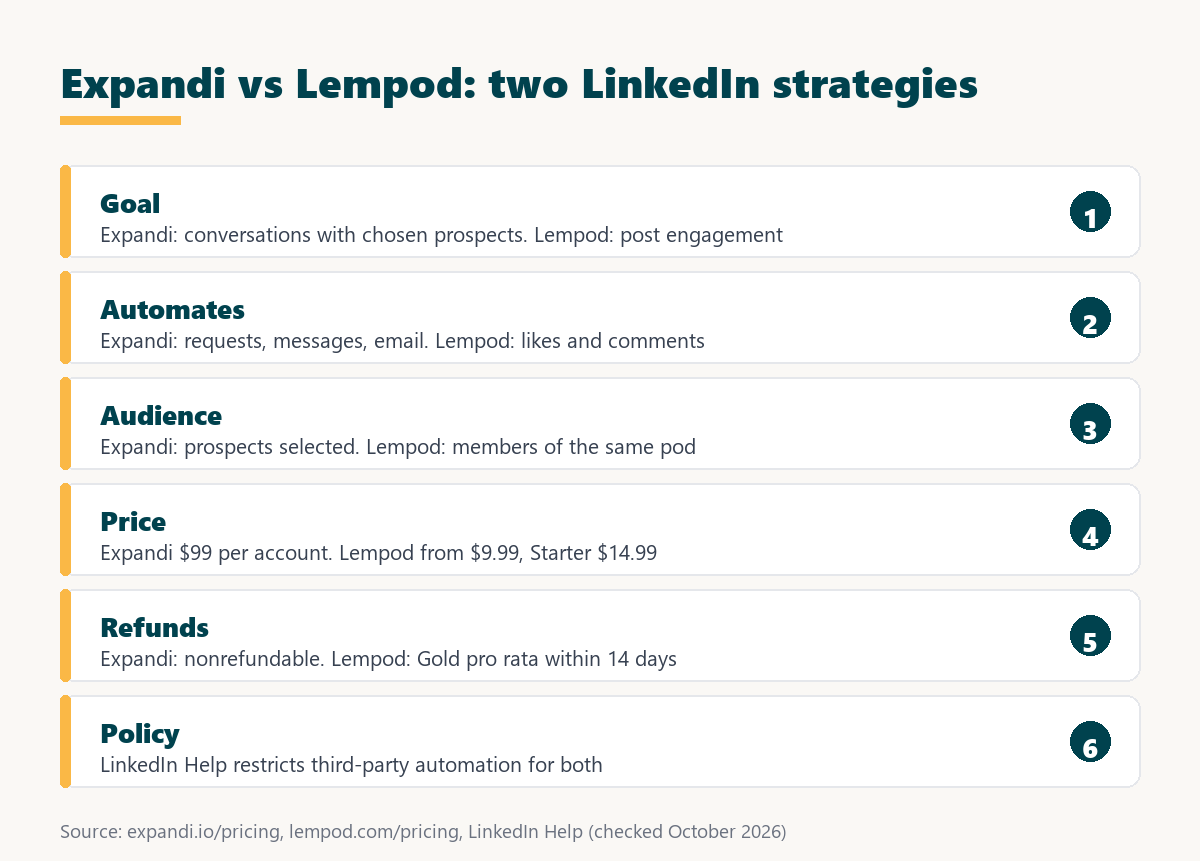
Source: expandi.io/pricing, Expandi Terms, checked October 2026; lempod.com and lempod.com/pricing, checked October 2, 2026.
The table shows two tools with separate goals, audiences, and billing units, sharing only the fact that both automate activity on a LinkedIn account.
Because almost nothing lines up, the comparison is a strategy decision first and a vendor decision second.
How Much Does Expandi Cost per LinkedIn Account?
Expandi costs $99 per LinkedIn account per month, or $79 per account per month when billed annually, which is a 20% saving. Every account receives the same Business feature set, and the seven-day trial applies only to the first subscription created on a user account.
There is no permanently free tier. Checkout asks for card details, and the Expandi FAQ says no charge is made until the seven days are up. Taxes are added by billing country, and agencies with ten or more accounts can request a custom Agency quote.
Expandi’s single rate covers the whole outbound feature set, so the cost question is how many LinkedIn accounts a founder actually needs to run.
How Much Does Lempod Cost?
Lempod pricing is a ladder of monthly plans that bundle credits and engagements, shown before tax. Lite costs $9.99, Starter costs $14.99 with 550 engagements, Essential costs $29.99 with 1,350, Growth costs $72.99 with 3,000, and Pro costs $134.99 with 5,600 engagements per month.
- Lite tier: costs $9.99 per month excluding tax and is labeled for experienced users only, with no engagement count shown for this tier.
- Starter tier: costs $14.99 per month with 100 Lempod Gold, 500 free Lempod Silver, and 550 engagements, described as suited to one small pod.
- Essential tier: costs $29.99 per month with 200 Lempod Gold, 3,500 free Lempod Silver, and 1,350 engagements included each month.
- Growth tier: costs $72.99 per month with 500 Lempod Gold, 5,000 free Lempod Silver, and 3,000 engagements included each month.
- Pro tier: costs $134.99 per month with 800 Lempod Gold, 16,000 free Lempod Silver, and 5,600 engagements, with an Agency tier above it at $149.99.
Credit bundles behave differently from a flat seat fee, a model explained in the guide to credit-based pricing. Lempod lists higher tiers above Agency as well; this comparison stops at Agency because those tiers serve volumes no single founder needs.
Lempod’s entry tiers cost a fraction of one Expandi account, which suits founders testing whether engagement on posts moves their pipeline at all.
How Do the Prices Compare Side by Side?
Expandi costs $99 per LinkedIn account per month, while Lempod tiers run from $14.99 for Starter to $134.99 for Pro. A founder therefore pays less for Lempod on its three lowest tiers with engagement counts and more than Expandi only from the Pro tier upward.
Source: expandi.io/pricing, checked October 2026; lempod.com/pricing, checked October 2, 2026. Lempod prices are listed excluding tax; Expandi taxes vary by billing country. Prices are not converted to a common unit because the two tools buy different outputs.
Lempod is cheaper than Expandi on its Starter, Essential, and Growth tiers, yet the two prices buy different things, so the figures cannot be compared like for like.
Price only matters after the strategy is chosen, because a cheap tool aimed at the wrong goal still costs more than it returns.
What Does LinkedIn Say About Automation Tools?
LinkedIn policy is the rule set that governs third-party tools on the platform. LinkedIn Help states that it does not permit third-party software, including bots and browser extensions, that automates activity on its website, and that members using such tools risk having accounts restricted or shut down.
The relevant LinkedIn Help page says members who use such tools “risk having their accounts restricted or shut down” (LinkedIn Help, prohibited software and extensions). The statement covers third-party automation in general. It applies to outbound automation and automated engagement alike, and LinkedIn Help does not single out engagement pods in the passage quoted here.
Expandi’s safety features, such as the dedicated IP and the warm-up ramp, are designed to keep activity looking ordinary; they do not change LinkedIn’s policy. No tool can promise an account will never be restricted, and this page makes no such claim for either product.
The policy risk sits with the account owner whichever tool is used, so a founder should choose one strategy deliberately rather than layering automation on a profile.
How Do Trials and Refunds Differ?
Trials and refunds are the terms that limit what a buyer can lose. Expandi offers a seven-day trial and states that subscription fees are nonrefundable, while Lempod refunds unused Lempod Gold on a prorated basis within fourteen days of a top-up and does not refund Silver or Points.
Expandi’s Terms put it plainly: “Unless required by law, the subscription fees are nonrefundable.” Lempod’s pages reviewed for this comparison do not mention a trial, so a founder testing Lempod would start on a low-cost tier instead. The SaaS free trial guide covers how to make a short evaluation count.
Expandi limits risk with a trial and Lempod limits risk with partial refunds on Gold, so each tool’s cheapest test looks different.
Which Founders Fit Expandi Best?
Expandi fits founders who need meetings with a defined list of prospects. A founder selling to a clear customer profile gains more from messages sent to those exact people than from extra reactions on posts, especially when the sales cycle depends on direct conversations with decision makers.
- Founder-led sales: founders who close deals personally need replies from named decision makers rather than broad visibility among other pod members.
- Defined ICP lists: a founder with a list of target companies and roles can load it into a campaign and contact exactly those people.
- Low posting frequency: founders who post rarely give a pod little to work with, while outbound runs whether or not new content exists.
- Multichannel sellers: sequences that mix LinkedIn steps with email follow-ups suit founders whose prospects answer on different channels at different times.
- Pipeline-measured teams: teams that report on replies and booked meetings get metrics from outbound that map directly onto the sales pipeline.
The common thread is a known audience: these founders already know who they want to talk to and need a tool that reaches those people directly.
Want replies from the prospects on a target list? Connect one LinkedIn account and run the seven-day trial.
Try Expandi for 7 Days →No charge until the seven days are up · taxes added by billing country
When Is Lempod the Better Pick?
Lempod is the better pick when a founder already posts regularly and wants more likes and comments on that content. Plans start at $9.99 per month, engagement counts are published for each tier, and the tool needs no prospect list or message sequence to begin.
- Regular posters: founders who publish several posts a week have content for pod members to like and comment on, which is what the tool is built for.
- Content-first strategies: a growth plan built around thought leadership posts benefits from engagement tools more than from outbound message sequences.
- Small budgets: the Starter tier costs $14.99 per month with 550 engagements, a small fraction of the price of one Expandi account.
- Creators without a prospect list: Lempod needs no target list or message copy, so it suits founders who have not yet defined an ideal customer profile.
- Teams testing engagement pods: low-priced tiers allow a short test of whether pod activity changes anything that matters before spending more.
HubSpot’s guide to social selling on LinkedIn sums up why engagement draws founders in the first place:
“Engagement is LinkedIn’s currency.”
HubSpot, LinkedIn for Social Selling
Saying plainly where Lempod wins keeps the comparison honest, because a founder whose strategy is content needs engagement tools rather than outbound sequences.
Can a Founder Use Expandi and Lempod Together?
Using both tools together is possible because they act on different parts of LinkedIn. One runs outbound sequences and the other adds engagement to posts, but the combination stacks two kinds of automated activity on a single profile, which raises the exposure LinkedIn policy describes.
This page does not recommend running both on one account. A founder who wants both outcomes can start with the strategy that matches the main goal, measure it for a month, and add the second only with a clear reason. Expandi’s own engagement actions, such as profile visits and post likes between follow-ups, already add light activity inside an outbound sequence.
Combining tools doubles the automated footprint on one profile, so the safer path is one strategy at a time with results measured before adding the second.
How Should a Founder Decide Between the Two?
A decision between the two tools is a short check of goals before any purchase. A founder should name the outcome wanted, count how often posts go out, check whether a prospect list exists, and then test the matching tool at its smallest commitment.
- Name the outcome: writing down whether the goal is booked conversations or post engagement points to one tool immediately and removes most of the comparison.
- Count weekly posts: a founder posting less than once a week has little for a pod to amplify, which shifts the choice toward outbound.
- Check for a prospect list: a defined list of target accounts and roles is the raw material outbound needs, and building one comes before any campaign.
- Test at the smallest commitment: the matching tool should be tried on the seven-day Expandi trial or a low Lempod tier before any larger spend.
- Read the terms first: LinkedIn’s policy on automation and each vendor’s refund terms should be read before the first payment, since neither refund policy is generous.
A five-minute goal check prevents the most common mistake in this comparison, which is buying the cheaper tool for a goal it was never designed to serve.
Verdict: Outbound Outreach or Engagement Pods?
The verdict is that Expandi suits founders who need direct conversations with selected prospects, and Lempod suits founders who want more engagement on posts they already publish. The tools are not substitutes, so the right choice follows from the growth strategy rather than from the price list.
“Higher response odds: a prospect who skips one may answer another.”
Growth Hack Suite, What Is Multichannel Outreach?
That logic favors outbound for founders with a prospect list, because a sequence reaches the same person through more than one touch instead of waiting for them to see a post.
Most founders can decide by naming the outcome they need this quarter, then testing the matching tool at its smallest commitment before scaling.
Expandi vs Lempod: Frequently Asked Questions
The 12 most-asked questions about Expandi vs Lempod.
Is Expandi better than Lempod?
They serve different goals. Expandi automates outbound messages to chosen prospects, while Lempod automates likes and comments on posts through engagement pods.
What is Lempod?
Lempod is a LinkedIn engagement pod tool. Its site says members join groups whose other members can automatically like and comment on their posts.
What is a LinkedIn engagement pod?
An engagement pod is a group of members who agree to like and comment on each other’s posts to increase visible activity on that content.
How much does Expandi cost per account?
Expandi costs $99 per LinkedIn account per month on monthly billing, or $79 per account per month when billed annually.
How much does Lempod cost?
Lempod starts at $9.99 per month on Lite. Starter costs $14.99 with 550 engagements and Pro costs $134.99 with 5,600, all excluding tax.
Does Lempod send messages to prospects?
No. Lempod automates likes and comments within engagement groups; it does not run connection request or message sequences.
Does Expandi boost post engagement?
Not as its main job. Expandi runs outbound sequences, though it can add engagement actions such as post likes between follow-up steps.
Does LinkedIn allow automation tools?
LinkedIn Help states that it does not permit third-party software that automates activity on its site, and that members using such tools risk restrictions.
Does Lempod have a trial?
The Lempod pages reviewed for this comparison do not mention a trial, so the lowest-priced tier is the practical way to test it.
Can Lempod credits be refunded?
Lempod Gold can be refunded pro rata within fourteen days of a top-up, minus what was used. Lempod Silver and Points are non-refundable.
Can Expandi fees be refunded?
No. Expandi’s Terms state that subscription fees are nonrefundable unless the law requires otherwise.
Can a founder use both tools together?
It is possible, but it stacks two kinds of automated activity on one profile. Starting with one strategy and measuring results is the safer path.
Need conversations with a defined prospect list? Start the seven-day Expandi trial on one LinkedIn account.
Start Your 7-Day Expandi Trial →Seven-day trial on the first subscription · cancel anytime · paid fees are nonrefundable
Growth Hack Suite Editorial, Outbound Sales Team
How we compared: Expandi figures come from expandi.io pricing, FAQ, and Terms, and from Expandi’s published platform data. Lempod figures come from lempod.com and lempod.com/pricing, read on October 2, 2026. LinkedIn’s position comes from LinkedIn Help. Because the two tools buy different outputs, prices are not converted to a common unit. No test campaigns were run for this page.
Last checked: October 2026. When either vendor changes its prices, this page is updated first.
Affiliate disclosure: this page contains affiliate links to Expandi. If a subscription is purchased through them, Growth Hack Suite may earn a commission at no extra cost to the buyer. Lempod links are not affiliate links.