Table of Contents
Expandi vs Hunter io is a comparison of two steps in one prospecting workflow. Expandi reaches prospects through LinkedIn campaigns at $99 per LinkedIn account per month, with warm-up and a dedicated IP. Hunter.io finds and verifies business email addresses on a credit model, with a Free tier of 50 credits a month and paid plans from $34 a month billed yearly.
Last checked: October 2026. Expandi figures come from expandi.io pricing, FAQ, Terms, and help center; Hunter.io figures come from hunter.io/pricing and the Hunter help center, re-checked on October 8, 2026. Prices change, so confirm both pages before buying.
Prospect list ready and LinkedIn is where buyers reply? Test Expandi on one account for seven days.
Start Your 7-Day Expandi Trial →Seven-day trial on the first subscription · dedicated country-based IP for each account · cancel anytime
Expandi vs Hunter io: Which One Does a Sales Team Need First?
Expandi vs Hunter.io is a decision about which gap blocks the pipeline today. Expandi fits teams that know who to contact and need LinkedIn outreach running safely, while Hunter.io fits teams that know which companies to target but lack verified email addresses for the people inside them.
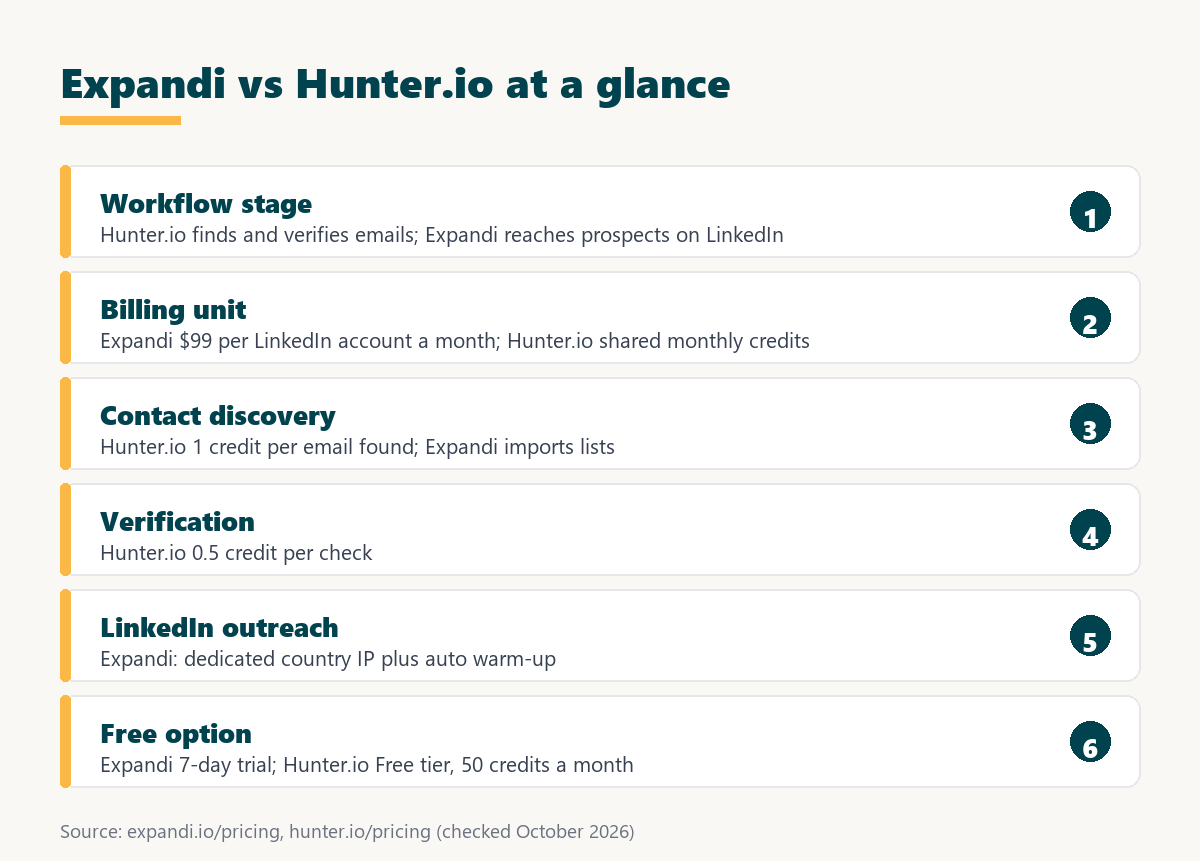
These tools are rarely true rivals. Hunter.io answers the question of how to contact a person by email, and Expandi answers the question of how to start a conversation on LinkedIn. A sales manager comparing them is usually deciding which step of prospecting to fund first with a limited budget.
There is one area of overlap worth knowing about. Hunter.io’s paid plans also connect email accounts for sending sequences, so it covers finding addresses and sending email, while Expandi covers LinkedIn plus email steps inside its campaigns. Neither replaces the other’s core job.
Teams missing contact data should start with Hunter.io, and teams with a list in hand that need LinkedIn conversations should start with Expandi.
What Is the Core Difference Between Reaching Prospects and Finding Their Emails?
Reaching prospects is the act of starting a conversation through a channel such as LinkedIn or email. Finding emails is the act of discovering and verifying the address needed before any email is sent. Expandi performs the first job on LinkedIn, and Hunter.io performs the second job for email.
Five traits separate the two jobs:
- Workflow stage: Hunter.io sits at the data stage of prospecting, while Expandi sits at the engagement stage that follows once a target list exists.
- Output: Hunter.io produces a list of found and verified email addresses, while Expandi produces accepted connections, replies, and LinkedIn conversations.
- Input needed: Hunter.io starts from a company domain or a person’s name, while Expandi starts from LinkedIn profile URLs or a Sales Navigator search.
- Billing unit: Hunter.io bills in credits shared by the whole team, while Expandi bills for each connected LinkedIn account that sends outreach.
- Channel: Hunter.io serves email outreach, while Expandi serves LinkedIn outreach with email available as an extra step inside a campaign.
Wikipedia’s definition of the broader activity both tools support is a useful anchor:
“the process of attracting and capturing consumer interest in a product or service”
Wikipedia, Lead generation
The finding step is explained in the guide to what an email finder is and how it works, and the reaching step in the guide to cold outreach for small teams.
Finding and reaching are consecutive steps, so the comparison is less about which tool wins and more about which step is currently broken.
What Does Expandi Do?
Expandi is a cloud-based LinkedIn automation platform that runs connection requests, messages, InMail campaign types, and email steps inside one sequence builder. Each connected account receives a dedicated country-based IP and an automatic warm-up, and lead lists arrive through CSV files or Sales Navigator URLs.
- Campaign types: the help center lists Connector, Mobile Connector, Messenger, Open InMail, Group, Event Invite, Company Follow Invite, and Inbound campaigns ready to configure.
- Sequence builder: an If/Action builder adds conditions between steps, so a follow-up only fires after a connection is accepted or a set delay passes.
- Profile auto warm-up: the gradual option starts at 5 actions per day and adds 3 more every two days until it reaches a ceiling of 21 daily actions.
- Dedicated country-based IP: Expandi states that every user gets a personal dedicated IP address, assigned from the country chosen when the account is connected.
- Campaign limits: the help center caps one campaign at 5,000 leads and allows 15 active campaigns at a time, with up to 500 campaigns per account.
The limit figures come from Expandi’s campaign limitations article and the ramp from its account warm-up guide. Sales Navigator lists import up to 2,500 people at once per list, a limit Expandi attributes to LinkedIn.
Expandi assumes the list already exists, which is exactly why it pairs with a data tool rather than competing with one.
What Does Hunter.io Do?
Hunter.io is an email finding and verification platform that returns business email addresses for a company domain or a named person. Each found email costs one credit, each verification costs half a credit, and failed lookups cost nothing. Paid plans also connect email accounts for sending sequences.
- Domain Search: Hunter.io lists the email addresses found for a company domain and charges one credit for each address the search returns.
- Email Finder: a name plus a company domain returns the most likely address for one person, again at one credit per email found.
- Email Verifier: each verification costs half a credit, and a result returned as Unknown is not charged, according to Hunter’s credit rules.
- Connected email accounts: plans connect 1, 3, 10, or 20 email accounts by tier, which Hunter uses to send its own email sequences.
- Unlimited team members: every Hunter tier allows unlimited members, all drawing from one shared pool of credits included in the plan.
Hunter’s credits article adds that repeated searches for the same email are counted once per calendar month, and that lookups returning no result use no credits.
Hunter.io is a data and email tool, and its pricing page lists no LinkedIn automation, so a team still needs a separate tool for LinkedIn outreach.
How Does Expandi Pricing Work?
Expandi pricing is a per-account model where each connected LinkedIn profile costs $99 per month, or $79 per account per month when billed annually. Every account gets the full Business feature set, and teams running ten or more accounts move to an Agency tier priced by custom quote.
Expandi’s FAQ states the rate without qualification:
“Expandi costs 99 USD per account per month.”
Expandi FAQ
Taxes are added by billing country, the personalization add-ons carry no listed price, and the Terms state that subscription fees are nonrefundable unless required by law (Expandi Terms and Conditions).
Each new rep who sends on LinkedIn adds one account to the Expandi bill, so cost tracks headcount on the sending side.
How Does Hunter.io Pricing Work?
Hunter.io pricing is a credit model where plans bundle monthly credits shared by the whole team. The Free tier includes 50 credits a month, Starter costs $34 a month billed yearly for 2,000 credits, Growth costs $104 for 10,000 credits, and Scale costs $209 for 25,000 credits.
Billed monthly, the same plans cost $49, $149, and $299, and Enterprise is custom. Hunter’s yearly billing is about 30% cheaper than paying month to month.
Source: expandi.io/pricing and expandi.io/faq, checked October 2026; hunter.io/pricing, re-checked October 8, 2026.
Expandi charges per LinkedIn account with no usage meter, while Hunter.io charges per credit bundle with unlimited team members, so one bill scales with senders and the other with lookups.
Hunter’s pricing page explains how teams share those credits:
“You can invite as many team members as you’d like at no extra cost.”
Hunter.io pricing FAQ
Hunter.io’s bill grows only when the team looks up more contacts, which makes it cheap for large teams that prospect selectively.
How Do Expandi and Hunter.io Compare Feature by Feature?
Expandi and Hunter.io compare as an outreach engine against a contact data tool. Expandi covers LinkedIn sending, warm-up, IP assignment, and campaign statistics, while Hunter.io covers domain search, email finding, verification, and email sequences from connected mailboxes, with little direct overlap between the two feature sets.
Source: expandi.io/pricing and Expandi help center, checked October 2026; hunter.io/pricing and Hunter help center, re-checked October 8, 2026.
The feature table shows Hunter.io owning contact discovery and verification, Expandi owning LinkedIn outreach and account safety, and both offering some form of email sending.
The overlap on email sending is real but narrow, since Expandi treats email as a follow-up step while Hunter.io builds sequences around the addresses it finds.
How Do the Billing Units Change Team Cost?
A billing unit is the thing a vendor counts when it calculates the invoice. Expandi counts LinkedIn accounts, so cost follows the number of reps sending outreach. Hunter.io counts credits and allows unlimited team members, so cost follows how many contacts the team looks up each month.
A five-rep team that sends LinkedIn outreach from every profile pays for five Expandi accounts, or $495 a month at list on monthly billing. The same five reps can share one Hunter.io Growth plan with 10,000 credits for $104 a month billed yearly, because Hunter does not charge for extra members. How per-seat pricing works in general is covered in the guide to SaaS seat licenses, and credit models in the guide to credit-based pricing.
Adding a rep raises the Expandi bill by one account but leaves the Hunter.io bill unchanged until the shared credit pool runs out, which shapes how each tool scales.
Where Does Each Tool Sit in a Prospecting Workflow?
A prospecting workflow is the ordered set of steps that turns a target account list into booked conversations. Hunter.io works at the start, supplying and verifying contact details, and Expandi works after it, running the LinkedIn touches and follow-ups that open the conversation.
- Account selection: a defined list of target companies gives both tools the same starting point and keeps credits and invitations focused on real buyers.
- Contact discovery: Hunter.io Domain Search returns the addresses it finds for each company domain, at one credit per email found.
- Verification: each address is checked by Hunter.io’s verifier at half a credit, which removes risky addresses before any email step is sent.
- LinkedIn engagement: Expandi sends connection requests and messages to the same people from a warmed-up account inside its limit ranges.
- Email follow-up: an email step inside the Expandi campaign, or a Hunter.io sequence, reaches prospects who did not accept on LinkedIn.
How to build the list that starts this workflow is covered in the guide to cold email list building.
Data comes first and conversations come second, so a team that skips the finding step often ends up with campaigns that cannot reach anyone by email.
How Do the Free Options Differ?
A free option is a way to test a tool before paying. Expandi offers a seven-day trial that applies only to the first subscription. Hunter.io offers a permanent Free tier with 50 credits a month and one connected email account, which works as an ongoing test without a deadline.
Expandi’s checkout asks for card details, and its FAQ says no charge is made until the seven days are up. Hunter’s Free tier never expires but stays small, enough to test data quality on a few dozen contacts each month. The difference between these two models is explained in the SaaS free trial guide.
The Hunter.io Free tier suits slow, ongoing data checks, while the Expandi week needs a prepared list and message so warm-up and a first campaign fit inside it.
Contacts found and ready for a first touch? Connect one LinkedIn account and run the seven-day Expandi trial.
Try Expandi for 7 Days →Checkout asks for card details · no charge until the seven days are up
Can Expandi and Hunter.io Work Together?
Expandi and Hunter.io can work together as the data stage and the outreach stage of one pipeline. Hunter.io finds and verifies addresses for target accounts, and Expandi imports the list as a CSV file to run LinkedIn touches with email steps as a second channel.
- Verified email column: a CSV exported from Hunter.io adds a checked address to each lead before the list enters an Expandi campaign as a lead list.
- LinkedIn first touch: Expandi opens with a connection request, which makes the rep’s name familiar before any email reaches the inbox.
- Email fallback: an email step reaches prospects who never accept the request, using the verified address from the Hunter.io column.
- Shared suppression list: the Expandi blacklist and the email tool’s exclusion list hold the same opt-outs, so nobody is contacted after declining.
- Reply webhooks: Expandi fires events such as contact replied to a CRM, which stops other sequences from continuing for that prospect.
The webhook events are documented in Expandi’s webhooks and integrations section, and the coordination idea is covered in the guide to multichannel outreach.
Using both tools turns two partial workflows into one complete one, at the cost of two bills and a CSV handoff between them.
When Is Hunter.io the Better Pick?
Hunter.io is the better pick when the team lacks contact data or plans to lead with email. Teams that need verified addresses, want to test at no cost on the Free tier, and prefer a bill that ignores headcount get more from Hunter.io first.
- Email-first outreach: teams sending cold email need found and verified addresses before any sequence can start, which makes data the first purchase.
- List verification projects: cleaning an existing list costs half a credit per address, which is far cheaper than bouncing emails from a sender domain.
- Zero-budget testing: the Free tier includes 50 credits a month with no deadline, enough to judge data quality before any spend.
- Large teams sharing data: unlimited members on every tier let a whole sales floor share one credit pool without paying for each person.
- Prospects inactive on LinkedIn: buyers who rarely check LinkedIn are easier to reach by email, which favors a finder over a LinkedIn tool.
Naming where Hunter.io wins keeps the comparison honest, since a team without contact data would get little from a LinkedIn tool’s email steps.
When Is Expandi the Better Pick?
Expandi is the better pick when the team already has a prospect list and needs conversations on LinkedIn. Managers who want campaigns, warm-up, and a dedicated IP for each rep account get an outreach engine that a contact data tool does not replace.
According to Expandi’s platform data from May 2025 to April 2026, 28.5% of connection requests were accepted and 10.4% of outbound messages received a reply, figures from one vendor rather than a LinkedIn standard. Expandi holds 4.3 out of 5 from 162 reviews on G2, checked October 2, 2026. LinkedIn’s own help center still says third-party automation is not permitted, so the safety settings reduce risk rather than remove it.
Expandi earns its fee when the list is ready and the constraint is opening conversations, which is where most SDR teams feel the pressure.
How Should an SDR Team Test Both Before Paying?
A side-by-side test is a short run that moves one target segment through both tools in order. Starting on the Hunter.io Free tier and then using the Expandi trial week shows data quality and reply behavior before Expandi fees become nonrefundable.
- Choose one segment: a single industry and job title keeps the sample small enough for the 50 monthly credits on the Hunter.io Free tier.
- Find and verify addresses: the Free tier finds and checks addresses for the segment, showing how many contacts come back usable.
- Export the CSV: the verified list leaves Hunter.io as a CSV with LinkedIn profile URLs added for each contact in the segment.
- Run the Expandi week: the seven-day Expandi trial on one connected account imports the list and runs a short Connector sequence.
- Compare results: found addresses, acceptance, and replies are recorded for the segment before any paid plan is chosen on either side.
A two-stage test shows whether the bottleneck is data or conversations, which matters because Expandi states that subscription fees are nonrefundable once paid.
Verdict: Which Tool Should a Sales Team Choose?
The verdict is that Hunter.io wins when contact data is the gap and Expandi wins when LinkedIn conversations are the gap. The tools serve consecutive steps of prospecting, so most outbound teams eventually budget for both instead of treating them as rivals.
Growth Hack Suite’s email finder guide makes the order of operations clear:
“Finding emails is only the first step. Verifying them before sending protects your domain from bounce damage.”
Growth Hack Suite, What Is an Email Finder?
Most teams can decide by asking whether they lack addresses or replies today, then funding that step first and adding the other later.
Which Related Tools Complete This Prospecting Stack?
Related tools are the products that sit beside a LinkedIn outreach tool and an email finder in a prospecting stack. A full Hunter.io review covers accuracy and credits in depth, a pricing guide breaks down its plans, and a cold email platform handles higher email volume.
- Hunter.io: accuracy, credits, and workflow in depth, in the complete Hunter.io email finder review.
- Hunter.io plans: every tier and credit allowance explained, in the Hunter.io pricing guide.
- Smartlead: cold email infrastructure for volume beyond a few mailboxes, in the Smartlead review.
These related tools extend the stack rather than replace either option, and each has its own review for teams that need more depth on that piece.
Expandi vs Hunter.io: Frequently Asked Questions
The 12 most-asked questions about Expandi vs Hunter.io.
Is Expandi better than Hunter.io?
They do different jobs. Expandi is better for reaching prospects on LinkedIn, and Hunter.io is better for finding and verifying business email addresses. Most outbound teams use a tool from each category.
What is the difference between Expandi and Hunter.io?
Expandi is a cloud LinkedIn automation platform for connection requests, messages, and email steps. Hunter.io is an email finding and verification platform that also sends sequences from connected email accounts.
Does Hunter.io automate LinkedIn?
No LinkedIn automation is listed on the Hunter.io pricing page. It works with company domains, names, and email addresses.
Does Expandi find email addresses?
Expandi is not an email finder. It imports lead lists through CSV files and Sales Navigator URLs and then runs outreach, so addresses usually come from a separate data tool.
How much does Expandi cost per account?
Expandi costs $99 per connected LinkedIn account per month, or $79 per account per month billed annually. Ten or more accounts move to a custom Agency quote.
How much does Hunter.io cost?
Hunter.io has a Free tier with 50 credits a month. Paid plans start at $34 a month billed yearly for Starter, or $49 billed monthly, with Growth and Scale above it.
What is a Hunter.io credit?
One credit covers one email found, and a verification uses half a credit. Lookups that return nothing use no credits.
Does Hunter.io charge for each user?
No. Hunter.io includes unlimited team members on every plan, and everyone shares the same pool of credits.
How long is the Expandi trial?
Seven days, limited to the first subscription. Checkout asks for card details, and Expandi says no charge is made until the seven days are up.
Is the Hunter.io Free tier time-limited?
No. The Free tier is permanent and includes 50 credits a month and one connected email account.
Can Expandi and Hunter.io be used together?
Yes. Hunter.io finds and verifies addresses, the list is exported as a CSV, and Expandi imports it to run LinkedIn touches with email steps as a second channel.
Which tool should a team buy first?
The one that fixes the current gap. Teams without contact data should start with Hunter.io, and teams with a ready list that need LinkedIn conversations should start with Expandi.
Contact list verified and LinkedIn is the next step? Start the seven-day Expandi trial on one LinkedIn account.
Start Your 7-Day Expandi Trial →Seven-day trial on the first subscription · cancel anytime · paid fees are nonrefundable
Growth Hack Suite Editorial, Outbound Sales Team
How we compared: every Expandi figure was read from expandi.io pricing, FAQ, and Terms and from the Expandi help center articles on campaign limits, warm-up, IP addresses, and Sales Navigator lists. Hunter.io figures were read from hunter.io/pricing and the Hunter help center, re-checked on October 8, 2026. Team-cost examples are calculated from list prices and marked as such.
Last checked: October 2026. When either vendor changes its prices or product, this page is updated first.
Affiliate disclosure: Growth Hack Suite has affiliate relationships with both Expandi and Hunter.io. This page links to Expandi through an affiliate link; if a subscription is purchased through it, Growth Hack Suite may earn a commission at no extra cost to the buyer. The assessment does not change either way.