
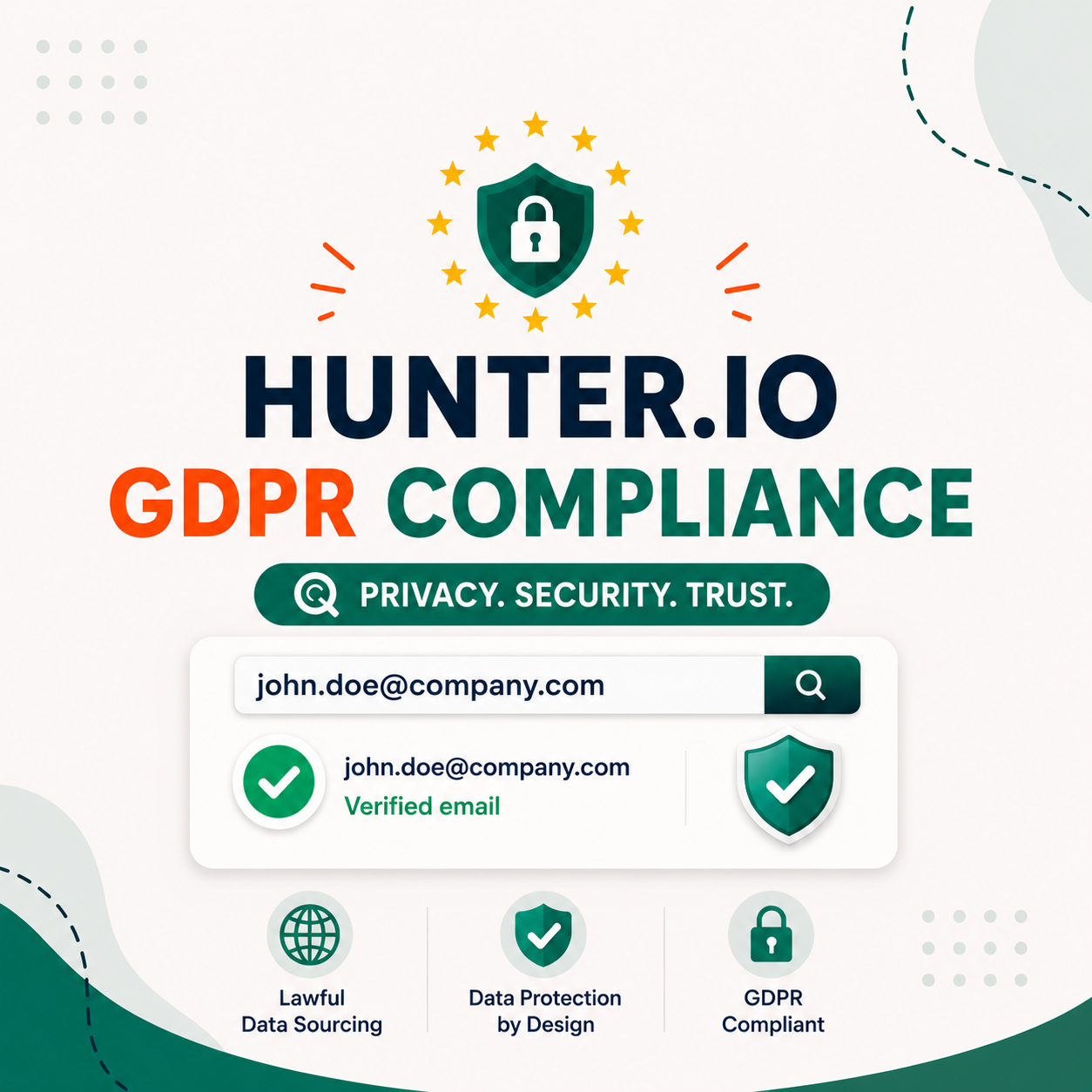
Is Hunter.io legal to use for B2B cold email? Yes : Hunter.io sources email addresses exclusively from publicly available business websites and operates in compliance with GDPR, CAN-SPAM, and CASL requirements. Compliance, however, is shared: Hunter.io handles data sourcing; you as the sender are responsible for your email content, opt-out mechanism, and documentation. Both US CAN-SPAM and EU GDPR allow B2B cold email with different conditions.
Table of Contents
Hunter.io Is Legal for Cold Outreach : With One Important Condition
Yes : with conditions that depend on your location and how you use the tool. Hunter.io’s data sourcing is GDPR-compliant: the platform collects business email addresses from publicly available websites, not private inboxes or scraped social profiles. Whether your cold outreach is legal depends on two distinct layers : what the tool does (Hunter’s responsibility) and what you send and how you send it (your responsibility as the sender).
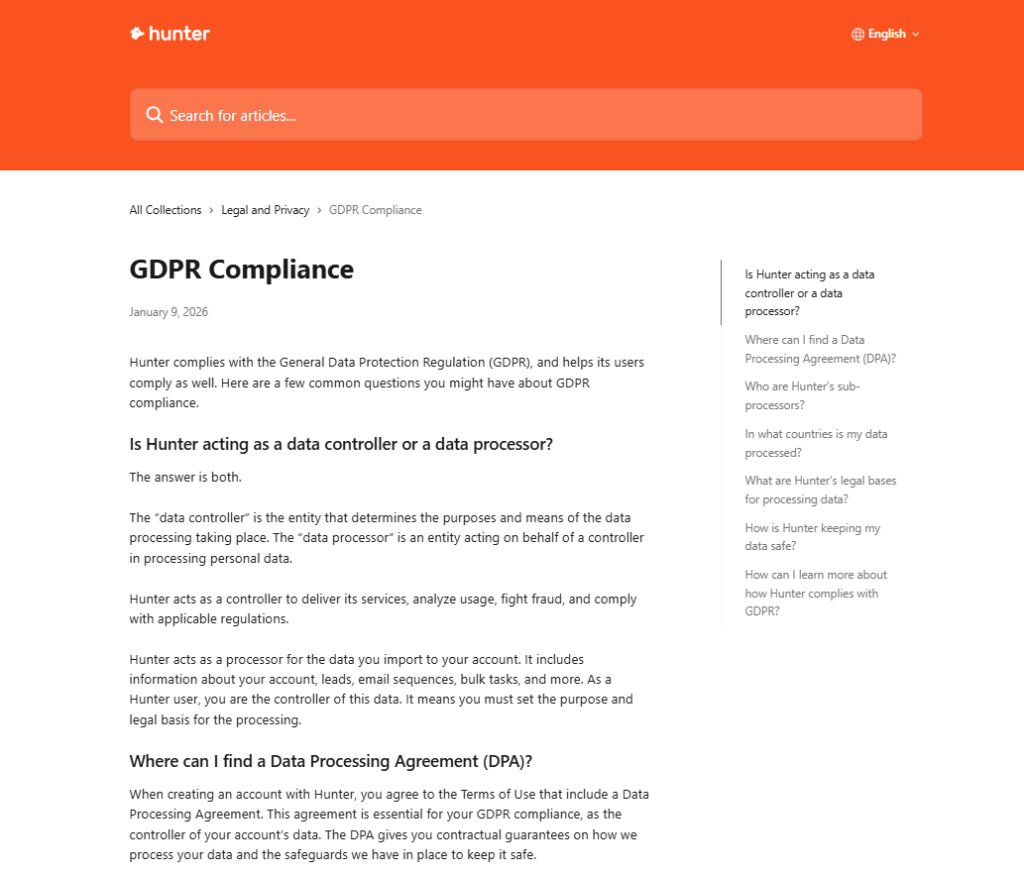
The most important concept for cold email legality is shared compliance. Hunter.io controls the data collection layer. You control the sending layer. Regulators : both the EU’s data protection authorities under GDPR and the US Federal Trade Commission under CAN-SPAM : will hold you, the sender, accountable for how you communicate with contacts, regardless of which tool you used to find their email addresses. Using a compliant tool does not automatically make your outreach compliant.
Shared Compliance: Who Is Responsible for What
For a complete review of how Hunter.io collects and verifies emails from public sources, see our Hunter.io Email Finder review. Understanding the tool’s sourcing mechanism is the foundation for understanding where compliance responsibility lies.
The short answer is yes : Hunter.io is a legal tool for cold outreach in both the US and EU when you pair it with compliant sending practices. The rest of this guide explains exactly what those practices look like under each legal framework.
Is Hunter.io Legal Under CAN-SPAM? Yes : If Your Emails Meet These 7 Requirements
The CAN-SPAM Act (2003) is relatively permissive by global standards : it does not require prior consent before sending commercial email. Cold outreach to US contacts is legal under CAN-SPAM as long as your emails meet seven specific requirements. Violating any one of them exposes you to fines of up to $50,000 per violation per email, enforced by the FTC. The good news: meeting all seven requirements is straightforward with any professional email outreach workflow.
CAN-SPAM’s permissive approach to B2B cold email is intentional : US law distinguishes between spam (deceptive, unsolicited mass email) and legitimate commercial communication. Meeting all seven requirements turns a cold email into a legally protected commercial message under US law. For guidance on building high-deliverability cold campaigns, see our Hunter.io cold email guide.
CAN-SPAM compliance is achievable with standard email outreach tools : every major cold email platform supports the required footer, physical address, and unsubscribe link. The FTC primarily pursues egregious violations: deceptive headers, fake opt-out links, and senders who ignore unsubscribe requests.
Is Hunter.io Legal Under GDPR? Yes : When You Document Legitimate Interest and Include an Opt-Out
GDPR is stricter than CAN-SPAM but does not prohibit B2B cold email. Under Article 6(1)(f), legitimate interest is the lawful basis most cold email senders rely on : no prior opt-in consent required. Three conditions apply: your offer must be relevant to the recipient’s professional role, you must document a balancing test in writing, and recipients must be able to object easily.
- Legitimate Interest (Article 6(1)(f)). B2B cold email to a business contact about a work-relevant offer typically passes the GDPR balancing test : the sender’s commercial interest is weighed against the recipient’s right to privacy. The test must be documented in writing before the campaign runs, not after a complaint arrives. Sending to personal email addresses (Gmail, Hotmail) is significantly harder to justify under this basis.
- Right to Object (Article 21). Every cold email to an EU contact must include a clear, easy opt-out. Recipients have an unconditional right to object to processing under legitimate interest, and you must honor that request immediately : there is no 10-day grace period as under CAN-SPAM. Continuing to contact someone after they object is a direct GDPR violation.
- Data Retention Limitation (Article 5(1)(e)). You may only keep contact data as long as it remains necessary for the purpose it was collected. For cold outreach, this typically means deleting contacts who have not engaged within 6–12 months of your last campaign. There is no fixed retention period in GDPR : the principle is “no longer than necessary.”
“As detailed in our Hunter.io full review, the platform’s data sourcing relies entirely on publicly available business websites : never private mailboxes, personal accounts, or scraped social profiles. This source restriction is what makes legitimate interest a more defensible legal basis under GDPR for B2B outreach using Hunter.io data.”
: Hunter.io Email Finder Review 2026, Growth Hack Suite
“Legitimate interests can be relied upon as a lawful basis where the processing is necessary for the purposes of the legitimate interests pursued by the controller or by a third party, except where such interests are overridden by the interests or fundamental rights of the data subject.”
: GDPR Article 6 : Lawfulness of Processing, gdpr.eu
“The GDPR applies to the processing of personal data of data subjects who are in the European Union, regardless of whether the processing takes place in the EU.”
: General Data Protection Regulation, Wikipedia
The extraterritorial scope of GDPR is its most significant feature for outreach teams outside Europe: if you are emailing contacts who are EU residents, GDPR applies to you regardless of where your company is based. This means a US company using Hunter.io to email prospects in Germany or France must still meet GDPR’s conditions : not just CAN-SPAM.
How Hunter.io Stays Legal: Public-Source-Only Data Collection Explained
Hunter.io’s compliance approach rests on one foundational principle: collect only what is publicly shared by the data subject themselves. The platform crawls publicly accessible business websites : company team pages, press releases, professional directories : and does not access private inboxes, personal social profiles, or any non-public data source. This sourcing restriction is what makes Hunter.io’s data collection defensible under GDPR’s legitimate interest framework for B2B email addresses.
Beyond data sourcing, Hunter.io maintains a Trust Center at hunter.io/trust detailing its data collection practices, privacy policy, and legal basis documentation. Paid customers (Starter plan and above) can request a Data Processing Agreement (DPA) : required under GDPR Article 28 when Hunter.io acts as a Data Processor on your behalf. For teams with active EU-facing campaigns, having a DPA in place with Hunter.io is part of a complete compliance posture.
Hunter.io’s approach : public-only sourcing, transparent data practices, and DPA availability : puts it ahead of many data broker alternatives that aggregate from less defensible sources. The platform’s compliance architecture is built to hold up under GDPR scrutiny on the data collection side. What happens after you download an email list is, again, your responsibility.
5 Rules That Keep Your Hunter.io Cold Outreach Legal in Both the US and EU
Whether your contacts are in the US, EU, or both, these five rules create a compliant cold email workflow that meets both CAN-SPAM and GDPR requirements simultaneously. Following all five does not guarantee you are fully compliant in every jurisdiction : laws vary and evolve : but it eliminates the most common violation categories that generate FTC and data protection authority enforcement actions.
- Document your legitimate interest balancing test before sending. Write a one-page internal document stating: (1) your legitimate interest, (2) why processing is necessary, (3) why it does not override the recipient’s rights. This typically takes 30 minutes. It is your primary defense if a GDPR complaint is filed.
- Include a privacy policy link and physical address in every email footer. Required by GDPR (privacy notice) and CAN-SPAM (physical address). A two-line footer with both satisfies both laws simultaneously. Your privacy policy must describe how you collect, use, and retain contact data.
- Add a one-click opt-out to every email and honor it within 24 hours. CAN-SPAM gives you 10 business days; GDPR requires immediate action. Set your standard at 24 hours to satisfy both and avoid the risk of sending a follow-up to someone who already objected. Remove opted-out contacts permanently : do not re-add them from another list.
- Set a data retention policy and delete inactive contacts. Remove contacts who have not engaged within 6–12 months of your last outreach. Keeping data indefinitely violates GDPR’s storage limitation principle. A quarterly list hygiene process addresses this automatically without additional overhead.
- Request a Data Processing Agreement (DPA) from Hunter.io if you’re targeting EU contacts. A DPA formalizes Hunter.io’s role as a Data Processor under GDPR Article 28, required when a third-party tool handles personal data on your behalf. Available to Hunter.io Starter plan and above customers via a support request.
Hunter.io’s sourcing is GDPR-compliant : test it free before scaling campaigns.
Try Hunter.io Free →Free plan: 25 searches + 50 verifications/month. No credit card required.
Remember: tool compliance ≠ sender compliance. Consult a qualified attorney for your specific legal questions.
These five rules work together as a system. The balancing test documents your legal basis; the footer elements demonstrate transparency; the opt-out process protects recipient rights; the retention policy limits ongoing risk; and the DPA formalizes your third-party data relationship. Together, they address the most common GDPR enforcement triggers for B2B cold email senders. For practical campaign setup, see our guide to reducing email bounce rate with Hunter.io : high bounce rates are often a compliance red flag as well as a deliverability problem.
Is Hunter.io Legal? 12 Compliance Questions Answered
These twelve questions cover the most common legal compliance concerns raised by Hunter.io users : from GDPR enforcement history and DPA availability to specific email footer requirements, data retention limits, and UK post-Brexit compliance. The answers apply whether your company is based in the US, EU, or anywhere else.
Has Hunter.io ever been fined for GDPR violations?
Based on publicly available records as of 2026, there is no known public GDPR enforcement action or fine against Hunter.io. GDPR enforcement actions by data protection authorities typically target data controllers : the businesses that send email campaigns : rather than the tools used to find email addresses. Hunter.io’s role as a data processor means that enforcement focus, if any, would most likely fall on the sender rather than the platform.
Bottom line: No public GDPR fine record for Hunter.io, but the sender remains the primary compliance target under GDPR enforcement : not the tool provider.
Can I legally send cold emails to EU contacts using Hunter.io?
Yes, under four conditions. First, target only professional business email addresses at business domains : not personal Gmail or Hotmail addresses. Second, document a legitimate interest balancing test before running the campaign. Third, include an opt-out link and privacy policy reference in your email footer. Fourth, honor opt-out requests immediately : within 24 hours at most. If all four conditions are met and your offer is genuinely relevant to the recipient’s professional role, B2B cold email is a recognized use case under GDPR Article 6(1)(f).
Bottom line: Legal with four documented conditions : target B2B emails only, document legitimate interest, include opt-out and privacy notice, and honor objections immediately.
Does Hunter.io provide a Data Processing Agreement (DPA)?
Yes. Hunter.io offers a Data Processing Agreement to paid customers on Starter plans and above. A DPA is required under GDPR Article 28 when a third-party tool acts as a Data Processor handling personal data on your behalf. You can request a DPA through Hunter.io’s support team or by visiting their Trust Center at hunter.io/trust. If you are running GDPR-regulated campaigns targeting EU contacts, having a signed DPA with Hunter.io in place is part of a complete compliance posture.
Bottom line: DPA is available for paid customers : required for GDPR compliance when Hunter.io acts as your Data Processor. Request via support or Trust Center.
What’s the difference between GDPR and CAN-SPAM for B2B cold email?
GDPR requires a lawful basis (typically legitimate interest for B2B) before you send any email to an EU contact, plus a privacy notice and immediate opt-out handling. CAN-SPAM allows cold email without any prior legal basis : you only need to meet seven sending requirements (truthful headers, opt-out link, physical address, etc.) and honor unsubscribes within 10 business days. GDPR is significantly stricter : its penalties reach €20 million or 4% of global annual revenue, versus CAN-SPAM’s $50,000+ per violation per email.
Bottom line: CAN-SPAM permits cold email without consent; GDPR requires documented lawful basis first. EU penalties are much larger. US companies emailing EU contacts must meet GDPR regardless of their location.
Do I need explicit opt-in consent before cold emailing B2B contacts in the EU?
Not necessarily. B2B cold email is often lawful under GDPR’s legitimate interest basis (Article 6(1)(f)) without requiring explicit opt-in consent. Consent (Article 6(1)(a)) is one of six lawful bases but is not the only valid basis. For legitimate interest to apply, your offer must be relevant to the recipient’s professional role, you must conduct a balancing test, and recipients must be able to object easily. Cold email to personal email addresses is much harder to justify without consent, because the privacy expectation for personal accounts is higher than for business addresses.
Bottom line: Explicit consent is not always required for EU B2B cold email : legitimate interest (Article 6(1)(f)) is a valid basis with proper documentation and a relevant offer.
What must I include in a cold email to be GDPR compliant?
Four elements are required in every cold email to EU contacts. First, clear sender identity : your name, company name, and a valid postal address. Second, the reason you are contacting them : a brief reference to your legitimate interest (e.g., “I’m reaching out because your company fits the profile of our target customers”). Third, a one-click opt-out link that works and leads to an immediate removal from your list. Fourth, a link to your privacy policy describing how you collect, use, and store contact data. Missing any one of these four creates a compliance gap.
Bottom line: Every GDPR-compliant cold email needs: sender identity, reason for contact, one-click opt-out, and a privacy policy link. Omitting any one is a compliance gap.
What is “legitimate interest” under GDPR and does it apply to cold email?
Legitimate interest (Article 6(1)(f)) is one of six lawful bases for processing personal data under GDPR. It allows data processing without consent when three conditions are met: the controller has a genuine interest in the processing, the processing is necessary to achieve that interest, and the interest is not overridden by the data subject’s rights. For B2B cold email, this typically means your commercial interest in reaching relevant business prospects is balanced against their professional expectation of receiving business communication. Sending irrelevant mass email to unrelated contacts weakens this argument significantly.
Bottom line: Legitimate interest is the standard GDPR basis for B2B cold email : valid when your offer is relevant, your interest is real, and the recipient’s rights are not disproportionately affected.
Can I use Hunter.io for cold email to EU contacts if my company is based outside Europe?
Yes, but GDPR still applies to you. GDPR has extraterritorial reach : it applies to any organization processing personal data of individuals located in the EU, regardless of where the organization is based. A US, UK, or Australian company using Hunter.io to email prospects in Germany or France must comply with GDPR, not just their local data protection law. This includes documenting legitimate interest, honoring opt-outs immediately, and having a DPA with Hunter.io in place for those campaigns.
Bottom line: GDPR applies regardless of your company’s location : if you’re emailing EU residents, GDPR governs the processing even if you’re based in the US or elsewhere.
How long can I keep contact data found through Hunter.io?
GDPR’s storage limitation principle (Article 5(1)(e)) requires keeping personal data only as long as necessary for the purpose it was collected. For cold outreach, this means contacts who have not engaged : no open, reply, or click : within a reasonable period should be deleted. A common practice is a 6-to-12-month inactivity window: if a contact has not responded to any outreach in that period, remove them from your active list. CAN-SPAM does not have an equivalent data retention rule, but keeping clean, actively managed lists is good practice for deliverability regardless.
Bottom line: No fixed retention period in GDPR : delete inactive contacts after 6–12 months of no engagement as a practical compliance standard.
Does GDPR apply to B2B emails or only consumer emails?
GDPR applies to any personal data : including professional email addresses associated with a named individual. A work email like firstname.lastname@company.com is personal data under GDPR because it identifies a specific person. Generic role addresses like info@company.com or sales@company.com are typically not personal data because they do not identify an individual. This distinction matters: cold email to john.smith@acme.com requires a GDPR-compliant legal basis; cold email to info@acme.com generally does not.
Bottom line: GDPR applies to individual professional email addresses (personal data), but not to generic role addresses like info@ or sales@ which don’t identify a specific person.
What happens if someone asks me to delete their data?
Under GDPR Article 17 (right to erasure), individuals can request deletion of their personal data when it is no longer necessary for the purpose collected, when they withdraw consent, or when they object under Article 21. For cold outreach, an opt-out or deletion request should trigger: removal from all active campaign lists, suppression to prevent re-adding from future lists, and deletion from any CRM or database where the contact’s data is stored. Under CAN-SPAM, the requirement is simply to honor the unsubscribe : no broader deletion obligation. Mixing jurisdictions means you should default to GDPR’s stricter standard.
Bottom line: Honor data deletion requests by removing contacts from all lists, suppressing re-addition, and deleting stored data. Default to GDPR’s stricter standard even for US contacts.
Is cold email legal in the UK after Brexit?
Yes, and UK cold email compliance closely mirrors EU GDPR. The UK retained GDPR in domestic law as “UK GDPR” following Brexit, enforced by the Information Commissioner’s Office (ICO). The rules for B2B cold email under UK GDPR are virtually identical to EU GDPR: legitimate interest is a valid lawful basis for professional outreach, opt-outs must be immediate, and data retention limits apply. UK-based senders also remain subject to the Privacy and Electronic Communications Regulations (PECR), which add requirements for electronic marketing alongside UK GDPR. In practice, treat UK contacts the same as EU contacts for compliance purposes.
Bottom line: UK cold email follows UK GDPR : essentially the same rules as EU GDPR. Treat UK and EU contacts identically for compliance, plus consider PECR for electronic marketing.
The clearest pattern across all twelve compliance questions is that Hunter.io’s data sourcing is not the legal risk point : the sender’s workflow is. Getting the tool right is step one; building a compliant sending process is the actual work.
Start with GDPR-compliant email sourcing : the rest is your workflow to build.
Try Hunter.io Free →Free plan: 25 searches + 50 verifications/month. No credit card required.
Or read our full Hunter.io Email Finder review · This article is general information, not legal advice. Consult a qualified attorney for specific compliance questions.


