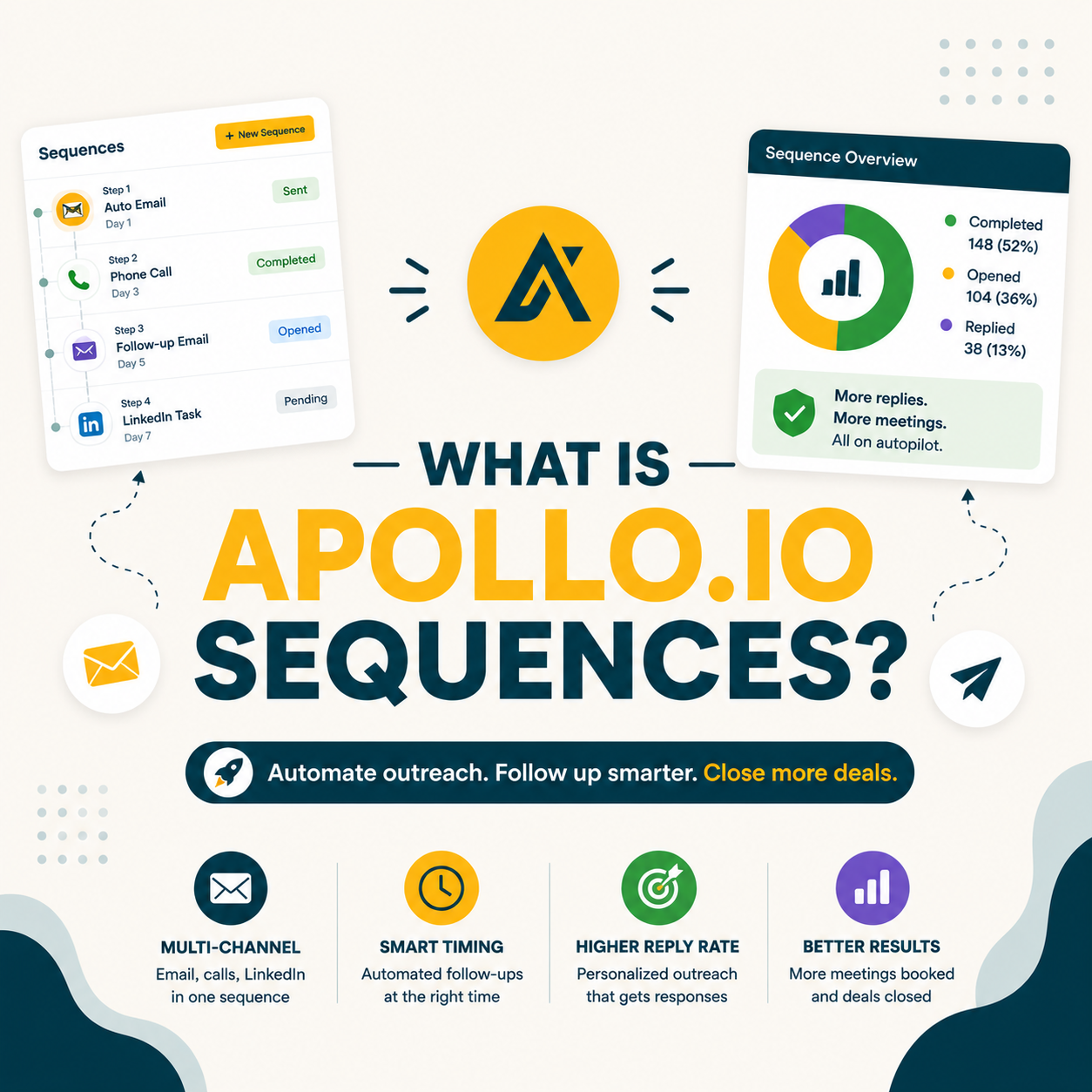
Apollo.io Sequences is the multi-step cold email automation feature inside Apollo.io. SDR teams build 5 to 15-step sequences with personalization tokens, A/B testing, and reply detection. Hunter Campaigns offers similar core functionality at a lower price point with better email accuracy on Hunter-sourced contacts. The choice between them depends on whether you already use Apollo for sourcing or Hunter for verification as the primary workflow anchor.
Table of Contents
What Are Apollo Sequences and How Do They Differ from Hunter Campaigns?
Apollo Sequences is the multi-step cold email automation feature inside Apollo.io. SDR teams build 5 to 15-step sequences with email plus LinkedIn touch plus call tasks, personalization tokens, A/B testing, and reply detection. Hunter Campaigns offers similar 3 to 7-step email-only sequences at a lower price point. The choice depends on whether you need multi-channel cadence (Apollo) or focused email workflow plus higher accuracy (Hunter). Both connect to Gmail or Outlook via OAuth.
For a practical comparison of both tools in real outreach workflows, see our complete cold email outreach guide.
“Email marketing is the act of sending a commercial message, typically to a group of people, using email.”
: Wikipedia: Email marketing
Apollo Sequences bets on multi-channel depth (email plus LinkedIn plus call) at higher per-user cost. Hunter Campaigns bets on email accuracy plus simplicity at flat pricing. Match tool to your channel mix. For the Hunter side on its own, see what Hunter.io Campaigns is.
How Does the Apollo Sequence Engine Actually Work?
Five components run when you launch an Apollo sequence. OAuth connects your Gmail or Outlook send account. Contact import pulls from Apollo’s 275M database or uploaded list. Sequence builder defines 5 to 15 steps with delays, personalization tokens, channel mix (email plus LinkedIn plus call tasks). Send scheduler queues emails at staggered times respecting rate limits. Reply detection auto-pauses on positive reply, A/B testing rotates copy variants. The same OAuth-plus-queue infrastructure underlies all major sequence tools including Hunter Campaigns.
- OAuth send account: connect Gmail or Outlook via OAuth, Apollo sends through your existing mailbox, inherits domain reputation, SPF/DKIM/DMARC setup. Multiple mailboxes connected on higher tiers.
- Contact import: pull from Apollo 275M database via filters (role, seniority, tech stack) or upload CSV, contacts come with Apollo enrichment data but lack pre-verification, recommend verify with Hunter before send for accuracy boost.
- Sequence builder: define 5 to 15 steps with day delays (typically 3 to 7 days between), variant copy per step on Professional plan, channel mix email plus LinkedIn task plus call task, personalization tokens for first name, company, custom fields.
- Send scheduler: queue emails at staggered times, respect Gmail 500 per day or Outlook 250 per hour rate limits, time zone aware send for global lists, business-hours window per recipient.
- Reply detection and A/B testing: monitor connected inbox for replies, auto-pause sequence on positive reply, rotate A/B copy variants on Professional+, log conversion events back to Apollo dashboard and connected CRM.
Apollo’s sequence infrastructure is the same OAuth-plus-queue pattern every cold email tool uses. Apollo’s edge is multi-channel task integration. Hunter’s edge is email-focused accuracy.
What Are the Top 5 Use Cases Where Apollo Sequences Win Over Specialists?
Five workflows justify Apollo Sequences over dedicated tools like Outreach or Lemlist. Multi-channel SDR cadence combining email plus LinkedIn plus call tasks in one sequence. Mid-market teams under 30 reps wanting database plus sequences unified. RevOps teams reducing tool sprawl to one vendor for sales engagement. Enterprise SDR with intent data triggering sequence enrollment automatically. Teams already on Apollo for sourcing avoiding the export-import cycle to a separate sequence tool. Each use case favors integration over per-feature specialization.
See the detailed Apollo vs Hunter use case breakdown for a full feature comparison across both platforms.
Five use cases below show where Apollo Sequences genuinely beats specialized sequence tools like Outreach, Lemlist, or Instantly.
- Multi-channel SDR cadence: teams combining email plus LinkedIn touch plus phone call in one sequence avoid context switching between tools, Apollo’s task system tracks all three channels with one analytics dashboard.
- Mid-market teams under 30 reps: SaaS companies wanting database plus sequences unified at Basic 49 dollars per user per month, saves 60 to 100 dollars per user versus stacking Hunter plus Outreach or similar specialized stacks.
- RevOps tool sprawl reduction: RevOps owners consolidating from 5 to 8 sales tools down to 3 to 4 platforms, Apollo absorbs 2 to 3 categories (database, sequences, dialer) into one vendor relationship.
- Enterprise SDR with intent triggers: sequences that auto-enroll accounts showing buyer intent signals (high content consumption, recent funding events), Apollo’s intent-to-sequence trigger automation is harder to replicate with separate tools.
- Teams already using Apollo for sourcing: if Apollo is your database tool, Sequences eliminates the export-import-resync cycle to separate sequence tool, saves 3 to 5 hours per week per SDR on operational overhead.
“Apollo.io’s Sequences feature enables sales teams to run multi-step, multi-channel outreach campaigns directly from their contact and account database.”
: Apollo.io Sequences documentation
Apollo Sequences wins on integration with Apollo’s database and intent data. Loses on accuracy vs Hunter-sourced contacts. Loses on multi-mailbox rotation vs Instantly. Match use case to your specific bottleneck.
What Are the 5 Limitations of Apollo Sequences Sales Leaders Should Know?
Five limitations cap Apollo Sequences versus specialized alternatives. Email accuracy of Apollo-sourced contacts sits at 84 percent, dragging sequence bounce rate above 6 percent without separate verification. Sender warming features are not native, requiring manual mailbox warm-up before high-volume sends. Per-user pricing scales fast for teams over 30 reps, hitting 47k annual at 50 reps Professional tier. Inbox rotation across multiple mailboxes is limited compared to Instantly or Smartlead. Personalization depth lacks Lemlist’s video plus custom image features.
For tools that fill these specific gaps, see our review of Hunter and Apollo alternatives for specific sequence needs.
Five limitations below shape whether Apollo Sequences fits your cold email workflow or whether a specialized tool delivers better ROI.
- Email accuracy of Apollo-sourced contacts: Apollo runs 84 percent accuracy on its own contact database, sequence bounce rate hits 6 to 10 percent without a separate Hunter verification step before launch.
- No native sender warming: Apollo Sequences sends through connected mailboxes but lacks built-in sender warming features that Instantly or Smartlead provide natively, manual warm-up required for high-volume scaling.
- Per-user pricing scaling cost: at 49 to 149 dollars per user per month, 50 reps on Professional tier hits 47k annual quickly, often exceeding specialized stack alternative for teams over 20 reps.
- Limited inbox rotation features: rotating sequences across multiple mailboxes for high-volume cold email (1000+ per day) is more constrained on Apollo versus dedicated tools like Instantly with native multi-mailbox infrastructure.
- Personalization depth lacking: Apollo offers text token personalization (first name, company, custom fields) but does not match Lemlist’s video personalization or custom image features for visual differentiation.
“As detailed in our Hunter.io Email Finder review, many SDR teams use Hunter to verify Apollo-sourced contacts before sequence launch, lifting effective deliverability from 84 percent to 91 percent and protecting sender reputation through the sequence cycle.”
: Growth Hack Suite: Hunter.io Email Finder review
Apollo Sequences wins on integration breadth, loses on per-feature depth versus specialists. Sender warming, inbox rotation, and personalization depth each have better-in-class alternatives at similar pricing.
Top 5 Cold Email Sequence Tools Compared: Apollo, Hunter, Outreach, Lemlist, Instantly
Five tools compete in the cold email sequence category in 2026. Apollo Sequences wins on multi-channel cadence plus database integration. Hunter Campaigns wins on email accuracy plus flat-rate pricing. Outreach dominates enterprise sales orgs with advanced analytics and team management. Lemlist wins on personalization depth (videos, custom images). Instantly wins on high-volume cold email with sender warming and inbox rotation. Each platform targets a specific buyer profile, no universal winner.
Five sequence tools below cover the main B2B cold email automation use cases, tested with 100-prospect 7-step sequences in early 2026.
Apollo wins on multi-channel. Hunter wins on accuracy plus pricing. Outreach wins enterprise. Lemlist wins personalization. Instantly wins volume. Match platform to your specific sequence requirements and team size.
How Do You Choose Between Apollo Sequences and Hunter Campaigns? 5-Step Framework
Five questions decide whether Apollo Sequences or Hunter Campaigns fits your workflow. Step 1: count team size, under 5 reps favors Hunter flat pricing, over 30 favors specialized stack. Step 2: identify channel mix, email-only fits Hunter, multi-channel needs Apollo. Step 3: check accuracy requirements, B2B SaaS strict ICP needs Hunter 91 percent. Step 4: calculate total cost at 12-month projection. Step 5: audit current stack integration tax versus consolidation savings.
See the full Apollo vs Hunter decision framework for cost modeling and deeper use case analysis.
Five decision steps below help sales leaders pick between Apollo Sequences integrated workflow and Hunter Campaigns flat-priced focused workflow.
- Step 1, count team size and growth trajectory: under 5 reps favors Hunter Campaigns flat 49 dollars per month (34 dollars billed annually) total, 5 to 30 reps balanced choice, over 30 reps usually favors specialized stack on cost ROI.
- Step 2, identify channel mix needs: email-only outreach fits Hunter Campaigns perfectly, multi-channel cadence (email plus LinkedIn plus phone) needs Apollo’s task system or Outreach for unified tracking.
- Step 3, check accuracy requirements for your ICP: B2B SaaS targeting strict ICP needs Hunter 91 percent accuracy to protect sender reputation, broader BDR motion tolerates Apollo 84 percent with sampling.
- Step 4, calculate 12-month total cost: Apollo at 10 reps Professional = 9480 dollars annual, Hunter Starter for full team = 408 dollars annual flat. Calculate against your projected team size and send volume.
- Step 5, audit current stack integration tax: already on Apollo for sourcing, Sequences saves export-import cycle. Not on Apollo, Hunter Campaigns avoids new tool learning curve and gives find plus verify plus send in one tool.
Try Hunter Campaigns free as your sequence alternative.
Hunter Campaigns delivers email sequences plus 91 percent verification accuracy at 49 dollars per month (34 dollars billed annually) flat-rate (not per-user), enough to test the workflow on 25 verified prospects before committing to Apollo per-user pricing.
Try Hunter Campaigns free →Flat $34/mo (not per-user) · SMTP-verified accuracy vs Apollo 84% · Find + verify + send in one tool
The framework: team size, channel mix, accuracy needs, 12-month cost, integration tax. Hunter Campaigns wins for accuracy-focused small teams. Apollo Sequences wins for multi-channel mid-market teams.
Apollo Sequences vs Hunter Campaigns: Frequently Asked Questions
Twelve questions below cover what SDRs and Sales Ops search when evaluating Apollo Sequences versus Hunter Campaigns: which is better, feature depth comparison, pricing models, accuracy benchmarks, and integration patterns.
Apollo Sequences vs Hunter Campaigns: which is better?
Depends on team size and channel mix. Apollo Sequences wins for mid-market teams needing multi-channel cadence (email plus LinkedIn plus call) at 49 dollars per user. Hunter Campaigns wins for email-focused workflows with flat 49 dollars per month (34 dollars billed annually) total team pricing plus 91 percent accuracy versus Apollo 84 percent. Many teams use both: Apollo for sourcing, Hunter for verification plus sending.
Can Apollo Sequences replace Outreach.io for enterprise sales teams?
Partially. Apollo Sequences covers core sequence functionality plus database plus dialer at lower price than Outreach 100 dollars per user. Outreach wins on advanced analytics, team performance dashboards, conversation intelligence, and enterprise admin features. For mid-market under 50 reps, Apollo replaces Outreach effectively. For 100+ rep enterprise sales orgs with complex hierarchies, Outreach features justify the premium.
What is the difference between Apollo Sequences and Hunter Campaigns?
Three main differences. Apollo supports 15-step sequences with multi-channel tasks (email plus LinkedIn plus call), Hunter Campaigns supports 7-step email-only. Apollo costs 49 dollars per user per month, Hunter Campaigns 34 dollars flat-rate for the whole team. Apollo accuracy on sourced contacts is 84 percent, Hunter 91 percent. Apollo wins on breadth, Hunter wins on focus plus accuracy plus pricing simplicity.
Do Apollo Sequences include sender warming features?
No, not natively. Apollo sends through your connected Gmail or Outlook mailbox but does not include built-in sender warming or inbox rotation features that Instantly or Smartlead provide natively. For high-volume cold email above 1000 per day, manual mailbox warm-up is required before scaling Apollo Sequences, or pair with separate warming tool like Mailreef or Lemwarm.
How much do Apollo Sequences cost compared to Hunter Campaigns?
Apollo Sequences are included in all paid Apollo plans starting at 49 dollars per user per month Basic. Hunter Campaigns are included in Hunter plans starting at 49 dollars per month (34 dollars billed annually) flat for the team. At 10 reps, Apollo Professional costs 9480 dollars annual versus Hunter Starter at 408 dollars annual flat. Apollo per-user model scales linearly with team size, Hunter stays flat.
Will Apollo Sequences improve team reply rate?
Indirectly yes through integration efficiency, not accuracy. Apollo saves 3 to 5 hours per SDR per week by eliminating tool switching between database, sequences, and dialer. Output volume jumps 30 to 50 percent on consolidation. Per-touch reply rate often drops 5 to 10 percent due to lower email accuracy versus verified contacts: net result is more replies at lower per-activity yield, often net positive.
Can Apollo Sequences be used on the free plan?
Limited. Free Apollo tier allows 1 active sequence with basic features. Paid Basic plan at 49 dollars per user unlocks unlimited sequences, A/B testing, and full multi-channel task integration. For testing sequence workflow before commitment, free tier is enough to validate basics, paid tier required for production cold email at any scale.
Do Apollo Sequences work with Hunter contacts?
Yes through CSV import or Zapier integration. Many mature sales stacks pair Hunter for contact discovery and verification with Apollo Sequences for outreach when the team prefers Apollo dashboard and analytics. The workflow: find with Hunter, verify with Hunter, import verified CSV into Apollo, launch sequence. Hunter-verified contacts running through Apollo Sequences combine the best of both tools.
What are Apollo Sequences?
Apollo Sequences is the multi-step cold email automation feature inside Apollo.io. SDR teams build 5 to 15-step sequences with personalization tokens, A/B testing, multi-channel tasks (email plus LinkedIn plus call), and reply detection. Pricing starts at 49 dollars per user per month Basic, scales to 149 dollars Organization tier. Connects to Gmail or Outlook via OAuth.
How do Apollo Sequences compare to Hunter Campaigns?
Apollo offers 15-step sequences with multi-channel tasks at 49 dollars per user per month. Hunter Campaigns offers 7-step email-only sequences at 49 dollars per month (34 dollars billed annually) flat-rate for the team. Apollo wins on multi-channel breadth and database integration. Hunter wins on accuracy (91 vs 84 percent) and pricing for small teams. Many mature stacks pair Hunter verification with Apollo Sequences for combined accuracy plus workflow.
Are Apollo Sequences free?
Limited free tier. Free Apollo allows 1 active sequence with basic features for testing workflow. Paid Basic at 49 dollars per user per month unlocks unlimited sequences plus A/B testing. Professional at 79 dollars per user adds multi-channel tasks plus advanced reporting. Organization at 149 dollars per user adds advanced automation. Free tier is for workflow validation only, paid tier required for production scale.
Do Apollo Sequences include A/B testing features?
Yes on Professional plan and higher. Apollo supports A/B testing on subject lines and email body copy across sequence variants. The platform automatically rotates variants and tracks which version drives higher open rate, reply rate, and meeting booked conversion. Statistical significance reporting available at the campaign level. Basic plan at 49 dollars per user does not include A/B testing, requires Professional at 79 dollars per user upgrade.
Apollo Sequences wins on multi-channel integration for mid-market teams. Hunter Campaigns wins on accuracy plus flat pricing for accuracy-focused workflows. Many mature stacks use both: Apollo for sourcing, Hunter for verification before send.
Try Hunter.io free: see Hunter accuracy plus Campaigns in one tool at $34
Hunter Campaigns delivers similar 3 to 7-step sequence workflow plus 91 percent email accuracy at 49 dollars per month (34 dollars billed annually) (not per-user). Test free on 25 verified prospects before committing to Apollo’s per-user pricing.
Try Hunter Campaigns free →7M+ professionals use Hunter. No card. Cancel anytime.