Apollo.io Data Enrichment appends firmographic, technographic, and contact data to CRM records using Apollo’s 275M+ contact database plus 73M+ company database. Sales Ops teams use it to fill CRM gaps on company size, tech stack, funding stage, and current employee count for lead scoring and ABM tier classification. Pricing starts at Professional plan 79 dollars per user per month. Hunter offers focused email enrichment plus pattern detection at 34 dollars flat-rate for the team.
Table of Contents
What Is Apollo Data Enrichment and How Does It Differ from Email-Focused Enrichment?
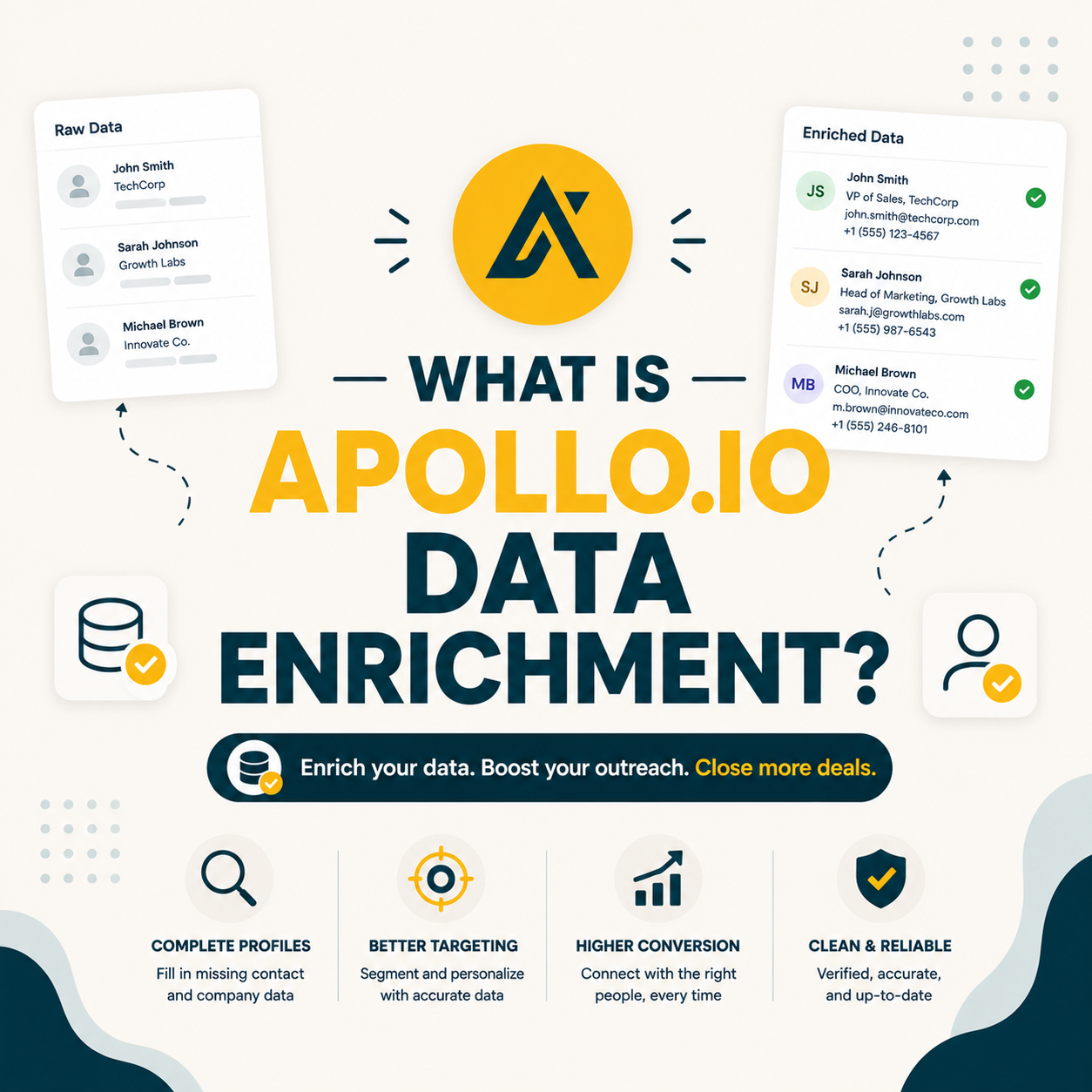
Apollo Data Enrichment appends firmographic, technographic, and contact data to CRM records using Apollo’s 275M+ contact database plus 73M+ company database. Sales Ops teams use it to fill CRM gaps on company size, tech stack, funding stage, current employee count, and recent hires. Pricing starts at Professional plan 79 dollars per user per month. The feature differs from email-focused enrichment (Hunter) by covering broader firmographic categories at the cost of email accuracy depth.
For a full comparison of both tools across all features, see our full Apollo vs Hunter comparison.
“Data enrichment is the process of enhancing existing records with additional information from external sources.”
: Wikipedia: Data enrichment
Apollo Enrichment bets on firmographic breadth across 5+ data categories. Hunter Enrichment bets on email plus pattern depth at lower price point. Match tool to whether the enrichment bottleneck is breadth or email accuracy.
How Does Apollo Data Enrichment Source and Match Data to Your CRM Records?
Four components power Apollo enrichment. Data sourcing pulls from Apollo’s 275M+ contact and 73M+ company database, plus third-party data partnerships (Bombora intent, Crunchbase funding). Record matching identifies CRM contacts against Apollo records using email plus domain plus name fuzzy matching. Data appending fills missing fields (company size, industry, tech stack) directly on the CRM record. Refresh cycle re-syncs quarterly to update stale data. Match rate ranges 70 to 90 percent depending on CRM data quality and industry vertical.
- Data sourcing: Apollo aggregates from 275M+ contact database, 73M+ company database, plus third-party data partnerships including Bombora for intent signals, Crunchbase for funding data, BuiltWith for tech stack detection.
- Record matching: identifies CRM contacts against Apollo records using fuzzy matching on email plus domain plus name plus LinkedIn URL, match confidence scored 0 to 100, low-confidence matches flagged for manual review.
- Data appending: fills missing CRM fields (company size, industry, revenue, tech stack, funding stage) directly on the contact record via Salesforce or HubSpot native integration or CSV bulk update workflow.
- Refresh cycle: Apollo re-syncs quarterly to update stale fields (employee count changes, funding rounds, tech stack changes), match rate typically 70 to 90 percent depending on CRM data quality.
Apollo’s enrichment engine is database lookup plus fuzzy matching plus quarterly refresh. The 70 to 90 percent match rate depends on whether your CRM data is clean enough for fuzzy matching to find the right Apollo record. If Hunter is the email layer in your stack, the Hunter.io integrations guide shows how its results sync into the same CRM.
What Are the Top 5 Use Cases Where Apollo Data Enrichment Delivers ROI?
Five workflows justify Apollo Enrichment over basic email enrichment. Lead scoring algorithms use Apollo firmographics (company size, revenue, industry) as scoring inputs to prioritize MQLs. ABM tier classification segments 500+ target accounts into tiers using Apollo firmographic plus technographic data. Tech stack-based outbound targets prospects using specific competitor tools via BuiltWith integration. Funding-triggered outreach auto-enrolls newly funded startups (Series A or higher) into sequences. CRM data hygiene workflows fill 10000+ missing fields in one batch enrichment job per quarter.
See our Apollo vs Hunter enrichment use case breakdown for a side-by-side review of each platform’s strengths.
Five use cases below show where Apollo Data Enrichment delivers ROI beyond what basic email enrichment can match for B2B sales workflows.
- Lead scoring algorithm inputs: firmographic data (company size, revenue, industry) feeds into lead scoring algorithms to prioritize MQLs, Apollo provides 5 to 10 attributes per contact for weighted scoring models.
- ABM target tier classification: segment 500+ target accounts into tier 1 (top 50 strategic), tier 2 (mid-market), tier 3 (volume play) using Apollo firmographic plus technographic data for systematic ABM motion.
- Tech stack-based outbound targeting: identify prospects using specific competitor tools or complementary technologies via BuiltWith integration in Apollo, target Salesforce users for Salesforce app integration outreach.
- Funding-triggered outreach automation: auto-enroll newly funded startups (Series A or higher in last 90 days) into outreach sequences when Apollo detects funding rounds via Crunchbase data partnership.
- CRM data hygiene quarterly batches: fill 10000+ missing fields in one batch enrichment job per quarter (company size, industry, revenue, employees), foundational for accurate sales analytics and reporting.
“Apollo’s enrichment feature enables sales teams to keep CRM data accurate and complete with firmographic, technographic, and contact data from Apollo’s 275M+ database.”
: Apollo.io Data Enrichment documentation
Apollo Enrichment shines on firmographic plus technographic breadth for ABM and lead scoring. Hunter Enrichment shines on email plus pattern for verification accuracy. The two workflows complement rather than compete in mature sales stacks.
What Are the 5 Limitations of Apollo Data Enrichment Sales Ops Should Know?
Five limitations cap Apollo Enrichment accuracy. Email field accuracy sits at 84 percent on Apollo data, requiring a separate verification pass before send. Quarterly refresh cycle leaves 10 to 20 percent of contacts with stale data at any given moment. Technographic data depends on BuiltWith coverage, missing for under 30 percent of SMB websites without recognizable tech signatures. Intent data quality trails Bombora or 6sense for enterprise-grade signal depth. Per-user pricing makes Professional tier (79 dollars per user) cost-prohibitive for teams over 30 reps just for enrichment.
For tools that address these specific gaps, see our review of enrichment alternatives when Apollo coverage gaps appear.
Five limitations below shape whether Apollo Enrichment fits your data hygiene workflow or whether specialized tools deliver better per-feature ROI.
- Email accuracy below specialists: Apollo enriches with 84 percent email accuracy on B2B SaaS samples versus Hunter at 91 percent, sequence bounce rate hits 6 to 10 percent without a separate verification pass.
- Quarterly refresh stale data: Apollo re-syncs quarterly meaning 10 to 20 percent of contacts have stale job titles or employer information at any given moment, real-time tools like ZoomInfo refresh more frequently.
- Technographic coverage gaps: tech stack data depends on BuiltWith scraping plus website detection, missing for 30 percent of SMB websites without recognizable JS frameworks, CDN signatures, or analytics tags.
- Intent data quality limits: Apollo intent signals are useful for surface-level prioritization but trail Bombora and 6sense for enterprise-grade signal depth and tracked content category breadth.
- Per-user pricing cost ceiling: Professional tier 79 dollars per user per month is cost-prohibitive for teams over 30 reps just for enrichment, specialized data tools like ZoomInfo or Clearbit may offer better per-feature ROI at scale.
“As detailed in our Hunter.io Email Finder review, many Sales Ops teams pair Apollo for firmographic enrichment breadth with Hunter for email verification depth, combining 91 percent email accuracy with Apollo’s tech stack and funding data.”
: Growth Hack Suite: Hunter.io Email Finder review
Apollo Enrichment match rate of 70 to 90 percent looks impressive on paper but leaves 10 to 30 percent of records still incomplete. Sales Ops teams budget for manual fallback on the long tail of unmatched records.
Top 5 B2B Data Enrichment Tools Compared: Apollo, Hunter, ZoomInfo, Clearbit, Lusha
Five tools compete in the B2B data enrichment category in 2026. Apollo wins on breadth at 79 dollars per user with firmographic plus technographic plus intent. Hunter wins on email accuracy plus pattern depth at flat 49 dollars per month (34 dollars billed annually). ZoomInfo dominates enterprise with deepest firmographic data at enterprise pricing. Clearbit (now HubSpot) wins on inbound form enrichment. Lusha specializes in phone plus email contact enrichment at SMB pricing. Each platform targets a specific enrichment bottleneck.
Five enrichment tools below cover the main B2B data hygiene use cases, tested with 5000-row CRM enrichment batches in early 2026.
Apollo wins on breadth. Hunter wins on email accuracy plus pricing. ZoomInfo wins enterprise depth. Clearbit wins inbound form enrichment. Lusha wins SMB phone plus email combo. Match platform to your specific enrichment workflow.
How Do You Choose Between Apollo Enrichment and Hunter Enrichment? 5-Step Framework
Five questions decide your enrichment tool. Step 1: identify primary enrichment need, broad firmographics fits Apollo, email-focused fits Hunter. Step 2: evaluate CRM data quality baseline, low quality needs Apollo fuzzy matching breadth. Step 3: count team size, under 30 reps Apollo Professional reasonable, over 30 hits per-user cost ceiling. Step 4: audit current stack, already on Apollo for sourcing reuses platform. Step 5: calculate 12-month total cost against expected match rate plus manual fallback effort.
For a deeper analysis of each decision factor, see the Apollo vs Hunter enrichment full decision guide.
Five decision steps below help Sales Ops pick between Apollo broad enrichment and Hunter email-focused enrichment, or how to pair them in mature stacks.
- Step 1, identify primary enrichment need: broad firmographics plus tech stack plus funding favors Apollo’s 79 dollars per user platform, email-focused enrichment plus verification favors Hunter at 34 dollars flat.
- Step 2, evaluate CRM data quality baseline: low quality CRM with 30 to 50 percent missing fields needs Apollo fuzzy matching breadth, higher quality CRM only needing email verification fits Hunter focus.
- Step 3, count team size and projected growth: under 30 reps Apollo Professional reasonable cost, over 30 reps hits 28k+ annual just for enrichment, specialized stack often cheaper at scale.
- Step 4, audit current stack integration: already using Apollo for sourcing, enrichment add-on saves vendor management overhead. Not on Apollo, Hunter Domain Search delivers email enrichment focus cheaper.
- Step 5, calculate 12-month TCO with fallback effort: Apollo 79 per user times team times 12 plus manual fallback hours, vs Hunter 34 flat times 12 plus Apollo for non-email data when needed, run both numbers against expected match rate.
Test Hunter Domain Search free for email enrichment.
Hunter delivers email pattern detection plus 91 percent verification accuracy at flat 49 dollars per month (34 dollars billed annually) for the entire team, complementing Apollo firmographic enrichment with focused email accuracy depth.
Try Hunter email enrichment free →50 credits per month free · SMTP-verified accuracy vs Apollo 84% · Pattern detection included
The framework: enrichment need, CRM data baseline, team size, current stack, 12-month cost. Apollo wins for firmographic breadth. Hunter wins for email accuracy at lower pricing. Pair them when the enrichment workflow needs both.
Apollo Data Enrichment vs Hunter Enrichment: Frequently Asked Questions
Twelve questions below cover what Sales Ops and RevOps search when evaluating Apollo Data Enrichment: which fits B2B workflow, match rate benchmarks, ZoomInfo comparison, pricing model, and CRM integration patterns.
Apollo Data Enrichment vs Hunter: which fits B2B Sales Ops better?
Depends on enrichment scope. Apollo fits mid-market teams needing firmographic plus technographic plus intent data breadth at 79 dollars per user. Hunter fits email-focused enrichment with 91 percent accuracy at 49 dollars per month (34 dollars billed annually) flat. Many teams pair both: Apollo for company size plus tech stack plus funding, Hunter for verified emails plus pattern detection. Match tool to specific bottleneck.
How does Apollo Data Enrichment compare to ZoomInfo for enterprise?
ZoomInfo wins enterprise on data depth (400M+ contacts, deeper firmographic categories, tighter Salesforce integration) at enterprise pricing starting around 15k annual. Apollo Professional at 79 dollars per user offers 80 percent of ZoomInfo functionality at 10 to 20 percent of cost. For teams under 50 reps without enterprise procurement requirements, Apollo delivers strong ROI. For 100+ rep enterprise sales orgs, ZoomInfo depth justifies premium.
What CRM platforms does Apollo Data Enrichment integrate with?
Apollo integrates natively with Salesforce, HubSpot, Pipedrive, plus 5000+ apps through Zapier. Bidirectional sync at the Professional plan automatically enriches new contacts on creation and updates existing records on quarterly refresh cycles. CSV bulk import supports legacy CRM platforms without native integration. Real-time API enrichment available on Organization plan for form-submit workflows.
Can Apollo Data Enrichment replace separate firmographic plus email tools?
Partially. Apollo Professional covers firmographic plus technographic plus contact enrichment in one tool at 79 dollars per user. Email accuracy at 84 percent leaves a verification gap that Hunter at 91 percent fills better. For broad enrichment workflow accepting 84 percent email accuracy, Apollo replaces multiple tools. For accuracy-strict workflows, pair Apollo for firmographic plus Hunter for email at total 113 dollars per user combined.
How much does Apollo Data Enrichment cost at production scale?
Apollo Enrichment is included in Professional plan at 79 dollars per user per month and Organization plan at 149 dollars per user. At 20 reps Professional tier, total enrichment cost equals 18960 dollars annual. Hunter Domain Search for the same team costs 408 to 1908 dollars annual (flat, not per-user). Cost gap widens significantly at 50+ rep team size, favoring focused tools over per-user platforms.
Will Apollo Data Enrichment improve lead scoring accuracy?
Yes by 20 to 40 percent on firmographic-driven scoring models. Apollo adds 5 to 10 attributes per contact (company size, industry, revenue, tech stack, funding stage) that feed into weighted lead scoring algorithms. Without enrichment, scoring relies on form-submitted fields only, often missing 60 to 80 percent of attributes. Enriched scoring improves MQL to SQL conversion rate measurably for ABM workflows.
Can Apollo Data Enrichment be tested for free?
Limited. Apollo free tier covers 60 monthly credits for contact discovery plus basic enrichment fields. Full enrichment with firmographic plus technographic plus intent data requires Professional plan at 79 dollars per user per month. Free tier is enough to validate the workflow on 60 records, paid tier required for production CRM enrichment batches at any meaningful scale.
Does Apollo Data Enrichment work alongside Hunter in the same stack?
Yes commonly. Many mature sales stacks pair Apollo for firmographic plus technographic plus funding enrichment with Hunter for email verification plus pattern detection. Workflow: Apollo enriches CRM with company data, Hunter verifies emails before send to lift effective deliverability from 84 to 91 percent. Combined stack costs roughly 113 dollars per user (79 Apollo plus 34 Hunter flat), cheaper than ZoomInfo enterprise.
What is Apollo Data Enrichment?
Apollo Data Enrichment is a feature that appends firmographic, technographic, and contact data to CRM records using Apollo’s 275M+ contact database plus 73M+ company database. Sales Ops teams use it to fill CRM gaps on company size, tech stack, funding stage, and current employee count. Pricing starts at Professional plan 79 dollars per user per month.
How does Apollo Data Enrichment match accuracy compare to ZoomInfo?
Apollo achieves 70 to 90 percent match rate on CRM enrichment batches depending on data quality. ZoomInfo hits 85 to 95 percent on similar batches due to deeper firmographic coverage and more frequent refresh cycles. Apollo costs 10 to 20 percent of ZoomInfo’s enterprise pricing. For teams accepting 80 to 85 percent match rate at lower cost, Apollo delivers ROI. For accuracy-strict enterprise workflows, ZoomInfo justifies premium.
Is Apollo Data Enrichment available on the free plan?
Partially. Apollo free tier (60 monthly credits) includes basic enrichment for contact discovery but full firmographic plus technographic plus intent enrichment requires Professional plan at 79 dollars per user per month. Basic plan at 49 dollars per user includes limited enrichment fields. Professional plan unlocks the full enrichment workflow including BuiltWith tech stack data and Bombora-style intent signals.
What data categories does Apollo Data Enrichment cover?
Five primary categories. Firmographic (company size, industry, revenue, employee count). Technographic (tech stack, tools used, integrations via BuiltWith). Funding data (recent rounds, total raised, investor list via Crunchbase). Contact data (email, phone, LinkedIn URL, job history). Intent signals (Bombora-style content consumption tracking). All five layers integrate with Salesforce, HubSpot natively on Professional plan and higher.
Apollo Enrichment fits mid-market teams wanting firmographic plus technographic breadth in one tool. Hunter fits email-focused enrichment at lower pricing. Many mature stacks use both: Apollo for company data, Hunter for verified emails.
Try Hunter.io free: see Hunter accuracy on enriched contact emails
Apollo enriches with firmographic breadth, Hunter enriches with email accuracy. Pair them for full coverage: Apollo for company data plus tech stack, Hunter for verified emails plus pattern detection at 49 dollars per month (34 dollars billed annually) flat.
Try Hunter free for email enrichment →7M+ professionals use Hunter. No card. Cancel anytime.