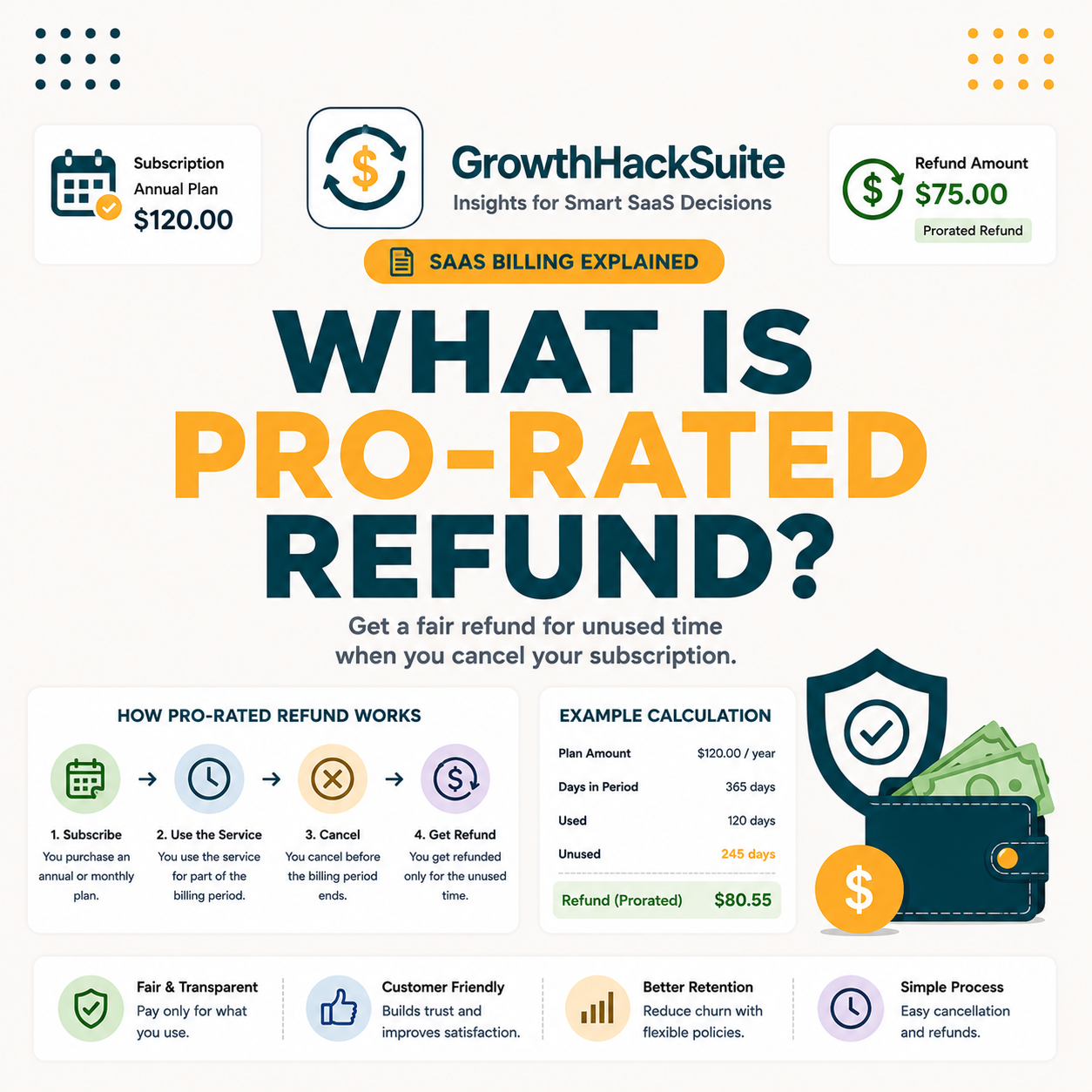
A pro-rated refund returns the unused portion of a paid SaaS subscription as cash or account credit when a user cancels before the billing period ends. For B2B teams managing email tools on annual plans, the formula is simple: days remaining divided by total days, multiplied by plan cost. Hunter.io and most major email finders publish refund windows of 30 days from the charge date.
What Is a Pro-Rated Refund? Core Definition for B2B Sales and Marketing Teams
A pro-rated refund is a partial reimbursement calculated in proportion to the unused time remaining in a subscription period. When a SaaS buyer cancels an annual plan after four months, a true pro-rata refund covers the remaining eight months. Most B2B tool vendors limit refunds to 30 days from the original charge, which makes understanding the exact policy critical before committing to annual billing.
The term “pro-rated” comes from the Latin pro rata, meaning “according to the calculated share.” In SaaS billing, it applies to mid-cycle upgrades, downgrades, and cancellations. Understanding the distinction between a full refund, a pro-rated refund, and a credit note determines how much cash actually returns to a buyer after cancellation.
“Proration is the process of apportioning amounts based on the proportion of time or use within a period.”
: Wikipedia: Pro rata
Understanding pro-rated refunds prevents costly surprises when switching SaaS tools mid-contract. Founders who plan cancellations strategically after month 10 of an annual plan recover significantly less than those who request refunds in month 2.
How Does a Pro-Rated Refund Actually Work? The Technical Mechanism Explained
A pro-rated refund follows a fixed formula: the refund amount equals the total charge multiplied by the ratio of unused days to total billing days. On a $99/month plan cancelled on day 10, the calculation is ($99 x 20/30) = $66. Most SaaS vendors automate this calculation through Stripe or Chargebee billing systems, but the refund eligibility window and the definition of “unused” vary by vendor policy.
- Billing system timestamp: The vendor records the exact time of cancellation request and compares it against the subscription start date to determine days consumed versus days remaining.
- Refund eligibility check: The billing engine verifies whether the cancellation falls within the vendor’s refund window (commonly 30 days for annual plans) and whether usage thresholds have been crossed that void eligibility.
- Unused days calculation: Days remaining in the billing period are divided by the total days in the period, producing the refundable proportion as a decimal between 0 and 1.
- Refund amount computation: The decimal is multiplied by the original charge. Annual plan buyers who paid $588 upfront and cancel after 45 days receive a refund for the remaining 320 days, approximately $515.
- Payment method routing: Refunds return to the original payment method within 5-10 business days for credit cards or as account credit redeemable on the next invoice, depending on vendor policy and Stripe account configuration.
The mechanism is straightforward mathematically, but vendor-specific eligibility conditions around usage caps, cancellation timing, and credit-versus-cash return options create real differences between tools at cancellation time.
What Are the Top 5 Use Cases for Pro-Rated Refunds in B2B Sales?
Pro-rated refunds apply across five recurring scenarios in B2B SaaS procurement: annual plan cancellations, mid-cycle plan downgrades, seat reductions, tool consolidations during mergers, and budget reallocation events. Each scenario produces a different refund calculation and requires a different negotiation approach with the vendor’s billing team.
Five use cases below show where pro-rated refunds deliver measurable cash recovery for B2B teams.
- Annual plan early cancellation: A founder cancels a $588/year Hunter.io Starter plan after 60 days, recovering approximately $491 in pro-rated credit, reducing tool migration cost to under $100.
- Mid-cycle plan downgrade: An SDR team reduces from Growth ($498/year, 500 requests) to Starter ($228/year, 250 requests) at month 4, with the billing difference applied as credit to the next renewal cycle.
- Seat count reduction: A 10-seat Apollo plan drops to 5 seats after a headcount reduction; the per-seat pro-rated credit applies immediately and offsets the next monthly invoice.
- Tool consolidation post-acquisition: Two merged sales teams consolidate duplicate Hunter.io accounts mid-contract, with the terminated account generating a pro-rated refund to offset the surviving account’s renewal cost.
- Budget reallocation event: An email marketer’s annual budget is cut mid-year; immediate cancellation of a ZeroBounce annual plan within the 30-day refund window recovers the majority of the prepaid cost for reallocation.
“Annual subscription billing increases customer lifetime value by 30-40% compared to monthly plans, but pro-rated cancellation policies determine whether buyers accept the lock-in risk.”
: HubSpot: Subscription Billing Strategy
Annual plan refund scenarios deliver the highest cash recovery because prepaid amounts are largest. Monthly plan refunds rarely exceed $50 and are often not worth the support ticket, making annual plan refund policy the more critical evaluation criterion.
What Are the 5 Limitations of Pro-Rated Refunds Every Buyer Should Know?
Pro-rated refunds carry five structural limitations that reduce actual cash recovery below the theoretical maximum: eligibility windows, usage thresholds, credit-only policies, processing delays, and contract carve-outs. Buyers who understand these limitations negotiate more favorable cancellation terms before signing annual contracts.
- Narrow eligibility windows: Most SaaS vendors restrict refund eligibility to 30 days from the charge date. Cancellations after day 31 of an annual plan produce no refund regardless of remaining subscription days, making the effective refund window roughly 8% of the annual term.
- Usage-based voidance clauses: Vendors including Apollo and Snov.io include terms that void refund eligibility once a defined percentage of credits or API calls is consumed, regardless of calendar days remaining in the billing period.
- Credit-only return policy: Several email finder tools issue account credit rather than cash refunds, locking the recovery inside the platform and requiring the buyer to renew to access the credit value, negating the cancellation intent entirely.
- Processing and banking delays: Credit card refunds typically take 5-10 business days to post. For teams managing quarterly cash positions, a mid-month refund initiated on day 30 may not clear the bank until day 40, affecting cash flow forecasts.
- Enterprise contract carve-outs: Negotiated enterprise agreements often include custom non-refund clauses or minimum-spend commitments that supersede the standard published refund policy, making the public policy irrelevant for deals above $5,000 annually.
“Hunter.io’s pricing structure makes it one of the more accessible entry points for email prospecting, and understanding the full refund and credit policy helps teams plan annual spend without lock-in risk.”
: Growth Hack Suite: Hunter.io Email Finder review
The 30-day eligibility window is the most consequential limitation in practice. Buyers who do not evaluate a tool within the first month of an annual plan forfeit refund rights for the remaining 335 days of prepaid service.
Top 5 Tools Compared by Pro-Rated Refund Approach: Hunter, Apollo, Snov, ZeroBounce, NeverBounce
Pro-rated refund policies vary significantly across the five major B2B email finder and verification tools. Hunter.io offers a 30-day refund window with credits returned to the account rather than the original payment method for most plans. Apollo and Snov.io implement usage-based voidance that limits effective refund eligibility. ZeroBounce and NeverBounce operate on credit-based models where credits roll over but are not refundable as cash.
Source: Vendor support documentation and terms of service pages reviewed May 2026. Policies subject to change.
Hunter.io’s refund policy stands out for its absence of usage-based voidance clauses. Buyers who find the tool does not fit their workflow within 30 days can cancel and receive a refund regardless of how many credits were consumed during the trial period.
How Do You Apply a Pro-Rated Refund in 5 Steps with Hunter.io (Free Workflow)?
Requesting a pro-rated refund from Hunter.io follows a five-step process that takes under 10 minutes when initiated within the 30-day window. The free plan allows teams to test Domain Search and Email Verifier with 25 monthly requests before committing to a paid tier, reducing the need for refund requests in the first place.
- Step 1, log in and navigate to billing: Access the Hunter.io dashboard, click the account avatar in the top-right corner, and select “Billing” to view the current subscription details including charge date and plan tier.
- Step 2, confirm eligibility window: Check the original charge date on the billing page. The 30-day refund window runs from that exact date. Cancellations on day 31 or later fall outside the refund-eligible period.
- Step 3, submit cancellation via support ticket: Navigate to Hunter.io’s support page and open a ticket referencing the charge date, plan name, and refund request. Hunter’s support team typically responds within one business day for billing inquiries.
- Step 4, confirm refund method: The support response confirms whether the refund processes as a credit card return (5-10 business days) or as account credit. Specify preference in the initial ticket to avoid processing as credit if cash return is needed.
- Step 5, verify receipt and downgrade or cancel: After refund confirmation, downgrade to the free plan or cancel the account entirely. The free plan retains 25 monthly requests indefinitely, useful for low-volume prospecting while the team evaluates alternative tools.
Start with Hunter.io Free Before Committing to Annual
Try Hunter.io Free25 free requests per month. No credit card required. 30-day refund window on paid plans.
Using the free plan as a genuine pre-purchase evaluation period eliminates most refund scenarios. The 25 monthly requests on the free tier are sufficient to validate domain search accuracy and email verification quality for a target account list before upgrading.
How Has the Concept of Pro-Rated Refunds Evolved Across the B2B Email Tool Category?
Pro-rated refunds in B2B SaaS emerged as a buyer-protection standard in the early 2010s when annual subscription pricing became the dominant model for productivity tools. Before 2012, most B2B software sold perpetual licenses with no refund mechanism. The shift to subscription billing created both lock-in risk for buyers and churn risk for vendors, making transparent refund policies a competitive differentiator.
Early email finder tools such as Hunter.io (launched 2015) and Apollo (founded 2015) established their refund policies as the market grew from developer-focused API tools toward sales team platforms. The growth of Stripe as a universal billing layer standardized the mechanics of pro-rated billing across the category, making credit notes and partial refunds technically trivial to implement. Policy differences between vendors now reflect commercial decisions rather than technical constraints.
The 2020-2023 period saw increasing buyer scrutiny of SaaS refund terms, driven by rapid tool proliferation and budget pressure during economic uncertainty. Vendors including Hunter.io responded by publishing clearer refund documentation and reducing support friction for billing inquiries. The market has effectively bifurcated: tools that compete on trust publish explicit pro-rated refund terms, while tools that optimize for revenue retention offer credit-only or no-refund policies.
Refund policy transparency has become a meaningful vendor trust signal. Tools that publish clear pro-rated refund terms in their pricing documentation attract buyers with higher annual commitment tolerance because the cancellation exit is well-defined and low-risk.
What Are the Real Cost Implications of Pro-Rated Refunds at SDR Team Scale?
At SDR team scale of 5-20 seats, pro-rated refund calculations become material budget decisions rather than individual billing corrections. A 10-person SDR team on Hunter.io Business ($499/month per seat) that cancels after month 3 of an annual commitment faces a very different financial outcome depending on whether the plan carries a pro-rated refund policy versus a no-refund policy.
Source: Hunter.io published Starter plan pricing at $19/month per seat billed annually = $228/seat/year. Refund window: 30 days from charge date. Month 3 cancellation falls outside refund window under standard policy.
The 30-day window concentrates all refund value in the first month post-charge. Teams that delay the evaluation decision beyond day 30 forfeit refund rights entirely, making rapid onboarding and pilot testing a financial imperative rather than just a technical preference.
What Are the 5 Common Mistakes B2B Teams Make With Pro-Rated Refunds?
Five recurring mistakes account for the majority of forfeited refund eligibility across B2B SaaS procurement teams. Each mistake is preventable with a simple pre-purchase checklist and a calendar reminder set at the point of subscription activation.
- Assuming refund terms match the sales pitch: Sales representatives frequently describe generous cancellation terms verbally that do not appear in the written terms of service. The published ToS governs the refund calculation, not conversation during a demo call.
- Conflating trial period and refund window: A 14-day free trial and a 30-day money-back guarantee are different mechanisms. The refund window starts from the first paid charge date, not from the trial start, meaning teams that use a full trial before upgrading have a shorter effective evaluation window on the paid plan.
- Exceeding usage thresholds inadvertently: Teams that run bulk tasks or upload large verification lists in the first week of a paid plan may trigger usage-based voidance clauses. Vendors that tie refund eligibility to credit consumption can deny refunds after intensive early use, even when the team decides to cancel within the window.
- Missing the calendar deadline by one day: Refund eligibility is strict. Day 31 is not day 30. Teams that submit refund requests on the 31st day after a charge consistently report denials, even when the delay results from a weekend or holiday falling on day 30. Submit requests on day 25-28 to ensure buffer.
- Accepting credit-only refunds without negotiating: First-line support agents default to account credit refunds even when the vendor’s policy technically allows cash returns. Buyers who explicitly request cash refunds to the original payment method in the initial ticket succeed at higher rates than those who accept the default credit offer.
Setting a calendar reminder for day 25 after every SaaS annual subscription charge prevents deadline misses. The 5-day buffer before the window closes provides enough time to evaluate, decide, and submit the request without rushing.
How Do SDRs, Email Marketers, and Founders Each Apply Pro-Rated Refunds Differently?
Three distinct buyer personas encounter pro-rated refund scenarios under different circumstances: SDRs managing team tool budgets on short quarterly cycles, email marketers maintaining deliverability tools across campaign seasons, and founders making initial SaaS procurement decisions without dedicated finance oversight. Each persona’s risk exposure and decision timeline differs.
SDRs face refund scenarios most frequently during territory changes, tool consolidation initiatives, and headcount fluctuations. An SDR managing a personal Hunter.io Starter account who moves to a company-licensed Apollo seat needs to cancel the personal account within the 30-day window to recover the annual prepayment. The Hunter.io free plan provides a low-cost fallback for ad hoc prospecting after cancellation, and a free account retains access to the Domain Search tool with 25 monthly requests.
Email marketers encounter pro-rated refund questions primarily during tool stack rationalization projects and vendor pricing changes. A deliverability team that consolidates from three verification tools to one during a mid-year audit triggers refund requests across multiple platforms simultaneously. Hunter.io’s verification layer integrates with cold outreach workflows in ways that ZeroBounce’s stand-alone verification does not, often making it the retained tool when stacks consolidate rather than the cancelled one. See our complete Hunter.io Email Finder review for accuracy benchmarks that inform these stack decisions.
Founders making first SaaS procurement decisions for growing teams lack institutional knowledge of vendor billing practices. The most common founder mistake is purchasing annual plans for the full projected team size before onboarding confirms adoption. Purchasing one seat annually and adding seats monthly until adoption validates keeps refund exposure minimal.
Each persona benefits most from the same discipline: evaluate rigorously within the first 30 days, set a calendar alert at day 25, and request cash refunds explicitly rather than accepting default credit notes when cancellation is required.
What Are the Best Practices for Managing Pro-Rated Refund Risk in 2026?
Five best practices reduce pro-rated refund risk before, during, and after SaaS annual plan commitments. Teams that apply these practices across every tool purchase eliminate surprise vendor lock-in and recover cash efficiently when tool switches are required.
- Read the ToS before purchase: Review the vendor’s Terms of Service or Refund Policy page specifically for cancellation terms, refund eligibility windows, usage-based voidance conditions, and whether refunds are cash or credit. Hunter.io publishes this information at hunter.io/terms.
- Set a day-25 evaluation calendar alert: Immediately after every annual subscription purchase, add a calendar event for day 25 with the refund window deadline. The 5-day buffer allows time to submit a support ticket and receive confirmation before the window closes.
- Start with monthly before committing annually: Monthly plans carry no annual commitment risk and no refund complexity. Switching to annual billing after 2-3 months of validated usage eliminates the primary refund scenario: paying annually for a tool that turns out to be a poor fit.
- Document the cancellation request in writing: Email or ticket-based cancellation creates a dated paper trail. Phone or chat-based cancellation requests without confirmation emails create disputes about whether the request fell within the eligibility window.
- Request cash to original payment method explicitly: The refund request ticket should state: “Please process this as a cash refund to the original credit card on file, not as account credit.” This explicit language prevents automatic credit-only processing and improves cash recovery rates.
Applying all five practices to every SaaS tool purchase in the stack converts refund risk from a reactive problem into a proactive budget management discipline that costs nothing to implement and can recover hundreds to thousands of dollars annually for active procurement teams.
What Industry Trends Are Reshaping Pro-Rated Refund Policies Going Into Late 2026?
Three trends are reshaping how SaaS vendors structure pro-rated refund policies in 2026: usage-based pricing displacing flat-rate subscriptions, AI-powered tool evaluation accelerating purchase decisions, and increasing buyer leverage from competitive alternatives reducing vendor ability to enforce strict no-refund terms.
Usage-based pricing models, where buyers pay per API call or per verified email rather than a flat monthly seat fee, eliminate the pro-rated refund question entirely. Hunter.io’s credit-based architecture already partially reflects this model: credits purchased do not expire and can be used at any cadence, reducing the urgency of refund requests compared to time-limited seat-based subscriptions. The broader industry shift toward consumption-based billing reduces refund disputes by aligning payment with value delivered.
AI-powered tool evaluation tools, including AI SDR platforms that test email finder accuracy programmatically, compress the evaluation timeline from weeks to days. Teams that can validate domain search accuracy across 200 target accounts in 48 hours make upgrade or cancellation decisions well within any 30-day window, reducing the number of cases where buyers are caught outside the refund eligibility period.
Buyer leverage is growing as the email finder market matures past 15 established players. Vendors that enforce strict no-refund policies face increased churn from buyers who migrate to competitors offering cleaner terms. Hunter.io’s refund policy clarity positions the tool favorably in a market where trust signals increasingly influence initial purchase decisions alongside feature comparisons.
The direction of travel is toward more buyer-friendly refund terms across the category, driven by competitive pressure rather than regulatory requirement. Teams evaluating tools in late 2026 have more leverage to negotiate custom refund clauses into enterprise contracts than at any prior point in the email finder market’s history.
Pro-Rated Refund: Frequently Asked Questions
Which email finder tool has the best pro-rated refund policy?
Hunter.io offers the clearest pro-rated refund policy among major email finders: a 30-day window from the charge date with no usage-based voidance clause. Apollo and Snov.io impose usage thresholds that can void refund eligibility. ZeroBounce and NeverBounce do not offer cash refunds under their standard credit-based models.
How accurate is the pro-rated refund calculation?
Pro-rated refund calculations are mathematically precise when automated through Stripe or Chargebee billing systems. The formula is: refund = total charge x (days remaining / total billing days). On a $228 annual plan cancelled on day 15, the refund is $228 x (350/365) = $218.52. Rounding may produce minor variations of a few cents depending on vendor billing system implementation.
What is the difference between a pro-rated refund and a credit note?
A pro-rated refund returns cash to the original payment method proportional to unused subscription time. A credit note adds the same value as account credit applicable to future invoices within the same vendor platform. Credit notes do not return cash to the buyer’s bank account and require a future purchase to redeem, making them less valuable when the intent is to cancel and switch tools entirely.
How long does it take to set up a refund request with Hunter.io?
Submitting a refund request to Hunter.io takes under 10 minutes via the support ticket system. Response times average one business day for billing inquiries. Cash refunds to credit cards post within 5-10 business days after approval. Account credit refunds appear immediately after support confirms the cancellation. Total elapsed time from request to cash receipt: typically 7-12 business days.
How much does a pro-rated refund cost in admin time?
Submitting a refund request requires approximately 15-20 minutes of admin time: 5 minutes to locate billing details, 5-10 minutes to write the support ticket, and follow-up confirmation reading. For teams recovering $200+ from an annual plan cancellation, the ROI on that time investment is significant. For monthly plans under $30, the admin overhead often exceeds the refund value.
Will a pro-rated refund improve team budget outcomes?
Pro-rated refund recovery directly improves quarterly budget outcomes for teams that switch tools mid-year. A 5-seat Hunter.io Starter team that cancels within 30 days of annual renewal recovers approximately $1,045, enough to fund one month of a comparable tool at a competing vendor. Multiply this across three or four annual tool swaps per year and refund optimization becomes a meaningful budget lever for lean sales operations teams.
Can a free-plan Hunter.io user test the refund workflow before upgrading?
The Hunter.io free plan provides 25 domain search requests and 50 email verifications per month without a credit card. Using the free tier for 1-2 months to validate accuracy before committing to annual billing eliminates the need for a refund request in most cases. The free plan does not carry a refund policy since no payment is made; refund terms apply only to paid Starter ($228/year), Growth ($498/year), and Business ($998/year) plans.
Does Hunter.io’s pro-rated refund policy integrate with team expense workflows?
Hunter.io generates invoices and credit memos automatically through its Stripe-powered billing system. These documents are accessible in the Billing section of the account dashboard and can be exported as PDFs for expense reporting. Refund confirmations arrive via email with a transaction reference number compatible with most corporate expense tracking systems. Enterprise customers can request custom billing documentation from the Hunter.io finance team.
What is a pro-rated refund in plain terms?
A pro-rated refund is money back for the part of a subscription a buyer paid for but did not use. If a buyer pays $228 for a full year of a tool and cancels after 15 days, a pro-rated refund returns approximately $219, representing the remaining 350 days of unused service. The refund amount scales linearly with unused time: the sooner the cancellation, the larger the refund.
How does the pro-rated refund mechanism work in SaaS billing systems?
SaaS billing systems such as Stripe calculate pro-rated refunds by recording the exact cancellation timestamp, computing the proportion of the billing period remaining, and multiplying that proportion by the original charge amount. The calculation runs server-side automatically when a cancellation is processed. The vendor’s support team then approves or denies the refund based on policy rules (eligibility window, usage thresholds) before the billing system executes the payment reversal.
Is a pro-rated refund included in Hunter.io’s free plan offer?
Hunter.io’s free plan involves no payment and therefore no refund policy. The refund policy applies exclusively to paid plans: Starter ($19/month billed annually), Growth ($49/month billed annually), and Business ($99/month billed annually). The 30-day refund window activates from the first charge date when a free account upgrades to a paid tier. Downgrading from paid back to free does not generate a refund after the 30-day window has passed.
What features does requesting a pro-rated refund require from the buyer?
Requesting a pro-rated refund requires: access to the billing section of the vendor’s account dashboard to confirm the charge date; a support ticket or email capability to submit the cancellation request; the original payment method details for cash refund routing; and a record of the subscription start date to verify eligibility. No technical integration or API access is required. The process is administrative, not technical, and takes under 20 minutes from decision to submitted request.
Evaluate Hunter.io Risk-Free
Start with 25 free monthly requests. Upgrade to annual only after confirming accuracy on your target account list. 30-day refund window protects every paid plan purchase.
Start Free with Hunter.ioNo credit card for free plan. Refund policy applies from first paid charge date.