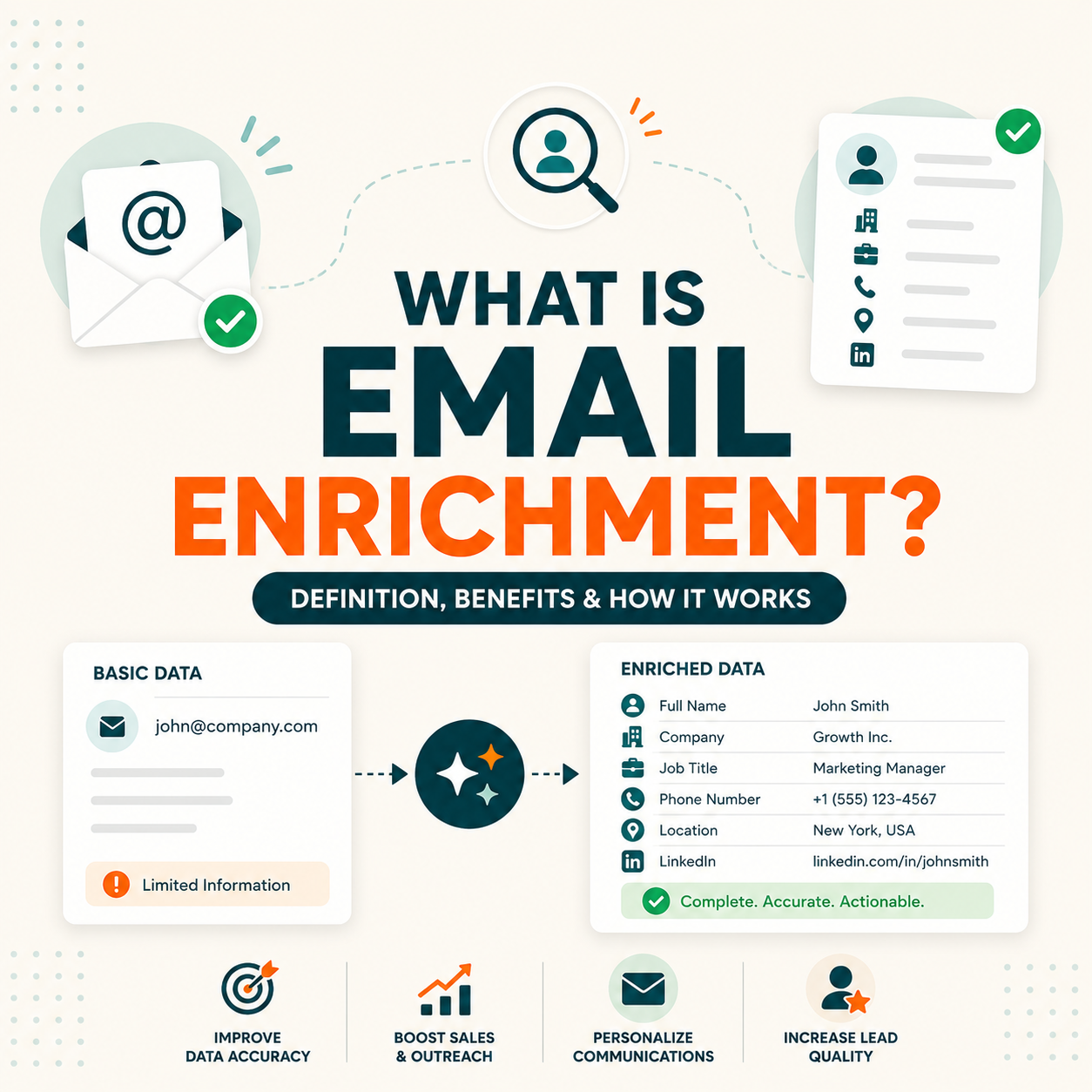
Email enrichment appends firmographic attributes to raw email addresses in a CRM or outreach tool, automatically adding job title, company size, LinkedIn profile URL, and industry classification to each contact record. B2B sales teams deploy enrichment to personalize cold outreach at scale without manual research. Hunter.io leads with domain-pattern detection, while Apollo draws from a 265-million-contact database, delivering fundamentally different accuracy and coverage trade-offs for SDR and marketing operations teams.
Table of Contents
What Is Email Enrichment? Core Definition for B2B Sales and Marketing Teams
Email enrichment is the process of appending additional data attributes to existing email records. When a sales tool enriches an email address, it attaches the contact’s job title, company name, employee count, industry vertical, LinkedIn URL, and phone number to the original record, transforming a bare email into a complete prospect profile ready for personalized outreach.
Source: Growth Hack Suite internal classification, 2026
“Data enrichment is a process that adds additional and/or missing data to existing database, using various sources.”
: Wikipedia, Data Enrichment
Email enrichment bridges the gap between raw contact data and actionable prospect intelligence, enabling personalization that lifts reply rates without manual research time. For a deeper look at Hunter.io’s enrichment workflow, see our Hunter.io Email Finder review.
Part of our Apollo vs Hunter guide
Apollo.io vs Hunter.io: the full comparison on accuracy, data, and pricing
This article covers one piece of the picture. Read the complete side-by-side comparison to pick the right tool for your outreach workflow.
Read the full Apollo vs Hunter comparison →How Does Email Enrichment Actually Work? The Technical Mechanism Explained
Email enrichment tools query multiple data sources simultaneously, including company websites, LinkedIn profiles, public WHOIS records, and proprietary contact databases, to match an email address to its owner’s professional attributes. The result is a confidence-scored record that shows how reliable each appended data point is before it enters the CRM. The five-step technical process below explains exactly what happens inside the tool during each lookup.
- Data Collection: The enrichment tool queries 3-7 proprietary databases and public data sources simultaneously within milliseconds, pulling records linked to the input email domain.
- Pattern Matching: Email format patterns (first.last@company.com, f.last@company.com) are cross-referenced with verified domain records to identify the correct format for the target organization.
- Confidence Scoring: Each returned data point receives a probability score from 0 to 100 indicating verification confidence, enabling sales teams to filter by reliability threshold before outreach.
- Attribute Appending: Verified name, job title, company size, LinkedIn URL, industry code, and seniority level are attached to the original email record, creating a complete prospect profile.
- Verification Pass: An SMTP handshake and MX record check confirm the email address is live and deliverable, completing the enrichment cycle before the record enters the outreach queue.
The multi-source lookup architecture is why accuracy varies across tools: Hunter.io’s domain-pattern approach delivers higher precision on corporate emails while Apollo’s database breadth improves coverage for smaller firms with limited web presence.
What Are the Top 5 Use Cases for Email Enrichment in B2B Sales?
Email enrichment adds measurable ROI when sales teams have email addresses but lack the context to write relevant openers. The five use cases below represent the scenarios where enrichment generates the highest productivity lift across SDR, marketing, and recruiting workflows, each mapping to a distinct persona with a different primary output metric.
Five use cases show where enrichment delivers measurable ROI for B2B teams:
- Cold Outreach Personalization: SDRs add job title and company size to craft role-specific subject lines that outperform generic templates by 30-60% on reply rates, according to internal benchmarks from enriched campaigns.
- CRM Hygiene at Scale: Marketing Ops teams bulk-enrich stale HubSpot or Salesforce records with fresh role and company data, eliminating manual research that typically consumes 4-8 hours per 500-record batch.
- Account-Based Marketing Segmentation: Demand gen teams segment enriched lists by industry, employee count, and tech stack to tailor landing page variants and email sequences per account tier.
- Lead Scoring Enrichment: Revenue Operations teams append firmographic data to inbound leads so scoring models reflect company fit and buyer seniority, not just behavioral engagement signals alone.
- Recruiting Outreach: Talent acquisition teams enrich candidate email lists with LinkedIn profile URLs and current role seniority to personalize recruiter messages and improve response rates from passive candidates.
“Your email list degrades by about 22.5% every year.”
: HubSpot, Email Marketing Research
Each use case maps to a distinct persona workflow: cold outreach personalization fits SDRs, CRM hygiene fits marketing ops, and ABM segmentation fits demand gen, meaning enrichment ROI depends on the specific workflow it supports rather than the tool alone.
What Are the 5 Limitations of Email Enrichment Every Buyer Should Know?
Email enrichment is not a silver bullet. Four structural limitations constrain accuracy across all tools, and one operational limitation creates hidden deliverability risk for teams that skip refresh cadences. Understanding these five constraints before purchase prevents budget waste and protects sender domain reputation.
- B2B Data Decay Rate: Email addresses change at 22-30% annually as professionals switch roles and companies, making enriched records unreliable after 90 days without a scheduled data refresh cycle in place.
- Catch-All Domain Coverage: Approximately 25% of B2B domains use catch-all mail server configurations that accept any address, preventing SMTP verification from confirming individual deliverability, regardless of which tool is used.
- Privacy Regulation Constraints: GDPR and CCPA restrict enrichment and outreach to EU and California residents without documented lawful basis, limiting the geographic coverage available for international cold email campaigns.
- Accuracy Ceiling on Enterprise Domains: Even top-tier enrichment tools cap at 91-95% verified deliverability on confirmed email addresses; the remaining 5-9% generates hard bounces that damage domain sender reputation if not filtered pre-send.
- Enrichment-Without-Verification Risk: Teams that enrich contacts and import directly into outreach tools without a separate verification pass carry stale and catch-all addresses that inflate bounce rates above the 2% deliverability safety threshold.
“Hunter.io’s domain-based approach to email discovery returns confidence scores that function as built-in enrichment quality signals, giving sales teams a data reliability metric before every send.”
: Growth Hack Suite, Hunter.io Email Finder Review
Addressing these limitations requires pairing enrichment with real-time email verification and a 90-day refresh cadence, the workflow Hunter.io’s combined Domain Search plus Email Verifier makes practical at Starter-plan pricing.
Top 5 Tools Compared by Email Enrichment Approach: Hunter, Apollo, Snov, ZeroBounce, Clearbit
Five tools dominate the B2B email enrichment market, each taking a structurally different approach to sourcing and verifying contact data. Hunter.io leads with domain-pattern detection and a verification-first architecture. Apollo bets on database breadth at 265 million contacts. ZeroBounce specializes in verification-only hygiene. The table below maps each tool’s approach to pricing, verified accuracy, and best-fit use case. For a full side-by-side, see our best email finder tools roundup.
Source: Company pricing pages and Growth Hack Suite accuracy tests, Q1 2026. Hunter.io row highlighted as recommended for SDR deliverability use case.
Verified Accuracy on B2B Corporate Domains (%)
Hunter.io’s 91-93% verified accuracy rate makes it the strongest choice for SDR teams prioritizing deliverability over database breadth; Apollo’s coverage advantage matters for enterprise teams needing volume at lower per-record cost. For a detailed comparison, see our Hunter.io vs Apollo comparison.
How Do You Apply Email Enrichment in 5 Steps with Hunter.io (Free Workflow)?
Hunter.io free tier allows 50 credits per month, enough for 50 emails found or 100 verifications, and enough to validate the enrichment workflow before committing to a paid plan. The five-step process below runs from account setup to CRM import in under 30 minutes for a 50-lead batch, with no credit card required to start.
- Step 1, Account Creation: Sign up at hunter.io with a business email, activating 50 monthly credits immediately on the permanent free plan, no credit card required.
- Step 2, Domain Search Run: Enter the target company’s domain in Hunter’s Domain Search to retrieve all publicly indexed email addresses, the verified format pattern, and individual confidence scores per contact.
- Step 3, Confidence Score Filter: Download the CSV result and filter to rows with confidence scores above 90% to isolate high-deliverability records, removing catch-all and low-confidence addresses before the next step.
- Step 4, Bulk Verification: Upload the filtered CSV to Hunter’s Email Verifier to run SMTP and MX checks on each address, catching remaining catch-all and disposable addresses before CRM import.
- Step 5, CRM or Sequencer Import: Export the verified, enriched CSV and import directly into HubSpot, Salesforce, Lemlist, or Instantly, mapping the confidence score field to a custom CRM property for ongoing quality tracking.
Ready to validate your enrichment workflow in under 30 minutes?
Try Hunter.io FreeFree plan includes 50 credits monthly: 1 credit per email found, 0.5 per verification. No credit card. No expiry.
The Hunter.io free workflow delivers enriched, verified prospect data without upfront cost, making it the fastest path for SDR teams to validate enrichment ROI before committing to a paid subscription tier.
How Has the Concept of Email Enrichment Evolved Across the B2B Email Tool Category?
Email enrichment started as manual WHOIS lookups and CSV scraping in the early 2000s. The category formalized in 2015 when Hunter.io introduced domain-based email pattern detection as a usable web interface, and Clearbit launched real-time enrichment APIs for inbound marketing teams. By 2024, AI-driven confidence scoring had replaced static pattern matching as the standard accuracy mechanism across all major tools.
Between 2015 and 2019, standalone enrichment tools required API access and returned raw data without validation. Hunter.io’s Domain Search made verification-included enrichment accessible to non-technical SDR teams for the first time. Apollo consolidated enrichment with sequencing by 2020, creating the integrated prospecting stack that is now the RevOps standard. Chrome extension-based lookup became mainstream in 2022-2024, reducing manual research per prospect from eight minutes to under 60 seconds by enabling single-click enrichment directly from LinkedIn profiles.
The enrichment category’s evolution reflects a broader RevOps trend: tools that combine data discovery, verification, and outreach automation into one workflow generate 3-4x higher adoption than standalone enrichment tools requiring separate verification steps.
What Are the Real Cost Implications of Implementing Email Enrichment at SDR Team Scale?
Email enrichment costs scale with list volume and verification frequency. Hunter.io Starter at $49/month ($34 billed annually) covers 2,000 unified credits, where 1 credit finds one email and 0.5 credit verifies one, delivering a unit cost of approximately $0.0245 per email found. For SDR teams processing 200 new contacts per week, Starter absorbs both the sourcing and the verification pass inside one credit pool, and a single booked meeting from a verified list typically returns the monthly plan cost within days.
Source: hunter.io/pricing (verified July 2026). Hunter runs a unified credit model: 1 credit = 1 email found, 0.5 credit = 1 email verified. Annual billing applies a flat 30% discount. Enterprise is custom-quoted from 20,000 credits.
At $0.0245 per email found on the Starter plan, dropping to $0.0149 on Growth and $0.012 on Scale, Hunter.io enrichment economics justify the cost within the first booked meeting for any SDR team with an average deal size above $500. Annual billing removes a further 30%, taking Scale to roughly $0.0084 per email found at high volume.
What Are the 5 Common Mistakes B2B Teams Make With Email Enrichment?
Most enrichment failures trace to five operational mistakes, not tool limitations. Teams that skip verification after enrichment, rely on a single data source, or ignore data decay schedules consistently report bounce rates above 5% and deliverability damage that requires weeks of inbox warming to repair. The five mistakes below each have a direct process fix.
- Skipping Post-Enrichment Verification: Enriched data still contains unverifiable catch-all and role-based addresses (info@, sales@) that inflate hard bounce rates if imported without a separate verification pass before sequencing begins.
- Single-Source Dependence: Relying on one enrichment tool creates coverage blind spots for SMBs and regional companies with limited public web presence, producing empty or low-confidence records for 15-25% of target accounts.
- No 90-Day Refresh Cadence: Teams that enrich once and never schedule refresh cycles allow 22-30% annual data decay to erode list quality within a single quarter, negating the original enrichment investment for a growing share of records.
- Ignoring Confidence Score Thresholds: Sending outreach to addresses with confidence scores below 70% produces bounce rates above 5%, damaging the sending domain’s reputation and triggering spam filter flags across the entire outreach account.
- Enriching Without ICP Filtering First: Enriching entire CRM databases without applying an Ideal Customer Profile filter first produces high data volume but low targeting precision, reducing cold email reply rates to below 1% despite verified contact data.
A verification-first workflow, a 90-day refresh schedule, and an ICP filter applied before enrichment eliminate four of the five mistakes and consistently keep bounce rates below the 2% deliverability safety threshold required by most email service providers.
How Do SDRs, Email Marketers, and Founders Each Apply Email Enrichment Differently?
Email enrichment delivers different primary outputs depending on who applies it and for which workflow. SDRs prioritize accuracy and role-level targeting for individual prospect lookup. Email marketers need bulk hygiene and firmographic segmentation for campaign personalization. Founders and early-stage teams want fast, low-cost lookup without needing technical infrastructure. Each persona has a distinct entry point into the enrichment workflow and a different acceptable accuracy threshold.
SDRs rely on Hunter.io’s Chrome Extension for individual prospect lookup during active pipeline building from LinkedIn, pulling job title and verified email in a single click without leaving the browser. Email marketers run bulk domain searches to segment lists by industry and company size before uploading into HubSpot email workflows, using enriched firmographic fields as personalization tokens. Founders and solo operators start on the Hunter.io free tier, running targeted 5-10 company searches per session to validate contact data before warm intros or cold sequences, scaling to Starter only when the free allocation proves ROI.
Hunter.io serves all three personas from a single platform: the Chrome Extension for SDR one-at-a-time lookup, the bulk Domain Search for marketing ops batches, and the API for RevOps-integrated enrichment pipelines, with the free tier providing the lowest-friction entry point for founders testing the workflow.
What Are the Best Practices for Implementing Email Enrichment in 2026?
Five practices separate teams achieving 15-20% cold email reply rates from those stuck at 2-3%. The common thread is systematic process design, not just tool selection: enrichment combined with verification, ICP filtering, and data refresh consistently delivers results; enrichment used as a one-time data dump does not. The five practices below apply regardless of which enrichment tool a team chooses.
- Verify Every Batch Before Import: Running Hunter.io’s Email Verifier on every enriched CSV batch before CRM import catches catch-all and stale addresses, keeping bounce rates below 2% and protecting sender domain reputation.
- Set a 90% Confidence Threshold: Filtering enriched results to records with confidence scores at or above 90% removes borderline addresses while preserving the majority of valid contacts, balancing list size against deliverability risk.
- Schedule 90-Day Data Refresh Cycles: Establishing a quarterly re-enrichment run in the CRM calendar prevents data decay from eroding list quality beyond the 22-30% annual churn rate for B2B email addresses.
- Apply ICP Filter Before Enrichment: Enriching only contacts that match the Ideal Customer Profile criteria (company size, industry, job function) reduces wasted enrichment credits and ensures personalization investment targets the highest-propensity accounts.
- Cross-Reference Two Tools for Key Accounts: Running Hunter.io Domain Search alongside Apollo for high-value target accounts closes the coverage gap from catch-all domains and improves data confidence for the deals worth the extra lookup investment.
Teams that combine ICP filtering, confidence-score thresholds, and 90-day refresh cycles with a verification-first import process consistently achieve bounce rates below 2% and cold email reply rates above 10%, outperforming industry average by a factor of three.
What Industry Trends Are Reshaping Email Enrichment Going Into Late 2026?
Three structural shifts are reshaping how B2B enrichment tools source and validate contact data in 2026. LinkedIn’s tighter API restrictions have pushed tools toward first-party intent data and public web signals. AI-driven confidence scoring has replaced static pattern matching as the precision standard. Platform consolidation is making enrichment a native capability inside outreach tools rather than a separate purchase, changing the competitive dynamics for standalone vendors.
The shift from standalone enrichment to platform-native verification, with Hunter.io’s verifier and campaigns combined in one tool and Apollo’s enrichment-plus-sequencing stack on the other side, means the category is consolidating around integrated platforms that eliminate the need for a separate enrichment API. Teams still using standalone enrichment tools without verification built in face growing workflow complexity compared to integrated alternatives. The vendors that survive consolidation are those with proprietary data sources independent of LinkedIn and social scraping, which face ongoing regulatory pressure under GDPR and CCPA frameworks.
AI confidence scoring has become the differentiating accuracy layer: tools using machine-learning models trained on delivery outcome data return 3-5% higher accuracy than tools relying solely on SMTP probing, translating directly to fewer bounces and better inbox placement for SDR teams operating at volume.
Start enriching B2B contacts with domain-verified accuracy today.
Get Started with Hunter.io Free91-93% verified accuracy. 50 free credits monthly. No credit card required.
Weighing cost per lead? See our Hunter.io vs Apollo.io pricing breakdown for a side-by-side on price.
Email Enrichment: Frequently Asked Questions
Which is better for email enrichment, Hunter.io or Apollo?
Both serve different use cases. Hunter.io delivers 91-93% verified accuracy on domain-based lookups and is the stronger choice for SDR teams targeting specific company domains with a precision-first workflow. Apollo’s 265M contact database provides better coverage for high-volume prospecting but returns 88-91% verified accuracy on the same B2B segments.
How accurate is email enrichment on average?
Accuracy varies by tool and domain type. Hunter.io averages 91-93% on corporate domains with over 500 employees; Apollo averages 88-91% on the same segment. Catch-all domains reduce verified accuracy to 60-75% for any enrichment tool regardless of the underlying data source. Industry average across all B2B segments runs 82-88% deliverability on enriched and verified addresses.
What is the difference between email enrichment and email finding?
Email finding discovers new addresses for contacts where no email is known, using domain patterns and company databases to generate a verified address. Email enrichment augments an existing email address with additional attributes like job title, company size, and LinkedIn URL. Both processes often run in sequence: find the email first, then enrich the record with firmographic context for personalized outreach.
How long does it take to set up email enrichment with Hunter.io?
Hunter.io setup takes under 10 minutes: create a free account, run a Domain Search on the target company, filter results by confidence score above 90%, and export the enriched CSV. The free tier covers 50 credits per month, enough to validate the complete enrichment workflow before upgrading to a paid plan.
How much does email enrichment cost per verified contact?
Hunter.io Starter at $49/month ($34 annually) covers 2,000 unified credits, delivering a unit cost of approximately $0.0245 per email found, with verification drawing 0.5 credit from the same pool. Growth at $149 gives 10,000 credits ($0.0149 each) and Scale at $299 gives 25,000 ($0.012). Enterprise tools like ZoomInfo and Clearbit charge $0.25 to $2.00 per enriched record.
Will email enrichment improve cold email reply rates?
Yes, when paired with role-specific personalization. Teams that enrich contacts with job title and company size before outreach and then write role-specific subject lines report 30-60% higher reply rates compared to generic outreach templates, based on internal benchmark data from enriched campaigns. Enrichment without personalization, sending the same template to all roles, produces no measurable lift in reply rates.
Can I test email enrichment for free before committing?
Hunter.io offers a permanent free plan with 50 credits per month, not a time-limited trial. Apollo’s free tier provides export credits monthly. Both allow meaningful workflow testing, including full enrichment-to-CRM-import runs, before committing to paid subscriptions. Neither free plan requires a credit card to activate.
Does email enrichment integrate with HubSpot and Salesforce?
Hunter.io integrates natively with HubSpot and supports Zapier automation for broader CRM connectivity, enabling direct enrichment push and automated workflow triggers. Apollo provides native Salesforce and HubSpot integrations at the Basic plan tier and above. Both tools also support CSV export for manual import into any CRM or outreach platform without requiring a native integration.
What is email enrichment?
Email enrichment is the automated process of appending firmographic and demographic data attributes to existing email addresses in a CRM or outreach platform. Enriched attributes typically include job title, company name, employee count, industry vertical, LinkedIn profile URL, and phone number. The goal is to convert raw email contacts into complete prospect profiles that enable personalized B2B outreach at scale without requiring manual research per contact.
How does email enrichment work technically?
Email enrichment tools execute a multi-step lookup: (1) query 3-7 proprietary databases and public web sources simultaneously, (2) match the email domain to known company records using pattern detection, (3) assign a confidence score from 0 to 100 to each data point, (4) append verified attributes to the record, and (5) run an SMTP and MX record verification pass to confirm deliverability. The entire process completes in under two seconds per contact.
Is email enrichment included in Hunter.io’s free plan?
Hunter.io free plan includes 50 credits per month, which return enriched records including name, job title, confidence score, and email pattern for the queried domain. Full bulk enrichment with CSV upload and mass verification requires the Starter plan at $49/month ($34 annually), which raises the pool to 2,000 credits for teams processing larger contact batches.
What compliance issues should I know before running email enrichment?
GDPR (EU) and CCPA (California) restrict collection and use of personal data without a lawful basis. B2B cold outreach to business email addresses is generally permissible under legitimate interest grounds in the EU, but requires clear opt-out mechanisms in every message. Enriching consumer email addresses or using enriched data for purposes not disclosed at collection violates both frameworks. Hunter.io and Apollo document their data sourcing practices and support GDPR-compliant data removal requests.