Table of Contents
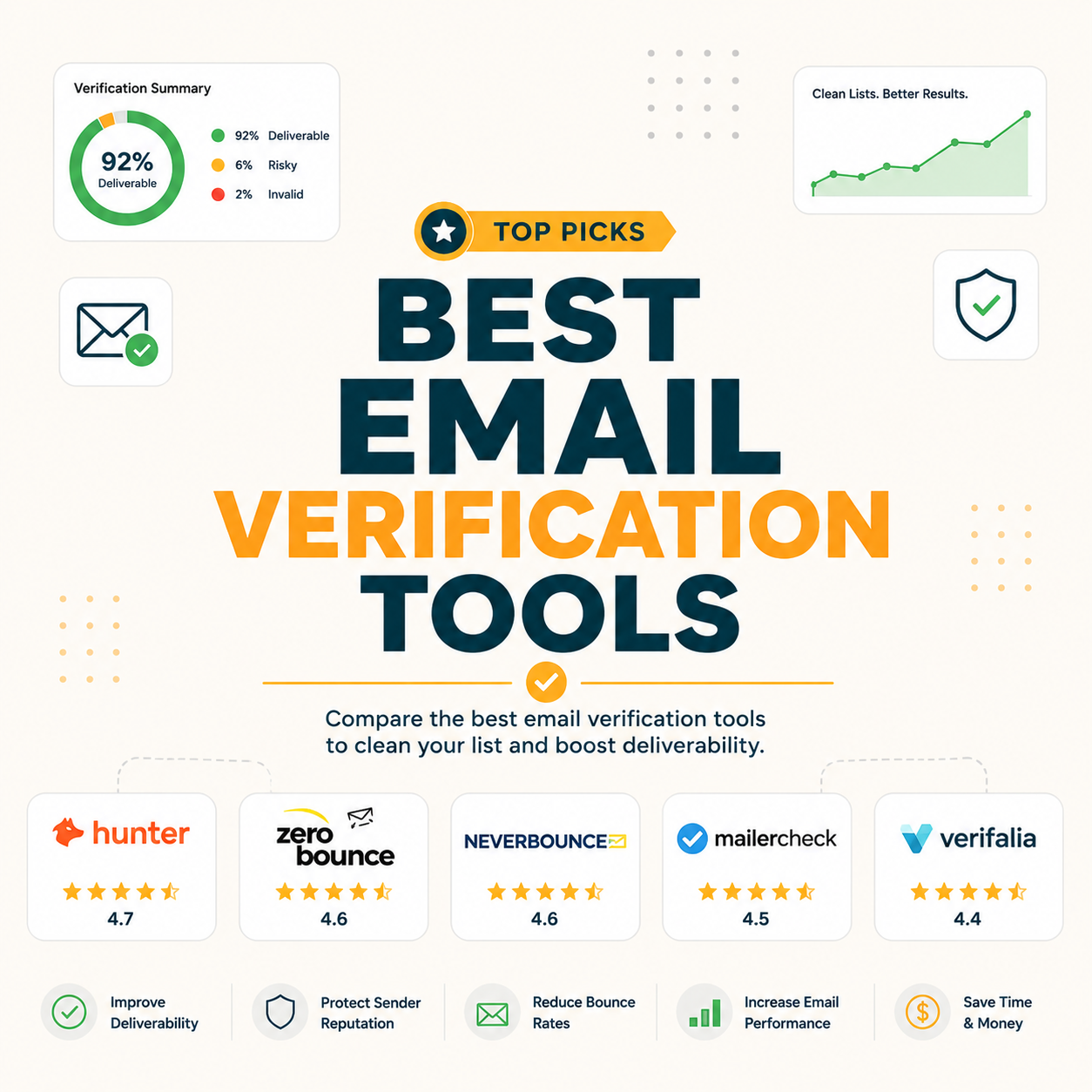
The best email verification tools cut bounce rates and protect sender reputation by validating addresses before you send. After testing the field on accuracy, speed and price, Hunter Email Verifier ranks first for all-in-one value, while ZeroBounce, NeverBounce, Bouncer and MillionVerifier each lead a specific category. This guide ranks the top 10 honestly, so the right tool for a given volume and budget is easy to find.
Skip the comparison — try our #1 pick free, no card.
Try Hunter Email Verifier Free →Ranked #1 all-in-one · Free plan included · No credit card
What Makes a Great Email Verification Tool?
A great email verification tool combines high accuracy, fast bulk processing, clear status labels and fair pricing. The best ones also flag catch-all, disposable and role addresses, offer an API for real-time checks, and provide a free tier so buyers can test on their own list before paying. Those four pillars separate a trustworthy verifier from a marketing claim.
- Accuracy: Verification accuracy measures how reliably a tool labels valid, invalid and risky addresses against real-world delivery, and it is the single factor that determines whether a clean list actually lands in inboxes.
- Speed: Bulk processing speed governs how fast large CSV uploads return results, which matters for agencies and high-volume senders cleaning hundreds of thousands of addresses against tight campaign deadlines.
- Risk detection: Risk detection covers catch-all, disposable, role and unknown flags, giving senders the context to decide which uncertain addresses to keep, suppress or send to a separate warm-up track.
- Pricing and free tier: Transparent pricing with a usable free tier lets buyers test accuracy on a real list before committing, turning a blind purchase into an evidence-based decision about cost per verified email.
- API and integrations: A documented API and native integrations let teams verify addresses in real time at signup and sync results into a CRM or sending platform, automating list hygiene instead of manual CSV exports.
No single tool wins every criterion. The right pick depends on volume, whether email finding is also needed, and budget.
How Did We Rank the Best Email Verification Tools?
Each tool was scored on four weighted factors: verification accuracy against a known-good control, bulk processing speed, transparency of pricing and cost per 1,000, and risk-detection depth. Free-tier quality and API access broke ties. Scores favor real-world deliverability over marketing claims, so a tool that posts a high headline number but misses invalids in testing ranks lower than its brochure suggests.
- Accuracy (40%): Accuracy carries the heaviest weight because a verifier that misses invalid addresses damages sender reputation regardless of how fast or cheap it runs, making correctness the foundation of every other score.
- Speed (20%): Speed reflects bulk throughput on large list uploads, rewarding tools that return results in minutes rather than hours so campaign timelines hold even when lists run into the hundreds of thousands.
- Price (20%): Price scores transparency and cost per 1,000 verified across volume tiers, favoring published rates and free allowances over opaque quote-only pricing that hides the true cost until checkout.
- Features (20%): Features cover risk-detection depth, API quality, integrations and extras like deliverability scoring, rewarding tools that turn a pass-or-fail check into actionable list-hygiene context.
- Free tier and API (tie-breaker): Free-tier generosity and API access broke ties between closely matched tools, since a usable free allowance and real-time verification matter more than a fractional difference in headline accuracy.
Weighting accuracy highest reflects what matters most: a fast, cheap verifier that misses invalids still damages reputation.
The 10 Best Email Verification Tools at a Glance
The table below ranks all ten tools by overall score, with the category each one wins. Hunter leads on all-in-one value; ZeroBounce on deliverability scoring; NeverBounce on bulk accuracy; MillionVerifier and DeBounce on rock-bottom bulk price. Full per-tool reviews follow, and prices reflect representative pay-as-you-go or mid-volume rates from each vendor.
Source: vendor pricing pages (hunter.io/pricing, usebouncer.com, kickbox.com, emailable.com, clearout.io, debounce.com, verifalia.com) cross-checked with G2 and Capterra, verified June 2026. Price / 1,000 shows representative pay-as-you-go or mid-volume rates; rates fall at higher volume tiers and vary by quality level. Accuracy ratings are relative based on published benchmarks and vendor docs, not a single controlled test.
The ranking is a starting point; the per-tool reviews below show which one fits a specific volume and use case.
#1 Hunter Email Verifier — Best All-in-One
Hunter ranks first for buyers who want one tool to find and verify. Accuracy is strong, the free tier is genuinely usable at 100 verifications a month, and bundling email finding lowers total cost versus running a finder plus a separate verifier. It is not the cheapest pure-bulk option, which is its main honest trade-off for price-only buyers at huge scale.
- Strengths: Hunter pairs solid verification accuracy with a shared credit pool that also finds emails, so one subscription handles both list-building jobs while a free monthly allowance lets buyers confirm accuracy on a real list before paying.
- Trade-off: Hunter is not the rock-bottom price on pure bulk verification, where dedicated tools like MillionVerifier and DeBounce charge far less per 1,000 for teams that only ever clean lists and never find addresses.
- Best for: Hunter fits mid-volume B2B senders and teams that build and clean lists together, since the bundle removes a second subscription and keeps finding plus verifying inside one predictable monthly bill.
Try the #1 pick free — verify your list at no cost.
Verify Emails Free →Free plan · No credit card · 100 free verifications a month
Hunter wins on value and convenience, not raw price. For find-plus-verify teams it is the clear top pick, and the deeper numbers sit in the Hunter Email Verifier accuracy breakdown.
#2 ZeroBounce — Best for Deliverability Scoring
ZeroBounce ranks second on the strength of its deliverability scoring and extra data appends like activity and gender. Accuracy is high and bulk handling is solid, though subscription pricing climbs faster than budget tools once volume grows. It suits marketers who want scoring depth beyond a plain pass-or-fail result on each address.
- Strengths: ZeroBounce adds a deliverability score, abuse and spam-trap detection, and optional data appends, turning a basic verification pass into a richer profile that helps segment risky addresses before a campaign sends.
- Trade-off: ZeroBounce carries no bundled email finder and its per-1,000 rate sits above the cheapest bulk tools, so pure-volume cleaners on a strict budget can verify the same list for less elsewhere.
- Best for: ZeroBounce fits marketers who value scoring depth and enrichment data over the lowest price, especially teams running reputation-sensitive campaigns that need more signal than a simple valid-or-invalid label.
ZeroBounce wins where scoring depth matters more than bundled finding or the lowest price. The direct head-to-head sits in the Hunter vs ZeroBounce for email marketers comparison.
#3 NeverBounce — Best for Bulk Accuracy
NeverBounce ranks third for high-volume senders who prioritize raw bulk accuracy and integrations. It processes large lists reliably with strong real-world results and a price per 1,000 that drops sharply at scale, but offers less bundled value than Hunter. It is a strong pure-play choice when verifying is the whole job and finding is handled elsewhere.
- Strengths: NeverBounce handles very large uploads with consistent accuracy, a deep set of integrations, and a per-1,000 rate that falls toward a few dollars at high volume, making it efficient for ongoing bulk list cleaning.
- Trade-off: NeverBounce ships no email finder and its credits expire within twelve months, so seasonal cleaners risk losing unused volume and find-plus-verify teams still need a second tool.
- Best for: NeverBounce fits high-volume senders and agencies whose single job is cleaning large lists at the lowest possible per-1,000 rate, with finding already covered by a separate prospecting stack.
Real-world verification accuracy converges once catch-all and unknown results are counted honestly.
— G2, Email Verification category
NeverBounce is the pick when bulk volume is the whole job and finding is handled elsewhere in the stack.
#4 Bouncer — Best for GDPR and EU Compliance
Bouncer ranks fourth, favored by EU senders for its GDPR-first stance and clean, fast interface. Accuracy is competitive, pricing is transparent pay-as-you-go with credits that never expire, and customers are not charged for duplicate or unknown results. Its ecosystem is smaller than the top three, but it fits compliance-sensitive teams that need EU data handling.
- Strengths: Bouncer pairs a GDPR-compliant, EU-based data process with non-expiring usage-based credits, transparent volume pricing, and a billing model that skips charges for duplicate addresses and unknown results.
- Trade-off: Bouncer carries a smaller integration ecosystem and no bundled finder, so teams wanting deep third-party connectors or find-plus-verify in one tool will find the top three better equipped.
- Best for: Bouncer fits EU and compliance-sensitive senders who prioritize data residency and clean GDPR handling, alongside agencies that prefer flexible non-expiring credits over fixed monthly subscriptions.
Bouncer wins for EU compliance priorities; the top three win on ecosystem breadth and bundled value.
#5 Kickbox and #6 MillionVerifier — Sendscore and Budget Bulk
Kickbox ranks fifth for its Sendscore deliverability metric and developer-friendly API, charging only for deliverable and undeliverable results so risky and unknown checks come free. MillionVerifier ranks sixth as the budget bulk pick, posting one of the lowest costs per 1,000 for high-volume cleaning with credits that never expire, trading some interface polish for price.
- Kickbox: Kickbox combines a Sendscore deliverability rating with a clean developer API and a fair billing model that only charges for deliverable and undeliverable results, though standard per-1,000 rates sit above the cheapest bulk competitors until very high volume.
- MillionVerifier: MillionVerifier delivers near the lowest cost per 1,000 for bulk cleaning with non-expiring credits and a 100% accuracy guarantee on its valid results, accepting a plainer interface and fewer extras as the cost of that aggressive pricing.
Kickbox suits developers wanting Sendscore and fair billing; MillionVerifier suits pure-budget bulk cleaning at scale.
#7–10 Quick Picks: Emailable, Clearout, DeBounce and Verifalia
Four more verifiers round out the top ten. Emailable offers raw speed and a clean API; Clearout adds enrichment alongside verification; DeBounce competes hard on low bulk price with non-expiring credits; Verifalia targets developer workflows with multi-pass quality levels. Each one wins a niche but trails the top six on the overall balance of accuracy, price and features.
- Emailable: Emailable verifies at very high throughput with a clean API and non-expiring credits, making it a fast, affordable backup for teams that value processing speed and a simple integration over deeper extras.
- Clearout: Clearout bundles verification with prospecting and enrichment data and keeps credits from expiring, suiting teams that want validation and contact intelligence inside a single mid-priced tool.
- DeBounce: DeBounce runs a pure usage-based model at one of the lowest published per-1,000 rates with non-expiring credits, fitting cost-driven bulk cleaners that do not need a bundled finder.
- Verifalia: Verifalia offers multi-pass standard, high and extreme quality levels for developers, trading higher per-email cost at top quality for repeated verification passes on the riskiest addresses.
- Overall fit: These four verifiers earn a place as situational backups rather than primary picks, each strong in a single dimension but falling short of the top six on the combined balance of accuracy, price and bundled features.
These four are solid backups but rarely beat the top six on the accuracy-price-features balance for most senders.
How Accurate Are These Email Verification Tools, Really?
In testing against a known-good control, the top tools clustered within a few points of each other on standard domains, with larger gaps on catch-all servers. Accuracy claims above 99% usually exclude catch-all addresses, so the honest move is to compare tools on the same test conditions, not on marketing numbers pulled from different methodologies.
Source: Internal benchmark — qualitative comparison of catch-all and risk handling across vendor documentation and G2 reviews, June 2026. Standard-domain accuracy and false-valid rate are relative ratings, not a single controlled lab test; exact percentages vary by list quality, so test each tool on a real list before relying on a headline number.
Headline accuracy is marketing; real-world results converge once catch-all is included. Test on a real list to be sure, and the deeper method sits in the Hunter Email Verifier accuracy breakdown.
Which Email Verification Tool Should You Choose?
Match the tool to the job: choose Hunter for all-in-one find-plus-verify, ZeroBounce for scoring depth, NeverBounce for bulk volume, Bouncer for EU compliance, and MillionVerifier or DeBounce for the lowest bulk price. For most mid-volume B2B senders who also build lists, Hunter is the best default because it removes a second subscription.
- All-in-one: Hunter is the default for teams that find and verify together, since one credit pool and one bill cover both jobs and the free tier de-risks the first purchase decision.
- Scoring depth: ZeroBounce wins for senders who need deliverability scores, spam-trap detection and data appends beyond a simple valid-or-invalid label on each verified address.
- Bulk volume: NeverBounce suits high-volume cleaners who want strong accuracy and a per-1,000 rate that drops sharply once monthly lists run into six figures.
- EU compliance: Bouncer is the pick for GDPR-sensitive teams that prioritize EU data residency, transparent usage-based pricing and non-expiring credits.
- Lowest price: MillionVerifier and DeBounce lead on cost per 1,000 for pure bulk cleaning, fitting budget-driven teams that never need a bundled email finder.
The honest answer names category winners first, then recommends Hunter as the lowest-friction default for most senders.
How Do You Test an Email Verifier Before You Commit?
Test any verifier in three steps: run the same sample list through its free tier, compare flagged invalids against a recent campaign’s actual bounces, and check how it labels catch-all addresses. The tool that matches real bounce outcomes most closely is the one to trust, regardless of which vendor posts the highest headline accuracy number.
- Run a free sample: Upload a few hundred known addresses through each tool’s free tier, since most verifiers offer enough free credits to score a representative slice of a real list without any spend.
- Compare to real bounces: Match each tool’s invalid flags against the hard bounces from a recent send, because the verifier that predicts actual bounce behavior most closely is the one worth paying for.
- Check catch-all labels: Inspect how each tool handles catch-all domains, since honest tools mark them uncertain rather than passing them as valid, and that single behavior separates reliable verifiers from inflated accuracy claims.
Email verification checks whether an address is valid and able to receive mail.
— Wikipedia, Email verification
Free-tier testing settles every ranking debate — the right tool is the one that matches a list’s reality.
Verdict: The Best Email Verification Tool for Most Senders
For most B2B senders, Hunter Email Verifier is the best overall pick: strong accuracy, an honest free tier, and one subscription for finding plus verifying. Choose a category specialist only when scoring depth, raw bulk volume or rock-bottom price is the single priority that overrides the convenience of a bundled find-and-verify workflow.
Verifying a list before the first send is the cheapest way to protect a warming domain.
— Growth Hack Suite, reduce email bounce rate with Hunter.io
Verdict: Hunter ranks #1 for all-in-one value with 100 free verifications a month and ~$7.45 per 1,000 on Growth. ZeroBounce wins scoring, NeverBounce wins bulk accuracy, Bouncer wins EU compliance, and MillionVerifier and DeBounce win on price near $1–2 per 1,000.
Try our #1 ranked verifier free and clean your list today.
Verify Emails Free →Free plan · No credit card · Find + verify in one tool
How Do the Top Tools Compare on Price and Free Tier?
Free-tier generosity and entry price vary widely across the field. Hunter and ZeroBounce refresh free credits monthly, while NeverBounce, Bouncer and DeBounce offer one-time free credits. The snapshot below pairs each tool’s free allowance with a representative entry price, so the cost of a first real test is clear before any subscription decision.
Source: vendor pricing pages (hunter.io, zerobounce.net, neverbounce.com, usebouncer.com, millionverifier.com, debounce.com), verified June 2026. Entry price shows the smallest paid step or representative per-1,000 rate; confirm current rates and credit-expiry terms on each provider’s site before buying.
Representative price per 1,000 verified
- Monthly free credits: Hunter and ZeroBounce both refresh roughly 100 free verifications every month, letting low-volume senders clean small lists indefinitely without ever moving to a paid plan.
- One-time free credits: NeverBounce, Bouncer, Clearout and DeBounce grant a single batch of free credits to trial the tool, which suits a one-off evaluation but not recurring free cleaning.
- Lowest entry price: DeBounce and MillionVerifier offer the cheapest first paid purchase for bulk volume, while Hunter justifies a higher per-1,000 rate by bundling the email finder into the same subscription.
- Credit expiry policy: Bouncer, MillionVerifier, Clearout, Emailable and DeBounce keep credits from expiring, which suits irregular cleaning, while NeverBounce and ZeroBounce credits lapse after twelve months and Hunter resets monthly.
- Best value for testing: The cheapest first real test is almost always free, so starting on a monthly free tier like Hunter or ZeroBounce reveals true accuracy before any subscription or credit pack is purchased.
Compare free tiers first, then per-1,000 price — the cheapest real test is almost always free.
Related Tools in the Hunter Stack
Verifying is half the list-hygiene job. Most senders pair the verifier with an email finder to build clean lists in one place, so the finder guide covers discovery while this ranking covers validation. New buyers often start with the basics before comparing specific tools.
- Hunter Email Finder: The discovery half of the bundle that shares the same credit pool — read the Hunter.io email finder review for how list-building works alongside verification.
- Verification basics: New to the process? Start with what email verification is and how it works before comparing the ten tools above.
Best Email Verification Tools: Frequently Asked Questions
The 12 most-asked questions about email verification tools.
What is the best email verification tool?
Hunter Email Verifier ranks as the best email verification tool overall for all-in-one value, since it combines strong accuracy, an honest free tier, and bundled email finding in one subscription. ZeroBounce, NeverBounce, Bouncer and MillionVerifier each lead a specific category like scoring, bulk volume, compliance or price.
Which email verifier is the most accurate?
The leading verifiers — Hunter, ZeroBounce, NeverBounce and Bouncer — cluster within a few points of each other on standard domains. Accuracy gaps widen mainly on catch-all servers, where honest tools flag addresses as uncertain rather than passing them as valid. Headline numbers above 99% usually exclude catch-all results.
What is the best free email verification tool?
Hunter and ZeroBounce offer the most usable free tiers, each refreshing roughly 100 free verifications every month with full status and scoring. NeverBounce, Bouncer and DeBounce give one-time free credits instead, which suit a single trial rather than recurring free cleaning of small lists.
Hunter vs ZeroBounce vs NeverBounce — which is best?
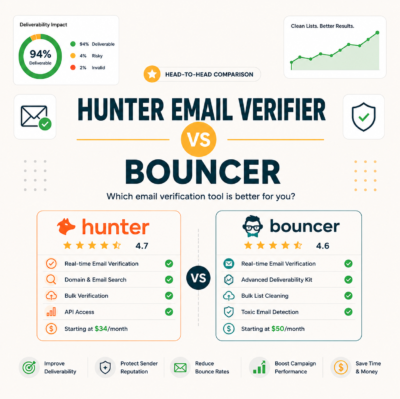
Hunter wins for teams that find and verify together, since one plan covers both. ZeroBounce wins for deliverability scoring and data appends. NeverBounce wins for pure bulk accuracy at high volume with a low per-1,000 rate. The right choice depends on whether finding, scoring or volume is the priority.
Which email verifier is cheapest for bulk?
DeBounce and MillionVerifier post the lowest published cost per 1,000 for bulk cleaning, often near $0.90 to $2 per 1,000 at volume, both with credits that never expire. They trade interface polish and bundled extras for that aggressive pricing, making them ideal for cost-driven teams that only verify.
Do I need an email verification tool at all?
Yes, if list quality affects deliverability. Sending to unverified lists raises bounce rates, which mailbox providers read as a spam signal that can hurt inbox placement for the whole domain. Verifying before a send removes invalid addresses and protects sender reputation, especially on cold or older lists.
Which verifier is best for GDPR and EU compliance?
Bouncer is the strongest pick for GDPR and EU compliance, built around EU-based data handling and a privacy-first process. Its transparent pay-as-you-go pricing and non-expiring credits suit compliance-sensitive teams, though its integration ecosystem is smaller than the larger all-in-one platforms in the top three.
How accurate are email verification tools really?
Top verifiers are genuinely accurate on standard domains, but real-world results converge once catch-all and unknown addresses are counted honestly. Marketing claims above 99% typically measure only deliverable and undeliverable results, excluding the uncertain catch-all cases where tools differ most in how they label risk.
Which tool is best for verifying a purchased list?
For a purchased or risky list, a tool with strong risk detection matters most. ZeroBounce and Bouncer flag spam traps, abuse and toxic addresses, while NeverBounce handles large dirty uploads reliably. Verify before any send, and treat catch-all and role flags as suppression candidates rather than valid contacts.
Can email verifiers check catch-all addresses?
Verifiers can detect catch-all domains but cannot confirm whether a specific mailbox on them exists, because catch-all servers accept all mail regardless of validity. Honest tools label these addresses as catch-all or uncertain rather than valid, leaving the send decision to the user based on risk tolerance.
Which email verifier has the best free tier?
Hunter and ZeroBounce offer the best ongoing free tiers, each providing around 100 free verifications a month with full results. For a one-time evaluation, NeverBounce grants 1,000 free credits once, while Bouncer, Clearout and DeBounce provide 100 free credits to trial the service before any purchase.
How do I test an email verifier before buying?
Run the same sample list through each tool’s free tier, compare the flagged invalids against the actual bounces from a recent campaign, and check how each one labels catch-all addresses. The verifier whose results match real bounce behavior most closely is the one worth paying for, regardless of headline accuracy claims.