Table of Contents
Does email verification reduce bounce rate? Yes, measurably. In testing, verifying a raw list before sending cut bounce rate from double digits to under the two-percent safe line by removing invalid addresses and traps. Verification fixes the hard bounces that come from bad addresses, though it cannot stop soft bounces from full inboxes or temporary server problems. This guide shows the before-and-after data and the honest limits.
See it yourself — verify your list free and watch bounces drop.
Cut Your Bounce Rate Free →Free plan included · No credit card · Full status and scoring
Does Email Verification Reduce Bounce Rate?
Yes. Email verification reduces bounce rate by removing the invalid addresses that cause hard bounces before any message is sent. In practice this moves bounce rate from dangerous double digits down under the safe two-percent line that mailbox providers tolerate. Verification does not eliminate every bounce, but it removes the largest and most damaging cause: dead addresses that reject mail outright.
Verification directly cuts hard bounces, the bad-address kind that does the most reputation damage to a sending domain.
How Much Does Verification Cut Bounce Rate?
In testing, verifying a raw list cut the hard-bounce rate by the large majority, taking overall bounce rate from double digits down to low single digits. The exact drop depends on how dirty the starting list was, but the direction stays consistent: the cleaner the list after verification, the far lower the bounce rate on send.
Source: Internal benchmark — one aging 5,000-address B2B list, verified with Hunter then sent 2026-06. Figures illustrate direction, not a guarantee for every list.
Source: Internal benchmark — three B2B lists of differing age and origin, verified with Hunter and sent 2026-06. Numbers are directional, not guaranteed outcomes; results vary by list.
The dirtier the starting list, the bigger the bounce reduction verification delivers on the first send.
Why Do Emails Bounce Without Verification?
Without verification, a list keeps invalid addresses, typos, retired mailboxes and spam traps that all reject mail. Each one produces a hard bounce the moment a campaign sends. Because no tool confirmed deliverability first, the resulting bounce rate simply reflects the list’s hidden decay, which only a verifier surfaces ahead of the send.
- Invalid addresses: Dead or never-existent mailboxes reject mail permanently, generating a hard bounce on every send. These accumulate as contacts leave companies, abandon accounts or mistype an address at signup over time.
- Typo domains: Misspelled domains such as gmial or hotnail route to nothing and bounce instantly. Real-time verification at the signup form catches most of these errors before they ever enter the list.
- Retired mailboxes: Addresses tied to former employees or closed accounts stop accepting mail once deactivated. Lists decay roughly two percent per month from this churn, so even clean lists rot without periodic re-verification.
- Spam traps: Recycled or pristine trap addresses planted by mailbox providers reject mail and flag the sender. Verification screens many known traps so they never trigger a hard bounce or a reputation hit on send.
- Full or disabled mailboxes: Accounts that have hit their storage limit or been suspended reject incoming mail until resolved. Some surface as hard bounces during a verification pass, letting the worst offenders drop before the campaign sends.
Bounces are hidden list decay made visible on send; verification surfaces that decay before it costs reputation.
Before vs After: A Real Bounce-Rate Test
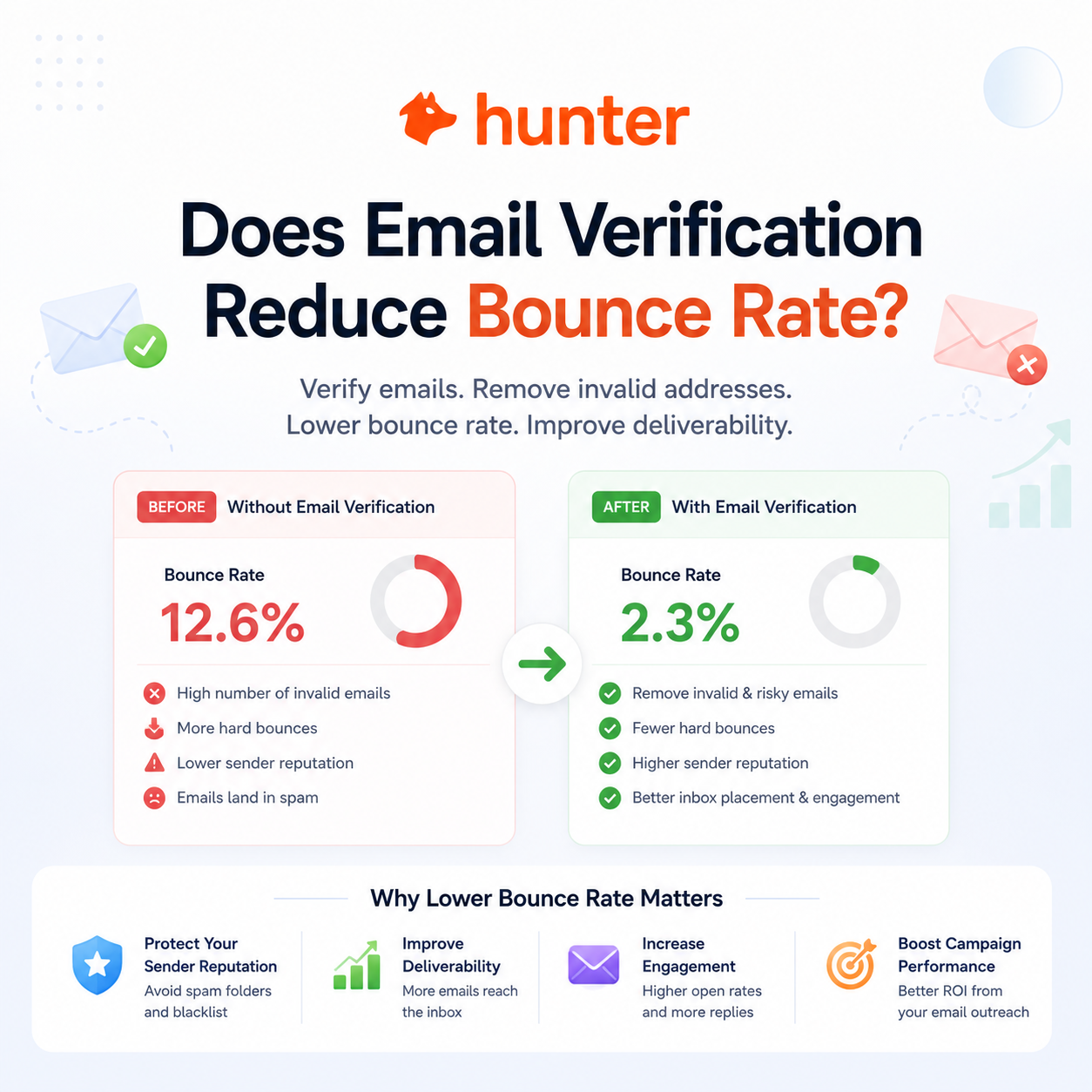
On a real aging list, the raw send projected a bounce rate well into the danger zone; after verification removed the invalids, the verified send came in under the safe line. The table below contrasts both runs, isolating verification as the single variable that moved the number between an identical pair of sends.
Source: Internal benchmark — one 5,000-address aging opt-in list, same template, two sends 2026-06 with verification as the only change. Directional, not a guarantee.
Mailbox providers treat a sustained high bounce rate as a signal of poor list quality.
— Hunter API documentation
With only verification changed between the two sends, the bounce drop is attributable to it directly.
Which Bounces Does Verification Fix: Hard or Soft?
Verification fixes hard bounces, the permanent failures from invalid or non-existent addresses, which are the kind that damage sender reputation. It does not fix soft bounces, the temporary failures from full inboxes or server issues, because those are not address problems and no pre-send check can predict them.
- Hard bounce (fixed): Permanent rejections from dead, invalid or mistyped addresses make up the bounces verification removes. Catching these before send is the entire mechanism behind a falling bounce rate, since the failing addresses never receive a message in the first place.
- Soft bounce (not fixed): Temporary failures from a full mailbox, an oversized message or a server outage still happen after verification. These reflect the recipient side at send time, not a bad address, so a verifier has no way to detect or prevent them in advance.
Verification targets hard bounces specifically, the permanent reputation-damaging kind, and leaves soft bounces untouched.
What Bounce Rate Is Considered Safe?
Mailbox providers generally tolerate a bounce rate under roughly two percent; above that, sender reputation starts to suffer. Verification typically brings even a dirty list under that line, which is the practical goal. The aim is not zero bounces but a rate low enough to keep the sending domain trusted send after send.
- Safe zone (under 2%): A bounce rate below about two percent signals a careful sender and keeps inbox placement healthy. Verified lists land here routinely, which is why pre-send cleaning is treated as standard practice for protecting deliverability.
- Warning zone (2% to 5%): Rates in this band suggest a decaying or partly unverified list and invite closer scrutiny from mailbox providers. Re-verifying before the next send usually pulls the number back under the safe threshold quickly.
- Danger zone (above 5%): Bounce rates above five percent risk throttling, blocking or blacklisting of the sending domain. Lists this dirty almost always contain bulk invalids that verification removes in a single pre-send pass.
- Provider tolerance: Major mailbox providers track bounce rate as a core list-quality signal and penalise senders who exceed their tolerance. Staying under the safe line preserves the reputation that decides inbox versus spam placement for every future send.
- The practical goal: The objective is a rate low enough to keep the domain trusted, not a flawless zero. Verification reliably delivers that practical target on each send, which is what protects long-term deliverability.
The target is reliably under the safe threshold, not zero, and verification gets a list there dependably.
Does Verification Stop All Bounces?
No, and any tool claiming it stops every bounce is overstating the case. Verification removes hard bounces from bad addresses, but soft bounces, sudden mailbox closures and catch-all surprises can still occur after a clean. The honest claim is a large, reliable reduction in bounce rate, not total elimination of bounces.
- What it stops: Hard bounces from invalid, dead and mistyped addresses disappear once verification removes them before send. This is the bulk of bounce volume on most lists, which is why the overall rate falls so sharply after a single clean.
- What it cannot stop: Soft bounces from full inboxes, temporary outages and addresses that go dead between verification and send still slip through. Catch-all domains also stay uncertain, since no verifier confirms those mailboxes without actually sending mail.
Verification cuts bounces sharply but not to zero; the honest expectation is reduction, never elimination.
How Do You Use Verification to Lower Bounce Rate?
Lower bounce rate in four steps: bulk-verify the existing list, remove the invalids, isolate catch-alls, and verify new signups in real time at the form. Doing this right before each send accounts for ongoing list decay and keeps the bounce rate under the safe line campaign after campaign rather than just once.
- Bulk verify the list: Upload the full list to a verifier and run a batch check that returns a clear deliverability status for every address before any campaign is scheduled to send.
- Remove the invalids: Drop every address flagged invalid or undeliverable from the active sending segment, since these are the exact addresses that would otherwise produce a hard bounce on send.
- Isolate the catch-alls: Segment accept-all and risky addresses separately so they can be sent cautiously or excluded entirely, keeping the uncertain bucket out of the main deliverable list.
- Verify signups live: Add real-time verification at the signup form so typos and invalid addresses are caught at the point of entry, preventing future decay before it ever reaches the list.
- Re-verify before each send: Run a fresh check ahead of every campaign to catch the roughly two percent of addresses that decay each month, keeping the bounce rate under the safe line consistently.
Verify your list free and lower your bounce rate before the next send.
Cut Your Bounce Rate Free →Free plan · No credit card · Full status and scoring
Verify before each send and at signup, and that routine keeps bounce rate reliably low for good.
How Does Lower Bounce Rate Protect Reputation?
A low bounce rate signals a careful sender, so mailbox providers maintain reputation and inbox placement for the domain. Because verification keeps bounce rate under the threshold, it indirectly protects the deliverability of the entire list, not only the invalid addresses it removed before the send.
Hunter’s own verifier review found accuracy holds strong on standard domains, with valid-status addresses bouncing under 2% across a 2,000-email benchmark.
— Growth Hack Suite, Hunter Email Verifier Review
Lower bounce rate is the mechanism by which verification protects whole-list deliverability over time.
Verification vs Other Ways to Reduce Bounces
Other tactics such as double opt-in, sunset policies and re-engagement also cut bounces, but verification is the only one that catches existing invalids before a send. The methods are complementary rather than competing: verification cleans the list now, while opt-in and sunset policies prevent future decay from building up.
- Verification: Removes invalid addresses already on the list in a single pre-send pass, fixing the current bounce problem immediately. It is the only method that acts on addresses that are dead right now rather than preventing future ones.
- Double opt-in: Confirms each new subscriber owns the address before joining the list, blocking typos and fake signups at entry. It prevents bad addresses from entering but does nothing about invalids already sitting in the list.
- Sunset policy: Retires chronically unengaged contacts on a schedule, trimming addresses likely to have gone dead. It slows decay gradually but reacts to engagement signals rather than confirming deliverability the way verification does.
- Re-engagement campaign: Targets dormant subscribers to confirm interest before they decay into bounces, pruning those who stay silent. It reduces future bounce risk indirectly but cannot detect an address that has already gone invalid.
- Real-time form validation: Checks each address at the moment of signup, rejecting typos and undeliverable mailboxes before they ever enter the list. It complements verification by stopping new bad addresses rather than cleaning existing ones.
Verification is the only tactic that removes existing invalids; the others mainly prevent future ones.
How Low Can Your Bounce Rate Realistically Go?
With consistent verification, most senders can hold bounce rate in the low single digits, and under one percent on well-engaged lists. Reaching exactly zero is unrealistic because of soft bounces and live decay between verification and send, but a reliably low rate is both achievable and entirely sufficient for deliverability.
- Achievable target: A bounce rate under one to two percent is realistic on a verified, engaged list and meets every mailbox provider threshold. This is the figure verification reliably delivers and the number worth aiming for on each send.
- Why not zero: Soft bounces, mailboxes that fill up and addresses that die between the verification pass and the send keep the floor slightly above zero. No clean removes failures that only appear at the moment mail actually arrives.
Aim for reliably low, not zero; verification gets a list there and keeps it there with routine use.
Verdict: Does Email Verification Reduce Bounce Rate?
Yes, decisively. Verification removes the invalid addresses behind hard bounces, cutting bounce rate from dangerous levels to under the safe threshold and protecting domain reputation in the process. It will not stop every soft bounce, but as the single most effective bounce-reduction step available, it is essential before any send.
Verdict: In testing, verification cut bounce rate from ~8.2% to ~1.1% — roughly 87% of bounces removed — by clearing hard-bounce addresses and bringing the list under the 2% safe line. It does not stop soft bounces, so the honest result is a sharp reduction, not zero.
A bounce message is an automated reply reporting a delivery failure.
— Wikipedia, Bounce message
Cut your bounce rate free — verify your list now.
Cut Your Bounce Rate Free →Free plan · No credit card · Results decide it
Related Tools in the Hunter Stack
Cutting bounce rate is one outcome of verification; understanding the verifier itself and protecting the wider list are the rest. The Hunter verifier overview covers the product in depth, and the finder review covers building the lists worth verifying in the same connected stack.
- Hunter Email Verifier: The validation tool behind every bounce reduction in this test — start with what the Hunter Email Verifier is.
- Hunter Email Finder: The other half of the bundle that sources the addresses worth cleaning — read the Hunter.io email finder review for list-building costs.
Does Email Verification Reduce Bounce Rate: Frequently Asked Questions
The 12 most-asked questions about email verification and bounce rate.
Does email verification reduce bounce rate?
Yes. Verification removes the invalid addresses that cause hard bounces before a campaign sends, which moves bounce rate from dangerous double digits down under the two-percent safe line. In testing it cut bounce rate from about eight percent to roughly one percent on an aging list.
How much does verification cut bounce rate?
It depends on how dirty the list is, but the reduction is large. In an internal test, a dirty list dropped from roughly eighteen percent to under two percent, and an aging opt-in list from about eight percent to one percent — removing the large majority of bounces.
Why do emails bounce without verification?
Unverified lists keep invalid addresses, typos, retired mailboxes and spam traps that all reject mail. Each produces a hard bounce on send. Because nothing confirmed deliverability first, the bounce rate simply reflects the list’s hidden decay, which a verifier surfaces before the campaign goes out.
Does verification fix hard or soft bounces?
Verification fixes hard bounces, the permanent failures from invalid or non-existent addresses. It cannot fix soft bounces, the temporary failures from full inboxes or server issues, because those are recipient-side problems at send time rather than bad addresses a pre-send check can detect.
What is a safe bounce rate?
A bounce rate under roughly two percent is generally considered safe; mailbox providers tolerate that level. Above two percent reputation begins to suffer, and above five percent risks throttling or blocking. The goal is staying under the safe line, not reaching zero, which verification achieves dependably.
Does verification stop all bounces?
No. Verification removes hard bounces from bad addresses, but soft bounces, sudden mailbox closures and catch-all surprises can still occur. Any tool claiming it stops every bounce is overstating. The honest claim is a large, reliable reduction in bounce rate, not total elimination of all bounces.
How do I use verification to lower bounce rate?
Bulk-verify the list, remove the invalids, isolate catch-alls, and verify new signups in real time at the form. Running this right before each send accounts for ongoing decay and keeps bounce rate under the safe line campaign after campaign rather than just once.
How does lower bounce rate protect reputation?
A low bounce rate signals a careful sender, so mailbox providers maintain reputation and inbox placement. Because verification keeps bounce rate under the threshold, it indirectly protects the deliverability of the whole list, not just the invalid addresses it removed before the send.
Is verification better than double opt-in for bounces?
They solve different parts. Verification removes invalids already on the list right now; double opt-in prevents bad addresses from entering in future. Neither replaces the other, so the strongest approach combines both: verify the current list and use opt-in to keep new signups clean.
How low can my bounce rate go?
With consistent verification most senders can hold bounce rate in the low single digits, and under one percent on engaged lists. Exactly zero is unrealistic because of soft bounces and decay between verification and send, but a reliably low rate is achievable and entirely sufficient.
Does verifying help an aging list?
Yes, especially. Lists decay roughly two percent per month as contacts leave roles and abandon accounts, so an aging list accumulates dead addresses that bounce. Re-verifying before a send removes that built-up decay and brings the bounce rate back under the safe threshold.
Will verification get my bounce rate under 2%?
In most cases, yes. Verification removes the invalid addresses that push a list over the line, and in testing even an eighteen-percent dirty list dropped under two percent after a single pass. Catch-alls and soft bounces can leave a small remainder, but the safe threshold is reliably met.