
Table of Contents
Real-time email verification checks a single address the instant it is entered, returning a deliverability result in under a second through an API call. It runs at the point of capture, such as a signup form, so fake and mistyped emails are blocked before they ever enter the database. This guide explains what real-time email verification is, how it works, where it fits, and how to add it.
Verify emails in real time — get an API key free.
Get API Access Free →Free plan included · No credit card · Same engine as bulk
What Is Real-Time Email Verification?
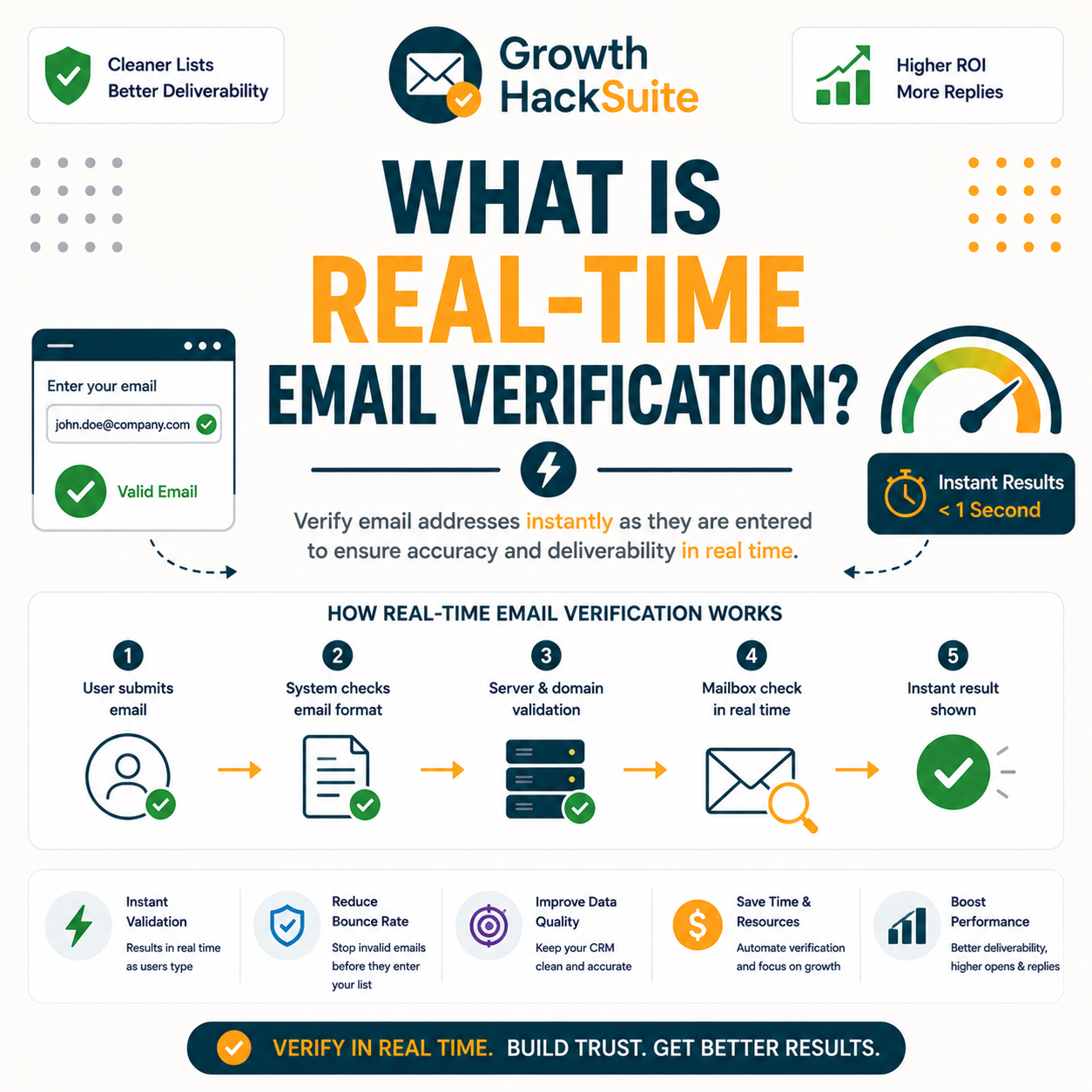
Real-time email verification checks one address at the moment it is submitted, returning a deliverability result in under a second through an API call. Instead of cleaning a list later, it validates each address at the point of capture, keeping bad data out of the database from the start. The check happens live, while the form is still open, not in a scheduled batch.
- At point of capture: Real-time verification runs the instant an address is entered, inside the signup form, checkout field or CRM record being created. Validating at that moment stops a bad address from ever being stored, rather than discovering the problem during a later cleanup pass.
- Sub-second API: A verification API receives the single address, runs its checks, and returns a status fast enough to fit inside a form submission. That speed is what separates real-time verification from bulk, since a result must arrive before the user finishes the action.
- Prevention not cleanup: Real-time verification stops fake and mistyped addresses at entry, so the database stays clean continuously instead of being repaired after the fact. Prevention costs less than cleanup because a blocked address never triggers a bounce, a wasted send or a corrupted segment.
- Single-address scope: Each call validates exactly one email rather than a whole file, matching the rhythm of a live form where addresses arrive one at a time. That one-at-a-time scope is what lets the check ride along inside a normal submission without a separate batch job.
- Decision before save: The returned status arrives early enough for the application to accept, warn or reject the address before writing the record. Acting on the verdict at that point keeps the stored data clean by construction, never needing a corrective pass afterward.
Real-time verification moves the check upstream, to the moment data is entered, not after. It validates one address live so bad data never reaches the database in the first place.
How Does Real-Time Verification Work?
When a user submits an address, the application calls the verification API with that email; the API runs syntax, MX and SMTP checks and returns a status and confidence score in milliseconds. The application then allows, warns or blocks based on the result, all before the record is saved. The whole exchange happens inside one request and response.
- API call on submit: The form passes the entered address to the verification endpoint as soon as the field loses focus or the user clicks submit. This single call carries one email and triggers the full check, replacing a manual list export with an automatic live request.
- Checks run instantly: The API validates syntax, resolves the domain’s MX record, then opens an SMTP probe to test whether the mailbox exists. Running all three in sequence produces a deliverability verdict within milliseconds, fast enough to fit inside the form interaction.
- Allow, warn or block: The application reads the returned status and confidence score, then decides whether to accept the address, prompt the user to fix a typo, or reject it outright. That decision happens before the record is written, keeping the database clean by construction.
One API call runs the full check and returns a decision before the form even saves. Syntax, MX and SMTP all resolve in milliseconds, so the user rarely notices the verification at all.
How a Real-Time Check Runs on Submit
Why Use Real-Time Verification?
Real-time verification stops fake, mistyped and disposable emails at entry, protecting database quality and deliverability continuously. Catching a typo live also recovers a real subscriber who would otherwise be lost to a silent bounce. It is the cheapest place to catch bad data, before it ever costs a send, a bounce or a damaged sender reputation downstream.
- Block bad data at entry: Real-time verification rejects fake, disposable and undeliverable addresses the moment they are typed, so they never enter the list. Keeping bad data out at the source protects deliverability far more reliably than scrubbing it after a campaign has already bounced.
- Recover typos: A live check that flags a mistyped address lets the form prompt for a correction while the user is still present. That prompt rescues a genuine subscriber who would otherwise vanish behind a bounce, turning a lost lead into a clean, deliverable contact.
The verifier API returns a deliverability status for each address it checks at request time.
— Hunter, Email Verifier API documentation
Catching bad data at the form is the cheapest fix, and it rescues mistyped real subscribers in the same step. Prevention at entry beats cleanup after a campaign has already sent.
Where Is Real-Time Verification Used?
Real-time verification runs anywhere emails are captured: signup and registration forms, checkout pages, lead-generation landing pages, and CRM contact creation. The common thread is the point of entry, where verifying once prevents a bad address from ever entering downstream systems such as email platforms, billing and analytics. Each capture point is a place new bad data can enter.
- Signup forms: Registration and newsletter forms are the most common place real-time verification runs, since they feed the email list directly. Validating each address on submit keeps fake and mistyped signups out of the audience before any welcome message is ever sent.
- Checkout: An e-commerce checkout captures the address used for receipts, shipping updates and account access, so an error there breaks the customer relationship. Real-time verification catches the typo at purchase, ensuring order confirmations actually reach a real, monitored inbox.
- CRM creation: Sales and support tools create contact records constantly, and a bad address corrupts pipeline data and outreach. Verifying at record creation keeps the CRM accurate, so reps work from contacts that can actually receive mail rather than dead entries.
- Lead-generation pages: Gated content and demo-request landing pages trade an asset for an email, making address quality central to the offer. Verifying the address before granting access ensures the captured lead is reachable, so follow-up sequences land instead of bouncing into dead inboxes.
- Account onboarding: Product signups tie the email to login recovery and critical notifications, so a bad address locks a real customer out later. A real-time check during onboarding confirms the address works before it becomes the account’s permanent point of contact.
Real-time verification belongs at every capture point, including forms, checkout, lead pages and CRM entry. Wherever a new address enters, verifying it live keeps the systems downstream clean.
How Fast Is Real-Time Verification?
A well-built verification API responds in well under a second, fast enough not to delay a form submission noticeably. For the best experience, calls run asynchronously and unknown or slow results are treated as a pass, so a sluggish upstream never blocks a real signup. Speed and graceful handling are what make real-time verification viable on live forms.
- Sub-second response: A production verification API returns a status quickly enough to fit inside the moment between submit and save, keeping the interaction smooth. The check stays invisible to the person filling the form, who simply sees the page proceed as normal.
- Async with graceful fallback: Robust implementations call the API asynchronously and accept the address when a result is slow or uncertain, never holding a real user hostage to an upstream delay. This fallback ensures a verification timeout degrades into a pass rather than a lost conversion.
Sub-second, asynchronous responses keep real-time verification invisible to the user filling the form. A graceful fallback ensures any rare slowdown becomes a pass, never a blocked signup.
How Does Hunter Do Real-Time Verification?
Hunter exposes its verifier through an API that returns the same status and confidence score as the dashboard, so a single endpoint call validates an address at capture. The API draws from the same credit pool as bulk verification, making real-time and bulk two uses of one verification engine rather than separate products with separate data.
- One endpoint, full result: The Hunter Email Verifier API accepts a single address and returns the complete status and confidence score in one call. That response carries the same verdict the dashboard shows, so a real-time check and a manual check produce identical results.
- Shared credit pool: Real-time API calls and bulk uploads both draw from the same Hunter credit balance, so a team runs both without juggling separate plans. This shared pool lets verification scale from one live form check to a whole list cleanup on a single account.
Verifying each address before a send is what keeps bounce rates low across a campaign.
— Growth Hack Suite, pre-send verification workflow
Hunter’s API delivers the full verification result in real time from the same engine as bulk. Real-time and bulk share one credit pool, so a team scales both on a single account.
Real-Time vs Bulk Verification: What’s the Difference?
Real-time verification checks single addresses at capture through an API; bulk verification checks whole lists in batches. Real-time prevents bad data from entering, while bulk cleans data already stored. The two are complementary, and most mature setups run both. The table below contrasts how they differ on timing, use case and integration.
Source: real-time vs bulk verification behavior per standard email-verification practice and hunter.io/api-documentation/v2, verified 2026-06-29.
Real-time prevents, bulk cleans, and running both keeps new and existing data clean. The two are complementary stages of the same goal, not competing alternatives.
What Are the Limits of Real-Time Verification?
Real-time verification faces the same catch-all blind spot as any SMTP check, and a slow or failed API call must be handled gracefully to avoid blocking real users. It prevents new bad data from entering but does nothing for the existing list, which still needs a bulk pass. Real-time is a guard at the door, not a cure for stored data.
- Catch-all limit: A domain that accepts every recipient returns an uncertain result, so real-time verification cannot always confirm a single mailbox on such domains. This is the same SMTP blind spot bulk verification hits, and it requires risk scoring rather than a clean yes or no.
- Needs fallback: A verification API can time out or error, and a strict implementation that blocks on failure would reject genuine signups. Treating unknown results as a pass keeps the form usable, so the fallback policy matters as much as the check itself.
- Not for old data: Real-time verification only touches addresses entered after it is installed, leaving every contact captured earlier unchecked. An existing list still ages and decays, so a periodic bulk verification pass remains necessary alongside the live guard.
- Credit consumption: Every live check spends a verification credit, so a high-traffic form draws against the plan with each submission. Budgeting for that volume, or rate-limiting obvious bot traffic, keeps real-time verification cost-effective rather than draining credits on junk.
- No content guarantee: A deliverable verdict confirms the mailbox exists, never that the person behind it wants the mail or will engage. Real-time verification protects deliverability and data hygiene, but consent and list quality remain separate disciplines layered on top.
Real-time verification guards new data only, while catch-alls and the existing list still need bulk verification. It is a preventive layer that complements, never replaces, periodic list cleaning.
How Do You Add Real-Time Verification?
Adding real-time verification takes four steps: get a verification API key, call the endpoint on email input or submit, read the returned status, and allow, warn or block accordingly. Most forms integrate it in a few lines of code or through a plugin, with no change to the rest of the flow. The check slots in front of the existing save logic.
- Get an API key: Sign up for a verifier with an API and generate a key from the account dashboard. The key authenticates each verification request, and a free tier lets a team test the integration on real traffic before committing to a paid plan.
- Call on submit: Wire the form to send the entered address to the verification endpoint when the field blurs or the user submits. This single asynchronous request passes one email and returns the deliverability verdict, slotting in front of the existing save step.
- Act on status: Read the returned status and confidence score, then accept a deliverable address, prompt to fix a likely typo, or block an undeliverable one. Applying that logic before the record saves is what turns the API response into a clean database.
- Handle the unknown case: Decide in advance what happens when the API is slow or returns an uncertain catch-all result, defaulting to accept so a genuine signup is never lost. This fallback rule keeps the form forgiving while still catching the clearly invalid addresses.
- Monitor and tune: Track block and warn rates after launch to confirm the check rejects junk without turning away real users. Reviewing those numbers lets a team tighten or relax the threshold so verification stays accurate as traffic patterns shift.
Get an API key free and verify in real time.
Get API Access Free →Free plan · No credit card · A few lines of code
A few lines of code add real-time verification to almost any form. Get a key, call the endpoint on submit, and act on the status before the record saves.
What Tools Offer Real-Time Verification?
Real-time verification requires a verifier with a fast API; tools differ in response latency, free allowance and the integrations they ship. Hunter provides a real-time verification API on a recurring free tier, while pure-play verifiers vary in their terms. The table below compares the common options on the points that decide which tool fits real-time use.
Source: hunter.io/pricing and hunter.io/api-documentation/v2, verified 2026-06-29 (free plan 50 credits/mo = ~100 verifications). Other rows describe common tool categories; confirm each provider’s current API before buying.
For real-time use, pick a verifier with a fast API and a free tier, and Hunter covers both. Syntax-only tools check format alone and cannot confirm a mailbox in real time.
Verdict: When Real-Time Verification Is Worth It
For any product collecting emails through forms, real-time verification is worth integrating: it blocks bad data at the source, protects deliverability, and rescues typo subscribers who would otherwise be lost. It does not replace bulk verification for existing data, so run both. Implement it asynchronously and forgivingly, treating unknown results as a pass to protect real signups.
Verdict: A sub-second verification API blocks fake and mistyped emails at capture, before they ever cost a send. It guards new data only, so pair it with bulk for the existing list. The free tier makes it free to test on real traffic first.
Email verification checks whether an address is valid and able to receive mail.
— Wikipedia, Email address
Verify emails in real time free — get API access.
Get API Access Free →Free plan · No credit card · Same result as the dashboard
Related Tools in the Hunter Stack
Real-time verification runs on the verifier API and pairs with bulk verification for cleaning existing data. The Hunter Email Verifier review covers the product behind the API, and the finder review covers building the lists worth verifying, all on one shared credit pool in the same connected stack.
- Hunter Email Verifier: The product that exposes the real-time verification API, covering every check it runs — start with what the Hunter Email Verifier is.
- Hunter Email Finder: The list-building half of the bundle that shares the same credit pool — read the Hunter.io email finder review for sourcing costs.
Real-Time Email Verification: Frequently Asked Questions
The 12 most-asked questions about real-time email verification.
What is real-time email verification?
Real-time email verification checks a single address the instant it is entered, returning a deliverability result in under a second through an API call. It runs at the point of capture, such as a signup form, so fake and mistyped addresses are blocked before they enter the database rather than cleaned out later.
How does it work?
When a user submits an address, the application calls the verification API, which runs syntax, MX and SMTP checks and returns a status and confidence score in milliseconds. The application then allows, warns or blocks the address based on that result, all before the record is saved to the database.
Why use real-time verification?
Real-time verification stops fake, mistyped and disposable emails at entry, protecting database quality and deliverability continuously. Catching a typo live also recovers a real subscriber who would otherwise be lost to a bounce. It is the cheapest place to catch bad data, before it ever costs a send.
Where is it used?
Real-time verification runs anywhere emails are captured: signup and registration forms, checkout pages, lead-generation landing pages, and CRM contact creation. The common thread is the point of entry, where verifying once prevents a bad address from ever entering downstream systems such as the email platform and CRM.
How fast is it?
A well-built verification API responds in well under a second, fast enough not to delay a form submission. For the best experience, calls run asynchronously and unknown or slow results are treated as a pass, so a sluggish upstream never blocks a real signup. Speed is what makes real-time viable on live forms.
How does Hunter do real-time verification?
Hunter exposes its verifier through an API that returns the same status and confidence score as the dashboard, so a single endpoint call validates an address at capture. The API draws from the same credit pool as bulk verification, making real-time and bulk two uses of one verification engine on a single account.
Real-time vs bulk verification?
Real-time verification checks single addresses at capture through an API; bulk verification checks whole lists in batches on a schedule. Real-time prevents bad data from entering, while bulk cleans data already stored. The two are complementary, and most mature setups run both rather than choosing one over the other.
What are its limits?
Real-time verification faces the same catch-all blind spot as any SMTP check, and a slow or failed API call must be handled gracefully to avoid blocking real users. It prevents new bad data from entering but does nothing for the existing list, which still needs a periodic bulk verification pass.
How do I add real-time verification?
Get a verification API key, call the endpoint on email input or submit, read the returned status, and allow, warn or block the address accordingly. Most forms integrate it in a few lines of code or through a plugin, with no change to the rest of the flow. The check slots in front of the save step.
What tools offer it?
Real-time verification requires a verifier with a fast API; tools differ in latency, free allowance and integrations. Hunter offers a real-time API on a recurring free tier, pure-play verifiers usually offer one too, and marketing platforms sometimes bundle it. Syntax-only tools check format alone and cannot confirm a mailbox.
Does real-time replace bulk?
No. Real-time verification only touches addresses entered after it is installed, leaving every earlier contact unchecked. An existing list still ages and decays, so a periodic bulk verification pass remains necessary. Real-time prevents new bad data while bulk cleans the data already stored, making them complementary stages.
Is real-time verification worth it?
For any product collecting emails through forms, real-time verification is worth integrating: it blocks bad data at the source, protects deliverability, and rescues typo subscribers. It does not replace bulk for existing data, so run both. A free tier makes it free to test on real traffic before committing.