Table of Contents
Is email verification legal? In general, yes. Checking whether an address can receive mail is a routine, lawful part of email infrastructure and does not by itself breach GDPR or CAN-SPAM. What regulators care about is how the underlying data is collected, stored, and used, not the deliverability check itself. This guide explains the legal basics in plain terms, and it is general information, not legal advice.
Verify compliantly — clean your list free with a reputable processor.
Verify an Email Free →Free plan included · No credit card · Documented data terms
Is Email Verification Legal?
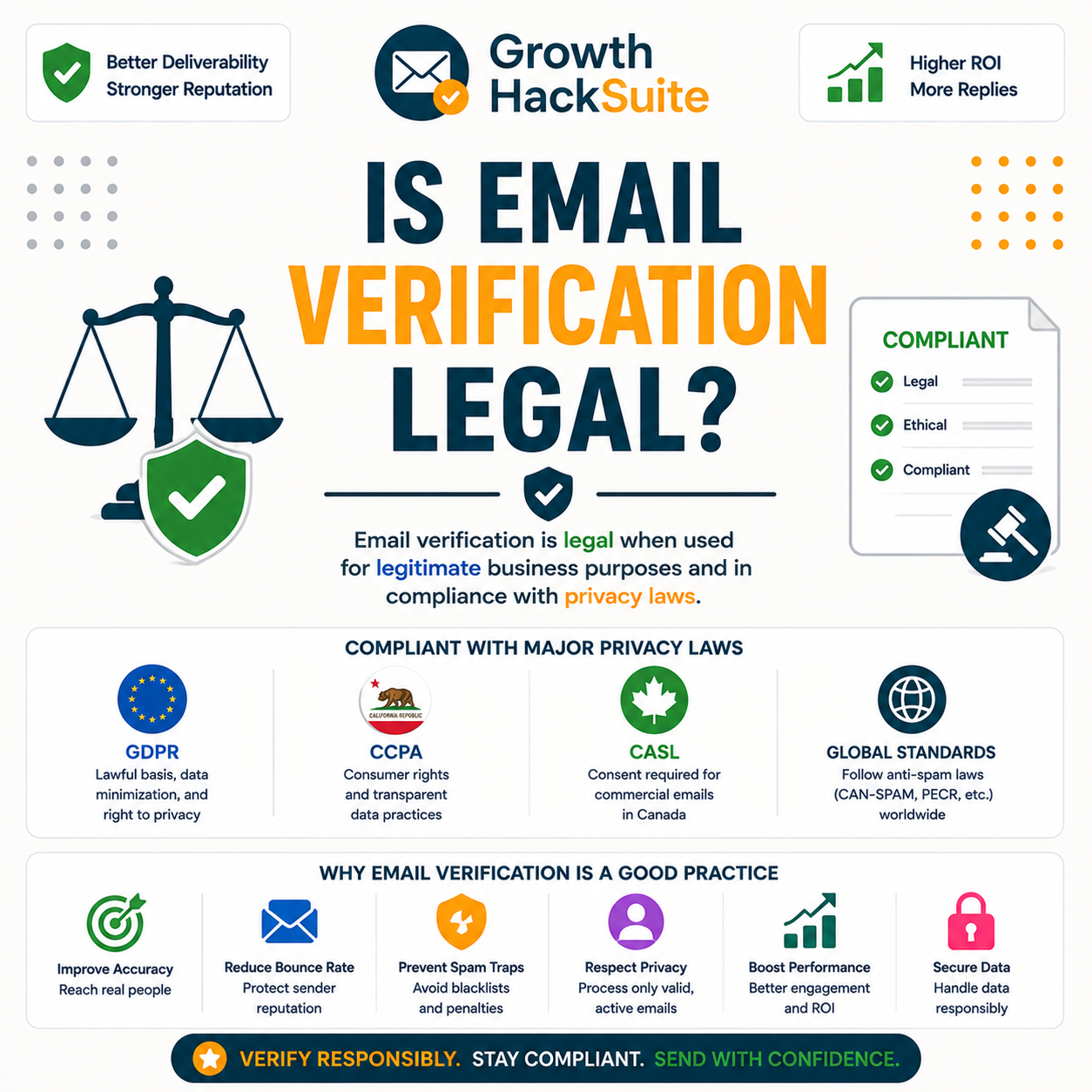
In general, yes. Email verification, checking whether an address can receive mail, is a routine and lawful part of email infrastructure and does not by itself violate GDPR, CAN-SPAM, or similar laws. What matters legally is how the underlying data was obtained, stored, and used, not the verification check. This is general information, not legal advice.
- Verifying is lawful: A deliverability check confirms only whether a mailbox exists and accepts mail, which sits among the ordinary technical operations email systems perform every day. No marketing message is delivered, so the check raises no sending-law issue on its own.
- Data handling is the issue: Regulators focus on how an address was collected, whether a lawful basis exists, and how results are stored and used. The legal weight attaches to that data lifecycle rather than to the verification probe that tests deliverability.
- Sending is the regulated act: Marketing email triggers consent rules, unsubscribe duties, and sender-identification requirements, whereas the silent deliverability check does not. Drawing that distinction clarifies why verification sits comfortably outside the heaviest sending obligations.
- Jurisdiction shapes detail: GDPR, CAN-SPAM, and other regimes share the same broad logic but differ on specifics like lawful basis and disclosure. Senders operating across regions should map each framework rather than assume one rulebook covers every market.
- Not legal advice: This article describes general principles to help senders understand the landscape, not a substitute for professional counsel. Specific situations, jurisdictions, and risk levels warrant consultation with a qualified lawyer before any final decision.
Verification itself is lawful, and the legal questions attach to how the data is collected and used rather than to the deliverability check.
Where the Legal Line Sits
Why Is Verifying an Address Lawful?
Verification only confirms deliverability; it does not send marketing mail, read message content, or create new personal data beyond a deliverability status. Because it is a technical quality check on data already held, most frameworks treat it as legitimate processing rather than a fresh act of collection or marketing that would trigger heavier obligations.
- No marketing sent: A verifier tests whether a mailbox can receive mail without delivering any commercial message, so sending laws such as CAN-SPAM never engage. The probe ends at a deliverability answer and stops well short of outreach.
- Quality check on held data: Verification operates on addresses an organization already possesses, refining accuracy rather than gathering new information. That positions it as data hygiene, a recognized legitimate purpose, instead of a fresh collection that would demand its own lawful basis.
Verification is a technical quality check on data already held, which most frameworks treat as legitimate processing rather than new collection.
How Does GDPR Apply to Email Verification?
Under GDPR, an email address is personal data, so verification must rest on a lawful basis such as legitimate interest, and the data must be handled securely and transparently. GDPR does not ban verification; it governs how addresses are collected, how consent for marketing is obtained, how results are stored, and what processor agreements apply.
- Lawful basis needed: Processing an address for verification requires a valid GDPR basis, commonly legitimate interest balanced against the recipient’s rights. Documenting that basis demonstrates the deliverability check serves a genuine business purpose rather than indiscriminate data use.
- Processor agreement: A third-party verifier acts as a data processor, so a data-processing agreement should govern how addresses are handled, retained, and secured. That contract keeps responsibility clear and aligns the vendor with the controller’s GDPR duties.
- Transparency: Privacy notices should explain that addresses may be verified for deliverability, keeping individuals informed about how their data moves. Clear disclosure supports the GDPR principle that processing stays fair and predictable for the people involved.
- Data minimization: Verification should touch only the addresses needed and retain results no longer than the purpose justifies, mirroring the GDPR minimization principle. Holding excess verified data widens exposure without adding any deliverability benefit to the program.
- Security obligations: The verified status remains personal data, so encryption, access control, and breach procedures apply just as they do to the source list. Treating results as protected data keeps the processing aligned with GDPR security duties.
An email address is personal data, so processing it requires a lawful basis.
— Hunter, Email Verifier API documentation
GDPR governs how the data is handled, not whether verification may happen, so a lawful basis and secure processing still apply.
How Does CAN-SPAM and US Law Apply?
CAN-SPAM regulates the sending of commercial email, requiring honest headers, a working unsubscribe option, and a physical postal address, but it does not restrict verifying whether an address exists. US law generally treats verification as a permissible data-quality step taken ahead of compliant sending rather than a regulated communication.
- CAN-SPAM governs sending: The statute applies to commercial messages once they are dispatched, mandating accurate routing information, opt-out mechanisms, and sender identification. Its obligations begin at the moment of sending, leaving pre-send checks outside its direct scope.
- Verification permitted: Confirming that a mailbox can receive mail involves no commercial message, so it falls before CAN-SPAM duties attach. US practice treats this deliverability check as routine list maintenance that supports, rather than circumvents, compliant outreach.
CAN-SPAM governs sending, not verifying, so checking whether an address exists is a permissible pre-send step under US law.
What Should You Watch Legally?
Watch the data side: maintain a lawful basis, use a reputable processor under a data agreement, store results securely, honor deletion and access requests, and never use verification to enable spam. The legal risk lives in unlawful collection or non-compliant sending, not in the verification step that simply tests deliverability.
- Lawful basis and DPA: Every verified address should rest on a documented lawful basis, with a data-processing agreement covering any third-party vendor. Together these establish that the deliverability check fits within an accountable, defensible data framework.
- Secure storage: Verification results constitute personal data and demand the same security as the source list, including access controls and sensible retention limits. Storing them carelessly creates exposure that the verification itself never would.
- No spam use: Verification should refine lists intended for lawful, consented mail, never to scrub a purchased or scraped list for blasting. Using a clean check to power unlawful sending shifts the legal problem squarely onto the sender.
- Data subject rights: Verified addresses remain subject to deletion, access, and correction requests, so the deliverability status must be reachable and removable on request. Honoring those rights keeps the processing accountable rather than a hidden side database.
- Source legitimacy: The list feeding verification should itself come from lawful collection, since a clean check cannot rescue an unlawfully obtained source. Verifying scraped or purchased addresses launders nothing and leaves the underlying collection problem fully intact.
Mind collection, storage, and use, because the legal risk lives there rather than in the verification step.
How Common Is This Legal Concern?
It is a frequent question, especially among EU and B2B senders wary of GDPR. The concern is reasonable, and the reassuring answer is that compliant verification through a reputable processor is standard practice across the email industry. Most senders verify routinely as part of ordinary list hygiene without legal trouble.
Verifying addresses before a send is treated as a routine hygiene step in compliant programs.
— Growth Hack Suite, pre-send verification workflow
It is a common EU and B2B concern, and compliant verification through a reputable processor is standard industry practice.
Is Verifying Different From Emailing Legally?
Yes. Verifying an address is a low-risk data-quality check, while sending marketing email to it is the regulated activity that requires consent or another lawful basis under GDPR and compliance with CAN-SPAM. The legal lines are drawn around sending, not around verifying. The table below contrasts the two activities.
Source: GDPR (Regulation (EU) 2016/679) and CAN-SPAM Act overview per Wikipedia and FTC guidance, verified 2026-06-29; general information, not legal advice.
Verifying is a quality check while emailing is the regulated act, so the legal lines sit around sending rather than around verification.
Does Verification Itself Create Privacy Risk?
Minimal. A reputable verifier processes the address securely and returns only a deliverability status, creating no sensitive new data about the person. The privacy risk comes from poor data handling or an untrustworthy processor, not from the silent deliverability check that simply asks whether a mailbox can receive mail.
- Only a status returned: The check produces a deliverability label rather than profiling data, behavioral records, or message content. Because the output is so limited, verification adds almost nothing to the personal data an organization already holds.
- Processor trust matters: Privacy exposure depends on how the verifier secures, retains, and transmits the address it processes. A vendor with clear data terms and strong controls keeps risk low, while an opaque provider raises it regardless of the check itself.
The check returns only a status, so privacy risk comes from data handling and processor choice rather than from the verification itself.
How Do You Verify Compliantly?
Verify compliantly by holding a lawful basis for the data, choosing a reputable processor under a data-processing agreement, storing results securely, honoring deletion and access requests, and verifying only to support lawful, consented mail. Treating verification as one step in a compliant data lifecycle keeps the whole program defensible.
- Establish a lawful basis and DPA: Confirm that each address rests on a valid GDPR basis and sign a data-processing agreement with the verifier. This foundation makes the deliverability check part of an accountable framework rather than an isolated data action.
- Choose a reputable processor: Select a verifier that publishes clear data terms, secures the addresses it processes, and supports EU-friendly handling. A trustworthy vendor reduces exposure and keeps the controller aligned with its own compliance duties.
- Secure and limit retention: Store verification results under the same controls as the source list and discard them once the deliverability purpose ends. Tight retention shrinks the data footprint and keeps the program inside minimization expectations.
- Verify only consented sends: Direct verification toward lists intended for lawful, consented outreach rather than scraped or purchased addresses. Restricting the check to legitimate sending keeps the deliverability gain from feeding any non-compliant campaign.
- Honor data rights: Build in processes to fulfill deletion, access, and correction requests for verified addresses just as for the source list. Respecting those rights demonstrates that verification fits within ongoing, lawful data stewardship.
Verify your list free with a reputable processor.
Verify an Email Free →Free plan · No credit card · Documented data terms
Compliant verification means a lawful basis, a reputable processor under a DPA, secure storage, and honoring data rights throughout.
What Tools Support Compliant Verification?
Choose verifiers that publish data-processing terms, offer EU-friendly handling, and act as a clear processor. Hunter provides verification with documented terms and a recurring free tier. The table below compares common verification options on the factors that matter most for compliance-minded senders weighing how each handles personal data.
Source: hunter.io/pricing verified 2026-06-29 (free plan 50 credits/mo = ~100 verifications). Other rows describe common tool categories; confirm each provider’s data terms before buying. General information, not legal advice.
Pick a verifier with clear data terms and EU-friendly handling, because compliant verification starts with a trustworthy processor.
Verdict: Is Email Verification Legal?
Yes, email verification is generally legal. The deliverability check itself does not breach GDPR or CAN-SPAM; the law governs how data is collected, stored, and used, and how mail is sent. Use a reputable processor, keep a lawful basis, and verify only to support compliant sending. This is general information, not legal advice.
Verdict: Verifying an address is generally lawful. GDPR and CAN-SPAM govern data handling and sending, not the deliverability check. Keep a lawful basis, use a reputable processor under a DPA, and verify only to support compliant mail. This is general information, not legal advice.
The GDPR governs how personal data of individuals in the EU is processed.
— Wikipedia, General Data Protection Regulation
Verify your list free, compliantly.
Verify an Email Free →Free plan · No credit card · Documented data terms
Related Tools in the Hunter Stack
Legality ties closely to how verification works and how the data is handled. The Hunter Email Verifier review covers the process and what each status means, while the finder review covers building the lists worth verifying in the same connected stack on one credit pool. Both help frame verification inside a compliant workflow.
- Hunter Email Verifier: The validation layer that determines each deliverability status and documents how addresses are processed — start with what the Hunter Email Verifier is.
- Hunter Email Finder: The list-building half of the bundle that shares the same credit pool — read the Hunter.io email finder review for sourcing details.
Email Verification Legality: Frequently Asked Questions
The 12 most-asked questions about email verification and the law.
Is email verification legal?
In general, yes. Checking whether an address can receive mail is a routine, lawful part of email infrastructure and does not by itself breach GDPR or CAN-SPAM. The legal questions attach to how the underlying data was collected, stored, and used, not to the deliverability check itself.
Why is verifying an address lawful?
Verification only confirms deliverability; it does not send marketing mail, read message content, or create new personal data beyond a status. Because it is a technical quality check on data already held, most frameworks treat it as legitimate processing rather than a fresh act of collection or marketing.
How does GDPR apply to verification?
Under GDPR, an email address is personal data, so verification must rest on a lawful basis such as legitimate interest, with secure and transparent handling. GDPR does not ban verification; it governs collection, consent for marketing, storage, and processor agreements with any third-party verifier acting on the controller’s behalf.
How does CAN-SPAM apply?
CAN-SPAM regulates the sending of commercial email, requiring honest headers, an unsubscribe option, and a physical address, but it does not restrict verifying whether an address exists. US law generally treats verification as a permissible data-quality step taken ahead of compliant sending, not a regulated communication.
What should I watch legally?
Watch the data side: keep a lawful basis, use a reputable processor under a data agreement, store results securely, honor deletion and access requests, and never use verification to enable spam. The legal risk lives in unlawful collection or non-compliant sending, not in the verification step itself.
How common is this concern?
It is a frequent question, especially among EU and B2B senders wary of GDPR. The concern is reasonable, and the reassuring answer is that compliant verification through a reputable processor is standard practice across the industry. Most senders verify routinely as part of ordinary list hygiene.
Is verifying different from emailing legally?
Yes. Verifying an address is a low-risk data-quality check, while sending marketing email is the regulated activity that requires consent or another lawful basis under GDPR and compliance with CAN-SPAM. The legal lines are drawn around sending, not around verifying a mailbox’s deliverability.
Does verification create privacy risk?
Minimal. A reputable verifier processes the address securely and returns only a deliverability status, creating no sensitive new data about the person. The privacy risk comes from poor data handling or an untrustworthy processor, not from the silent deliverability check that simply tests whether a mailbox exists.
How do I verify compliantly?
Hold a lawful basis for the data, choose a reputable processor under a data-processing agreement, store results securely, honor deletion and access requests, and verify only to support lawful, consented mail. Treating verification as one step in a compliant data lifecycle keeps the program defensible.
What tools support compliant verification?
Choose verifiers that publish data-processing terms, offer EU-friendly handling, and act as a clear processor. Hunter provides verification with documented terms and a recurring free tier of about 100 verifications a month. Pure-play verifiers usually publish terms too, but often offer only one-time trial credits.
Is email verification GDPR compliant?
It can be. Verification is GDPR compliant when it rests on a lawful basis, runs through a reputable processor under a data agreement, stores results securely, and respects data rights. GDPR does not prohibit the check; it sets conditions on how the personal data involved is collected, processed, and retained.
Is this legal advice?
No. This article is general information to help senders understand the legal landscape around email verification, not legal advice and not a substitute for professional counsel. Laws differ by jurisdiction and circumstances vary, so a qualified lawyer should be consulted before any final compliance decision is made.