Table of Contents
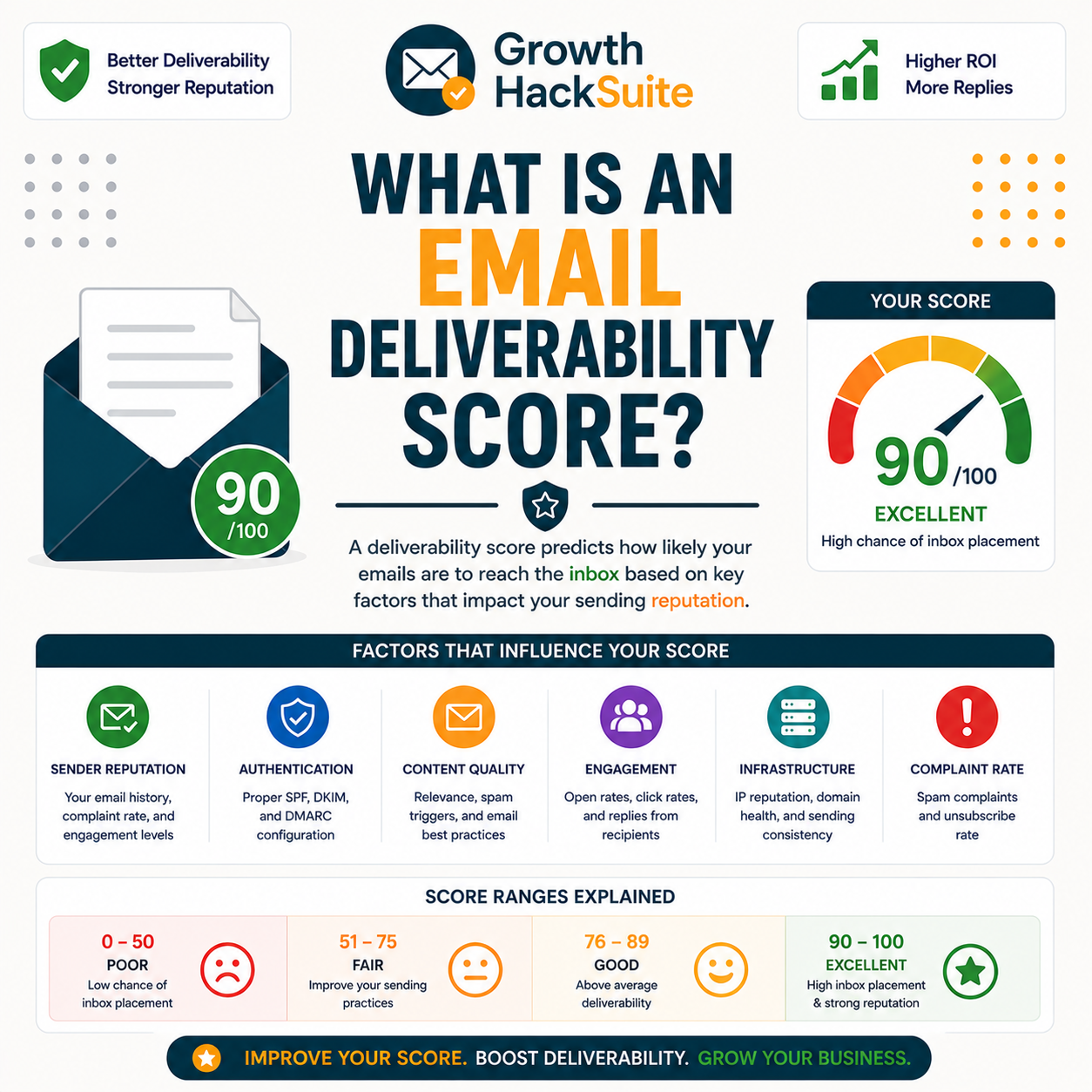
An email deliverability score is a single number that estimates how likely your emails are to reach the inbox rather than spam, based on factors like sender reputation, list quality, authentication and engagement. Different tools calculate it differently, but all use it as a quick health check on sending. This guide explains what an email deliverability score is and how to improve it.
Raise your deliverability score — verify your list free.
Verify Your List Free →Free plan included · No credit card · Cuts the bounces that drag scores down
What Is an Email Deliverability Score?
An email deliverability score is a single rating that estimates how likely your emails are to land in the inbox rather than spam. It combines signals like sender reputation, list quality, authentication and engagement into one number. Senders use it as a quick health check, watching the figure rise or fall as their sending habits and list hygiene change over time.
- Single rating: An email deliverability score compresses many sending signals into one readable figure that summarizes inbox health. That single number lets a sender judge overall standing at a glance without manually inspecting reputation, authentication and bounce data separately.
- Inbox-likelihood estimate: The score estimates the probability that a sent message reaches the inbox rather than the spam folder or a hard block. It reflects likelihood based on current signals, not a guarantee, since each receiving provider applies its own filtering rules.
- Health check: Deliverability scores function as an ongoing health check that flags problems before engagement collapses. A falling score warns of list decay, authentication gaps or reputation damage early, giving senders time to fix the cause first.
- Composite metric: The figure is composite rather than a single measurement, rolling reputation, hygiene and authentication into one weighted result. That composition is why two providers can report different numbers for the same sending domain on the same day.
- Directional indicator: The score works best as a directional indicator that shows whether sending health is improving or decaying. The movement matters far more than any absolute value, since context and weighting differ across every measurement tool.
A deliverability score rolls many signals into one number, giving a quick read on inbox likelihood and overall sending health.
How Is a Deliverability Score Calculated?
Tools calculate a deliverability score from a weighted mix of sender reputation, bounce and complaint rates, authentication status, list hygiene and engagement history. The exact formula varies by provider, so two tools can rate the same domain differently. Scores are best used to track one sender’s own trend over time rather than compared head to head across tools.
- Weighted signals: Calculation blends reputation, bounce rate, complaint rate, authentication and engagement, each carrying a different weight in the final figure. Heavier negative factors like complaints and hard bounces pull the score down faster than minor signals lift it.
- Varies by tool: Each provider applies its own weighting and data sources, so the same domain can score differently across platforms. The absolute number matters less than the direction it moves inside one consistent measurement system.
- Track your trend: Reliable use means watching the score’s trend within a single tool rather than comparing numbers between providers. A steady climb signals improving hygiene and reputation, while a sudden drop points to a specific fixable problem.
Each tool weights the signals differently, so the score works best as a trend line inside one platform, not a cross-tool benchmark.
What Feeds an Email Deliverability Score
What Does the Score Actually Measure?
The score measures the overall health of your sending. Clean lists, strong reputation, full authentication and good engagement push it up, while bounces, complaints, spam-trap hits and missing authentication push it down. In effect, a deliverability score is a single summary of the underlying factors that decide whether mail reaches the inbox.
- Lifts it: Clean verified lists, full SPF, DKIM and DMARC authentication, consistent volume and high recipient engagement all raise the score. These positive signals tell receiving providers that the sender is trusted and that recipients want the mail.
- Lowers it: Hard bounces, spam complaints, spam-trap hits, missing authentication and stale inactive addresses all drag the score down. These negative signals tell providers the list is poorly maintained, which threatens inbox placement across the whole domain.
The score summarizes sending health, with clean hygiene and authentication lifting it and bounces and complaints pulling it down.
What Factors Move Your Deliverability Score?
The biggest movers of a deliverability score are bounce rate, complaint rate, spam-trap hits, authentication status and engagement. Most of these trace back to list quality, which means verification, by cutting bounces and removing traps, is one of the most direct ways to lift the score without changing anything else about how you send.
- Bounce and complaint rate: High bounce and complaint rates signal a poorly maintained list and rank among the heaviest negative factors in any score. Cutting both through verification and clean opt-in practices delivers the fastest visible improvement.
- Authentication: SPF, DKIM and DMARC records prove the sending domain is genuine, and missing or broken records lower the score sharply. Correct authentication establishes the technical trust that providers require before granting inbox placement.
- Engagement: Opens, replies and low spam-marking show recipients value the mail, and strong engagement steadily lifts the score. Falling engagement warns providers that the audience has gone cold, dragging placement down across future sends.
- Spam-trap hits: Hitting recycled or pristine spam traps signals a stale or purchased list and damages the score severely. Verification removes most trap addresses before a send, which is why clean list hygiene prevents the steepest reputation drops.
- Sending consistency: Erratic volume spikes look suspicious to receiving providers and can pull the score down even on a clean list. Steady, predictable sending volume reassures filters and supports a stable score over successive campaigns.
Verification confirms an address before sending, so invalid contacts never inflate the bounce rate.
— Hunter, Email Verifier API documentation
Bounces, complaints and authentication move the score most, and list quality drives the first two directly.
How Does Verification Improve the Score?
Verification removes invalid addresses and spam traps before sending, lowering bounce and complaint rates, two of the heaviest negative factors in any deliverability score. By improving the underlying list quality rather than masking the symptom, verification raises the deliverability score steadily over time and protects the domain reputation that the score reflects.
Verifying a list before each send keeps invalid addresses from inflating bounce rates and damaging deliverability.
— Growth Hack Suite, pre-send verification workflow
Verification cuts the bounces and complaints that weigh the score down, making it the most direct lever a sender controls.
How Do You Check Your Deliverability Score?
Check a deliverability score through dedicated deliverability platforms, sender-score services and provider postmaster tools, which rate your domain and sending IP. Track the figure over time and watch the underlying bounce and complaint trends behind it, since those metrics are the levers a sender directly controls and the fastest path to a higher score.
- Sender-score services: Reputation-scoring services rate the sending IP and domain on a numeric scale drawn from complaint, bounce and volume data. Checking one regularly reveals reputation damage early, well before it shows up as falling open rates in the campaign dashboard.
- Postmaster tools: Major mailbox providers publish postmaster dashboards that report spam rate, authentication results and domain reputation for mail sent to their users. Monitoring these tools shows exactly how each provider judges the sending domain at the source.
- Deliverability platforms: Dedicated deliverability platforms run seed tests and blocklist checks to produce a composite score across multiple providers. They surface placement problems that a single sender-score lookup misses, giving a broader read on inbox performance.
- Blocklist monitors: Blocklist monitoring services watch whether the sending IP or domain appears on major public blocklists that crush deliverability. Catching a listing early lets a sender request delisting before the score and inbox placement both collapse.
- Bounce and complaint logs: Campaign platform logs report bounce and complaint rates directly, exposing the two metrics that move the score most. Watching these trends weekly often warns of a falling score faster than any external scoring tool does.
Check the score through sender-score and postmaster tools, then watch the bounce and complaint trends that sit behind it.
How Common Are Low Deliverability Scores?
Low deliverability scores are common among senders who skip verification and authentication, especially those using purchased, scraped or aging lists. Because the causes stay invisible from the inbox view, many senders carry a low score for months without realizing, noticing only when open rates fall and campaigns quietly stop converting the way they used to.
- Common without verifying: Senders who mail unverified or purchased lists routinely accumulate bounces and complaints that depress the score from the first campaign. The absence of a verification step makes a low score almost predictable for these sending patterns.
- Often unnoticed: A low score frequently goes unnoticed because the inbox view shows no obvious failure until engagement and reply rates decline. By the time the drop becomes visible, reputation damage has often compounded across several sends.
- Worse on cold lists: Cold, scraped or aged lists carry the highest share of invalid addresses and traps, so they produce the lowest scores. Senders who reuse old exports without re-verifying typically start every campaign already in the danger zone.
- Hidden until placement falls: The score stays hidden from everyday workflow until inbox placement visibly drops, masking a slow decline. Senders without monitoring tools often discover the problem only after a major provider starts routing mail to spam.
- Reversible with hygiene: A low score is reversible once the sender verifies the list, fixes authentication and prunes inactive contacts. Recovery takes consistent clean sending over several campaigns rather than a single fix, but the trend reliably turns around.
Low scores are common and often unnoticed, since the causes hide from the sender until engagement finally drops.
Deliverability Score vs Sender Reputation: How Do They Differ?
Sender reputation is the receiving provider’s own internal trust judgment of a domain and IP. A deliverability score is a third-party or tool estimate of that reputation combined with other factors like list quality and authentication. Reputation is the underlying reality; the score is a readable proxy for it. The table below contrasts the two.
Source: concepts per Wikipedia, Email deliverability, and provider postmaster documentation; reputation visibility per Google Postmaster Tools docs, verified 2026-06-29.
Reputation is the provider’s real judgment, while the score is a readable proxy for it plus other measurable signals.
How Do You Improve Your Deliverability Score?
Improve a deliverability score by verifying lists to cut bounces, authenticating with SPF, DKIM and DMARC, removing inactive subscribers, sending engaging content and maintaining consistent volume. Verification is the foundational move, since it addresses the heaviest negative factors first and stops the bounce-and-complaint cycle that depresses the score before any other tactic can help.
- Verify lists: Running every list through verification before sending removes invalid addresses and traps, cutting the bounces and complaints that dominate a low score. This single step delivers the largest, fastest improvement available to most senders.
- Authenticate: Publishing correct SPF, DKIM and DMARC records proves the sending domain is legitimate and lifts the technical trust component of the score. Providers treat authenticated mail as far safer than unsigned messages.
- Remove inactives: Pruning subscribers who never open or click reduces dead weight that signals a stale list to receiving providers. A leaner, engaged list raises both engagement metrics and the overall score over successive sends.
- Warm the domain: Ramping volume gradually on a new domain or IP builds reputation safely instead of triggering spam filters with a sudden spike. Consistent warm-up sending establishes the trust that a healthy deliverability score depends on.
- Maintain consistency: Sending on a steady cadence at predictable volume keeps reputation stable and supports the score between campaigns. Long gaps followed by large blasts unsettle filters and can undo gains earned through clean hygiene.
Verify your list free to raise your score.
Verify Your List Free →Free plan · No credit card · Cuts bounces at the source
Verification is the foundational move, tackling the heaviest negative factors behind a low score first.
What Tools Show and Improve Your Score?
Deliverability platforms and sender-score services show the score, while a verifier improves the list-quality factors that sit behind it. Hunter handles the verification side on a recurring free tier, cutting bounces before they ever reach the score. The table below compares the common tool categories on what each one shows versus what each one fixes.
Source: hunter.io/pricing and hunter.io/email-verifier, verified 2026-06-29 (free plan 50 credits/mo = ~100 verifications). Other rows describe common tool categories; confirm each provider’s behavior before buying.
Monitoring tools show the score, while a verifier improves the hygiene factors behind it, so most senders need both.
Verdict: What an Email Deliverability Score Tells You
An email deliverability score is a single estimate of how likely your mail reaches the inbox, summarizing reputation, list quality, authentication and engagement into one figure. Use it to track your own trend over time, not to compare tools. Verification lifts it most directly by cutting the bounces and complaints that drag it down.
Verdict: A deliverability score is a single inbox-likelihood estimate built from reputation, hygiene, authentication and engagement. It varies by tool, so track your own trend, not cross-tool numbers. Verification lifts it most directly by cutting bounces and complaints.
Email deliverability is the ability to deliver emails to subscribers’ inboxes.
— Wikipedia, Email deliverability
Verify your list free and raise your deliverability score.
Verify Your List Free →Free plan · No credit card · Bounces cut before they hit the score
Related Tools in the Hunter Stack
A deliverability score reflects reputation and list hygiene, but those are improved with tools, not just monitored. The Hunter Email Verifier review covers the verification that lifts the score by cutting bounces, while the finder review covers building the clean lists worth verifying in the same connected stack on one shared credit pool.
- Hunter Email Verifier: The validation layer that removes invalid addresses and traps before they bounce and lower the score — start with what the Hunter Email Verifier is.
- Hunter Email Finder: The list-building half of the bundle that shares the same credit pool — read the Hunter.io email finder review for sourcing costs.
Email Deliverability Score: Frequently Asked Questions
The 12 most-asked questions about email deliverability scores.
What is an email deliverability score?
An email deliverability score is a single number that estimates how likely your emails are to reach the inbox rather than spam. It combines sender reputation, list quality, authentication and engagement into one figure that senders use as a quick health check on their sending and watch as it rises or falls.
How is a deliverability score calculated?
Tools calculate it from a weighted mix of sender reputation, bounce and complaint rates, authentication status, list hygiene and engagement history. Each provider applies its own weighting and data sources, so the same domain can score differently across platforms. That is why a score is best read as a trend inside one consistent tool.
What does the score measure?
It measures the overall health of your sending. Clean lists, strong reputation, full authentication and good engagement push it up, while bounces, complaints, spam-trap hits and missing authentication push it down. In effect, the score is a single summary of the underlying factors that decide whether mail reaches the inbox.
What factors move my score?
The biggest movers are bounce rate, complaint rate, spam-trap hits, authentication status and engagement. Most of these trace back to list quality, which means verification, by cutting bounces and removing traps, is one of the most direct ways to lift the score without changing anything else about how you send.
How does verification improve the score?
Verification removes invalid addresses and spam traps before sending, lowering bounce and complaint rates, two of the heaviest negative factors in any deliverability score. By improving the underlying list quality rather than masking the symptom, verification raises the score steadily over time and protects the domain reputation that the score reflects.
How do I check my deliverability score?
Check it through dedicated deliverability platforms, sender-score services and provider postmaster tools, which rate your domain and sending IP. Track the figure over time and watch the underlying bounce and complaint trends behind it, since those metrics are the levers a sender directly controls and the fastest path to a higher score.
How common are low scores?
Low scores are common among senders who skip verification and authentication, especially those using purchased, scraped or aging lists. Because the causes stay invisible from the inbox view, many senders carry a low score for months without realizing, noticing only when open rates fall and campaigns quietly stop converting.
Deliverability score vs sender reputation?
Sender reputation is the receiving provider’s own internal trust judgment of a domain and IP. A deliverability score is a third-party or tool estimate of that reputation combined with other factors like list quality and authentication. Reputation is the underlying reality, while the score is a readable proxy for it.
How do I improve my score?
Improve it by verifying lists to cut bounces, authenticating with SPF, DKIM and DMARC, removing inactive subscribers, sending engaging content and maintaining consistent volume. Verification is the foundational move, since it addresses the heaviest negative factors first and stops the bounce-and-complaint cycle that depresses the score before other tactics can help.
What tools show and improve the score?
Deliverability platforms and sender-score services show the score, while a verifier improves the list-quality factors behind it. Hunter handles the verification side on a recurring free tier of about 100 verifications a month, cutting bounces before they ever reach the score. Most senders need a monitoring tool and a verifier together.
Can I compare scores across tools?
Not reliably. Each tool weights signals and pulls data differently, so the same domain can score higher on one platform and lower on another. The number is meaningful only inside one consistent measurement system. Track the trend within a single tool rather than comparing raw scores between providers.
Does list quality affect the score?
Yes, heavily. List quality drives bounce rate, complaint rate and spam-trap hits, three of the heaviest negative factors in any deliverability score. A clean, verified list keeps those metrics low and steadily lifts the score, while a stale or purchased list drags it down from the very first campaign.