Table of Contents
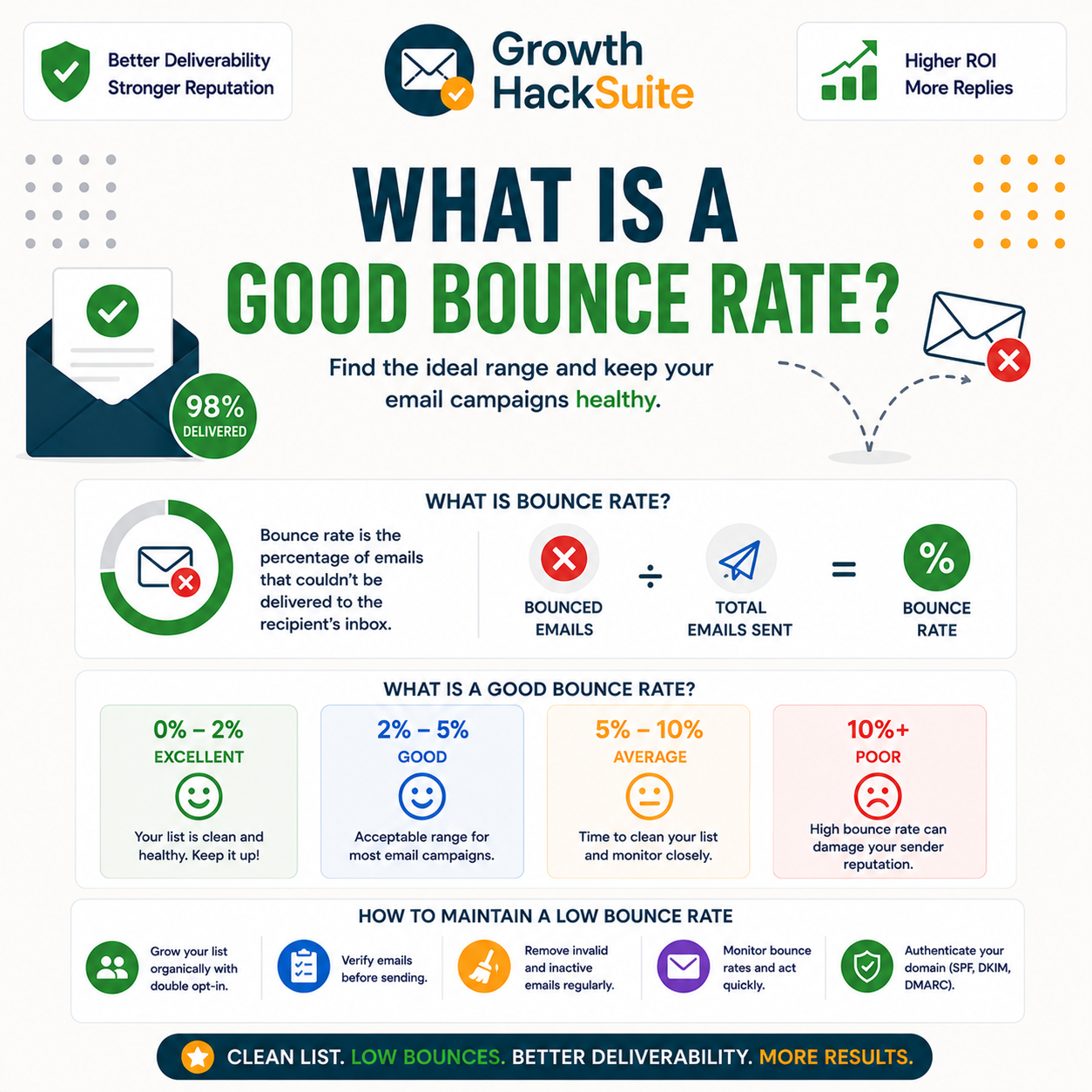
A good bounce rate sits under two percent, with under one percent being excellent for a well-maintained list. Above two percent, mailbox providers start questioning list quality and sender reputation suffers. Benchmarks vary slightly by industry, but the safe ceiling is consistent across sectors. This guide explains what a good bounce rate is, what the danger zone looks like, and how to reach and hold one.
Hit a safe bounce rate — verify your list free.
Verify Your List Free →Free plan included · No credit card · Removes invalids before they bounce
What Is a Good Bounce Rate?
A good bounce rate is under two percent, and under one percent is excellent for a well-maintained list. Two percent is the ceiling mailbox providers tolerate before sender reputation suffers. The goal is not zero, which is unrealistic on any real list, but a rate low enough to keep the sending domain trusted across every campaign that goes out.
The Good Bounce Rate Scale at a Glance
- Under 2% good: A bounce rate beneath two percent keeps a sending domain in good standing with mailbox providers and counts as the standard safe ceiling. Most permission-based lists hold this line comfortably when addresses are verified before each send.
- Under 1% excellent: A rate under one percent marks an excellent, well-maintained list where invalid addresses have been removed and signups are confirmed. Clean ecommerce and transactional lists frequently land here without any special effort beyond routine hygiene.
- Not zero: A zero bounce rate is unrealistic because a few addresses always go stale between cleaning cycles. Chasing zero wastes effort; the practical target is a rate low enough to protect reputation, not a perfect score that no live list sustains.
- Reputation anchor: A good bounce rate functions as the headline trust signal mailbox providers read first when deciding inbox placement. Staying under the ceiling protects open rates, click rates, and every downstream metric that depends on landing in the primary inbox.
- Permission baseline: A consent-based list collected through confirmed opt-in naturally trends toward the good band before any cleaning. Permission lowers the starting bounce rate because subscribers enter real, current addresses they actively monitor and want messages from.
Aim for under two percent, ideally under one, low enough to stay trusted by mailbox providers rather than an impossible zero that no live list maintains.
What Bounce Rate Is Dangerous?
Above two percent, mailbox providers begin treating the sender as careless, and reputation declines; a rate above five percent signals a real list-quality problem and risks spam-folder placement or ESP restrictions. The further past the ceiling a rate climbs, the faster the damage. Crossing two percent is the warning line to act on before reputation erodes.
- Above 2% warning: A bounce rate past two percent stains reputation with mailbox providers and puts future emails at risk of the spam folder. Providers read repeated bounces as a sign the sender mails stale or unverified data without cleaning it.
- Above 5% restrictions: A rate above five percent marks a serious list-quality failure and commonly triggers ESP throttling, suspension, or account review. Email service providers police bounce rates closely because high-bounce senders threaten the deliverability of every customer sharing their infrastructure.
Verifying an address before sending flags invalid mailboxes that would otherwise bounce on delivery.
— Hunter, Email Verifier API documentation
Two percent is the warning line; past it reputation slips, and beyond five percent restrictions and spam-folder placement become a real risk.
How Does a Good Bounce Rate Vary by Industry?
Benchmarks shift slightly by sector: B2B lists with more job churn tend to bounce a little higher, while consumer lists built on double opt-in run lower. Engagement-heavy sectors like ecommerce and retail often sit under half a percent total. The safe ceiling of two percent holds across industries; the table shows typical ranges by sector.
Source: Mailchimp Email Marketing Benchmarks (average hard bounce ranges by industry, 0.07% daily deals to 0.98% construction; overall average hard bounce 0.21%), verified 2026-06-29.
Industry shifts the typical range, with B2B sectors bouncing higher than consumer ones, but the two-percent safe ceiling applies to every sender.
What Raises Your Bounce Rate?
Bounce rate climbs from unverified addresses, aging data, purchased lists, typos at signup, and infrequent cleaning. Each adds invalid addresses that bounce on send. The common driver is sending without verifying first, which lets natural data decay and bad records inflate the rate past the safe line before a campaign even reaches real inboxes.
- Unverified addresses: Sending to addresses that were never verified guarantees a share of dead mailboxes that bounce immediately. Each unchecked record is a coin flip, and enough of them push a list past two percent on the very first send.
- Aging data: Email data decays as people change jobs and abandon mailboxes, so a list that was clean a year ago bounces more today. Decay accumulates silently, turning a once-safe rate into a problem without any new bad addresses being added.
- Purchased lists: Bought or scraped lists carry high shares of invalid, outdated, and spam-trap addresses that bounce heavily and harm reputation. Mailbox providers treat the resulting bounce spikes as a strong signal of low-quality, non-consensual sending.
- Signup typos: Manual entry produces misspelled domains and malformed addresses that fail on delivery. Without real-time verification at the form, these typos enter the list directly and bounce on the next campaign that includes them.
- Infrequent cleaning: Long gaps between list-hygiene passes let invalid addresses pile up unnoticed until a large send exposes them all at once. A list cleaned years ago carries far more dead records than its last bounce report suggested.
Bounce rate climbs whenever a list is sent without verifying first, since decay, typos, and bad records quietly do the rest.
How Do You Measure Bounce Rate?
Bounce rate is bounced messages divided by total messages sent, expressed as a percentage. Most ESPs report it per campaign and split it into hard and soft bounces. Watching the hard-bounce share is the most telling figure, since that is the part verification directly controls by removing permanently invalid addresses before a send.
- Bounces over sends: The formula divides total bounced messages by total messages sent, then multiplies by one hundred for a percentage. This single ratio is what every ESP and mailbox provider watches as the headline deliverability health number.
- Hard vs soft: Hard bounces hit permanently invalid addresses, while soft bounces reflect temporary issues like a full inbox. Hard bounces matter most because they signal dead records that verification removes, whereas soft bounces often clear on a later retry.
- Per-campaign reporting: Email platforms calculate bounce rate per campaign rather than as a lifetime figure, so a single dirty send shows up immediately. Tracking the trend across campaigns reveals whether list hygiene is holding or drifting upward.
- Hard-bounce focus: The hard-bounce percentage is the figure most worth isolating, since it maps directly to permanently dead addresses a verifier can strip. A rising hard-bounce share is the clearest early warning that list quality has begun slipping.
- Trend over snapshot: A single campaign reading matters less than the direction across several sends, because one bad list segment can spike an otherwise healthy rate. Watching the multi-campaign trend separates a one-off anomaly from genuine list decay.
Verifying before a send keeps invalid addresses from quietly inflating the bounce rate past the safe line.
— Growth Hack Suite, pre-send verification workflow
Bounce rate is simply bounces over sends; watch the hard-bounce share, since that is the portion verification controls before a campaign goes out.
How Common Is a Safe Bounce Rate Without Verification?
Without verification, holding under two percent is difficult on anything but a small, fresh, opt-in list; unverified and aging lists routinely exceed it. With regular verification, a safe rate becomes achievable and repeatable, which is why verification is the practical path to a good bounce rate rather than an optional extra step.
- Hard without verifying: Sustaining a sub-two-percent rate on an unverified list is rare outside small, recently collected, double-opt-in audiences. Most lists accumulate enough decay and bad entries that they drift over the ceiling within months of the last clean.
- Repeatable with verifying: Routine verification makes a safe rate a reliable outcome instead of luck, because invalids are removed before each send. The same list that bounces high unverified stays comfortably under two percent once verification is part of the workflow.
A safe bounce rate is hard to sustain without verifying and routine once verification becomes a standing part of the sending workflow.
Bounce Rate vs Other Email Metrics
Bounce rate measures undelivered mail; open and click rates measure engagement; complaint rate measures spam reports. Bounce rate is the deliverability gatekeeper, since high bounces suppress every other metric by pushing mail to the spam folder. The table compares each metric and its safe target so the relationships are clear.
Source: spam-complaint thresholds per Google and Yahoo 2024 bulk-sender requirements (keep complaint rate under 0.3%, ideally under 0.1%) via Higher Logic and Mailgun; bounce ceiling per industry deliverability consensus. Verified 2026-06-29.
Bounce rate is the gatekeeper metric; let it slip and engagement metrics fall with it as more mail lands in spam.
How Do You Reach a Good Bounce Rate?
Reach a good bounce rate by verifying lists before sending, removing hard bounces promptly, verifying signups in real time, and re-verifying aging data on a schedule. Verification removes the invalid addresses behind high bounce rates, bringing even a previously dirty list under the safe two-percent line before the next campaign ships.
- Verify before sending: Running the full list through a verifier ahead of each campaign removes dead and risky addresses before they bounce. This single step does the most to bring a high-bounce list under the safe ceiling in one pass.
- Remove hard bounces: Deleting permanently invalid addresses immediately after every send stops the same dead records from bouncing again. Letting hard bounces linger guarantees the next campaign repeats the same reputation damage on the same addresses.
- Verify at signup: Checking addresses in real time at the form blocks typos and disposable addresses from entering the list at all. Catching bad data at the door keeps the list clean continuously rather than relying only on periodic bulk cleaning.
- Re-verify aging data: Passing older segments through verification on a schedule catches addresses that have gone stale since the last clean. A pre-campaign re-verification of dormant contacts keeps decay from surfacing as a bounce spike on the next major send.
- Segment by recency: Mailing the most recently engaged contacts first warms reputation before any risky older segment goes out. Sequencing sends by engagement recency keeps the early bounce rate low and signals quality to mailbox providers.
Verify your list free to hit a safe bounce rate.
Verify Your List Free →Free plan · No credit card · Removes invalids before they bounce
Verification brings even a dirty list under two percent, making it the direct route to reaching a good bounce rate quickly.
What Tools Help You Hit a Good Bounce Rate?
A verifier is the core tool, because it removes invalid addresses before they bounce. Hunter offers verification with a recurring free tier, while pure-play verifiers compete on bulk price and validation tools bundle it with other features. The table below compares the common options for keeping a bounce rate under the safe line.
Source: hunter.io/pricing and hunter.io/api-documentation/v2 (free plan 50 credits/mo = ~100 verifications, recurring), verified 2026-06-29. Other rows describe common tool categories; confirm each provider’s terms before buying.
A verifier is what keeps a bounce rate under the line, since it removes the addresses that would otherwise bounce on send.
How Do You Keep a Good Bounce Rate Over Time?
Hold a good bounce rate by verifying on a cadence rather than once: re-verify aging lists, verify every new signup, and remove hard bounces after each send. Because email data decays continuously, a one-time clean drifts back over the safe line within months unless an ongoing routine keeps removing the new invalids.
- Re-verify on cadence: Scheduling regular re-verification of older segments catches addresses that have gone stale since the last clean. A quarterly or pre-campaign pass keeps decay from accumulating into a bounce spike on the next major send.
- Verify new signups: Validating every address at the point of capture stops fresh typos and disposable addresses from entering the list. Continuous entry-point verification holds the rate steady between bulk cleans rather than letting bad data build up.
A good bounce rate is maintained, not achieved once, because ongoing decay pulls it back over the line without a standing verification routine.
Verdict: What a Good Bounce Rate Is
A good email bounce rate is under two percent, ideally under one. Above two percent, reputation suffers, and above five percent a list-quality problem is in play. Benchmarks vary slightly by industry, but the safe ceiling holds. Verification is the reliable way to stay under it, by removing the invalid addresses that drive bounces up.
Verdict: A good bounce rate is under 2%, with under 1% excellent. Above 2% is the warning line where reputation slips, and above 5% signals a list-quality problem. Verification removes the invalid addresses that drive bounces, keeping the rate under the safe ceiling.
A bounce message notifies the sender that delivery of an email failed.
— Wikipedia, Bounce message
Verify your list free and stay under 2%.
Verify Your List Free →Free plan · No credit card · Removes invalids before they bounce
Related Tools in the Hunter Stack
A good bounce rate depends on verification more than on any other single factor. The Hunter Email Verifier review covers how it determines each status and cuts bounces before a send, while the finder review covers building the lists worth verifying in the same connected stack on one shared credit pool.
- Hunter Email Verifier: The validation layer that removes invalid addresses before they bounce and decides each status — start with what the Hunter Email Verifier is.
- Hunter Email Finder: The list-building half of the bundle that shares the same credit pool — read the Hunter.io email finder review for sourcing costs.
Good Bounce Rate: Frequently Asked Questions
The 12 most-asked questions about a good email bounce rate.
What is a good email bounce rate?
A good email bounce rate is under two percent, with under one percent counting as excellent for a well-maintained list. Two percent is the ceiling mailbox providers tolerate before sender reputation suffers. The aim is not zero, which no live list reaches, but a rate low enough to keep the sending domain trusted.
What bounce rate is dangerous?
Above two percent is the warning zone where mailbox providers begin doubting list quality and reputation declines. Above five percent signals a real list-quality problem and commonly triggers spam-folder placement or ESP restrictions. The further past the ceiling a rate climbs, the faster reputation erodes, so two percent is the line to act on.
How does a good bounce rate vary by industry?
Benchmarks shift slightly by sector. Engagement-heavy industries like ecommerce and daily deals often run under half a percent total, while B2B software and professional services sit closer to one percent because of job churn. Construction reports among the highest hard-bounce averages near one percent. The two-percent safe ceiling still applies to every sector.
What raises my bounce rate?
Bounce rate climbs from unverified addresses, aging data, purchased lists, signup typos, and infrequent cleaning. Each adds invalid addresses that bounce on send. The common driver is sending without verifying first, which lets natural data decay and bad records inflate the rate before a campaign reaches real inboxes.
How do I measure bounce rate?
Bounce rate is bounced messages divided by total messages sent, expressed as a percentage. Most ESPs report it per campaign and split it into hard and soft bounces. Watching the hard-bounce share matters most, since that is the part verification removes by clearing permanently invalid addresses before a send.
Is a safe rate possible without verification?
It is possible only on a small, fresh, double-opt-in list, and even then briefly. Unverified and aging lists routinely exceed two percent as data decays. With regular verification a safe rate becomes repeatable, which is why verification is the practical path to a good bounce rate rather than an optional step.
Bounce rate vs other metrics?
Bounce rate measures undelivered mail; open and click rates measure engagement; complaint rate measures spam reports. Bounce rate is the gatekeeper, because high bounces push mail to spam and suppress every other metric. Keep bounces under two percent and spam complaints under 0.3 percent to protect deliverability.
How do I reach a good bounce rate?
Verify the list before sending, remove hard bounces promptly, verify signups in real time, and re-verify aging data on a schedule. Verification removes the invalid addresses behind high bounce rates, bringing even a previously dirty list under the safe two-percent line before the next campaign ships.
What tools help hit a good rate?
A verifier is the core tool, since it removes invalids before they bounce. Hunter offers verification on a recurring free tier of about 100 verifications a month, pure-play verifiers compete on bulk price, and ESP cleaning removes addresses only after a bounce has already happened. Pre-send verification beats reactive cleaning.
Is under 2% good?
Yes. Under two percent is the standard benchmark for a good bounce rate and keeps a sending domain in good standing with mailbox providers. Under one percent is excellent and typical of clean, permission-based lists. Above two percent is the point where reputation starts to suffer and the rate needs attention.
Can I reach a zero bounce rate?
A true zero is unrealistic on any live list, because a few addresses always go stale between cleaning cycles. Chasing zero wastes effort. The practical target is a rate low enough to protect reputation, which means under two percent and ideally under one, not a perfect score no real list sustains.
Does verification lower bounce rate?
Yes. Verification removes invalid and risky addresses before they are sent to, which is the most direct way to lower a bounce rate. Running a list through a verifier ahead of a campaign brings even a dirty list under the safe ceiling, and re-verifying on a cadence keeps it there as data decays.